A Performance-First Amazon Brand Strategy For Sustainable Growth
Amazon brand strategy on Amazon means aligning ads, content, and pricing. Our guide connects the dots for sustainable growth.

An effective Amazon brand strategy isn't a collection of tactics; it's a unified system where market positioning, advertising, and content work together to fuel profitable growth. Think of it as a flywheel: smart ad spend boosts organic rank, which reduces your reliance on ads, freeing up capital to capture more market share. This self-reinforcing cycle is the key to sustainable scale.
This guide provides a blueprint for eCommerce and retail leaders to move beyond outdated metrics and build a cohesive, profitable Amazon brand strategy.
Why Your Old Amazon Playbook Is Broken
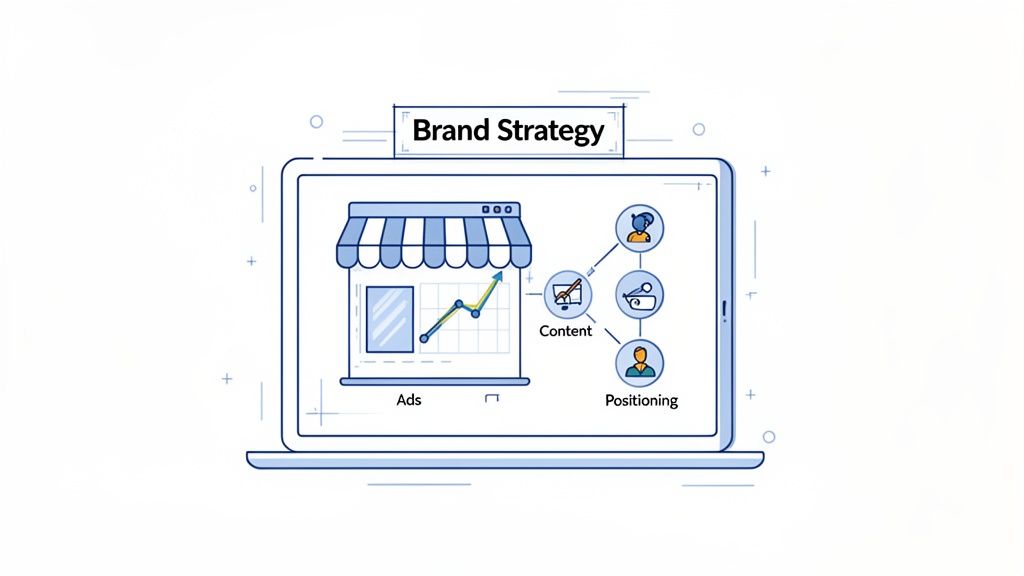
If your game plan is still chasing a low Advertising Cost of Sale (ACoS), you're leaving money on the table. The Amazon marketplace is a full-funnel ecosystem, not a simple keyword auction. Many brands operate in silos: the PPC team obsesses over ACoS, the content team tweaks listings in a vacuum, and the brand team worries about high-level equity. This disjointed approach is inefficient and misses the powerful synergy between paid advertising and organic growth.
Shifting from Expense to Investment
The single most important mental shift is to see ad spend not as a cost, but as an investment in a long-term, revenue-generating asset. Every dollar spent on a well-designed campaign should do more than generate a single sale—it should build your brand's moat on the platform.
Here’s how a performance-first strategy connects the dots:
- PPC as a Lever for Organic Rank: Strategic ad spend on key search terms signals sales velocity and relevance to Amazon's A10 algorithm, directly lifting your organic search position over time.
- Data-Driven Positioning: Before launching campaigns, deep competitive analysis reveals market gaps, allowing you to carve out a unique value proposition that resonates with your ideal customers.
- Content That Converts: Your product detail pages and A+ Content are high-powered conversion tools. Their sole purpose is to convert the traffic driven by ads into loyal customers.
The Takeaway: The objective is to build a self-sustaining growth loop. As organic rank climbs, customer acquisition costs drop. This frees up capital to reinvest in winning new market segments, defending your position, or launching new products. This is the path to real, sustainable scale.
Mastering Your Competitive Landscape First
Jumping into Amazon ads without deep market intelligence is the fastest way to burn your budget. A winning Amazon brand strategy starts with analysis, not ad spend. Before launching a single campaign, you must dissect the market to find your opening. This means reverse-engineering what makes top sellers in your category tick—their pricing strategy, review velocity, and A+ Content narrative.
This groundwork separates brands that dominate from those that merely participate. The goal isn't to copy competitors but to identify a defensible position that makes your brand the only logical choice for a specific customer segment.
From Data to a Defensible Position
Your mission is to find a gap—a customer need that major players are ignoring or under-serving. This requires combining third-party tools with Amazon's own data to get a 360-degree view.
- Competitor Deep Dives: Use a tool like Helium 10 to uncover estimated sales volume, pricing history, and the exact keywords your rivals rank for. This data benchmarks your position and exposes their weak spots.
- Voice of the Customer Analysis: Go beyond star ratings and read competitor reviews. Customer complaints are gold—they reveal unmet needs and provide the exact language you should use in your copy to highlight your product's solutions.
- Search Query Insights: The Search Query Performance (SQP) report is the most powerful and underutilized tool for brand-registered sellers. It reveals the exact terms shoppers use, along with impression and conversion data. Dig in to find high-intent, low-competition keywords your rivals have missed.
The Takeaway: This intelligence-gathering makes you "retail ready." Once you've defined your unique value proposition based on hard data, optimized your listings to reflect it, and set competitive pricing, then you're ready to add fuel with paid advertising. Rushing this step is the #1 reason ad campaigns fail. For a deeper dive, learn more about conducting a thorough Amazon competitor analysis in our guide.
Building an Ad Strategy for AI and Profitability
If you’re still treating Amazon ads like a simple keyword auction, you are operating with an obsolete model. The platform is now a sophisticated, AI-driven ecosystem. To succeed, your Amazon brand strategy must align with how the platform actually works today.
A modern ad strategy builds campaigns around customer personas and their buying journeys, not just keywords. This structure trains Amazon's algorithm to understand who your ideal customer is, not just what they type in the search bar. This is the only way to win in a world where AI assistants like Rufus increasingly guide purchasing decisions.
From Keywords to Customer Journeys
The old model was reactive: find a keyword, bid on it, and hope. A persona-driven structure is proactive. You strategically build campaigns that mirror how shoppers discover, consider, and purchase products. This means segmenting Sponsored Products, Brands, and Display campaigns to target different stages of the funnel—from broad, top-of-funnel awareness campaigns to highly targeted campaigns aimed at brand-aware buyers.
By feeding the algorithm clean, consistent conversion data, you teach it to find more of your ideal customers, often at a lower cost. This creates the flywheel: paid ads drive targeted traffic, which boosts your organic rank for your most important customer segments, increasing your profitability.
A clear, data-driven process is key. It starts with deep analysis, moves into brand positioning, and culminates in a strategic campaign launch.
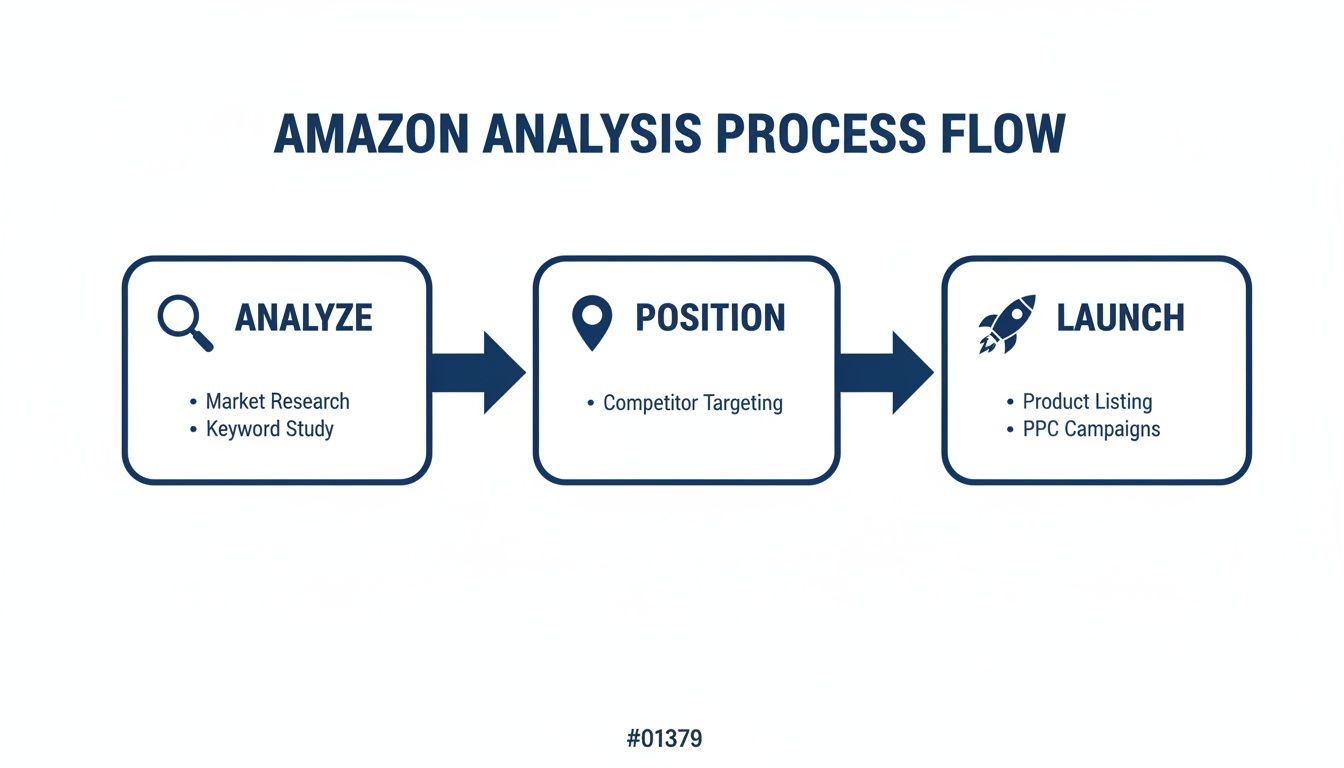
This structured flow ensures every ad dollar is an investment in building a strategic market position, not just a short-term gamble on a keyword.
The Proof is in the Performance
Shifting to this AI-aligned model delivers dramatic results. We worked with a premium kitchen appliance brand spending $47,000/month on ads with a crippling 42% ACoS and zero insight into performance drivers.
Within 60 days of implementing a persona-driven PPC framework, we slashed their ACoS to 24%—a 43% reduction. Simultaneously, their total revenue jumped 31%, all without increasing their ad budget.
This isn't a fluke; it's a necessary evolution. Amazon’s algorithm already personalizes over 60% of search results, and with AI assistants projected to drive 40% of purchases by late 2026, aligning with the AI is non-negotiable.
The Takeaway: Your goal is no longer just to win a keyword bid. It's to educate Amazon's AI on your ideal customer profile. When you get this right, the algorithm becomes your most powerful growth partner, driving both efficiency and scale. This strategic pivot moves your team from playing defense on ACoS to playing offense for market share. For a closer look at these campaign structures, check out our complete guide to Amazon's advertising strategy.
Turning Your Listings Into Conversion Engines
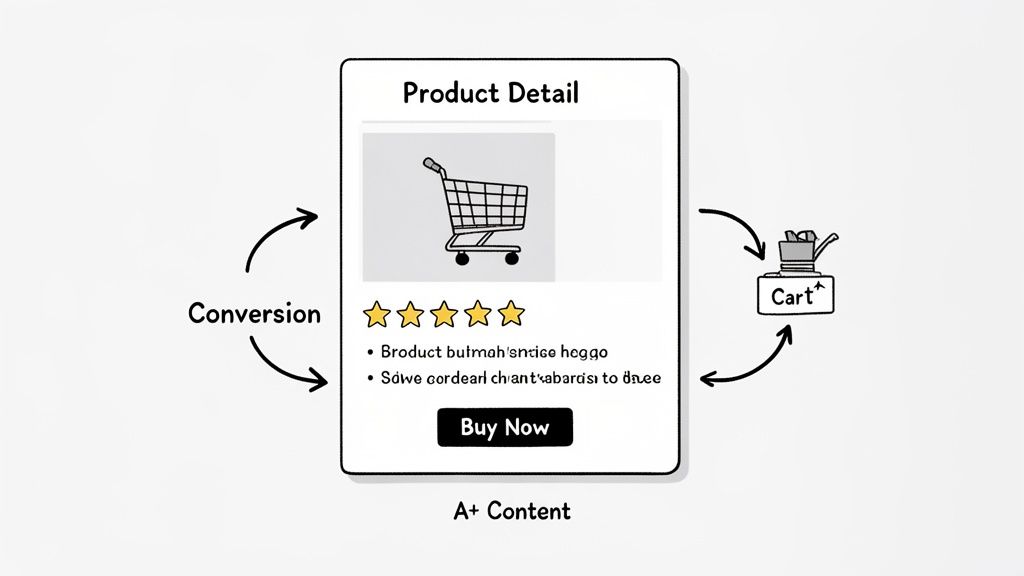
Your product detail page is the final touchpoint where all your market research and ad spend culminate in a single decision: buy or bounce. An intelligent Amazon brand strategy engineers this page to be a high-performance conversion machine, not a static product sheet.
Every element—from images to bullet points—must work in concert to build trust, answer questions preemptively, and guide the customer to "Add to Cart." The key is to stop listing features and start selling solutions. Instead of saying your water bottle is "triple-insulated," show an image of it packed with ice after a full day at the beach. That sells the outcome, not the spec. This directly improves engagement metrics like session time and conversion rate, which signals relevance to the A10 algorithm, boosting organic rank and making your ad spend more efficient.
Elevating the Digital Shelf Experience
For brand-registered sellers, Amazon provides powerful tools to create an immersive shopping experience that builds brand equity and drives sales. Premium A+ Content is a prime example. While Amazon's data shows basic A+ Content can lift sales by 8%, we’ve seen well-executed Premium A+ Content, rich with video and interactive modules, boost sales by as much as 20%.
Our strategic rollout:
- Nail the Core: Start with benefit-driven copy and professional creative that shows the product solving real-world problems.
- Tell Your Brand Story: Use the Brand Story module to communicate your mission and differentiate your brand from faceless competitors.
- Deploy Premium A+ Content: For top-selling ASINs, invest in rich media, comparison charts, and detailed visuals to maximize conversion potential.
The Takeaway: The goal is to create a seamless narrative that removes friction and makes the buying decision feel easy and obvious. A well-crafted detail page is a critical lever for improving performance across the board.
Impact of Content Optimization on Key Amazon Metrics
| Content Element | Metric Impacted | Potential Performance Lift |
|---|---|---|
| High-Quality Imagery & Video | Conversion Rate, Session Time | 5-15% increase in conversion |
| Benefit-Driven Bullet Points | Click-Through Rate (from search), Conversion | 3-7% increase in unit session percentage |
| Basic A+ Content | Conversion Rate, Reduced Returns | Up to 8% sales lift |
| Premium A+ Content | Conversion Rate, Brand Affinity, AOV | Up to 20% sales lift |
| Brand Story Module | Repeat Purchases, Customer Loyalty | Builds long-term brand equity |
As the table shows, each layer of optimization adds tangible value, pushing your key metrics in the right direction and fueling the flywheel for long-term growth.
Integrating Keywords Beyond the Title
While your title and bullet points are customer-facing, your backend search terms are your secret weapon for discoverability. This hidden field is where you add long-tail keywords, synonyms, and niche use-cases without cluttering your on-page copy. Get inside your customer's head: someone looking for a "yoga mat" might also search for a "non-slip exercise mat for home workouts." The backend is the perfect place for these terms.
Critical best practices:
- Avoid Duplication: Never repeat keywords already present in your title, bullets, or A+ Content. The backend is for net new search terms only.
- No Commas: Use single spaces to separate keywords and phrases to maximize character count.
- Stay Relevant: Don't stuff the backend with irrelevant, high-traffic terms. This will tank your conversion rate for those searches and signal to Amazon that your product is a poor match.
By thoughtfully crafting both on-page and backend content, you attract highly qualified traffic and convert it with compelling, solution-focused creative. For more hands-on advice, dive deeper into our guide on optimizing Amazon product listings.
Measuring What Truly Matters for Amazon Success
A performance-first Amazon brand strategy is built on the right data. Too many teams celebrate a low Advertising Cost of Sale (ACoS) while their market share stagnates. ACoS only measures ad efficiency; it says nothing about growth.
Beyond ACoS: The Metrics That Actually Drive Profit
To get a true measure of your brand’s health and profitability, you need to look beyond vanity metrics. The single most important KPI for any eCommerce leader is Total Advertising Cost of Sale (TACoS). The formula (Ad Spend ÷ Total Revenue) is simple, but its insight is profound: it reveals how effectively your advertising is lifting your entire business, including organic sales.
A consistently decreasing TACoS is the ultimate sign of a healthy flywheel. It's proof that your ad spend is building a long-term asset by improving organic rank and brand visibility, making you less reliant on paid media over time.
The Takeaway: Your goal isn't just to make ads more efficient; it's to make them so effective that you become less dependent on them. A falling TACoS is concrete proof that your PPC is a lever for profitable, organic growth.
Alongside TACoS, your team should be tracking these performance indicators:
- Organic Rank Growth: Are you climbing the search results for your most valuable keywords? This is a direct measure of your ad investment's long-term ROI.
- Buy Box Win Rate: For resellers or brands in crowded categories, owning the Buy Box is non-negotiable. Top brands consistently maintain an 80%+ win rate on key ASINs.
- Review Velocity and Rating Quality: A steady stream of 4- and 5-star reviews is conversion fuel, boosting click-through and conversion rates and sending powerful quality signals to shoppers and the algorithm.
Adopting a Customer-Centric Measurement Framework
This shift toward holistic metrics enables smarter, data-driven decisions. With global AI marketing spend projected to exceed $107 billion by 2028, using advanced analytics to connect ad spend to customer behavior is no longer optional. You can dig deeper into these trends in Amazon's latest marketing report.
This approach changes the executive conversation from "How low is our ACoS?" to "How is our ad spend impacting market share and the bottom line?" It correctly frames advertising as a strategic investment with a clear, measurable return—the foundation of a scalable and defensible Amazon business.
Got Questions About Your Amazon Brand Strategy?
We’ve outlined the framework for building a profitable presence on Amazon, but implementation always raises questions. Here are the most common ones we hear from eCommerce leaders.
How Do I Balance Aggressive Growth with Profitability in My Ad Campaigns?
This isn't an either/or choice; it's about changing how you measure success. Make TACoS (Total Advertising Cost of Sale) your North Star metric. While ACoS measures ad efficiency, TACoS shows how ad spend impacts your entire business, including organic sales. If your TACoS is trending down, your ad investment is successfully building organic rank and creating the growth flywheel.
To execute, define a target TACoS based on your margins and growth goals. Then, use PPC strategically. Identify high-potential keywords where you're on the cusp of page one and apply a strategic ad boost. As paid sales lift your organic position for that term, you can scale back the ad spend. Every dollar becomes an investment in long-term, sustainable rank, not just a one-time sale.
What Is the Biggest Mistake Brands Make with Amazon PPC?
The "set it and forget it" approach. Launching a broad-match automatic campaign and letting it run is the fastest way to burn your budget. You’re handing control to Amazon's algorithm, which often results in wasted spend on irrelevant search terms—the opposite of a performance-first mindset.
An effective Amazon brand strategy uses auto campaigns as a research tool to harvest winning search terms. Once a term converts, immediately move it into a manual campaign where you have full control over bids and budget. This allows you to scale what works and cut waste. It's an active, data-driven process of continuous optimization within your Search Term Reports.
The Takeaway: Move from passive discovery to active targeting. Letting an algorithm run unchecked is a recipe for budget drain; guiding it with precise, data-backed manual campaigns is how you build a profitable advertising machine.
Should My Amazon Strategy Include Advertising Off-Amazon?
Absolutely. A full-funnel strategy that drives traffic from Google Ads, social media, and a DSP (Demand-Side Platform) is what separates category leaders from the rest. Driving external traffic signals to Amazon that your brand has real-world demand, which can provide a significant boost to organic rank.
Using tools like Amazon Attribution, you can now track the direct sales impact from these off-Amazon channels, eliminating guesswork. Start by targeting your existing community—run ads to your email list or social media followers, sending them directly to your Amazon Storefront. This leverages your owned audience to fuel your Amazon growth flywheel.
A winning Amazon brand strategy needs a partner who understands the intricate relationship between paid media, organic growth, and profitability. Headline Marketing Agency combines deep analytics with hands-on expertise to build advertising systems that drive sustainable scale. Discover how we can help you dominate your category.
Get Your Free Amazon PPC Audit
Discover untapped growth opportunities and see how our data-driven approach can improve your ROAS.
Get Free Audit →Wollen Sie Ihre Amazon PPC-Performance aufs nächste Level bringen?
Lassen Sie Ihre Amazon PPC-Kampagnen professionell analysieren und entdecken Sie neue Wachstumsmöglichkeiten.