Amazon Competitive Analysis: A Performance-First Guide for Brand Growth
We've spent years in the Amazon trenches with real brands. Our Amazon competitive analysis guide distills what works from what's noise.


Think of an Amazon competitive analysis as reverse-engineering your competitor's entire growth engine. It’s not about passively peeking at their prices. A performance-focused analysis dismantles their PPC strategy, listing tactics, and operational health to expose strategic openings that fuel your own profitable growth. You're turning their data into a data-backed roadmap for winning market share.

Why Your Amazon Competitive Analysis Fails
If your competitive analysis is a spreadsheet of prices and keywords, you're operating with a fraction of the necessary intelligence. That surface-level check is reactive, not strategic. It tells you what your competitors are doing, but it fails to explain the why or the how—the very insights that drive market share, profitability, and sustainable scale.
A performance-first approach treats competitive analysis as an offensive discipline. It’s not about imitation. It's about systematically deconstructing a competitor’s market strategy to pinpoint their vulnerabilities and capitalize on them. With over 9.5 million sellers on Amazon, simply existing isn't a strategy. You must actively hunt for the gaps your competition leaves behind.
Shifting from Observation to Action
Real analysis means getting your hands dirty with performance data. This guide is a no-fluff framework for e-commerce leaders, designed to move past simple monitoring and start using competitor data as a strategic weapon.
The goal is to answer the performance-driven questions that drive smarter decisions:
- How is their PPC investment directly influencing their organic keyword rank and sales velocity?
- What is their promotional cadence, and what does it reveal about their inventory health and cash flow?
- Are there specific weaknesses in their A+ Content or main images that we can exploit for a higher conversion rate?
The Headline Takeaway: A winning Amazon competitive analysis isn't a static report; it's a dynamic playbook. It must deliver a clear, actionable plan that leverages advertising insights to accelerate organic growth, increase profitability, and build a defensible brand on the marketplace.
When you make this shift, analysis stops being a reactive chore and becomes a core driver of your Amazon strategy. You'll learn to deconstruct competitor campaigns, assess their operational strengths, and use their own playbook against them to fuel your growth.
Identifying Competitors Who Actually Matter
Before you can outmaneuver the competition, you need a precise understanding of who you're truly up against. It’s a common mistake to focus only on sellers with identical products. The reality is, your most dangerous competitors are those stealing your customers on the search results page (SERP), even with a different product.
Your fight isn't just over products; it's a battle for visibility and customer clicks. I advise leaders to shift from a product competitor mindset to a SERP competitor one—the brands consistently appearing for your most valuable, high-intent keywords. A brand outbidding you for "organic dog treats" is a more immediate threat than a brand with the same recipe buried on page five.
With 9.7 million sellers on Amazon and 1.35 million new ones expected to join this year, the marketplace is hyper-competitive. Knowing exactly how to identify competitors who directly impact your performance is the critical first step.
Pinpoint Rivals at the Keyword Level
Your high-intent keywords are where the most profitable battles are won and lost. A rigorous competitive analysis always starts here.
Isolate your top 5-10 revenue-driving keywords and search for them in an incognito window. Document who owns the top organic positions and, critically, who has secured the top-of-search Sponsored Brands and Sponsored Products ad slots. These are your performance competitors—they are actively paying to intercept your customers, and it's working.
Expert Takeaway: Don't just check once. Track these SERPs for a full week. A brand consistently occupying top ad placements has a funded, committed strategy. A brand that appears for a single day is likely just testing. Consistency reveals your true, strategic rivals.
This exercise quickly separates established but slow-moving brands from the agile, data-driven sellers who understand how to win on Amazon.
Go Beyond Search to Find Hidden Competitors
While the SERP is your primary battlefield, other areas on Amazon can reveal competitors influencing customers at the moment of decision.
Here are a few places our team always investigates:
- Share of Voice (SOV) Analysis: Tools can reveal which brands command the most visibility across a basket of your target keywords. A high SOV, particularly a paid one, is a clear indicator of a well-funded, dominant competitor.
- "Frequently bought together" Section: This is pure gold. Amazon is explicitly showing you what other products your customers are purchasing. Sometimes they are complementary, but often they are direct competitors stealing a sale you should have won.
- Competitor Brand Storefronts: A tour of a competitor's storefront reveals their entire product portfolio, uncovering cross-category threats you would have otherwise missed.
This flowchart provides a high-level view of how a structured analysis should flow, from identification to decisive action.
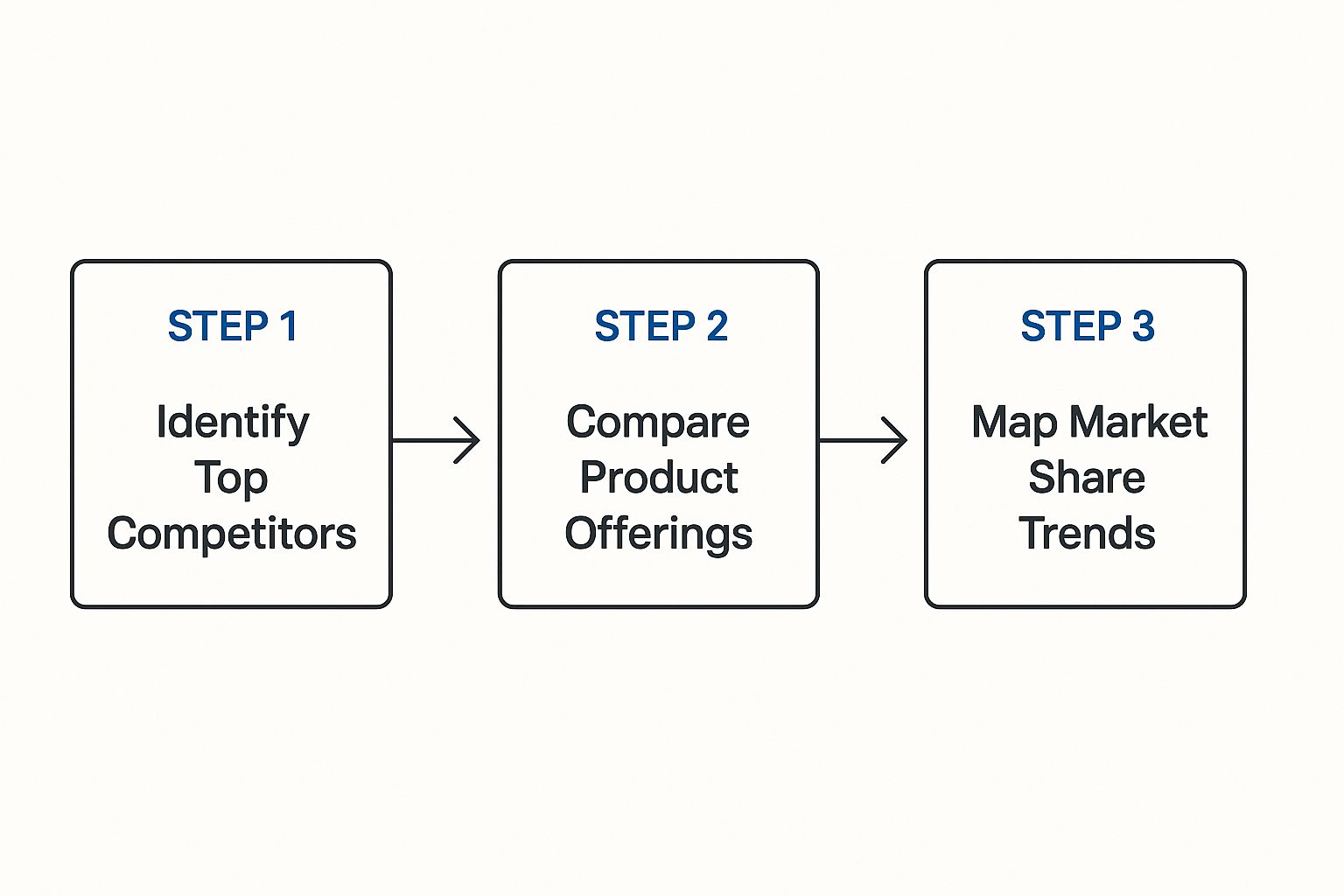
This systematic approach ensures you’re not just gathering data but converting it into a concrete plan to reclaim market share.
To keep your analysis organized and actionable, use this checklist to systematically uncover every competitor impacting your sales.
Competitor Identification Checklist
| Analysis Area | What to Look For | Key Insight Gained |
|---|---|---|
| Organic Search | Top 3-5 ranking ASINs for your main keywords. | Identifies competitors with strong SEO and listing optimization. |
| Paid Search (PPC) | Top-of-search Sponsored Product & Brand ads. | Reveals who is aggressively bidding on your traffic. |
| "Frequently Bought Together" | Products paired with your own ASINs. | Uncovers direct and complementary rivals influencing your customers. |
| "Customers Also Viewed" | Products shown on your listing page. | Highlights alternatives your shoppers are actively considering. |
| Brand Storefronts | Product range of your top SERP competitors. | Shows their full market presence and potential for cross-selling. |
| Category Bestsellers | Top 100 products in your primary category. | Pinpoints market leaders and fast-moving trends. |
By methodically working through this list, you'll build a comprehensive map of your competitive environment. This foundational work ensures you focus your strategic efforts on the players who directly challenge your visibility and sales, driving more impactful results.
Decoding a Competitor's Listing and Content Strategy
A high-converting Amazon product page is an exercise in strategic persuasion. Success isn't just about the product; it's about presenting that product so effectively that a shopper feels confident clicking “Add to Cart.” A deep dive into your competition’s content strategy is one of the highest-value actions you can take.

When you deconstruct a top-performing listing, you're reverse-engineering their sales funnel. Every element—from the title to the last image—is a deliberate choice designed to attract, educate, and convert. Your job is to uncover the why behind those choices.
For example, a competitor leading with a benefit-driven title over one stuffed with keywords may indicate they are targeting a high-intent buyer. It can also signal a heavy reliance on PPC to drive qualified traffic, freeing up the title to focus entirely on conversion.
Breaking Down the Core Listing Components
Dissect the product detail page into its fundamental parts. Think of this as an investigation into their sales psychology, not just a checklist.
- Product Title: How is it structured? Does it lead with the brand, a key benefit, or the main keyword? The first 80 characters are critical for mobile visibility, so analyze what information they prioritize in that crucial space.
- Bullet Points: Are these mini-sales pitches technical and feature-heavy, or do they tell a story that solves a customer problem? Look for the tone—is it confident, helpful, urgent? Note any embedded guarantees or social proof.
- Product Images & Video: Images are arguably your most important conversion asset. How many do they use? Look for a mix of lifestyle shots, feature-callout infographics, and comparison charts. The presence of a video, even a simple one, is a significant conversion driver. Analyze its quality and message.
This initial breakdown provides a high-level scorecard. Is their copy more compelling? Are their images sharper? Every "yes" represents a gap you must close.
Pro Tip: Don't just catalog what content they have; analyze how it's organized. A strong listing guides the shopper on a journey. Each image and bullet point should anticipate and answer a potential question, creating a seamless experience that builds trust and drives conversion.
Deconstructing A+ Content and Brand Story
A+ Content is where brands break free from Amazon's template to showcase their unique value proposition. It’s your competitor’s digital brochure and a goldmine of strategic insight.
As you review their A+ Content, ask these questions:
- What’s the core message? Are they emphasizing premium quality, technical specifications, brand heritage, or user testimonials?
- How are they using the modules? Are they leveraging large, aspirational images or detailed comparison charts that position their product against others (even if unnamed)?
- Is it easily scannable? The best A+ Content uses clear headings, icons, and short text blocks. A wall of text is a conversion killer.
The Brand Story carousel, positioned above the A+ Content, is another key area. This is your competitor’s attempt to connect on a personal level. Analyze what they feature: their mission, other products, or a founding story. This reveals whether their goal is long-term brand loyalty or a single, transactional sale.
Digging into Customer Reviews and Ratings
Reviews are the ultimate source of unbiased market intelligence. They reveal exactly what customers love and, more importantly, hate about a competitor’s product and experience.
Look for patterns in both positive and negative reviews. Recurring complaints about a feature are a strategic gift—they signal a product flaw or misleading marketing copy. For example, if a rival's portable charger consistently gets negative reviews for slow charging, your A+ Content should feature a bold infographic showcasing your product's rapid-charge technology. This is a direct, data-driven counter-move.
Finally, analyze their review velocity and rating trends. A sudden spike in reviews could signal a successful product launch or, potentially, a non-compliant review-gathering tactic. A star rating that's slowly declining often indicates a drop in manufacturing quality. These trends are powerful leading indicators of a competitor's market health and momentum.
By systematically decoding these elements, you build a detailed blueprint of your competitor’s conversion playbook. This scorecard doesn’t just show you where they’re winning; it shines a spotlight on the specific, actionable opportunities you can seize to improve your own listings and steal market share.
Peeking at Your Competitor’s Advertising Playbook
On Amazon, paid advertising is more than a budget line item; it's a primary lever for seizing market share and, critically, fueling organic growth. A competitor's Pay-Per-Click (PPC) strategy is a real-time broadcast of their strategic priorities. It reveals if they’re launching a new product, defending a core keyword, or liquidating underperforming inventory.
While you can't log into their ad account, you are not flying blind. By combining manual research with powerful third-party tools, you can piece together an astonishingly clear picture of their ad strategy. This isn't about mere observation; it's about understanding the why behind their spend and using that intelligence to build a more profitable strategy for your own brand.
How Much Are They Spending and Where?
You’ll never know a competitor’s exact Advertising Cost of Sale (ACOS), but you can make highly educated estimates based on their visibility. A brand consistently owning the top-of-search ad placements for high-volume, high-value keywords is not doing so by accident. That real estate requires significant, sustained investment.
Start by manually searching your most important keywords in an incognito browser. Note which competitors consistently own the Sponsored Brands and Sponsored Products placements. Repeating this at different times of day can reveal dayparting strategies designed to optimize spend.
Once you have this baseline, leverage specialized tools to pull back the curtain.
With these tools, you can discover:
- Who owns the digital shelf? Analyze their Share of Voice (SOV) for both paid and organic results. A high paid SOV is the clearest sign of an aggressive, well-funded ad strategy.
- Which keywords are they bidding on? Uncover their entire sponsored keyword portfolio, including the long-tail terms where they are likely finding profitable, low-competition traffic.
- How has their ad presence evolved? Track their visibility over time. A sudden spike often signals a product launch or a major promotional event.
This data moves you beyond guesswork. You can start attributing their ad spend to changes in their organic rank and sales—a cornerstone of any serious amazon competitive analysis.
Performance-First Takeaway: When a competitor invests heavily in PPC for a specific keyword like "waterproof hiking socks," it's a massive signal that this product is a core revenue driver. That's your cue to analyze their execution and plan a data-driven counter-attack.
Decoding Their Ad Formats and Campaign Goals
The types of ads your competitors run are direct clues to their strategic objectives. Are they using top-of-funnel Sponsored Brands video ads to build awareness? Or are they all-in on bottom-of-funnel Sponsored Products, relentlessly focused on converting high-intent shoppers?
Look for these patterns in their ad choices:
- Going on Offense: Are their ads appearing on searches for your own brand name? This is "brand conquesting," an aggressive tactic to poach your loyal customers at the point of purchase.
- Playing Defense: Conversely, are they running ads on their own branded terms? This is a defensive move to protect their turf. If they aren't, it may represent a significant opportunity for you.
- Targeting Your Listings: Check your own product detail pages. If competitor ads appear there (as Product Targeting Ads), they are making a direct play to steal your traffic at the last possible second.
By understanding their ad mix, you can anticipate their next move. To get ahead, you'll need to build your own effective campaigns, and these essential Amazon PPC tips can provide a framework for countering their strategy.
The goal is to connect their advertising actions to business objectives. A big push on Sponsored Brands video is a brand-building play. A surge in Sponsored Display ads suggests a retargeting effort to win back shoppers who visited but didn't buy. Weaving these insights into your broader https://www.headlinema.com/blog/amazon-ppc-marketing framework is how you turn data into revenue.
Amazon owns 37.8% of the US e-commerce market, making it the most critical arena for any retail brand. In this environment, a sharp, competitor-aware ad strategy isn't optional; it's essential for survival and growth.
Ultimately, analyzing your competitor’s ad playbook is about connecting spend to results. Once you understand how they leverage PPC to influence organic rank and drive sales, you can stop reacting and start building a smarter, more proactive, and more profitable advertising engine for your own brand.
Analyzing Pricing, Promotions, and Inventory Health
A competitor’s price is more than a number; it’s a direct signal of their operational health, supply chain efficiency, and market confidence. An insightful Amazon competitive analysis moves beyond simple price tracking to decode what that price means and how you can exploit the vulnerabilities it reveals.

Think of a price as the final output of their sourcing, logistics, and marketing strategies. A consistently premium price signals strong brand equity and healthy margins. Constant promotions suggest a scramble for sales rank or a desperate need to liquidate aging inventory.
Decoding Pricing and Promotional Rhythms
Your first step is to track not just the price, but its velocity and the promotions attached to it. Price is rarely static. Understanding the rhythm of a competitor's promotional strategy allows you to anticipate their moves and plan effective counters.
Watch for these common promotional signals:
- Coupons: Analyze their coupon strategy. A small, persistent coupon (5% off) is often a permanent fixture designed to improve click-through rates. A sudden, large coupon (30% off or more) is an aggressive, short-term move to liquidate stock or surge up the Best Sellers Rank (BSR).
- Subscribe & Save (S&S): For consumables, a strong S&S offering is a powerful competitive moat. A high S&S adoption rate indicates significant brand loyalty and a stable recurring revenue stream, making them much harder to disrupt on price alone.
- Price Swings: This is where a price tracking tool is indispensable. Monitor their pricing history. A stable price indicates confidence in their product's value proposition. Erratic, frequent price drops often signal desperation or poor inventory management.
Pro Tip: A sudden, deep price cut is often a fire sale, indicating a competitor is trying to avoid long-term storage fees. Do not get dragged into a margin-destroying price war. Hold your position and prepare to capture their customers when they inevitably stock out.
The All-Important Link to Inventory
Price and promotions are inextricably linked to inventory. A competitor cannot sell a product they don't have. Estimating their stock levels is one of the most powerful—and overlooked—levers in competitive analysis. Knowing when a rival is about to stock out is a predictive tool for your own sales spikes.
Major shopping events like Prime Day, which recently generated $14.2 billion in US sales, place immense strain on supply chains. A competitor's inability to stay in stock during these peaks is a major operational weakness. You can explore other Amazon statistics to understand these evolving consumer behaviors.
The "999 cart trick" remains a simple yet effective method for estimating a competitor's FBA inventory. Add their product to your cart and attempt to change the quantity to 999. Amazon will cap the quantity at their current stock level, revealing their inventory position.
Tracking this number over time allows you to map their operational cadence:
- Frequent Stockouts: If they constantly run out of a popular size or color, it's a clear opportunity. Increase your ad spend on keywords for that specific variation and capture their frustrated shoppers.
- Low Stock Levels: A competitor consistently holding fewer than 100 units is vulnerable to any demand spike. You can time your own promotions to coincide with their low-stock periods, effectively hijacking their sales momentum.
- Deep Inventory: Conversely, a competitor with thousands of units is a high-volume player with a robust supply chain. A direct price war would be a costly and likely losing battle.
By connecting the dots between price, promotions, and inventory, you shift from observation to strategic action. You're no longer just reacting to a price drop; you're anticipating it based on their stock levels and preparing to capitalize on the operational weaknesses that forced their hand. That is how you turn their data into your revenue.
Turning Competitive Insights into Action
The data you've gathered is useless without a plan. The entire purpose of a deep-dive competitive analysis is to connect the dots and build an actionable roadmap for growth. It’s time to weaponize your findings and start taking market share.
Begin by building a competitor-focused SWOT analysis. This isn't a generic internal exercise. Frame every point through the lens of your competitive landscape.
For example, a key competitor's poorly executed A+ Content is a massive Opportunity. The fact that they are aggressively bidding on your branded keywords is a direct Threat. This framework transforms a mountain of data into a clear strategic roadmap.
From SWOT to Roadmap
With your SWOT complete, you can prioritize initiatives. The key is to balance potential impact against the required effort. A complete packaging redesign might be a game-changer, but it's a long-term, high-effort project. Conversely, optimizing your main image to beat your top competitor's click-through rate is a quick, high-impact win.
Let’s walk through a few real-world scenarios:
High-Impact, Low-Effort: You discover a top competitor is out of stock on their best-selling color variation. Your move: Immediately launch a hyper-targeted PPC campaign for the exact keywords related to that variation to capture their high-intent customers.
High-Impact, High-Effort: You find a competitor dominates a major search term, but their product has mediocre reviews and a weak organic rank. They are propped up entirely by a massive ad budget. Your move: This is a long-term offensive. Develop a superior product, meticulously optimize your listing for that core keyword, and execute a smarter Amazon advertising strategy to methodically unseat them.
Low-Impact, Low-Effort: A minor competitor has slightly better-written bullet points. Your move: Note it for your next scheduled listing optimization. Don't let it distract from higher-impact priorities.
The Headline Takeaway: Your competitive analysis must yield a prioritized to-do list of offensive and defensive actions. Go after the low-hanging fruit first by exploiting competitor weaknesses (stockouts, poor reviews) and neutralizing their strengths (top ad campaigns). This is how you convert research into revenue.
For sustainable, long-term growth, integrate these competitive insights into your broader business planning. Treat this as part of a practical business intelligence strategy that ensures your Amazon tactics align with your company's overarching goals.
Ultimately, this analysis provides your team with a data-backed playbook. It empowers everyone—from marketing to operations—to make smarter, more strategic decisions. Every PPC bid adjustment and every content update becomes a deliberate move toward building a more profitable and defensible brand on Amazon.
Your Top Questions About Amazon Analysis, Answered
Let's cut through the noise. Here are no-nonsense answers to the most common questions e-commerce leaders ask about Amazon competitive analysis.
How Often Should I Run a Competitor Analysis?
Think in two cadences. A comprehensive, deep-dive analysis should be conducted quarterly. This aligns with broader business planning cycles and informs high-level strategy.
However, you must also maintain a weekly pulse check on your primary rivals. This is a quick-hit review of their pricing, Best Sellers Rank (BSR), new review velocity, and sponsored ad placements. This weekly rhythm allows you to spot and act on real-time opportunities—like a competitor stocking out or launching a major coupon—before the window closes.
What Are the Best Tools for Amazon Analysis?
There is no single "magic bullet" tool. The most powerful insights come from synthesizing data from a few key sources.
- PPC & Keyword Intelligence: To reverse-engineer ad strategies and uncover keyword opportunities, industry standards like Helium 10, Jungle Scout, or Semrush are indispensable.
- Price & Sales History: Keepa is non-negotiable. It provides the historical price and BSR data needed to understand a product's sales velocity and promotional cadence.
Never discount the value of manual research. Regularly using an incognito browser to search your core keywords provides a real-time, unfiltered view of the SERP that tools can sometimes miss.
Can My Brand Realistically Compete with Huge National Brands?
Yes, absolutely. Large, established brands are often slow-moving. They are frequently hindered by corporate bureaucracy and cannot pivot as quickly as an agile brand. Your speed is your primary competitive advantage.
You can optimize a listing, adjust a PPC bid, and respond to a negative review before their marketing department has even scheduled the meeting to discuss it.
Your analysis will reveal the cracks in their armor—and there are always cracks. Zero in on a niche they are ignoring or a long-tail keyword set they deem too small to pursue. That is how you establish a beachhead and build momentum. As you grow, ensuring ad spend translates to profit is critical. You can learn more about how to calculate return on ad spend to ensure every dollar invested is closing the gap with your larger rivals.
Ready to stop guessing and start winning? Headline Marketing Agency turns competitor data into your sharpest weapon. We build data-driven PPC strategies that expose market gaps and drive profitable growth. Get in touch with our experts today and let's talk about how we can help you dominate your category.
Get Your Free Amazon PPC Audit
Discover untapped growth opportunities and see how our data-driven approach can improve your ROAS.
Get Free Audit →Ready to Transform Your Amazon PPC Performance?
Get a comprehensive audit of your Amazon PPC campaigns and discover untapped growth opportunities.