Wholesale Products to Sell on Amazon: What Pays in 2026
Find wholesale products to sell on Amazon with real margin math, approval checks and inventory limits, so each buy is profitable before you order.

In 2025, more than 60% of sales in Amazon's store came from independent sellers, most of which were small and medium-sized businesses, according to Amazon's seller statistics. That scale is why experienced operators keep looking for wholesale products to sell on Amazon. It is also why weak product math gets exposed fast.
Bestseller lists are the wrong starting point. A product can sell every day and still lose money after referral fees, fulfillment, storage, returns and advertising. A product can look profitable and still be unlistable if you can't prove you're authorized to sell it.
Rank every candidate by contribution profit after all Amazon costs. Then apply three risk filters before you buy. Can the paperwork survive an Amazon review? Will the stock turn before aged-inventory fees start? How much paid traffic does the product need to move at the speed your order size requires? If a product fails any one of those tests, drop it, whatever its sales rank says.
Which Wholesale Categories Sell Well on Amazon
Category choice wrecks more wholesale margin than supplier negotiation does. Total online demand keeps expanding: the U.S. Census Bureau quarterly e-commerce release estimated seasonally adjusted retail e-commerce sales at $340.2 billion in the second quarter of 2026, up 3.8% from the previous quarter, with e-commerce representing 17.1% of total U.S. retail sales during that period. A large market supports scalable distribution of replenishable branded products. It promises nothing about the ASIN you pick.
How to Read the Category Table
Rank categories by contribution profit after Amazon costs, then read the table as a risk screen rather than a popularity contest. Repeat purchase tells you whether customers come back on a cycle, which supports steady inventory turns and makes paid visibility easier to justify. Size and fee exposure tells you whether physical bulk will push the product into a more expensive fulfillment tier. Documentation load predicts how hard approval and compliance will be later.
Wholesale categories compared on demand and risk
| Category | Repeat purchase | Size and fee exposure | Main risk | Documentation load |
|---|---|---|---|---|
| Health and personal care | High | Low to medium | Expiry dates, claims and regulated ingredients | High |
| Pet supplies | High | Medium | Ingestible claims and brand gating | High |
| Kitchen and home essentials | Medium | High for bulky items | Dimensional weight and breakage | Medium |
| Office and school supplies | Medium | Low | Thin margins and heavy competition | Low |
| Tools and hardware | Medium | Medium | Batteries and dangerous goods rules | Medium |
| Beauty and cosmetics | High | Low | Brand authorisation and counterfeit checks | High |
| Sports and outdoor | Low to medium | High | Seasonality and bulky stock | Medium |
| Toys and baby products | Medium | Low to medium | Child safety testing and recalls | High |
A consumable a household reorders every 30 days gives you a forecasting rhythm and repeat demand you can build PPC around. A one-off furniture purchase gives you neither, and it carries the heaviest fee exposure in the table. Toys sit at the opposite end: low fee exposure, cheap freight, but the heaviest documentation load of any row, because safety testing drives approval and a single failed test or recall notice can pull an entire ASIN overnight. Demand inside the category is still worth understanding, and the Playz guide to sensory toys shows how specific developmental use cases shape what parents search for and buy. Search demand does not rescue a product you cannot document, so treat toys as a paperwork project before you treat them as a sourcing opportunity.
Shortlist three categories that match your working capital, your ability to produce compliance paperwork, and your appetite for inventory risk. Then name two or three starter product types in each. In pet, that might be refillable supplements and dental chews. In kitchen, stackable storage containers and replacement filters. In office, refill packs and desk consumables.
Use structured product research for Amazon candidates to turn those product types into a scored longlist. Depth in three beats surface coverage in eight every time.
How to Calculate Profit Per Unit Before You Buy
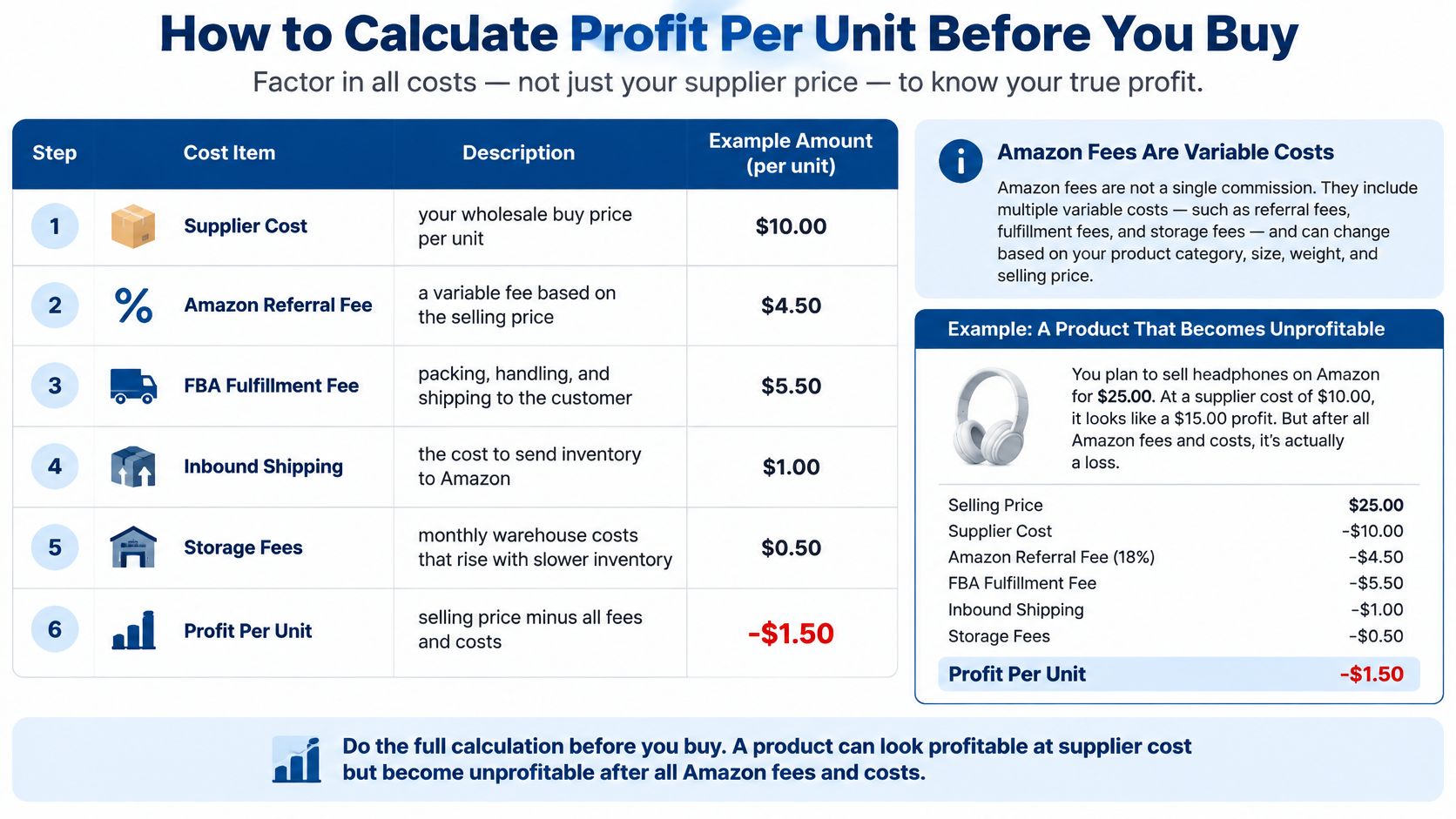
Amazon fees are a stack of variable costs, and they decide whether a wholesale SKU earns a purchase order. Treat them as one blended commission and half the products on a supplier price list will pass a screen they should fail. Rejecting a product in a spreadsheet costs nothing. Rejecting it after the freight lands costs thousands.
Per-unit math is not unique to Amazon. Apparel sellers use the same logic. Hat pricing with Dirt Cheap Headwear shows how material and setup costs get spread across a run before a quote. On Amazon you take that discipline and add referral fees, fulfilment, storage, returns and ads.
The $30 Worked Example
Take a standard-size item listed at $30 with a $12.50 landed cost. The numbers below use stated assumptions. Check the current Amazon fee schedule for your category and size tier before you commit.
Per-unit profit line items for a $30 product
| Line item | How to calculate |
|---|---|
| Selling price | Listed price including delivery |
| Landed wholesale cost | Unit cost plus inbound freight and duties |
| Referral fee | Category rate (assumed 15%) times total sale price |
| FBA fulfilment fee | Size tier and shipping weight (assumed standard tier) |
| Monthly storage | Cubic feet times rate, spread per unit |
| Expected returns | Return rate times unit cost and processing (assumed 3%) |
| Advertising cost | Target ACOS (10%) times selling price |
| Contribution profit | Price minus all lines above |
| Stress test at $27 price, 15% ACOS | Same lines with 10% lower price and higher ad cost |
Under the base assumptions, the referral fee at 15% is $4.50, FBA fulfilment is $6.00, storage is $0.50, the returns allowance is $0.40 and advertising at 10% ACOS is $3.00. Contribution profit is $3.10 per unit.
Drop the price 10% to $27 and push ACOS to 15%, and the same SKU loses money. Referral and ad cost both rise against a lower sale price. That is the stress test doing its job. The base case looked healthy. The downside does not.
Run These Eight Steps on Every SKU
- Confirm the total sale price. Include delivery and gift-wrap charges, because the referral fee applies to that total.
- Build landed cost fully. Add unit price, inbound freight, duties and prep. Supplier price alone is not your cost.
- Apply the category referral rate. Some categories carry minimum referral fees, so check the rate for the specific category.
- Add FBA fulfilment for the size tier. Use actual shipping weight and dimensions, not the supplier's optimistic estimate.
- Add monthly storage. Base it on cubic feet and average daily inventory, then spread it per unit.
- Add expected returns and promotions. A product with frequent returns needs a bigger allowance than a sealed consumable.
- Add advertising cost per sale. Use your target ACOS, not your hoped-for ACOS.
- Stress-test the result. Model a 10% lower selling price and a higher ad cost before you approve the order.
Amazon's Seller Central referral fee guidance states that referral fees are charged on every item sold and are calculated as a percentage of the total sales price, which includes the product price plus delivery charges and gift-wrap charges. Individual sellers also pay a $0.99 fee for each item sold. Professional sellers do not pay that per-item charge. Amazon's seller FAQ puts the Professional plan at $39.99 per month plus category-dependent referral fees, according to the Amazon compliance and selling cost guidance. For any real wholesale volume, Professional is the only serious option.
Freight and buy cost deserve the heaviest scrutiny in your stress test. In Jungle Scout's survey of nearly 1,500 Amazon sellers and businesses, 38% of Amazon sellers identified higher shipping costs as a top challenge in 2025, while 34% cited rising costs of goods.
Buy only when contribution profit stays positive after the stress test. A product that needs perfect pricing and cheap clicks to survive is not a wholesale product. It's a gamble.
Vet Suppliers and Prove Approval Before You Buy
The costliest wholesale mistake isn't picking a slow seller. It's buying 500 units you cannot list. You pay for stock, freight and prep, then discover the brand is gated, the invoice doesn't meet Amazon's standard, or a safety document is missing. Your options narrow to removal, disposal, or frozen cash while you argue your case.
Where Legitimate Supply Comes From
Work the routes that produce verifiable paperwork. Brand-authorised distributors are the cleanest source because the supply chain is short and documentable. Wholesale directories and trade shows work when you verify the distributor behind the listing rather than trusting the directory entry. Direct approaches to brands already selling on Amazon take longer, but a direct relationship gives you the strongest authorization position.
When you evaluate a pet supplier, for example, look at how clearly the wholesale program is structured before you talk price. A supplier page such as the one for design-forward pet products for your store shows the kind of defined wholesale channel you want, with a clear route to ask about authorization and terms. Use focused research on wholesale suppliers for Amazon sellers to build your outreach list, then vet every name on it the same way.
Amazon's guide to finding wholesalers says approval may require invoices from a manufacturer or distributor, or a brand authorization letter, and that invoices may need to be recent, itemized, tied to the seller's account details, identify the supplier, and cover at least 10 units. Product requirements also vary by product type and country, with separate documentation for product safety, dangerous goods, import trade, and export trade.
That last point matters more than most buyers admit. Batteries, aerosols and flammables trigger dangerous goods declarations. Children's products need safety records. A product that's clean to sell in one marketplace may need different evidence in another. Documentation survivability is a pre-purchase test, not an afterthought.
Six Questions to Ask in Order
- Authorisation first. Is the supplier authorised for the brand, and can they prove it in writing?
- MOQs and price breaks. What changes at 50, 100 and 300 units?
- Lead times. What are production and freight lead times to your fulfilment centre?
- Price basis and risk. Are prices ex-works or landed, and who carries damage risk in transit?
- Sample paperwork. Can you see a sample invoice and the relevant safety documents before paying?
- Exit protection. Are damaged-goods credits and restocking offered if a brand restricts resale?
Before you pay anything, verify the basics. Check business registration, a traceable address, reseller references, and a sample invoice that matches your account details. Record every answer on one comparison sheet so suppliers rank on identical criteria, not on whoever answered the phone most warmly.
Practical rule: a slightly weaker product with clean, verifiable documents beats a bestseller with weak paperwork on risk-adjusted profit. You can't advertise your way out of a listing you were never approved to sell.
Size Each Order So Stock Turns Before Fees Bite
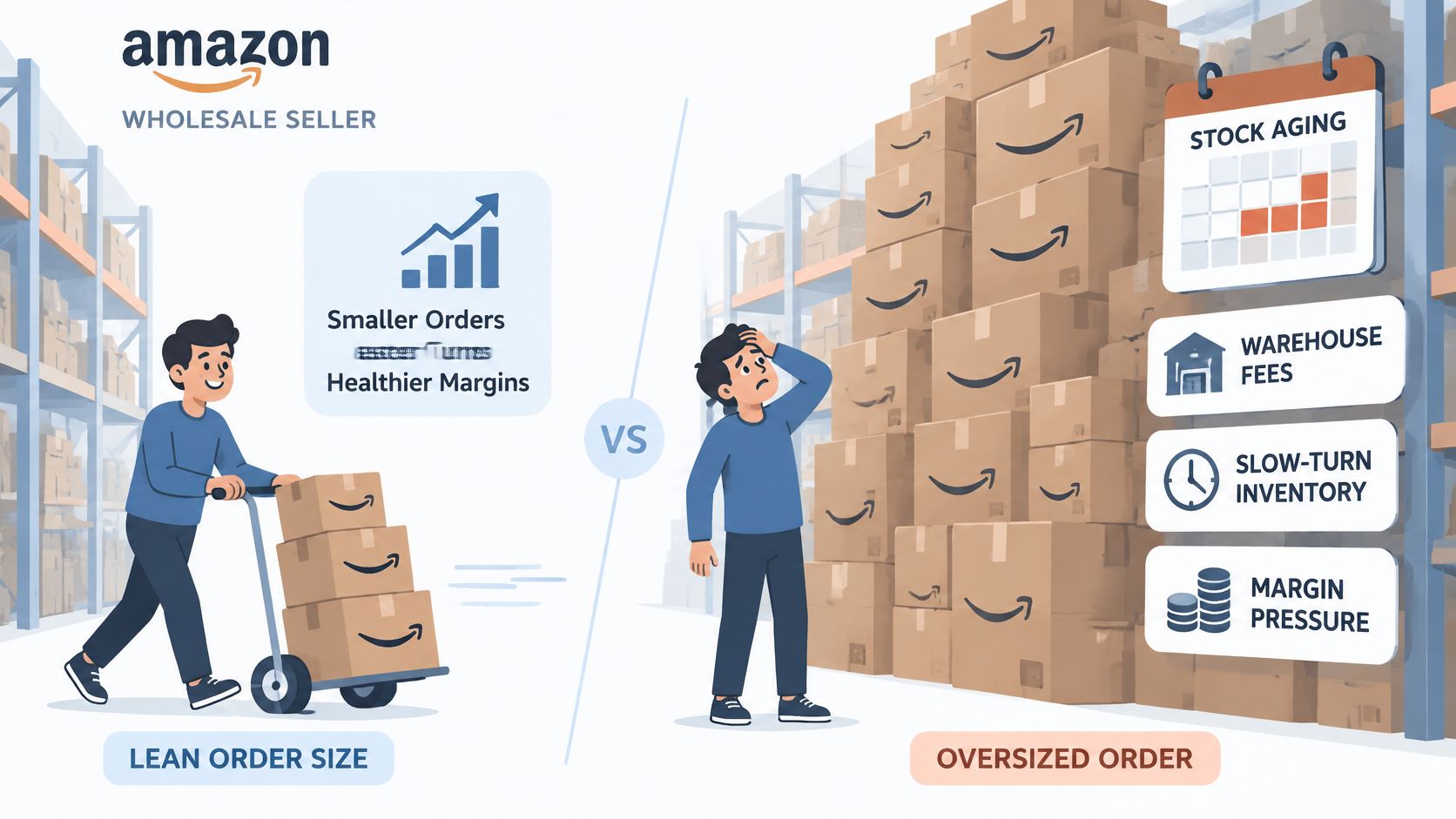
Deep buying destroys margin even when demand is positive. Excess units consume cubic capacity, raise carrying cost, and eventually force discounting or liquidation. The product didn't fail. The order size did.
The illustration below contrasts a lean order that turns cleanly with an oversized order that ages in storage.
The 181-Day Line
Amazon's FBA aged inventory guidance states that inventory stored for 181 days or longer is subject to an aged-inventory surcharge, assessed using an inventory snapshot on the 15th of each month. That surcharge sits on top of ordinary monthly storage, which Amazon bases on the daily average volume your inventory occupies.
The penalties for very old stock are getting sharper. Amazon's 2026 U.S. fee update indicates that the minimum aged-inventory fee for units stored 12 to 15 months rises to $0.30 per unit per month, up from $0.15, while standard-size FBA fees also increase by roughly $0.05 to $0.25 per unit in several price bands. Slow stock doesn't just sit there. It bills you monthly for the privilege.
The 300-Unit Test
Say a supplier offers you 300 units and you expect to sell 20 per week. That's 15 weeks, about 105 days, well inside the threshold. Now halve the velocity. At 10 per week, the same order takes about 210 days and crosses into surcharge territory. Same product, same price, completely different economics.
Sell-through check for a 300-unit order
| Scenario | Weeks to sell through | Aged-inventory check |
|---|---|---|
| 300 units at 20 per week | 15 weeks | Clears inside 181 days |
| 300 units at 10 per week | 30 weeks | Crosses 181 days, order too deep |
Forecast with real inputs, not sales rank alone. Use recent unit sales, seasonality, Buy Box availability, competitor stock levels, and planned advertising demand. Then set a coverage target of one to two replenishment cycles and calculate your reorder point as lead-time demand plus a measured safety buffer. Run that calculation with a disciplined weeks of supply formula so every buyer on your team sizes orders the same way.
Watch the relationship between age and velocity weekly. If inventory age is growing faster than sales velocity, reduce or pause replenishment immediately. Don't wait for the surcharge to confirm what your own numbers already told you.
Use PPC to Speed Up Sales Without Breaking Margin
Paid traffic is how you control the speed of the test. Amazon's advertising overview reports that sellers using Sponsored Products experienced 34% more sales growth than sellers who did not use the format, measured four weeks after adoption. That doesn't prove advertising caused every increment of growth. It does justify a controlled test with a baseline and a short review window.
The illustration below frames PPC as a growth and profit lever, not just a cost line.
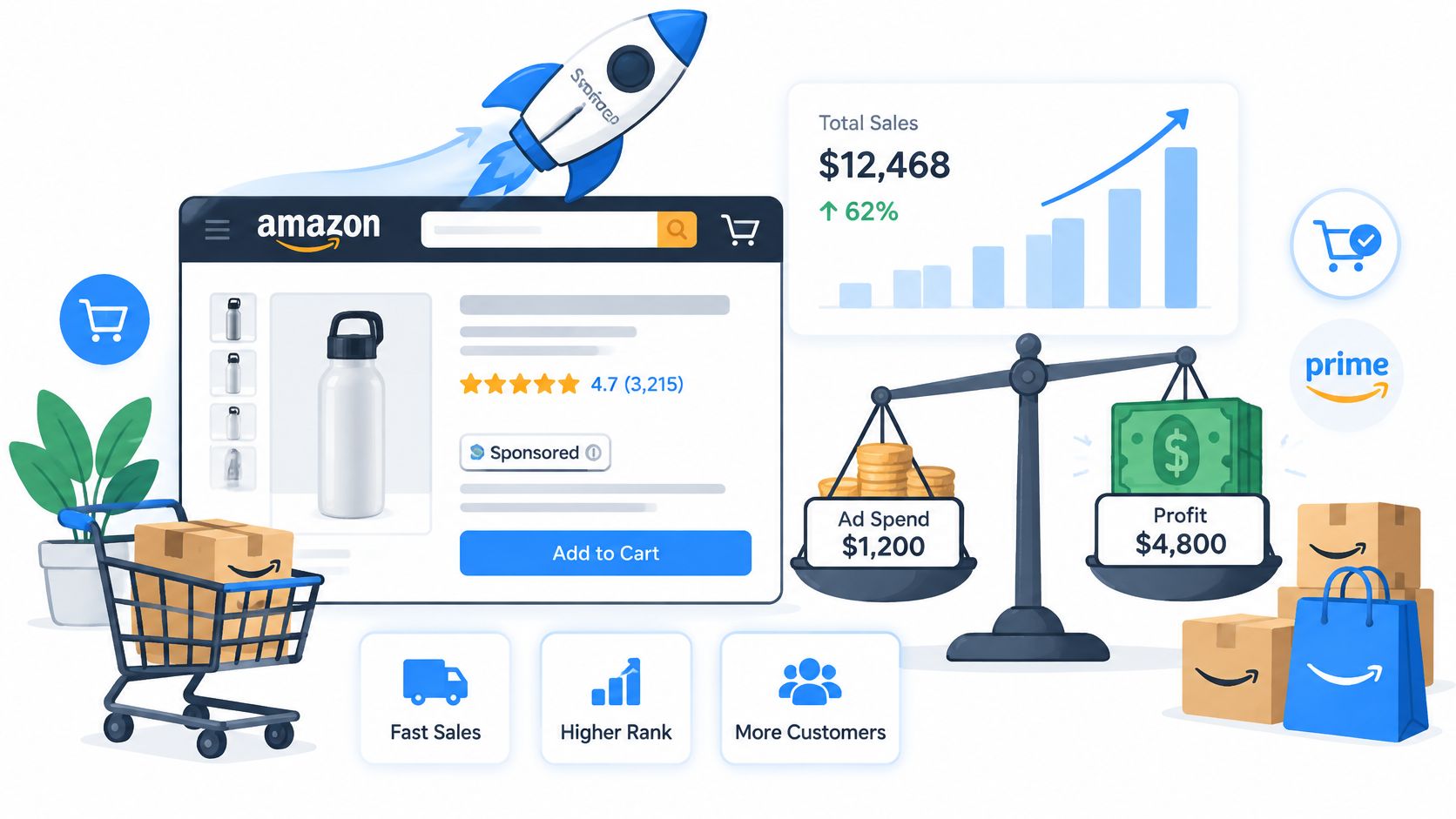
Sponsored Products runs on cost-per-click billing. There's no monthly campaign fee. You pay when a shopper clicks. That structure suits wholesale products on existing detail pages, where you're buying additional exposure while you test demand, conversion and keyword relevance.
Tie Bids to Days of Supply
Judge campaigns by incremental profit and search-position momentum, not ACOS in isolation. A campaign with a mediocre ACOS that lifts organic rank and clears stock before it ages can be the right spend. A cheap campaign that sells units you'd have sold anyway is waste dressed up as efficiency.
Connect every bid decision to inventory. Raise bids when stock covers at least the replenishment cycle. You have the depth to convert extra demand into rank and revenue. Lower bids when cover falls. Driving demand into thin stock raises stockout risk, and a stockout wastes the rank you just paid to build. PPC that accelerates stock turns also keeps units clear of aged-inventory exposure, which makes advertising part of your inventory management, not a separate silo.
The video below walks through how to structure that launch testing in practice.
Run a tight launch sequence. Record a baseline before you spend. Launch controlled campaigns on a small set of high-converting keywords. Review cost per click, conversion rate, contribution margin and organic rank every week. Kill keywords that eat margin without moving rank. Scale the ones that do both.
Pick Your First Three Products and Run the Numbers
You don't need twenty products. You need three that survive arithmetic, paperwork and inventory discipline. Everything else is a distraction until those three prove themselves.
Score Ten Candidates, Keep Three
Build a longlist of ten candidates from your shortlisted categories. Score each one on the same five criteria, using the same spreadsheet, on the same day.
- Contribution profit after the stress test. Positive at a 10% lower price and higher ACOS, or it's out.
- Documentation readiness. Invoice, authorization and safety records available before payment, not promised after.
- Size tier and storage exposure. Compact products carry less fee risk per unit than bulky ones at the same price.
- Days of supply against supplier lead time. Your order must turn inside the aging window at conservative velocity.
- Expected advertising cost. Estimate what visibility will cost on the keywords that convert in that category.
Keep the three highest scorers. Drop any product that fails the documentation or profit check, whatever its demand looks like. A failed gate is not a low score. It's a disqualification.
Set the Test Budget and the 90-Day Review
Size the first purchase to 90 days of forecast demand at your conservative velocity, not your optimistic one. Set a fixed ad budget with a weekly review, and don't let either number drift without a written reason. The test only produces a clean decision if the inputs stay controlled.
At 90 days, review six metrics for each product. Contribution profit per unit. Days of supply. Aged-inventory exposure. Cost per click. Conversion rate. Organic rank movement. The product that earns the next purchase order is the one that improves on profit and rank together, not the one with the highest revenue.
Disconnected reporting breaks down when sales are in one dashboard, ad spend in another, and fees in a settlement report, hiding a losing product for months. Our Holistic P&L Analysis integrates sales, advertising spend, product COGS and Amazon fees to show profitability on Amazon, and our approach to Amazon advertising focuses on contribution margin optimization and profit-based bidding. We bid on contribution margin rather than revenue alone, so PPC spend follows the products that make money.
Treat the first 90 days as a paid experiment with a clear verdict. PPC should build organic rank and profit at the same time. If it's only buying revenue, you're funding Amazon's growth, not yours.
Pick boring, replenishable, well-documented products. Size orders to turn before fees bite. Spend on ads only where stock depth and margin support it. Do that consistently and wholesale stops being a product hunt and becomes a repeatable buying system.
If you're ready to rank wholesale candidates by real contribution profit instead of headline revenue, Headline Marketing Agency can build the P&L view and the PPC strategy to act on it. We connect your sales, ad spend, COGS and Amazon fees into one profitability picture, then bid for profit and organic rank together. Visit Headline Marketing Agency to start the conversation.
Get Your Free Amazon PPC Audit
Discover untapped growth opportunities and see how our data-driven approach can improve your ROAS.
Get Free Audit →Ready to Transform Your Amazon PPC Performance?
Get a comprehensive audit of your Amazon PPC campaigns and discover untapped growth opportunities.