Your Growth Flywheel: A Modern Leader's Guide to Amazon PPC
Getting the Amazon growth flywheel right means balancing short-term ROAS with long-term organic growth. Here's how we do both.

Stop thinking about Amazon PPC as an advertising cost. For today's leading brands, Pay-Per-Click is a strategic investment—the single most powerful lever for driving organic growth, market share, and sustainable profitability on the world’s largest product search engine.
This isn't just about buying clicks. It's about using paid media to influence Amazon's algorithm, creating a flywheel effect that turns ad spend into a long-term competitive advantage.
Beyond Bids: Why Amazon PPC Is Your Primary Growth Engine
Many eCommerce leaders view Amazon PPC as a necessary evil—a line item on the P&L. This mindset is fundamentally flawed and actively limits your brand's potential. A sophisticated Amazon PPC strategy isn't an expense; it's an investment in mission-critical assets: invaluable first-party sales data, defensible market share, and, most importantly, direct influence over Amazon’s A10 ranking algorithm.
The core principle is to treat every ad dollar as a catalyst. You're not just paying for placement; you're funding a data-driven process to teach Amazon which products to favor organically.
The PPC-to-Organic Flywheel: How Ad Spend Creates Profitability
The strategic centerpiece is the "PPC-to-Organic Flywheel," a powerful cycle that savvy brands use to dominate their categories. The logic is brutally simple: Amazon's algorithm is designed to promote products that sell. By using targeted ads to generate consistent sales for specific keywords, you send an undeniable signal that your product is a top performer for that search query.
This paid momentum triggers a powerful chain reaction:
- Increased Sales Velocity: Paid sales contribute directly to your product's overall sales history, building critical momentum.
- Improved Best Seller Rank (BSR): Higher sales velocity improves your BSR, a key signal of relevance and popularity to Amazon.
- Enhanced Organic Ranking: Recognizing this sales data, Amazon rewards your product with higher placement in the free organic search results for the keywords you targeted.
- Greater Profitability & Scale: As your organic rank solidifies, you can strategically reduce ad spend for those keywords, which lowers your Total Advertising Cost of Sale (TACOS) and dramatically improves your bottom line.
The Takeaway: The objective isn't to perpetually buy sales. It's to use paid advertising as a strategic tool to make Amazon's organic algorithm work for you, securing a profitable and defensible position in the market.
A Marketplace Engineered for Conversion
This flywheel strategy is uniquely effective because Amazon is not a general search engine; it's a commercial engine. Nearly every search carries purchase intent. You are advertising to an audience that is already in a buying mindset, making it an incredibly efficient environment for ad spend.
The scale is staggering. By 2025, Amazon is projected to capture 22.3% of the entire U.S. search ad market—a clear indicator that the modern shopper journey starts on Amazon, not Google. For any serious brand, mastering the platform's ad ecosystem isn't just an advantage; it's a core business competency. For a deeper dive into the mechanics, see our foundational guide on what Amazon PPC is.
A Look Inside the Amazon Advertising Ecosystem
To build a profitable Amazon PPC strategy, you must master the entire toolkit. The Amazon advertising ecosystem is a collection of distinct ad types, each designed for a specific purpose. Top-performing brands don't just use one—they orchestrate all of them to engage customers across the entire buying journey.
Think of it as a full-funnel toolkit, not a menu of options. Your objective is to deploy the right tool to achieve a specific business goal, from initial brand discovery to driving repeat purchases.
Sponsored Products: Your Conversion Workhorse
Sponsored Products are the foundation of any performance-focused PPC strategy. These are the single-product ads appearing directly within search results and on competitor product detail pages.
Their purpose is clear and direct: capture high-intent demand at the moment of consideration.
When a shopper searches "noise-canceling headphones," a Sponsored Product ad places your offering directly in their path. For driving immediate revenue and building the sales velocity needed to power the organic flywheel, no ad type is more critical. It is the most direct lever for revenue generation, making it indispensable for product launches and capturing bottom-of-funnel demand.
Performance Takeaway: Sponsored Products are your front-line sales force. They are engineered for conversion and serve as the primary engine for the PPC-to-Organic flywheel, turning paid sales into improved organic rank for your most valuable keywords.
Sponsored Brands: Building Your Digital Storefront
While Sponsored Products focus on a single item, Sponsored Brands amplify your brand's presence. These are the prominent banner ads at the top of search results, featuring your logo, a custom headline, and a curated selection of products.
This format transcends a single transaction; it tells a brand story. A well-executed Sponsored Brands campaign can intercept shoppers early in their journey, directing them to a custom Brand Store or a landing page that showcases your full product line.
Imagine you sell a range of organic skincare. A Sponsored Brands ad targeting "natural face wash" could introduce a customer to your entire facial care system. This achieves two critical goals:
- Defend Your Brand Equity: It prevents competitors from poaching customers who are specifically searching for your brand name.
- Increase Average Order Value (AOV): It exposes shoppers to your broader catalog, encouraging larger cart sizes and upsells.
Sponsored Display: Reaching Shoppers On and Off Amazon
Sponsored Display ads expand your reach beyond the Amazon search results page. This ad type enables you to retarget shoppers who have previously viewed your products, visited your Brand Store, or even browsed similar items from competitors.
Its strategic power lies in its extensive reach. These ads can follow high-value audiences across thousands of third-party websites and apps within the Amazon Display Network.
Consider this: a customer views your high-end espresso machine but navigates away without purchasing. A Sponsored Display ad for that exact machine can reappear while they read the news or check a weather app. This remarketing tactic keeps your product top-of-mind, nudging them back toward purchase and turning consideration into conversion.
A winning strategy is not about choosing one ad type. It's about orchestrating all three in concert: Sponsored Products to convert, Sponsored Brands to build brand equity, and Sponsored Display to re-engage and expand your reach. This layered approach ensures you are connecting with customers at every stage of their decision-making process.
Performance Metrics That Actually Drive Profit
Running Amazon PPC generates a torrent of data, but more data doesn't mean more clarity. To build a genuinely profitable program, leaders must look beyond vanity metrics and focus on the KPIs that reflect true business health. Clicks and impressions are meaningless if they don't translate into profitable growth.
Success demands interpreting the numbers within the context of your strategic goals and product-level margins. Let's cut through the noise and focus on the metrics that move the needle.
From ACoS to TACOS: The True Measure of Performance
Most sellers fixate on a single metric: Advertising Cost of Sale (ACoS). It measures ad spend relative to the revenue generated directly from those ads. While it’s a useful tactical metric, an over-reliance on ACoS is a strategic error.
A "good" ACoS is entirely situational. A 40% ACoS can be a brilliant investment for a new product launch aimed at capturing market share. Conversely, a 15% ACoS could represent a significant loss on a low-margin hero product. The metric that provides true strategic clarity is Total Advertising Cost of Sale (TACOS).
TACOS = Total Ad Spend / Total Revenue (Paid + Organic)
TACOS is your ultimate business health metric for Amazon. It reveals the true impact of your advertising investment on your entire Amazon business. A decreasing TACOS over time is hard evidence that your PPC strategy is working—it proves your ads are successfully fueling the organic flywheel, increasing your overall sales efficiency.
Interpreting Your Funnel Metrics
Beyond high-level KPIs, you must diagnose performance at each stage of the customer journey. Two metrics are crucial for this: Click-Through Rate (CTR) and Conversion Rate (CVR).
Click-Through Rate (CTR): Your first-impression score. It measures the percentage of shoppers who see your ad and click on it. A low CTR is a clear signal of a creative or targeting problem—your main image, title, or keyword choice is failing to compel a click.
Conversion Rate (CVR): The measure of your product detail page's effectiveness. CVR calculates how many clicks result in a sale. A high CVR indicates your pricing, reviews, and product content are effectively persuading shoppers.
Analyzing these two metrics together delivers actionable insights. For instance, a high CTR paired with a low CVR indicates your ad successfully grabs attention, but your product page fails to close the deal. This points to an issue with price, reviews, or listing copy. To gain a competitive advantage, leading brands increasingly leverage automated creative testing to rapidly iterate on ad creative and lift both CTR and CVR.
Setting Realistic Benchmarks
Knowing what to measure is half the battle; knowing what to aim for is the other. Globally, the average Amazon PPC conversion rate is approximately 10.33%—a remarkably high figure compared to other digital ad platforms. If your CVR falls significantly below this benchmark, optimizing your product detail page should become an immediate priority.
Ultimately, the goal is to create a profitable system where each metric informs the next. Use CTR and CVR to diagnose tactical issues, ACoS to manage campaign-level profitability, and TACOS to steer your overarching growth strategy. This integrated view ensures every ad dollar is an investment in sustainable market dominance.
Mastering the PPC Flywheel for Organic Lift
The single most important strategic shift for any brand on Amazon is viewing PPC spend as a direct lever for organic ranking. This is not about short-term sales; it's about systematically training the A10 algorithm to favor your products, playing the long game to win.
The logic is refreshingly simple: Amazon’s search engine is built to reward products that sell.
Your objective is to use targeted ad campaigns to generate a high sales velocity and conversion rate. These are two of the most potent signals you can send to Amazon, proving your product’s relevance for a given search query. This ad-fueled momentum initiates the virtuous cycle we call the "PPC Flywheel."
The Core Concept: You deploy strategic ad spend to build a concentrated sales history. This sales history improves your organic search ranking. Improved organic rank generates "free" sales, which in turn lowers your Total Advertising Cost of Sale (TACOS) and increases overall profitability.
This flywheel isn't theory; it’s a repeatable playbook for transforming ad dollars into a durable competitive moat. It breaks down into a two-phase approach: an aggressive "Launch" phase to generate velocity and a disciplined "Sustain" phase to capture profit.
The Launch Phase: Driving Initial Velocity
When launching a new product or attacking a high-value keyword, your primary objective is not immediate profit; it is velocity. You must prove to Amazon—quickly and decisively—that your product is a superior answer to a customer's search.
This stage requires aggressive, focused execution.
- Targeting: Concentrate your budget on high-intent, exact match keywords. Identify the top 5-10 search terms that signal a clear intent to buy and focus your spend there.
- Bidding: Bid aggressively to secure a top-of-search placement. This prime real estate is non-negotiable for generating the initial clicks and sales needed to start the flywheel.
- Budgeting: Expect a high Advertising Cost of Sale (ACoS). An ACoS of 50%, 80%, or even higher can be a sound investment during this phase, provided it drives significant sales volume and improves organic rank. Treat it as a calculated investment in future organic sales.
The goal is to rapidly accumulate a strong sales history tied to your most critical keywords. This investment demonstrates relevance, and the algorithm will reward you with improved organic placement. To see how different ad types can fuel this initial push, explore our guide on how to increase Amazon sales with a structured strategy.
This chart illustrates the fundamental decision-making loop for setting up and tweaking your campaign bids.
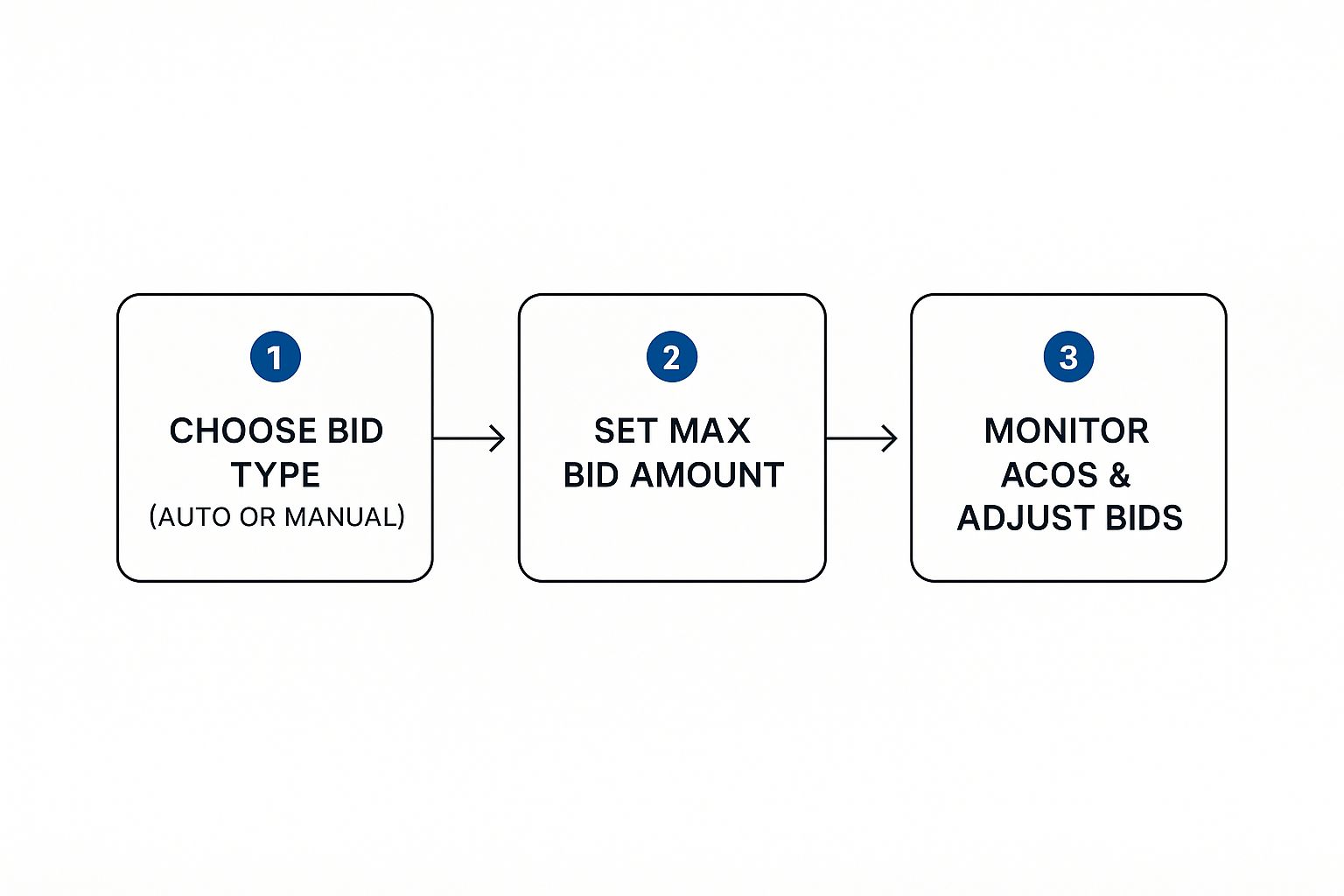
It’s the core rhythm of PPC management: select targets, set your price, and analyze performance data to inform your next move.
The Sustain Phase: Pivoting to Profitability
Once you achieve a strong organic ranking—consistently appearing on the first page for your primary keywords—the strategy shifts from aggression to efficiency. The objective is no longer just rank acquisition; it's profit maximization.
This is where you capitalize on the flywheel effect. Your organic sales now contribute significantly to your revenue, allowing you to strategically reduce ad spend.
- Bid Reduction: Systematically decrease bids on keywords where you hold strong organic positions. There is no need to pay a premium for visibility you are already earning organically.
- ACoS Optimization: Your target ACoS should now be set well below your product's break-even point. For established products, a target in the 15-25% range is common.
- TACOS Monitoring: This becomes your north-star metric. As you reduce ad spend while total sales remain stable (buoyed by organic traffic), your TACOS will decline. This is the ultimate proof of a successful flywheel strategy.
A Flywheel Success Story: From Page 3 to Profitability
Consider a brand that launched a premium blender into the hyper-competitive kitchenware category. Initially, their product was buried on page three for the high-traffic keyword "high-speed blender."
- Launch (Weeks 1-4): They executed an aggressive Sponsored Products campaign targeting that exact keyword, accepting a 65% ACoS to maintain a top-three ad placement. This generated over 300 paid sales in the first month.
- Momentum (Weeks 5-8): The algorithm responded. Their organic rank for "high-speed blender" jumped from page three to the bottom of page one. As organic sales started contributing, their TACOS began to drop.
- Sustain (Weeks 9+): Now holding a top-five organic position, they strategically reduced bids, bringing their ACoS down to a highly profitable 22%. With organic traffic driving over 70% of total sales for that keyword, their TACOS plummeted from an initial 40% to just 12%.
By following this two-phase playbook, they transformed their ad budget from a simple expense into a strategic asset that built a dominant—and highly profitable—market position.
Structuring Campaigns for Scale and Control
Let's be blunt: a disorganized Amazon PPC account is a money pit. A chaotic campaign structure prevents clean data analysis, precludes precise bid control, and makes scaling successful strategies impossible. A generic, "catch-all" campaign structure simply burns cash and forces you to make decisions based on guesswork.
To make confident, data-backed decisions, you need a battle-tested framework. The goal is an account structure that is clean, manageable, and built for granular analysis. This means moving beyond a single campaign to implement a logical system from day one.
The Targeting Triangle: A Classic Framework
One of the most effective and widely used structures is the "Targeting Triangle." This framework segments campaigns by keyword match type—Auto, Broad, and Exact—to create a systematic keyword harvesting funnel.
Here’s how it works in practice:
Auto Campaign (The Explorer): This is your automated research engine. You allow Amazon's algorithm to match your ad against a wide array of search terms it deems relevant. Your role is to monitor the Search Term Report to discover what shoppers are actually searching for.
Broad Campaign (The Qualifier): When a search term in your Auto campaign generates a conversion, you "graduate" it to a separate Broad Match campaign. This allows you to test the keyword and its close variations with more budget control, validating its performance.
Exact Campaign (The Closer): Once a keyword proves its profitability in the Broad campaign, it earns its final promotion into an Exact Match campaign. This is where your proven, high-converting keywords live. Here, you can bid with confidence and precision to maximize returns.
CRITICAL STEP: When graduating a converting search term to a Broad or Exact campaign, you must add it as a negative exact match in the original Auto campaign. This prevents budget cannibalization and ensures clean, non-overlapping performance data.
This "keyword harvesting" process transforms your account into a perpetual discovery engine, systematically moving terms from broad exploration to precise, profit-driven targeting.
Segmenting Campaigns for Strategic Control
Beyond match types, sophisticated advertisers segment campaigns based on clear business objectives. Lumping all products and keywords into one bucket is a recipe for wasted ad spend. A high-margin bestseller requires a fundamentally different bidding strategy than a new product launch.
Consider these powerful segmentation strategies:
- By Product Lifecycle: Create distinct campaigns for 'Launch' products (where a high ACoS is acceptable to build velocity) and 'Mature' products (where a low ACoS is targeted to maximize profit).
- By Profit Margin: Group high-margin and low-margin SKUs into separate campaigns. This enables you to set ACoS targets that align with the actual profitability of each product group.
- By Brand vs. Non-Brand: Always isolate branded searches ("YourBrand blender") from non-branded, generic searches ("high-speed blender"). There are unique benefits to running search ads for brand keywords, including defending your brand space and capturing high-intent buyers.
This level of organization provides the control necessary to pull the right strategic levers for the right products at the right time.
Putting It All Into Practice: Your Action Plan
Theory is only valuable when applied. Let's translate these concepts into a concrete action plan for your brand.
Winning on Amazon PPC isn't about finding a secret hack. It's about building a robust system where advertising, inventory management, listing optimization, and business goals are fully integrated. It's about moving from a reactive posture—constantly chasing ACoS—to a proactive one where you command performance.
For example, your annual strategy must account for tentpole events. You can't improvise your way through the year's biggest sales moments; there are specific tips for Amazon Prime Day that require weeks, if not months, of advanced planning. This foresight is what separates market leaders from laggards.
Your Performance Audit Checklist
Conduct a quick, candid assessment of your current PPC program. Where are you excelling, and where are the opportunities for improvement?
- Campaign Structure: Is your account architecture clean and segmented, or a tangled mess? Are you isolating campaigns by match type, product lifecycle, and brand vs. non-brand terms? A clean structure yields clean data and minimizes wasted spend.
- Flywheel Health: Analyze your TACOS trend over the last 6-12 months. Is it declining? If it's flat or increasing, your ad spend is not effectively boosting organic sales. Your flywheel is stalled.
- Keyword Harvesting: Do you have a disciplined, repeatable process for identifying winning search terms in auto campaigns and graduating them to manual campaigns? This is non-negotiable for scaling what works.
- Listing Optimization: Are you leveraging PPC data to improve your product detail pages? Your highest-converting ad-driven keywords should be integrated directly into your titles and bullet points.
The Recommendation: Shift your focus from simply buying clicks to building a profitable, defensible brand on Amazon. This requires integrating your advertising strategy with every other component of your Amazon operations.
If this checklist raises concerns, it may be time to seek expert guidance. A specialized Amazon PPC management service can implement these advanced principles, transforming your ad budget from an expense into a powerful growth engine.
Amazon PPC: Your Questions Answered
Even for seasoned eCommerce leaders, Amazon PPC can feel like a moving target. Getting clear, no-nonsense answers is critical for making intelligent decisions that drive profitable growth.
Let's address the most pressing questions we hear from brands aiming to scale on Amazon.
How Much Should I Spend on Amazon PPC?
There is no universal "right" amount. Your budget must be a direct reflection of your strategic goals for a specific product.
- For a New Product Launch: An aggressive investment is required. A common framework is to budget 20-30% of target revenue for PPC. The goal isn't just clicks; it's generating the sales velocity needed to signal relevance to Amazon's algorithm and ignite organic rank.
- For a Mature Product: Once a product has established sales history and organic rank, the goal shifts to profitability. Here, the focus is on maintaining a healthy Total Advertising Cost of Sale (TACOS), typically in the 8-15% range.
Before spending anything, calculate your break-even ACoS by understanding your product margins completely. Set a daily budget aligned with your strategic objectives and adjust it based on performance data. Treat your ad spend as a calculated investment, not a sunk cost.
What Is a Good ACoS for My Business?
A "good" ACoS is entirely specific to your business, your margins, and your current strategic objective. Stop comparing your performance to generic benchmarks.
Your break-even ACoS is your product's sale price minus all Cost of Goods Sold (COGS) and Amazon fees. This percentage represents your absolute ceiling; any ACoS below this number is profitable on a per-sale basis.
Your target ACoS must be dynamic. For a stable, mature product, a low ACoS (15-25%) maximizes profit per ad sale. For a product launch, however, a much higher ACoS—even 40% or more—is often a wise investment, as the primary objective is market share acquisition and long-term organic ranking, not immediate profit.
How Long Until I See Results from Amazon PPC?
You will see top-of-funnel data like impressions and clicks almost immediately, often within hours of launching a campaign. However, this early data is too volatile to be actionable.
You must allow at least 2-4 weeks for performance data to normalize before making significant optimizations. Only then can you begin making informed decisions with confidence.
The true strategic win—a measurable lift in organic ranking from your PPC efforts—requires more patience. The "flywheel effect" is a marathon, not a sprint. Plan for a minimum of 2-3 months of consistent, strategic campaign management before expecting to see a significant and durable impact on organic sales.
At Headline Marketing Agency, we don’t just manage ads; we build growth engines. Our expertise lies in creating comprehensive Amazon PPC strategies that look beyond ACoS to drive real profitability and lasting scale. We focus on the metrics that matter for your brand's long-term dominance. Partner with us to start building your advantage in the marketplace.
Get Your Free Amazon PPC Audit
Discover untapped growth opportunities and see how our data-driven approach can improve your ROAS.
Get Free Audit →Ready to Transform Your Amazon PPC Performance?
Get a comprehensive audit of your Amazon PPC campaigns and discover untapped growth opportunities.