What Are the Growth Strategies That Scale Amazon Brands
What are the growth strategies that actually scale Amazon brands? Learn frameworks, KPIs, and PPC levers for profitable growth.

An Amazon brand can reach a frustrating plateau even when the team is working hard. Sponsored Products generate sales, organic visibility stays flat, bids rise, and the finance team questions why revenue growth is consuming more cash. The obvious response is often to increase spend, but more traffic doesn't fix a weak detail page, poor query coverage, low repeat purchase, or inventory constraints.
The better question isn't how to sell more. It's what are the growth strategies that fit the brand's current constraint, and which one can improve revenue without damaging contribution margin?
A useful growth strategy gives leaders a decision structure. It identifies whether the next move should come from winning more share with existing products, reaching new shoppers, developing new products, or building a new category. On Amazon, that choice becomes more precise when paid media and organic performance are treated as one connected system.
Growth is uneven across businesses. McKinsey found that a typical company grew 2.8% per year in the decade before COVID-19, while only one in eight companies achieved annual growth above 10%. McKinsey's growth research links stronger performance to focused diagnosis, deliberate prioritization, and decisive investment, not scattered activity.
For Amazon operators, sustainable scale means more than higher sales. It means improving query coverage, conversion, organic rank, new-to-brand acquisition, repeat demand, and cash discipline together. The framework below starts with the classic growth model, then translates it into Amazon categories, PPC and DSP execution, measurement, experimentation, and governance.
Introduction Why Growth Strategy Matters on Amazon Today
Consider a consumer brand with a proven hero ASIN. Its branded campaigns perform reliably, but nonbrand search visibility is inconsistent. The team adds keywords, raises bids, launches another campaign, and celebrates a sales lift. A month later, ad costs are higher, organic share hasn't moved meaningfully, and the business has less flexibility to fund inventory.
That pattern usually reflects a strategy problem, not a lack of effort. The team is using acquisition tactics to solve every growth problem, even when the opportunity may be listing conversion, retention, assortment, pricing, or market expansion.
Amazon growth has several possible jobs:
- Capture more existing demand from current queries and competitors.
- Create demand with new audiences through display, video, and broader distribution.
- Convert more efficiently through better content, offers, and retail readiness.
- Increase customer value through repeat purchase, bundles, and complementary products.
- Protect profitability by aligning advertising, inventory, and contribution margin.
These jobs require different investments. A campaign manager can improve visibility, but a new product requires product development, supply planning, compliance, content, and working capital. A coupon may improve conversion, but it can also reduce margin if the offer reaches shoppers who would've purchased anyway.
Practical rule: Treat growth strategy as a choice about where the next unit of investment should work hardest, not as a list of tactics to run simultaneously.
Amazon also changes the relationship between paid and organic growth. An academic study of Amazon marketplace search found that in 85% of cases, at least one sponsored result appeared before the top organic result on the first results page. The Amazon marketplace search study shows why paid placement can shape discovery, consideration, and the route shoppers take to a product.
The implication is direct. PPC shouldn't be judged only by attributed sales or ACOS. It should also be evaluated as a lever for query-level visibility, conversion signals, organic rank, profitability, and long-term share capture.
Understanding the Core Growth Framework Every Brand Should Know
Growth isn't one lever. Think of it as four routes on a map, each taking the business farther from what it already knows.
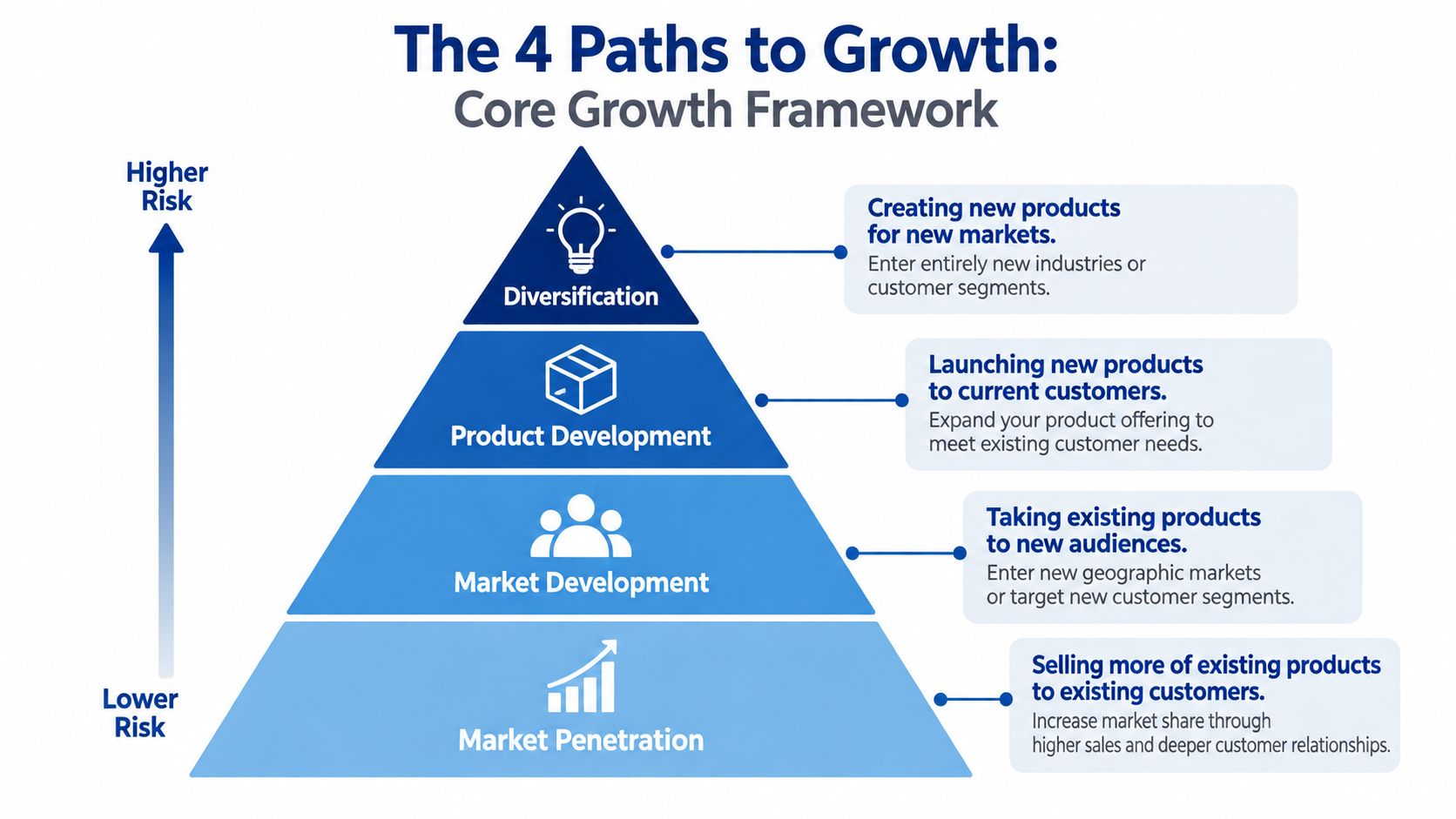
Igor Ansoff popularized a framework that identifies market penetration, market development, product development, and diversification. The model compares existing and new products with existing and new markets, helping leaders understand the risk and resource demands behind each route. Quantilope's explanation of the Ansoff growth framework describes why the framework remains useful for choosing between share capture, geographic expansion, innovation, and category entry.
The four routes in plain language
Market penetration means selling more of the products you already have in markets you already serve. On Amazon, that could mean improving nonbrand keyword coverage, defending branded queries, lifting conversion on a hero listing, winning competitor traffic, or increasing repeat purchases from existing customers. It typically carries the lowest risk because the product, customer context, and operating model are familiar.
Market development takes a proven product to a new audience, region, customer segment, or channel. An Amazon brand might adapt its messaging for a different shopper need, expand into another marketplace, or use DSP to reach audiences who haven't interacted with the brand.
Product development creates new products for customers the business already understands. Variations, bundles, adjacent sizes, and complementary products can increase relevance and basket value, but they introduce development, forecasting, and retail-readiness requirements.
Diversification enters a new product category and a new market at the same time. It can create a new growth engine or hedge against a maturing core category, but it has the highest uncertainty because the brand must learn both the customer and the product economics.
Risk ladder: Existing products and existing markets usually offer the most controlled path. New products and new markets require stronger evidence, more capital discipline, and greater operational readiness.
Use the framework before choosing a tactic
Start with the catalog, not the campaign manager. Ask three questions:
- Is demand already present for the current product, but the brand is losing visibility or conversion?
- Does the product have clear relevance for an audience the brand hasn't reached?
- Has the current customer base shown a need that a new product could solve?
If the first answer is yes, penetration may deserve priority over expansion. If the current category is crowded or mature, market development or product development may offer a better route. Diversification should follow a strategic rationale, not boredom with the existing catalog.
The framework also protects leaders from confusing top-line volume with quality growth. Selling more through heavy discounting can increase revenue while weakening contribution margin. Winning share through stronger query coverage, better conversion, and repeat demand may produce a more durable result even when the initial sales increase looks less dramatic.
Key Growth Strategies Categorized for Amazon and Ecommerce Brands
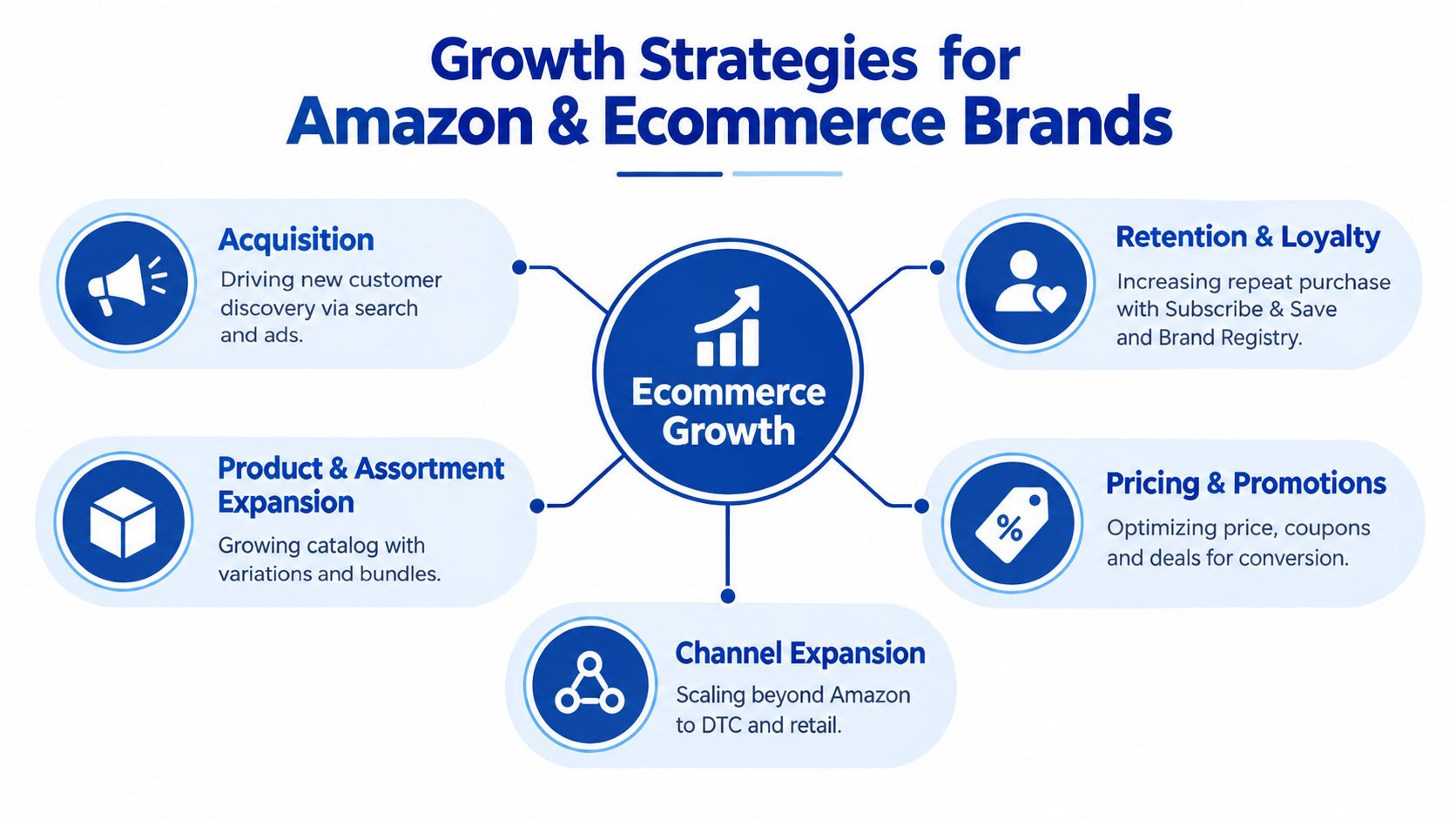
An Amazon brand can increase traffic while losing margin, add products while creating inventory risk, or win new shoppers without generating repeat demand. A useful taxonomy connects each growth strategy to the constraint it is meant to solve, rather than treating every slowdown as an acquisition problem.
Match the strategy to the constraint
| Growth category | Primary job | Best fit |
|---|---|---|
| Acquisition | Create discovery and convert new shoppers | Brands with demand opportunity and competitive search gaps |
| Retention and loyalty | Increase repeat demand and customer value | Consumables, replenishable products, and broad brand portfolios |
| Product and assortment expansion | Create more reasons to buy | Brands with strong customer insight and operational capacity |
| Pricing and promotions | Reduce purchase friction | Products with conversion or offer-positioning challenges |
| Channel expansion | Reach shoppers outside the current Amazon footprint | Brands with proven economics and broader distribution goals |
| Organic growth | Improve unpaid visibility and conversion | Listings with query relevance, content, or retail-readiness gaps |
Acquisition uses Sponsored Products, Sponsored Brands, Sponsored Display, DSP, video, and external demand generation to bring qualified shoppers into the consideration path. It requires media capital and disciplined targeting. The category fits products with a clear value proposition that lack sufficient visibility for relevant searches.
Retention and loyalty increases value after the first purchase through repeat ordering, Subscribe & Save, complementary products, Brand Store journeys, and post-purchase engagement. Strong retention can improve acquisition economics because the brand earns more value from customers it has already converted.
Product and assortment expansion covers variations, bundles, accessories, and adjacent products. These additions can give an existing audience more reasons to buy, while adding forecasting, content, inventory, and quality requirements.
Pricing and promotions address purchase friction, support launches, or respond to competitive pressure. Leaders must separate incremental demand from subsidized demand. A discount that converts a shopper who would have paid full price can reduce profitability without advancing the broader strategy.
Channel expansion may include DTC, retail, additional marketplaces, or wholesale partnerships. It can diversify revenue and reduce dependence on Amazon, but each route brings separate operating and measurement requirements. A brand seeking consistent prospecting beyond Amazon can evaluate an SDR for hire resource for retail or partnership development.
Organic growth compounds through relevance, conversion, and sales momentum rather than continuous media payment. Content quality, keyword alignment, ratings, reviews, availability, and paid interactions all influence how a product competes for unpaid visibility. This is the PPC-to-organic flywheel: paid campaigns expose query and conversion opportunities, while improved relevance and retail readiness help future demand convert more efficiently.
A practical ecommerce growth strategies framework can help teams compare these paths. Choose the smallest group of initiatives that addresses the current constraint, then judge paid activity by its contribution to query coverage, organic rank, repeat demand, and profitable scale, not ACOS alone.
How Amazon PPC and DSP Turn Paid Media Into Organic Growth
Headline's central view is simple: PPC is not only a harvesting channel. It can help create the conditions for organic growth when teams manage it at the query, funnel, and profitability levels.
Sponsored Products capture high-intent demand at the search results page. Sponsored Brands defend branded shelf space and introduce the broader portfolio. Sponsored Display can re-engage shoppers based on relevant shopping behavior. DSP expands reach beyond immediate search intent and can reconnect audiences across the consideration journey.
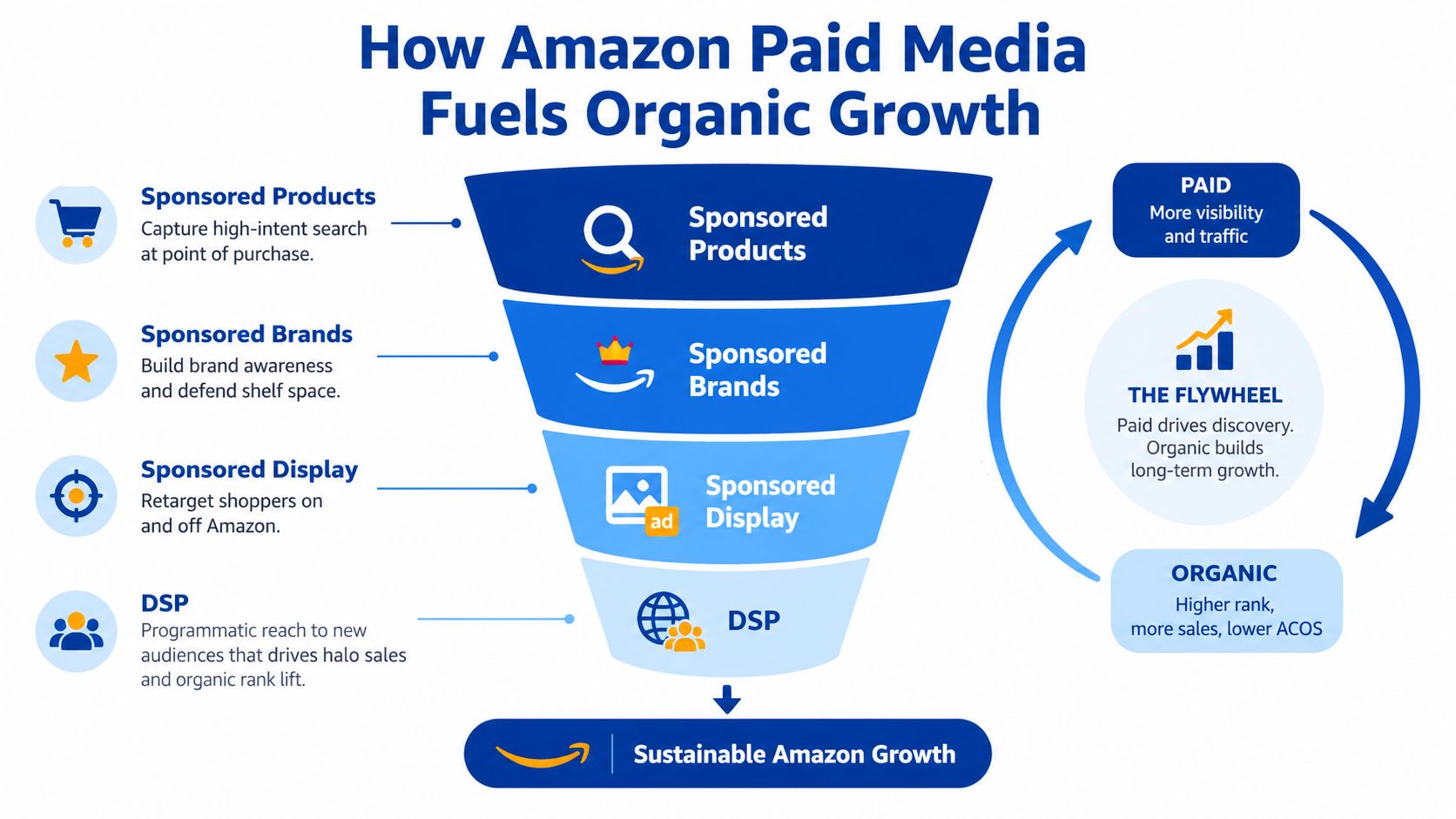
The flywheel works when paid media produces qualified product interactions, those interactions improve sales momentum and relevance, and stronger organic visibility then captures more demand without requiring every sale to remain paid. This isn't a reason to spend without limits. It is a reason to separate investment media from harvest media and evaluate each role differently.
Amazon Search Query Performance makes that separation actionable. The first-party diagnostic exposes query volume, impressions, clicks, add-to-cart activity, and purchases at brand-query level, with weekly refreshes. A team can use that funnel map to identify the broken stage:
- High impressions and low clicks: Review main image, title, price position, and creative relevance.
- Strong clicks and weak add-to-cart: Inspect detail-page promise, variation structure, reviews, and offer clarity.
- Strong add-to-cart and weak purchases: Check price, promotions, delivery promise, and Buy Box conditions.
- High conversion but low query share: Expand keyword coverage and increase qualified visibility.
- Wasted clicks: Tighten targeting and add negative targets where the traffic doesn't support the commercial objective.
Amazon's Search Query Performance documentation supports this query-to-funnel approach. The report isn't merely a keyword list. It connects demand capture with on-page conversion and media efficiency.
Use DSP to create demand without losing measurement discipline
Amazon Marketing Cloud adds path-to-conversion, audience overlap, and response-window analysis. Teams can build ASIN- or category-level audiences, understand how paid and organic interactions overlap, and serve product-specific creative to more relevant segments.
Amazon case evidence illustrates the value of coordinated journeys. In one study, open-internet DSP and on-Amazon journeys produced 200% more click-throughs than PPC-only journeys and 42% more reach. Amazon Advertising's Tinuiti audience and intent case study shows why prospecting and conversion roles should be designed together rather than judged as isolated campaigns.
For a deeper operating view of the channel, see this guide to Amazon DSP ads.
A profitable flywheel needs guardrails. Monitor contribution margin, inventory position, query-level share, new-to-brand demand, and organic rank alongside ACOS. If paid traffic grows while the detail page fails to convert, the campaign is financing inefficiency. If paid coverage protects strategic queries and improves the product's total sales position, the same spend may be building an asset.
Measuring What Matters KPIs and Data for Each Growth Strategy
Measurement should answer a decision question. A report that shows ACOS but doesn't explain whether the brand is gaining query share, attracting new customers, or improving repeat behavior leaves leaders with activity data instead of strategy data.
Use leading indicators to manage the work now, and lagging indicators to judge whether the growth path created durable value. The right combination depends on the job each strategy is meant to perform.
| Growth Strategy | Primary KPIs | Diagnostic Data Source | When to Prioritize |
|---|---|---|---|
| Acquisition | TACOS, new-to-brand rate, click-through rate, conversion rate, query share | Search Query Performance, campaign reports, AMC | When qualified discovery and customer acquisition are constrained |
| Retention and loyalty | Repeat purchase rate, Subscribe & Save activity, customer value, branded demand | AMC, brand analytics, customer behavior reports | When the catalog supports replenishment or cross-sell |
| Product and assortment expansion | New-product conversion, contribution margin, attach behavior, inventory health | Sales reports, AMC, product-level analytics | When existing customers show adjacent unmet needs |
| Pricing and promotions | Conversion rate, unit economics, promotion-attributed demand, price position | Business reports, campaign data, experimentation results | When offer friction is limiting conversion |
| Channel expansion | Channel revenue quality, contribution margin, fulfillment reliability, customer acquisition cost | Channel analytics, finance data, inventory systems | When Amazon economics are proven and capacity exists |
| Organic growth | Organic rank, organic share, click-through rate, conversion rate, branded and nonbrand sales | Search Query Performance, detail-page testing, organic reporting | When paid traffic exposes a content or relevance opportunity |
Search Query Performance finds the leak
Search Query Performance is most useful when teams compare the funnel stages rather than optimizing keywords in isolation. A query with high impressions but low clicks needs a creative or relevance response. A query with strong clicks but weak purchases needs a detail-page, price, offer, or retail-readiness response.
Amazon Marketing Cloud supports a different question: what path did the shopper take before conversion? It helps teams assess audience overlap, exposure sequences, and response windows instead of relying only on last-click ROAS.
Amazon Marketing Stream DSP performance datasets add traffic, conversion, clickstream, and rich-media signals for Amazon DSP campaigns. Amazon's Marketing Stream DSP dataset documentation supports fuller-funnel evaluation beyond ACOS-style reporting.
The practical rule is to assign one primary decision to each KPI. Use TACOS to monitor total advertising pressure, organic share to assess unpaid momentum, conversion rate to evaluate the retail experience, and new-to-brand rate to understand acquisition quality. Don't force every campaign to prove value through the same last-click metric.
For a broader operating dashboard, use this reference on KPIs for Amazon. The dashboard should make budget movement easier, not create another layer of reporting that nobody uses.
Prioritization Experimentation and Governance That Sustain Growth
The best growth opportunity isn't always the one with the largest theoretical revenue. It is the initiative where impact, capital agility, and operational readiness meet.
A product expansion may have attractive demand potential, but it shouldn't outrank a listing fix if the current ASIN has strong traffic and weak conversion. A DSP prospecting plan may extend reach, but it needs inventory coverage and a measurement design that can capture downstream effects. A promotion may create short-term volume, but it needs a margin threshold.
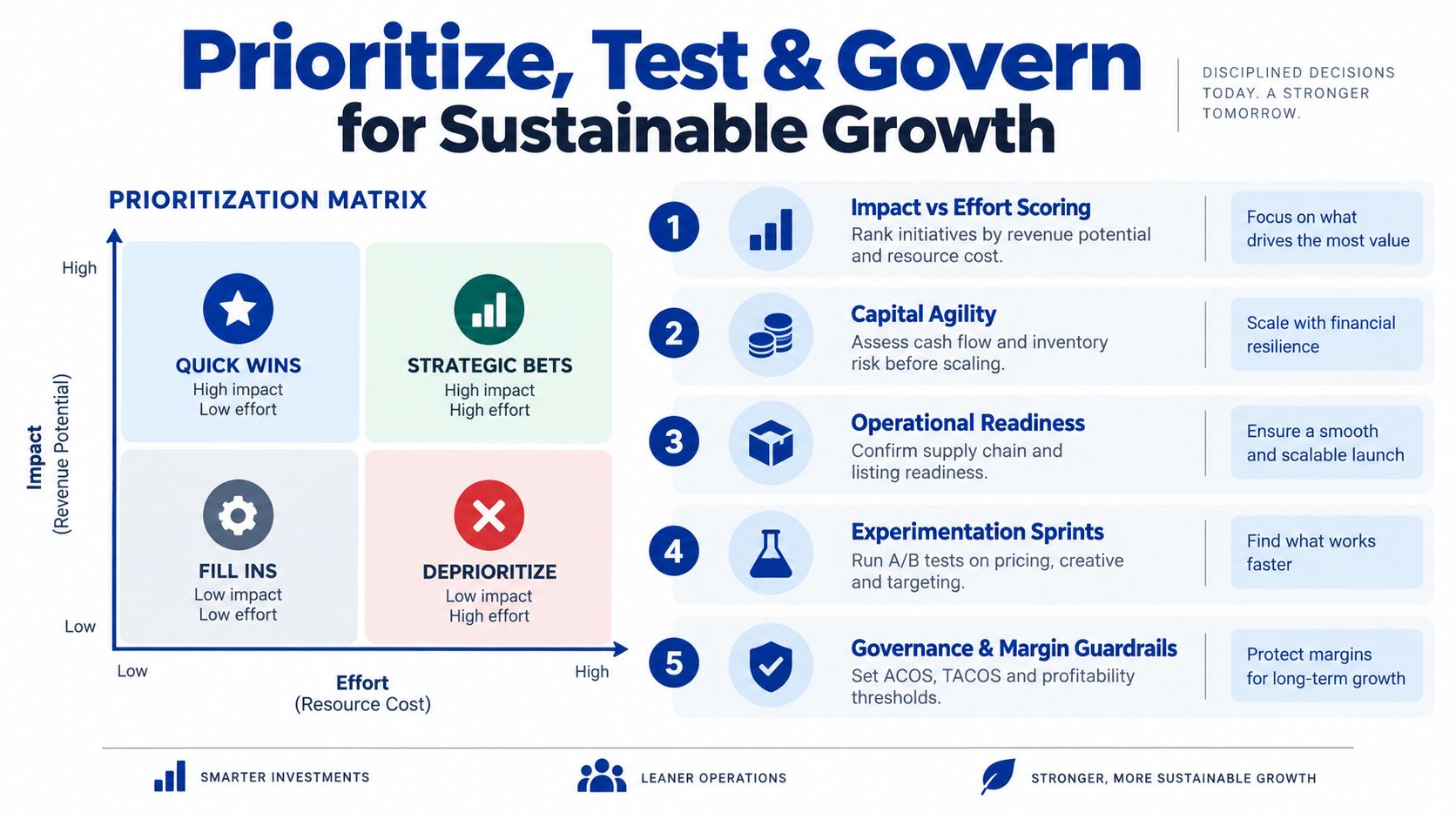
Score the opportunity before funding it
Use a simple review:
- Impact: Which customer, query, category, or revenue constraint could this change?
- Effort: What content, media, technology, people, and approvals are required?
- Capital agility: Can inventory, ad spend, and supplier payments move at the same pace as demand?
- Operational readiness: Are the listing, offer, fulfillment, and replenishment systems ready?
- Evidence quality: Does the initiative have query, audience, conversion, or customer evidence behind it?
Recent ecommerce finance coverage highlights why capital agility deserves explicit attention. A 2026 survey of 208 ecommerce finance and operations leaders identified cost of capital, demand forecasting, and the cash-flow gap between supplier payments and revenue collection as major challenges, while external capital access ranked last. The 2026 ecommerce growth and finance coverage supports a practical conclusion: scaling demand without pacing inventory and media can destroy the economics of growth.
Run controlled experiments
Test one meaningful variable at a time where possible:
- Listing experiments: Compare images, titles, or A+ content against a defined conversion objective.
- Query experiments: Expand high-converting terms while isolating match types and negative targets.
- Audience experiments: Use AMC to compare segment-specific messaging and exposure paths.
- Media orchestration: Separate prospecting DSP from conversion-focused Sponsored Products, then assess downstream outcomes.
- Offer experiments: Test price and promotion changes against margin and conversion guardrails.
Amazon case evidence offers a useful benchmark for audience-led efficiency. During Q2 2024, audiences identified through AMC Flexible Shopping Insights generated 36% of total new-to-brand purchases while using 17% of the ad budget. Amazon Advertising's The Honest Company case study demonstrates why audience analysis can improve the quality of growth, not merely its volume.
Amazon's advertising environment is also becoming more competitive. Amazon reported advertising services revenue of $17.2 billion in Q1 2026, up 22% year over year, and $19.8 billion in Q2 2026, up 26% year over year. Forbes' coverage of strategic growth and Amazon advertising reinforces the need to improve orchestration and efficiency rather than assume higher spend will remain an easy growth answer.
Governance turns experiments into an operating system. Review query and campaign movement weekly, align budget changes with inventory and cash flow, and stop initiatives that miss their margin or readiness thresholds. Keep a written record of the hypothesis, audience, spend role, result, and next action.
Choosing Your Next Growth Move With Confidence
The answer to what are the growth strategies isn't a universal priority list. Market penetration may be right for a brand with strong products and weak query share. Market development may fit a proven offer with an addressable audience it hasn't reached. Product development can create a new revenue path when customer needs and operating capacity support it. Diversification belongs on the agenda when the core business needs a new engine and the organization can absorb the risk.
On Amazon, the decision should begin with the constraint. Use Search Query Performance to locate the funnel break, AMC to understand audiences and paths, and DSP plus Sponsored Products to assign clear prospecting and conversion roles. Measure organic share, conversion, new-to-brand demand, contribution margin, and inventory health alongside ACOS.
The strongest growth system connects paid visibility to better retail execution and organic momentum. It doesn't treat PPC as an expense to minimize or a budget to maximize. It treats PPC as a controlled investment in profitable demand, customer learning, and long-term marketplace position.
If your team is deciding what to fund next, start with one high-confidence constraint, one measurable hypothesis, and one margin guardrail. Efficient full-funnel orchestration will usually create a stronger foundation than just adding spend to every campaign.
Headline Marketing Agency helps consumer brands manage Amazon PPC, DSP, Search Query Performance, and Amazon Marketing Cloud initiatives around profitability and organic growth. Visit the agency to discuss a data-driven execution plan for your next Amazon growth move.
Get Your Free Amazon PPC Audit
Discover untapped growth opportunities and see how our data-driven approach can improve your ROAS.
Get Free Audit →Ready to Transform Your Amazon PPC Performance?
Get a comprehensive audit of your Amazon PPC campaigns and discover untapped growth opportunities.