Sponsored Brand Ads: How Amazon Brands Should Use Them
Sponsored brand ads explained for Amazon leaders: formats, CPC vs vCPM vs share of voice, targeting, and how to judge profit beyond ACOS.

In the fourth quarter of 2024, Sponsored Brands investment sat flat year over year while clicks fell 15% and cost per click rose 17%, according to the Tinuiti Digital Ads Benchmark Report for Q4 2024. Fewer clicks at a higher price looks like a format losing ground, until you notice what the buyers were paying for.
That's the split most accounts get wrong. Sponsored Brand ads get managed as a Sponsored Products clone with a banner attached, judged on the same ACOS target, and paused the first week it loses that comparison. The campaigns that survive aren't the efficient ones. They're the ones whose job a click count can describe.
Score each campaign by the job it does: defense of the branded search result, acquisition of first-time buyers, or discovery of demand you don't own yet. Then pick the billing model that buys that job, the format that shows it, and the metric that proves it. A campaign with a worse ROAS than your best exact-match Sponsored Products campaign can still be the most valuable line in the account, and a campaign with a beautiful ROAS can be selling to people who were going to buy anyway.
Where Sponsored Brand Ads Sit in the Spend Mix
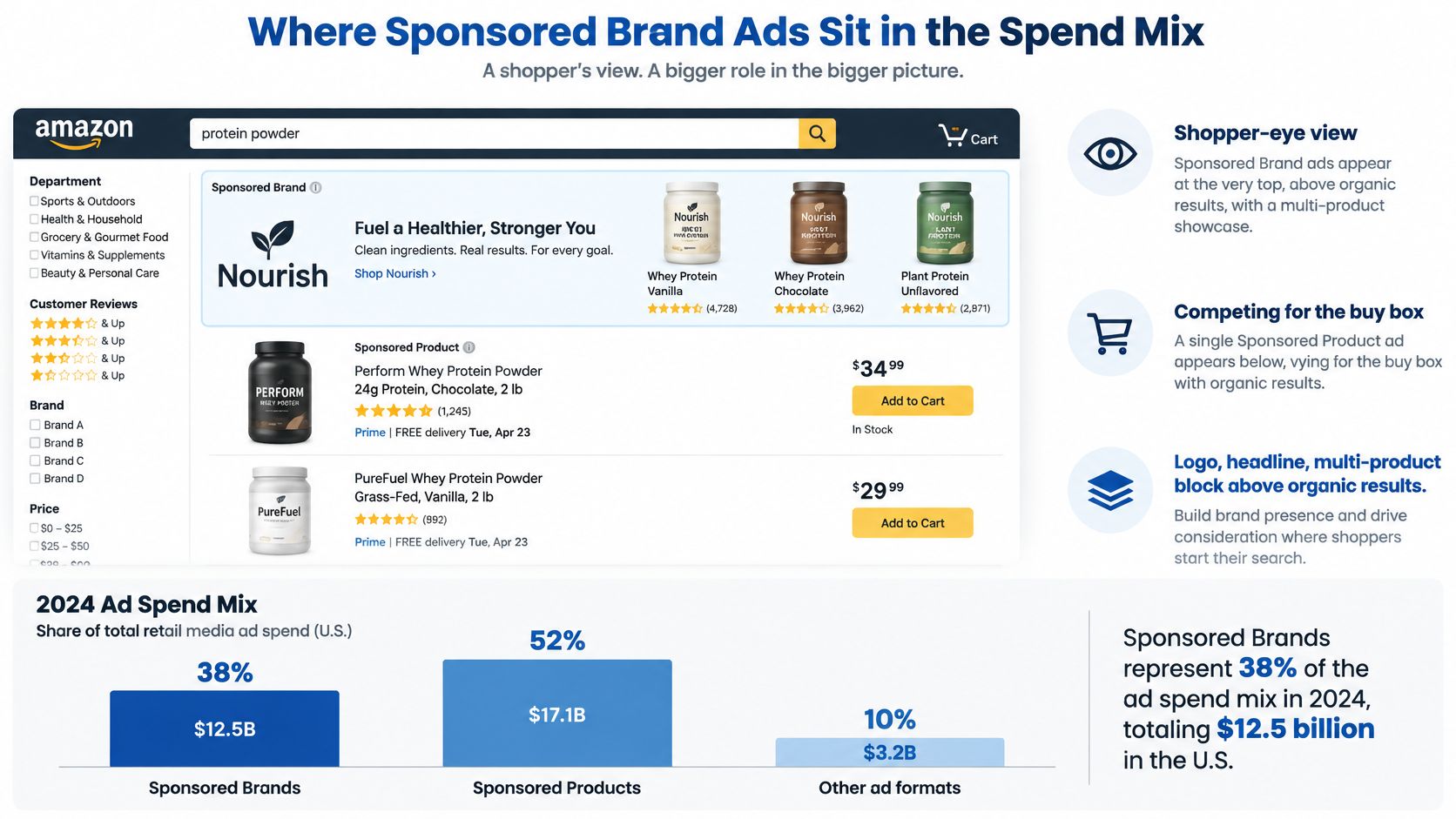
A shopper searching your category sees two different objects on the same page. One is a single product card with a price and a star rating, fighting for the buy box. The other is a storefront: your logo, a headline you wrote, and a row of products or a short video, sitting above the organic results. That second object is a sponsored brand ad, and it behaves like a shelf rather than a SKU.
The 2024 advertising spend mix tracked by Axiobench put Sponsored Brands at about 25% of advertiser spend, against 60% for Sponsored Products. Early-2024 performance data in the same dataset gave Sponsored Brands roughly $3.06 return on ad spend, behind Sponsored Products at $3.41 and ahead of Sponsored Display at $1.85.
Adoption shows who has already made that bet. Jungle Scout data cited by Axiobench found 38% of third-party Amazon sellers use Sponsored Brands, rising to 66% among sellers with more than $1 million in lifetime sales. Tinuiti's own client data put Sponsored Brands, video included, at 18% of Amazon Ad Console investment in Q2 2024, per its Q2 2024 benchmark report.
| Ad type | Spend share | Reported return | What the shopper sees | Best commercial job |
|---|---|---|---|---|
| Sponsored Products | About 60% of advertiser spend in 2024 | About $3.41 ROAS in early 2024 | One product in search or on detail pages | Harvest high-intent conversions at the SKU level |
| Sponsored Brands | About 25% of advertiser spend; 18% of Ad Console investment in Q2 2024 | About $3.06 ROAS in early 2024 | Logo, headline, several products or video | Defend branded search, launch a line, acquire first-time buyers |
| Sponsored Display | Part of the remaining ~15% of the 2024 mix, not broken out separately | About $1.85 ROAS in early 2024 | On- and off-Amazon display and retargeting | Re-engage shoppers and extend reach beyond the search result |
The cost side tightened as the year went on. During Prime Day 2024, Sponsored Brands spend rose 10% year over year while clicks fell 4% and CPC rose 15%, according to Jungle Scout data reported by Fit Small Business. Paying more for each visit and getting fewer of them is exactly the condition that makes a click-based verdict misleading.
A lower return than Sponsored Products isn't a failure signal. It's the price of a different placement: the brand block above the results, the multi-product row, the video, and the new-to-brand measurement that comes with the format. Brands use it to hold branded queries they'd otherwise share with competitors, introduce a product line to people who already trust them, and create demand that converts later through organic results. If you're weighing the two formats against each other, Sponsored Products versus Sponsored Brands lays out where each one wins.
Treat that 25% as a portfolio allocation with a purpose, not a rounding error. The next decision is which buying model funds the purpose, because clicks, viewable impressions, and reserved share of voice behave nothing alike.
CPC, vCPM and Reserve Share of Voice
Every Sponsored Brands campaign should carry one commercial objective and one metric that matches it. Amazon sells the format three ways, and its Sponsored Brands buying documentation describes three materially different mechanisms: cost per click for traffic and product-page visits, cost per 1,000 viewable impressions for building brand impression share, and fixed upfront pricing to reserve share of voice at the top of search on branded keywords.
| Buying model | What you buy | Spend floor | Judge it on | Do not judge it only on |
|---|---|---|---|---|
| Cost per click (CPC) | Clicks and product-page visits | No minimum spend | Incremental sales and contribution margin | Blended account ACOS |
| Viewable CPM (vCPM) | Brand impression share per 1,000 viewable impressions | No minimum spend | Visibility, branded-search demand, downstream organic effects | Same-session ROAS |
| Reserve share of voice | Fixed upfront top-of-search placement on branded keywords | Minimum spend commitment required | Branded top-of-search impression share and lost-sales ratio | ACOS versus Sponsored Products |
Cost per click is the default and the easiest to judge fairly. Score it on what the click produced and what the resulting order left behind in contribution margin, not on the blended ACOS of an account that has already mixed defense, acquisition, and discovery into one average.
Viewable CPM buys brand impression share in blocks of 1,000 viewable impressions, and Amazon sets no minimum there either. Its return arrives through branded search volume, repeated exposure, and organic rank movement over weeks. A same-session ROAS readout will always make vCPM look like the weakest line in the account, because the effect it produces lands somewhere the sales report doesn't follow.
Reserve share of voice is the one with a commitment attached. Fixed, upfront pricing holds top-of-search placement on your branded keywords, and it requires a minimum spend. You're buying a position rather than a click, so the verdict comes from branded top-of-search impression share, the share of branded sales you were losing to competitors' ads, and whether those competitors stop showing up on your brand query at all.
The kill decision to avoid: cutting a vCPM or reserve campaign because its ACOS trails an exact-match Sponsored Products campaign. It was never hired to convert on the last click.
The mechanics make the separation real. Amazon lets you set budgets, bids, targeting, and campaign dates per campaign, so defensive branded coverage and category expansion never have to share a budget or a bidding strategy.
Plan each budget against its own job and its own commitment. A reserve campaign's floor is a number you chose in advance. A CPC campaign's ceiling is whatever its contribution margin can carry. Averaging the two produces a figure that describes neither.
Before anyone touches a bid, label every live campaign as defense, acquisition, or discovery. A campaign that needs two labels is two campaigns sharing one budget, and one of them is about to lose the argument.
Formats Shoppers Actually See in Search
A Sponsored Brands ad's format determines what a shopper sees before the click, and what they expect to find after it. The headline frames the offer, the product row shows the range, and the landing page should continue the same story.
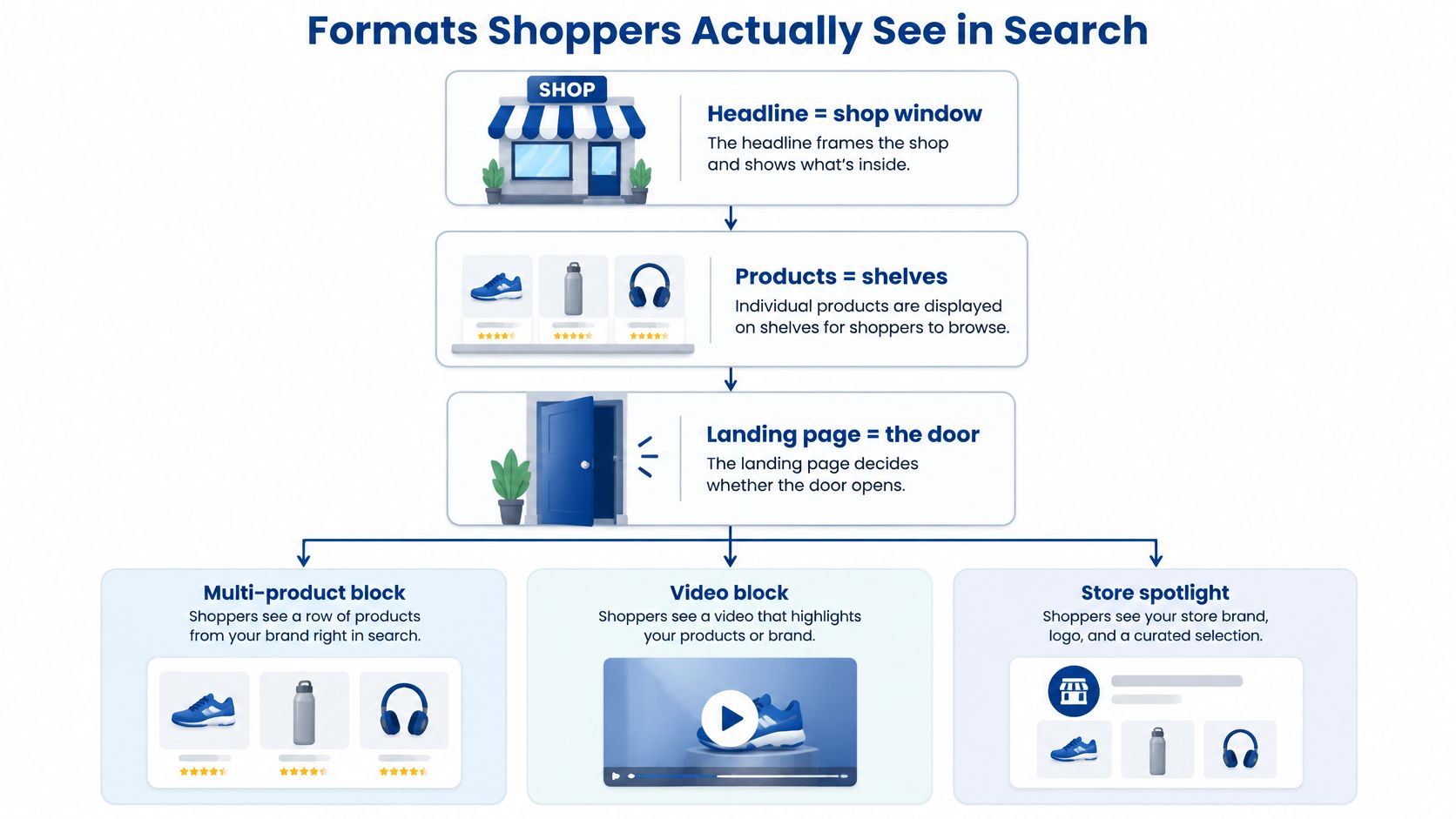
Product collection, the shelf you control least
Product collection pairs your logo and custom headline with at least three products. Choose visually clean, well-rated ASINs that represent the range: the product row is the ad. Match the landing page to the promise in the headline and the products shown.
Store spotlight, for the range story
Store spotlight turns subpages of your Amazon Store into shoppable tiles. Use it when the assortment itself helps the shopper decide, such as a routine, a room, or a good-better-best line. The tile should lead to a subpage that makes that range easy to browse.
Video, when the consideration gap is visual
Video fits products shoppers need to see in use before clicking, such as items where size, texture, or differences between models matter. The landing page should answer the question the video raises. A clip that shows a compact fold needs a destination that makes the product's dimensions clear.
For a comparison of Sponsored Products video and Sponsored Brands video, compare Amazon video ad formats.
| Format | Best job | Landing-page rule | Skip when |
|---|---|---|---|
| Product collection | Present a product line with a logo, custom headline, and at least three products | Use a product page or Store page that continues the same offer | No relevant destination exists |
| Store spotlight | Guide shoppers through a genuine assortment | Link each tile to its matching Store subpage | The Store has no coherent subpage structure |
| Video | Show product size, use, or differences before the click | Send shoppers to a page that answers the question shown in the video | The product's value is difficult to demonstrate visually |
Use the format to serve the campaign's job. Product collection can support acquisition across a range, Store spotlight can aid discovery, and a focused video can clarify a product's use. Judge each by whether its creative and destination help shoppers take the intended next step, not by whether it resembles a Sponsored Products ad.
For image-led placements, see how Sponsored Brands custom images can contribute to the creative. Test one variable at a time, such as the headline, product selection, or video thumbnail. Changing all three together makes it harder to identify what influenced the result.
Keyword and Product Targeting That Earns the Click
Sponsored Brands can reach shoppers through search terms or the product pages they are browsing. Keyword targeting captures stated intent. Product and category targeting reaches shoppers in a relevant context, including on competing or substitute detail pages. Category targets can be narrowed by brand, price band, and review rating, as Amazon's targeting documentation describes. Video campaigns can also target recent product searches. Negative keywords and negative product targets exclude traffic unlikely to convert.
Start with a useful test, not a fixed threshold
Set a budget and targeting list large enough to gather useful evidence, then adjust them to the campaign's job and available spend. A daily budget that runs out early limits opportunities to learn across the day. A broad keyword list can help surface queries, but it needs regular review so irrelevant traffic does not absorb spend.
Build four campaigns, not one
- Exact match on proven converters. Separate branded terms and generic terms that already sell from discovery traffic. Distinct bids and budgets make their performance easier to assess.
- Phrase match for close variants. Use phrase match to test related queries while keeping the traffic closer to the original intent. Review the search-term report and remove terms that do not fit.
- Broad match as a query mine. Use broad match to find search terms you did not think to list. Review the search-term report regularly and move promising terms into campaigns where their performance can be managed separately.
- Product and category targets, split in two. Separate defense on your own detail pages from conquest on competitor pages. The targeting type may be the same, but the campaign jobs and economics differ. Sponsored Brands product targeting explains how to structure these targets without bidding against yourself.
Read two signals, then stop
Low impressions point to an eligibility, bid, or relevance issue. Check whether the campaign qualifies to serve before changing the creative. Low click-through rate points instead to a mismatch between the query and the headline, creative, or offer. Fix that mismatch before raising the bid.
Move proven, profitable search terms out of broad match and give them a dedicated campaign, bids, and budget. Their job has shifted from discovery to controlled delivery. Keeping them in broad match blurs the cost of learning with the cost of serving established demand.
New-to-Brand Metrics That ACOS Hides
Two Sponsored Brands campaigns can show the same ROAS while doing different jobs. One may mostly convert existing customers; the other may bring in first-time buyers. ACOS and ROAS alone cannot distinguish retention from customer acquisition.
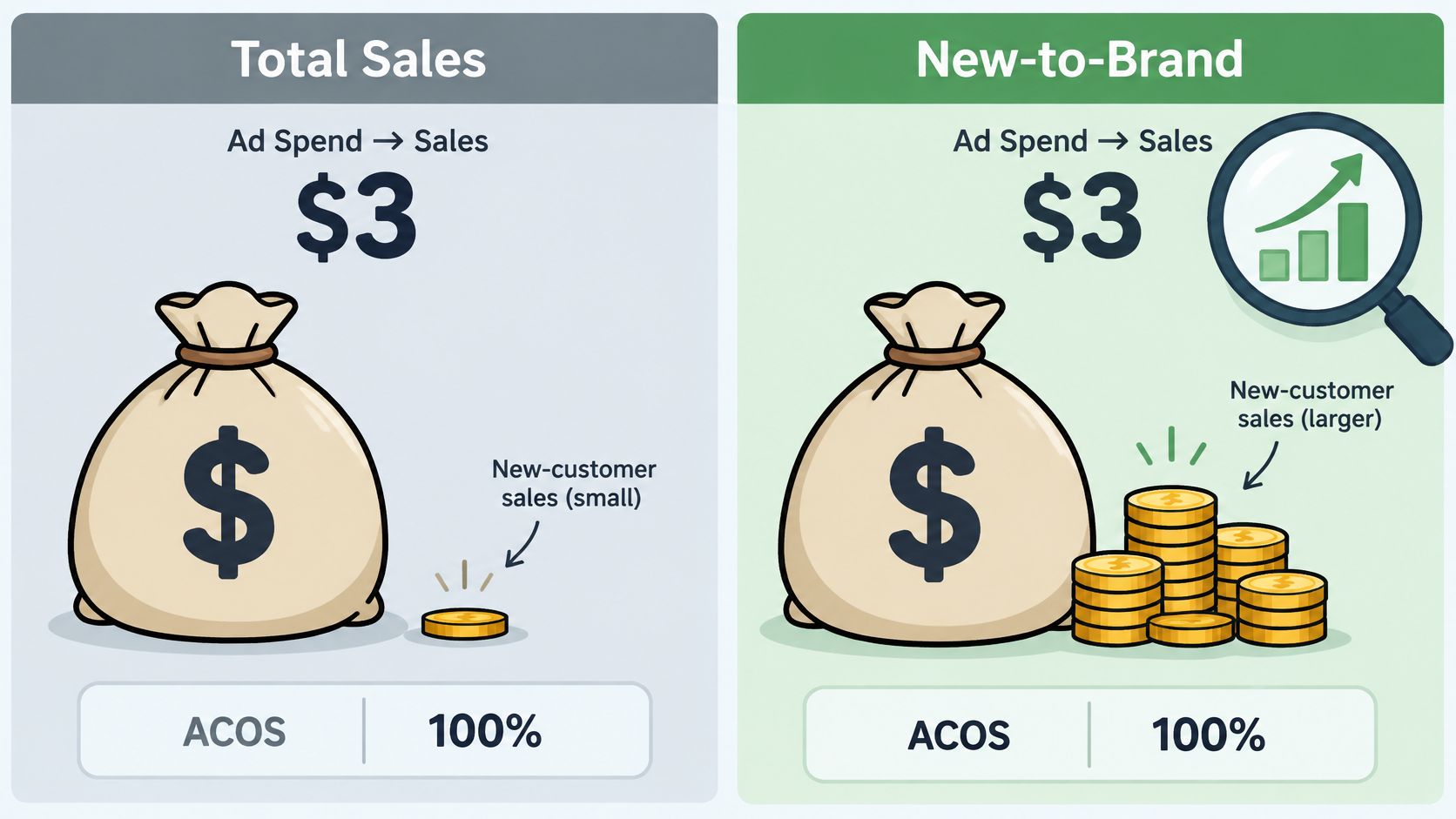
What the metric actually measures
Amazon's new-to-brand reporting identifies first-time customers using a one-year lookback window. It reports new-to-brand purchases, sales, units, purchase rate over clicks, detail-page views, and the share of total purchases or sales that are new to brand, according to Amazon's new-to-brand documentation. Sponsored Brands purchases and add-to-cart activity use a 14-day attribution window.
Add new-to-brand sales divided by spend alongside ROAS. This ratio shows how much campaign output came from new customers, rather than mostly capturing existing demand. Break it out by targeting, placement, creative, and product to see which parts of the campaign are acquiring customers and which are harvesting demand.
A campaign with lower ROAS may still be the stronger acquisition investment if its new-to-brand sales share is substantially higher.
Reporting changes and comparability
Amazon's attribution documentation describes changes to view attribution for some placements, including the use of additional shopping-behavior patterns, while the general lookback remains about 14 days, according to Amazon's attribution documentation. That makes comparisons across reporting changes risky: a reported sales increase may reflect a changed definition rather than stronger campaign performance. The same applies to a decline, which can prompt unnecessary bid or creative changes.
A migration checklist you can run now
Archive existing exports and record the attribution window shown for each metric. Keep a stable set of measures for comparisons: spend, cost per click or cost per 1,000 viewable impressions, branded top-of-search impression share, new-to-brand sales share, and contribution margin. Reconcile totals across reporting formats for an overlapping period, then mark the reporting transition on charts so a measurement change is not mistaken for a performance shift.
For the reconciliation process, the ELECTE guide to ecommerce growth offers a primer on ecommerce analytics.
Keep CPC and vCPM campaigns on separate scorecards. Changes in viewability attribution affect how vCPM results are counted, so judge those campaigns against their intended job, not a conversion metric they were not designed to maximize.
What Strong Sponsored Brands Results Look Like
Three published outcomes are worth keeping on a wall, as benchmarks rather than promises. Each one comes from a different job, and each one is measured with metrics you can put on a dashboard next month.
Read each case as a different job
The first is defense. In Amazon's Samsung case study on reserve share of voice, branded top-of-search impression share moved from 44.9% to 99.8%, click-attributed sales rose 187%, conversion rate went from 13.2% to 14.3%, and the lost top-of-search sales ratio fell from 7.4% to 0.04%. The last figure is the one to steal. Near-total branded coverage turns a leak into a rounding error.
A 2025 reserve share-of-voice pilot reported by Amazon Ads produced the same shape: branded top-of-search impression share from 62.7% to 99.3% and click-attributed sales up 143%. Two cases, two catalogues, one pattern. The win is demand you stopped handing to competitors, not a magical ACOS.
The third is consideration. In Amazon's HP Sponsored Brands video case study, investment rose 206% year over year, clicks rose 142%, Sponsored Brands video clicks specifically rose 42%, and click-through rate beat Amazon's benchmark by 36%. Revenue grew 80% and units sold rose 60%. In category paths, shoppers exposed to the video showed a 954% higher purchase rate on printers with 30% higher ROAS, and a 709% higher purchase rate on laptops with 44% higher ROAS.
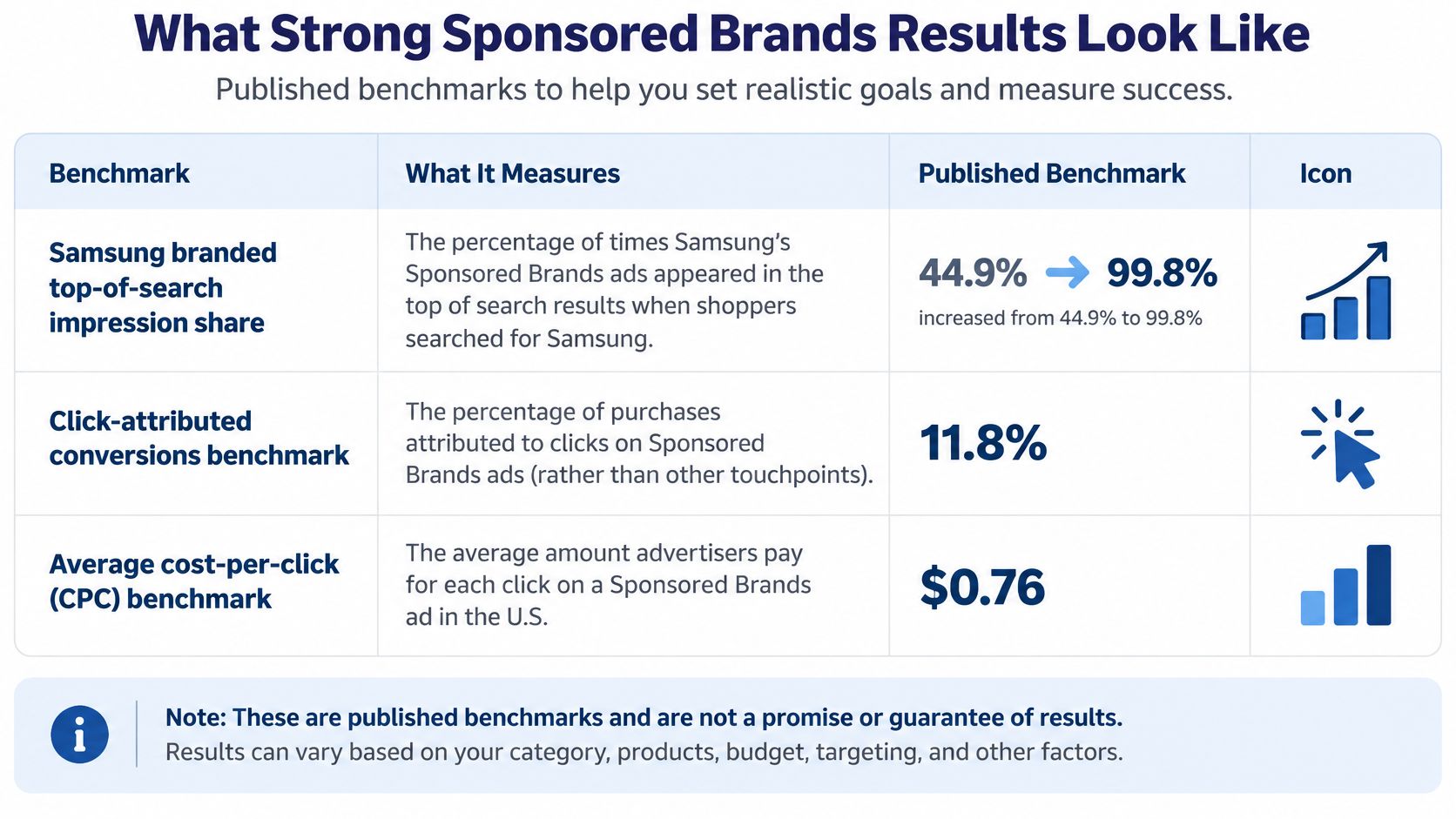
| Case | Move | Visibility or efficiency | Sales result | What to copy |
|---|---|---|---|---|
| Samsung reserve share of voice | Branded top-of-search defense | Impression share 44.9% to 99.8%; lost sales ratio 7.4% to 0.04%; CVR 13.2% to 14.3% | Click-attributed sales +187% | Track impression share and lost sales together |
| 2025 reserve share-of-voice pilot | Branded query coverage | Top-of-search impression share 62.7% to 99.3% | Click-attributed sales +143% | Treat near-full branded coverage as the goal, not a ROAS target |
| HP Sponsored Brands video, 2023 | Video versus the category path | CTR 36% above Amazon benchmark; video clicks +42% | Revenue +80%; units +60%; printer purchase rate +954% and ROAS +30%; laptop purchase rate +709% and ROAS +44% | Test video by category before scaling spend |
The transferable pattern is to track four numbers as a set: branded top-of-search impression share, lost-sales ratio, conversion rate, and click-attributed sales. One without the others is easy to misread. Impression share can climb while conversion falls, which means you bought coverage on queries that were never going to convert.
The same shape shows up outside Amazon's case library. In a lifestyle brand case study, we doubled market share and increased organic visibility by 156%, funding PPC as an investment in organic visibility rather than a last-click channel.
Then test video against your static collection one category at a time, on click-through, conversion, ROAS, and new-to-brand share, and scale only the categories that improve on more than one of those. A single-metric win is usually a targeting change wearing a creative costume.
Fund the Campaign That Matches One Job
The decision isn't which format to run. It's which job gets the next dollar.
If branded queries already convert and your top-of-search impression share sits well below the near-full coverage in those reserve cases, fund defense first. That means exact-match CPC on brand terms, or a reserve share-of-voice test if the commitment fits, scored on impression share and lost sales rather than ACOS.
If the leak is customers you've never had, fund a separate acquisition campaign and score it on new-to-brand sales divided by spend, read beside ROAS rather than instead of it.
If shoppers need to see the product before they'll consider it, test video against the static collection on click-through, conversion, ROAS, and new-to-brand share, one category at a time.
Do not launch all three on one budget and one ACOS target. That's how the acquisition campaign gets killed in week two by a report measuring something it was never asked to do.
Before any scaling decision, run the archive and reconciliation steps so the 2026 move to unified reporting doesn't rewrite your history in the middle of a test. Brands that want this scorecard managed against contribution margin rather than blended ACOS can talk to Headline Marketing Agency, which runs Sponsored Brands on profit-based bidding and reviews branded coverage, lost sales, and new-to-brand results as one picture.
Pick one job. Fund that campaign. Hold the other two on the backlog until their matching metric moves.
Headline Marketing Agency manages Amazon advertising on contribution margin and profit-based bidding, not a single blended ACOS target, and scores Sponsored Brands by the job each campaign was funded to do. If your branded coverage, lost-sales ratio, or new-to-brand share has never been reviewed next to spend, that review is the fastest way to find money already sitting in the account. Visit Headline Marketing Agency to request a free audit covering organic visibility and ranking trends, bleeder spend, targeting gaps, target starvation, and campaign structure.
Get Your Free Amazon PPC Audit
Discover untapped growth opportunities and see how our data-driven approach can improve your ROAS.
Get Free Audit →Ready to Transform Your Amazon PPC Performance?
Get a comprehensive audit of your Amazon PPC campaigns and discover untapped growth opportunities.