Amazon Sponsored Ads: The Performance-First Playbook for Profitable Scale
Most Amazon Sponsored Ads advice online is outdated or oversimplified. Here's the nuanced, data-driven approach we use.

A sponsored ad on Amazon is more than just a paid placement; it’s a strategic lever for growth. It's pay-per-click (PPC) advertising that positions your products directly in the path of high-intent shoppers on Amazon’s search results and product pages. For brand leaders, this isn’t just about buying digital shelf space—it’s about leveraging paid media to engineer organic dominance and drive sustainable profitability.
Beyond ACOS: The New Playbook for Amazon Ads
For years, the Amazon advertising discourse has been shackled to a single metric: Advertising Cost of Sale (ACOS). While ACOS offers a narrow view of campaign efficiency, this obsession fosters short-term thinking that actively stifles long-term, profitable growth. It’s time for a more sophisticated approach.
This guide is for eCommerce leaders who understand that a sponsored ad on Amazon is a strategic investment, not an operational cost. We will reframe the conversation from chasing a low ACOS to adopting a performance-first mindset—one where PPC is the primary engine for building a defensible, scalable brand on the marketplace.
PPC as a Growth Engine, Not a Cost Center
The most successful brands on Amazon don’t view ad spend as a cost center. They see it as fuel for their organic growth engine. A strategically executed PPC campaign doesn't just deliver a short-term sales lift; it systematically improves a product’s organic search ranking, creating a powerful flywheel effect. Paid ads drive sales velocity, which signals relevance to Amazon's algorithm, which boosts organic visibility and drives more sales.
This performance-first strategy is built on three core pillars:
- Profitability Over Vanity Metrics: Shift focus from ACOS to metrics that reflect true business impact, like Total Advertising Cost of Sale (TACOS) and Return on Ad Spend (ROAS).
- Organic Rank is the Ultimate Prize: Use sponsored ads to strategically drive sales velocity, a critical input for Amazon's A10 search algorithm. Higher velocity leads to higher organic rank.
- Sustainable Scale: The objective is to build a system where ad-driven sales create such a strong organic foundation that your dependency on paid media decreases over time.
The real objective isn't just to win ad auctions; it's to win market share. A sophisticated Amazon sponsored ad strategy understands that every dollar spent should either generate a profitable sale or strengthen your brand's organic moat for the future.
The marketplace is only getting more competitive. Amazon's ad revenue is projected to hit a staggering $94 billion globally by 2026—up from $37.7 billion in 2022. To put that in perspective, Amazon captured over 75% of all U.S. digital retail media spending in 2023. You can read more about Amazon's ad revenue growth and its implications.
This guide is your playbook for turning your ad budget from a line item into your most powerful tool for driving profitable, sustainable growth.
Choosing the Right Tools from Your Amazon Ad Arsenal
Amazon’s ad formats aren't a checklist; they're a coordinated toolkit. Each ad type serves a specific function in a full-funnel strategy. Winning isn't about picking one format—it's about deploying the right asset at the right time to guide a customer from awareness to purchase.
Think of it as deploying a specialized sales team. Sponsored Products are your closers, capturing high-intent shoppers at the point of purchase. Sponsored Brands are your brand builders, establishing market presence and credibility. Sponsored Display is your retention system, re-engaging interested shoppers and defending your turf.
Sponsored Products: Your Conversion Engine
Sponsored Products are the workhorse of any Amazon advertising strategy. These cost-per-click (CPC) ads target individual products within search results and on competitor product pages. Their primary objective is conversion.
Every sale contributes to sales velocity, a key signal to Amazon's A10 algorithm. Higher conversion rates from your ads directly feed the algorithm, improving your organic ranking. These ads are your highest-converting asset because they intercept shoppers with clear commercial intent. A search for "men's waterproof running shoes" is a buying signal, and a well-placed Sponsored Product ad closes the deal.
Sponsored Brands: Your Digital Billboard
While Sponsored Products convert existing demand, Sponsored Brands create it. These prominent banner ads appear at the top of search results, featuring your logo, a custom headline, and multiple products.
Key Takeaway: Sponsored Brands are an investment in long-term defensibility. They build brand recall, create a perception of market leadership, and allow you to tell a bigger story than a single product listing ever could.
This format is essential for establishing category leadership and driving traffic to your brand's Amazon Storefront. It’s less about the immediate transaction and more about building a loyal customer base that actively seeks you out.
Sponsored Display: Your Intelligent Retargeting Arm
Sponsored Display ads are your mechanism for continued engagement. They enable you to retarget shoppers who viewed your products (or similar ones) both on and off Amazon. This is critical for re-capturing lost leads and staying top-of-mind.
They also play a vital defensive role. Placing Sponsored Display ads on your own product detail pages effectively boxes out competitors, preventing them from poaching the high-intent traffic you’ve worked to acquire.
A Strategic Glance at Amazon Ad Types
This table breaks down the three primary ad types by their core function, placement, and role in the sales funnel, enabling smarter budget allocation.
| Ad Type | Primary Goal | Placement | Best For |
|---|---|---|---|
| Sponsored Products | Drive immediate sales & conversions | Search results, product detail pages | Bottom-of-funnel shoppers with high purchase intent |
| Sponsored Brands | Increase brand awareness & consideration | Top of search results | Top-of-funnel shoppers; building brand recognition |
| Sponsored Display | Re-engage shoppers & defend product pages | On & off Amazon (apps, websites) | Mid-funnel re-engagement & brand defense |
A balanced, full-funnel strategy leveraging all three formats is the only sustainable path to growth on the platform.
The data confirms this. One Amazon case study revealed that a home goods brand combining Sponsored Products and Sponsored Brands saw a +23% increase in return on ad spend (ROAS) compared to running Sponsored Product campaigns alone. This demonstrates the compounding effect of an integrated strategy.
To execute this effectively, brands often need specialized tools. The right PPC Amazon software provides the data and automation required to manage complex, multi-format campaigns. And supplemental resources like the best geo tools for Amazon sellers can offer market insights that sharpen your overall ad strategy.
How the Amazon Ad Auction Really Works
Assuming the highest bid wins the ad auction on Amazon is a costly mistake. Amazon’s system is a sophisticated marketplace designed to optimize the customer experience, not simply reward the deepest pockets.
This means your ad’s relevance is as critical as your bid—and often, more so.
Amazon uses a second-price auction. When you win a placement, you don't pay your maximum bid. Instead, you pay just $0.01 more than the next-highest bidder. This model encourages you to bid the true value of a click without the risk of significant overpayment.
The winner is determined by a combination of your bid and your ad's historical performance, particularly its click-through rate (CTR) and conversion rate (CVR). Amazon wants to show the ad most likely to result in a sale. An ad with a strong performance history can win a top placement against a higher bidder with a less relevant or compelling offer.
Keyword Targeting: The Foundation of Relevance
Keyword targeting is your primary method for signaling relevance to Amazon. It's the language you use to align your product with specific customer search queries. Mastering this is the first step toward auction efficiency.
Your keyword toolkit contains three primary match types:
- Broad Match: Casts the widest net, showing your ad for searches containing your keywords in any order, plus synonyms and related terms. Ideal for keyword discovery in the early stages of a campaign.
- Phrase Match: Offers more control. Your ad appears for searches that include your exact keyword phrase in order, with the potential for other words before or after. It balances discovery with precision.
- Exact Match: Your high-precision tool. Your ad is eligible to show only for a shopper’s exact search term. Impressions are lower, but traffic is highly qualified, typically leading to the best conversion rates.
Product Attribute Targeting: A Different Approach
Beyond keywords, Product Attribute Targeting (PAT) allows you to target shoppers based on product details.
Want to appear on a key competitor’s product page? Target their brand or specific ASINs. Selling a premium item? Target shoppers browsing in a higher price range. You can even target based on category or average customer review rating. PAT is a powerful way to intercept customers during their consideration phase.
Strategic Takeaway: The Amazon ad auction rewards smart strategy over brute force. A seller with a highly relevant, high-converting ad can consistently win better placements for less money than a competitor who just throws cash at poorly targeted campaigns. Your ad's performance history is your most valuable asset.
This visual gives a great breakdown of the main ad types and how they fit into different goals, from driving immediate sales to building long-term brand awareness.
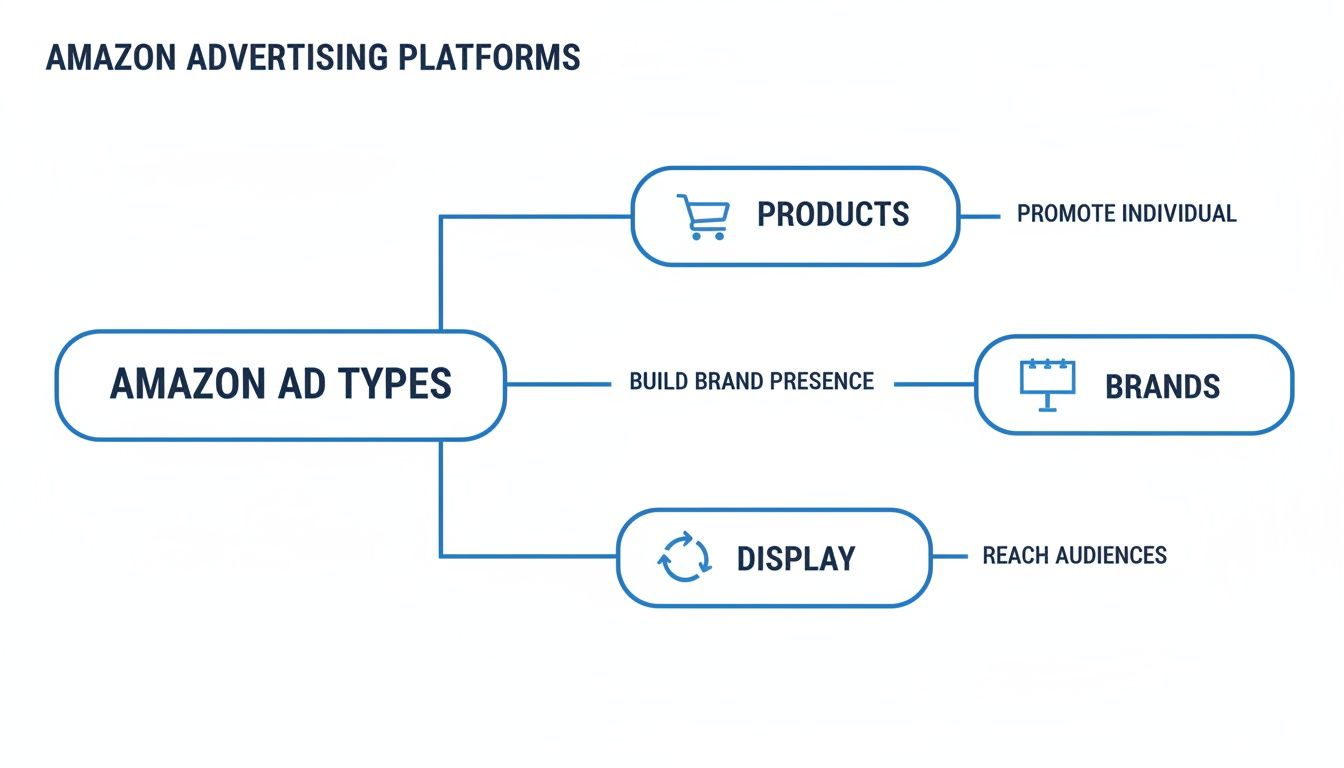
As you can see, a winning Amazon ad strategy involves using each tool—Sponsored Products, Sponsored Brands, and Sponsored Display—for the right job at the right time.
Mastering the auction dynamic is non-negotiable. Nailing relevance and targeting not only wins more placements but does so more profitably, forcing competitors to overspend just to keep up. For a deeper dive, our guide on how to bid on Amazon is packed with advanced techniques to maximize profitability.
Measuring Performance Metrics That Drive Profit
If your leadership reports are still centered on metrics like click-through rate (CTR), it's time to elevate the conversation. Tactical metrics are essential for campaign managers, but senior leaders need to understand business impact: Is this ad spend profitable, and is it driving sustainable growth?
To answer this, you must move beyond campaign-level vanity metrics and focus on KPIs that directly reflect bottom-line performance and overall marketplace health.
Moving From ACOS to Total ACOS
Every Amazon advertiser knows ACOS (Advertising Cost of Sale). But relying on it exclusively is dangerously myopic. It only measures sales directly attributed to an ad click, completely ignoring the critical "halo effect"—the lift your ads provide to your organic sales.
Enter Total Advertising Cost of Sale (TACOS). A far more insightful metric.
TACOS measures your total ad spend against your total revenue (paid + organic). It is the single best indicator of whether the Amazon flywheel is working in your favor.
Key Insight: If your ACOS is holding steady but your TACOS is trending down over time, you have undeniable proof that your ad dollars are boosting your organic sales. This is the sign of a healthy, scalable Amazon business.
A falling TACOS demonstrates you are building brand equity, not just renting traffic. For a deeper look, our guide on how to calculate TACOS will help you integrate this KPI into your strategic planning.
Gauging True Profitability With ROAS
While TACOS measures the health of your paid-to-organic ecosystem, Return on Ad Spend (ROAS) provides a clear, immediate read on profitability. It answers one simple question: "For every dollar I invest in ads, how many dollars in revenue am I generating?"
A higher ROAS signifies a more profitable campaign. It's the ideal metric for making real-time budget allocation decisions and assessing the direct financial return of specific campaigns or keywords. It cuts through the noise and connects spend directly to revenue.
Performance Metrics From Vanity to Value
This hierarchy clarifies which metrics matter for day-to-day optimization versus strategic, executive-level decision-making.
| Metric | What It Measures | Why It's Important for Leaders |
|---|---|---|
| Impressions & Clicks | Campaign reach and initial engagement. | A basic health check, but doesn't show business impact. Think of it as foot traffic, not sales. |
| Click-Through Rate (CTR) | The percentage of shoppers who click an ad after seeing it. | An indicator of ad relevance and creative effectiveness, but a high CTR doesn't guarantee sales. |
| ACOS | Ad spend as a percentage of ad-attributed sales. | A core campaign efficiency metric, but it misses the bigger picture of organic lift. |
| ROAS | Revenue generated for every dollar of ad spend. | A direct measure of profitability. Answers: "Is this ad investment paying off right now?" |
| TACOS | Total ad spend as a percentage of total sales (paid + organic). | The best indicator of long-term brand growth and the flywheel effect. Shows if ads are building sustainable momentum. |
| New-to-Brand (NTB) | The percentage of sales from first-time customers. | Proves that advertising is acquiring new customers and expanding market share, not just recapturing existing ones. |
As you move down the table, the strategic value increases. Impressions are a tactical starting point; TACOS and NTB are the KPIs that prove you're building a dominant, profitable brand.
Quantifying Growth With New-To-Brand Metrics
Are your ads merely recycling existing customers, or are they expanding your market share? Amazon’s New-to-Brand (NTB) metrics provide the answer.
This data reveals the percentage of your ad-attributed sales that came from first-time buyers. A high NTB rate is definitive proof that your sponsored ad on Amazon is winning new customers. This is especially critical in today's competitive landscape.
In 2025, the average CPC on Amazon has hit $1.12, and ACOS benchmarks are sitting between 25-36%. In an environment this competitive, proving you can acquire new customers efficiently is non-negotiable. Discover more insights about these competitive Amazon advertising stats to get a better feel for your performance goals. Tracking NTB justifies aggressive ad spend during product launches and validates that your brand is capturing new ground.
Advanced Strategies to Dominate the Marketplace
Mastering the fundamentals is table stakes. To join the top 1% of sellers, you must move beyond campaign management and adopt the mindset of a data scientist. This means leveraging advanced analytics to out-think, not just out-bid, your competition.
The standard ad console provides a rearview mirror. Advanced tools offer a predictive lens, enabling you to stop reacting to past performance and start engineering future outcomes.
Tapping into Customer Intent with Search Query Performance Data
For years, understanding pre-click customer behavior was a black box. Amazon’s Search Query Performance (SQP) data changes that. This is your direct line into the mind of your audience, revealing the exact search terms they use before they ever click an ad.
SQP provides impression, click, and conversion data for every search term that surfaces your products, both organically and paid. This is how you unearth high-conversion, low-competition keywords your competitors will never find with standard tools. You are no longer guessing customer language; you are observing it directly.
By weaponizing this data, you can:
- Identify emerging search trends before they become mainstream.
- Discover long-tail keywords that signal immediate purchase intent.
- Optimize product listings and ad copy with the precise vocabulary of your target customer.
Seeing the Full Customer Journey with Amazon Marketing Cloud
The customer journey is not linear. A shopper might see a Sponsored Brands ad on Monday, click a Sponsored Products ad on Tuesday, and finally convert after seeing a Sponsored Display ad on Thursday. Standard reporting fails to connect these dots. Amazon Marketing Cloud (AMC) does.
AMC is a secure, privacy-safe data clean room where you can join disparate datasets to build a holistic view of the path to purchase. It’s designed for brands ready to move beyond simplistic last-click attribution.
With AMC, the guesswork is gone. You can build your own attribution models to see how your video ads influence your search ads, measure the actual lifetime value of customers you bring in, and finally prove the ROI of those top-of-funnel campaigns that are so hard to track.
This is a strategic game-changer. It provides the evidence needed for intelligent budget allocation and proves the value of every touchpoint. Any modern sponsored ad on Amazon strategy at scale hinges on the deep insights available through AMC.
Building Your Brand Beyond Amazon with DSP
Sponsored Ads are brilliant for capturing existing demand on Amazon. But what about creating new demand? That is the role of the Amazon Demand-Side Platform (DSP).
DSP allows you to programmatically buy display, video, and audio ads to reach audiences across the web, on Amazon-owned properties like IMDb and Twitch, and on a massive network of third-party sites and apps.
This is your tool for strategic audience building and sophisticated retargeting. Re-engage past purchasers, target shoppers who viewed but didn't buy, or build lookalike audiences to find new customers who exhibit behaviors similar to your best ones. DSP fills the top of your funnel and ensures your brand remains top-of-mind from initial consideration to final purchase.
Turning Your Amazon Ad Data into Dominance
We've covered the mechanics, the metrics, and the advanced tools. The unifying principle is this: your sponsored ad on Amazon data is not just for reporting; it is the raw material for building a dominant market position.
Winning on Amazon is no longer about campaign management. It’s about executing a coordinated strategy where every ad dollar serves a purpose beyond the initial click. The concepts covered here are not isolated tactics; they are interconnected components of a growth machine. This is where you translate insight into an insurmountable competitive advantage.
From Data Points to Strategic Action
Success requires a paradigm shift. Move from reactively managing ACOS to proactively using data to answer strategic questions.
This performance-first approach is built on three pillars:
- Ads as a Catalyst for Organic Growth: Every ad-driven sale fuels the flywheel, directly boosting your product’s organic ranking. This creates a virtuous cycle that reduces long-term dependency on paid media.
- A Relentless Focus on Profitability: Move beyond surface-level stats. Metrics like TACOS and New-to-Brand sales reveal the true impact of advertising on your bottom line and market share, distinguishing between temporary wins and sustainable growth.
- The Advanced Analytics Edge: Tools like Search Query Performance (SQP) and Amazon Marketing Cloud (AMC) are no longer optional for serious brands. They provide the granular insights needed to understand the full customer journey and exploit opportunities your competitors cannot see.
The ultimate goal is to build a system where your advertising efforts compound. This creates market momentum that is incredibly difficult for competitors to disrupt. It requires a mindset shift from viewing ad spend as an expense to treating it as a strategic investment in your brand's future equity.
Your Partner in Performance
Navigating this complex ecosystem requires more than software. To translate raw Amazon ad data into market dominance, you need a partner who can connect the dots between ad formats, platforms, and analytics to build a cohesive, full-funnel strategy. The best AI tools for data analysis can provide a significant advantage, but human expertise is what turns data into decisions.
At Headline, we transform advertising data into your most potent competitive weapon. We architect strategies that deliver not just clicks, but profitable, defensible, long-term growth. We build the systems that enable your brand to stop reacting and start leading.
Frequently Asked Questions
Navigating Amazon advertising brings up critical questions. Here are concise, no-nonsense answers to the most common queries from brand leaders.
What Is a Good ACOS for a Sponsored Ad on Amazon?
There is no universal "good" ACOS. The right target is entirely dependent on your product's profit margin and your strategic objective.
For a new product launch, a high ACOS—even 40% or more—can be a strategic investment. You are buying data, initial sales velocity, and reviews to fuel the flywheel. For a mature, profitable product, the target ACOS will be significantly lower to maximize contribution margin.
A more strategic KPI is Total ACOS (TACOS). If your TACOS is decreasing over time, it’s a clear indicator that your ad spend is successfully lifting organic sales—the hallmark of a sustainable Amazon business.
How Long Until My Amazon Ads Are Profitable?
Plan for an initial investment period of 30 to 90 days. During this phase, the primary goal is data acquisition, not immediate profit. You are identifying converting keywords, optimizing bids, and understanding customer search behavior.
Sustainable profitability emerges as this initial ad-driven velocity begins to improve your organic rank. This flywheel effect—paid ads driving sales, which lifts organic rank, leading to more organic sales—is where true scale is achieved. Expect to see a clear trajectory toward profitability within the first quarter if the strategy is sound.
Should We Manage Amazon Ads In-House or Hire an Agency?
Managing a sponsored ad on Amazon in-house is viable, but many brands reach a ceiling where complexity outpaces internal bandwidth and expertise. The platform's constant evolution demands dedicated focus, and missteps can lead to significant wasted spend.
A specialized agency partner brings capabilities that are difficult to replicate internally:
- Deeper Analytics: Expertise in advanced platforms like Amazon Marketing Cloud (AMC) to uncover attribution insights beyond the standard console.
- Cross-Category Experience: An agency synthesizes learnings from dozens of brands, applying proven strategies and avoiding common pitfalls.
- Specialized Technology: They leverage sophisticated bid management, competitive intelligence, and data visualization tools that are often prohibitive for a single brand to license.
For brands serious about achieving market leadership, an expert partner provides the strategic horsepower required to accelerate growth and outperform the competition.
At Headline Marketing Agency, we turn your advertising data into your greatest competitive advantage. We build smart, scalable strategies that make your ad spend a true growth engine. Let's start building your marketplace dominance together.
Get Your Free Amazon PPC Audit
Discover untapped growth opportunities and see how our data-driven approach can improve your ROAS.
Get Free Audit →Ready to Transform Your Amazon PPC Performance?
Get a comprehensive audit of your Amazon PPC campaigns and discover untapped growth opportunities.