Native Ads vs Display Ads: A 2026 Amazon Playbook
Compare native ads vs display ads for Amazon sellers: learn how each format works, where to place spend, and how to pick the right mix for 2026.

36% of U.S. small-business sales on Amazon are driven by Amazon Ads, so the question isn't whether native ads or display ads “wins.” What matters is which format moves the exact business outcome you need right now.
If you keep judging both formats by CTR alone, you'll make bad budget decisions. Native and display do different jobs, and Amazon brands that scale profitably treat them as complementary tools inside one full-funnel system, not as substitutes.
| Format | Best job | Weak spot | Best KPI focus |
|---|---|---|---|
| Native ads | Attention, recall, shopping-intent capture | Disclosure risk, context mismatch | Detail-page views, new-to-brand sales, view-through impact |
| Display ads | Reach, retargeting, broad awareness | Lower engagement in some contexts | Incremental reach, assisted conversions, profit ROAS |
Why Format Choice Drives Sustainable Amazon Growth
A consumer brand can burn a lot of money on Amazon while still growing the wrong way. I've seen teams get excited about a cheap click rate, then realize later that they bought traffic that didn't improve ranking, didn't create repeat demand, and didn't support the next round of sales. That's why format choice matters. It shapes the type of demand you create, not just the cost of the click.
Amazon says 36% of sales generated by U.S. small businesses are driven by Amazon Ads, and that's the number that should anchor every format decision. If ads are already driving that much business, then the job is not to pick the flashiest unit. The job is to allocate the right format to the right stage of demand so paid media supports both immediate sales and the organic lift that comes after it. Amazon Ads for small businesses
The wrong question is “which is better”
Native ads vs display ads is a poor question if you care about scale. Native is better when the buyer needs continuity, context, and a reason to read. Display is better when the job is reach, reminder, and retargeting. That split matters because one format can introduce your product while the other can keep it in front of a shopper until they're ready to act.
Practical rule: Judge the format by the outcome, not the label.
That's the core Headline view of Amazon PPC. Paid media should support profitability, organic growth, and sustainable scale, not just produce a pretty ACOS screenshot. Low ACOS means very little if the campaign doesn't create branded search, improve product visibility, or help you hold share in a category that's getting more competitive by the month.
What this changes in practice
If you're launching, native can help you meet shoppers inside a relevant browsing moment. If you're defending a category, display can keep your brand visible while retargeting people who already showed intent. If you're trying to grow long term, you need both. One creates attention and memory, the other creates reach and repetition, and the win comes from sequencing them with discipline.
Many Amazon teams get stuck here. They compare native and display like they're interchangeable banners. They aren't. They behave differently in the funnel, they need different measurement, and they influence different parts of the customer journey.
Native Ads and Display Ads Defined for Amazon
Amazon's own distinction is straightforward. Responsive e-commerce ads use product information such as ASIN details, headlines, descriptions, and images to generate in-feed native or size-responsive placements that send shoppers to a product-detail page. Standard display ads are image-based units that show across desktop, mobile, apps, and publisher websites, which makes them better suited to broad reach and retargeting. Amazon ad format guidance
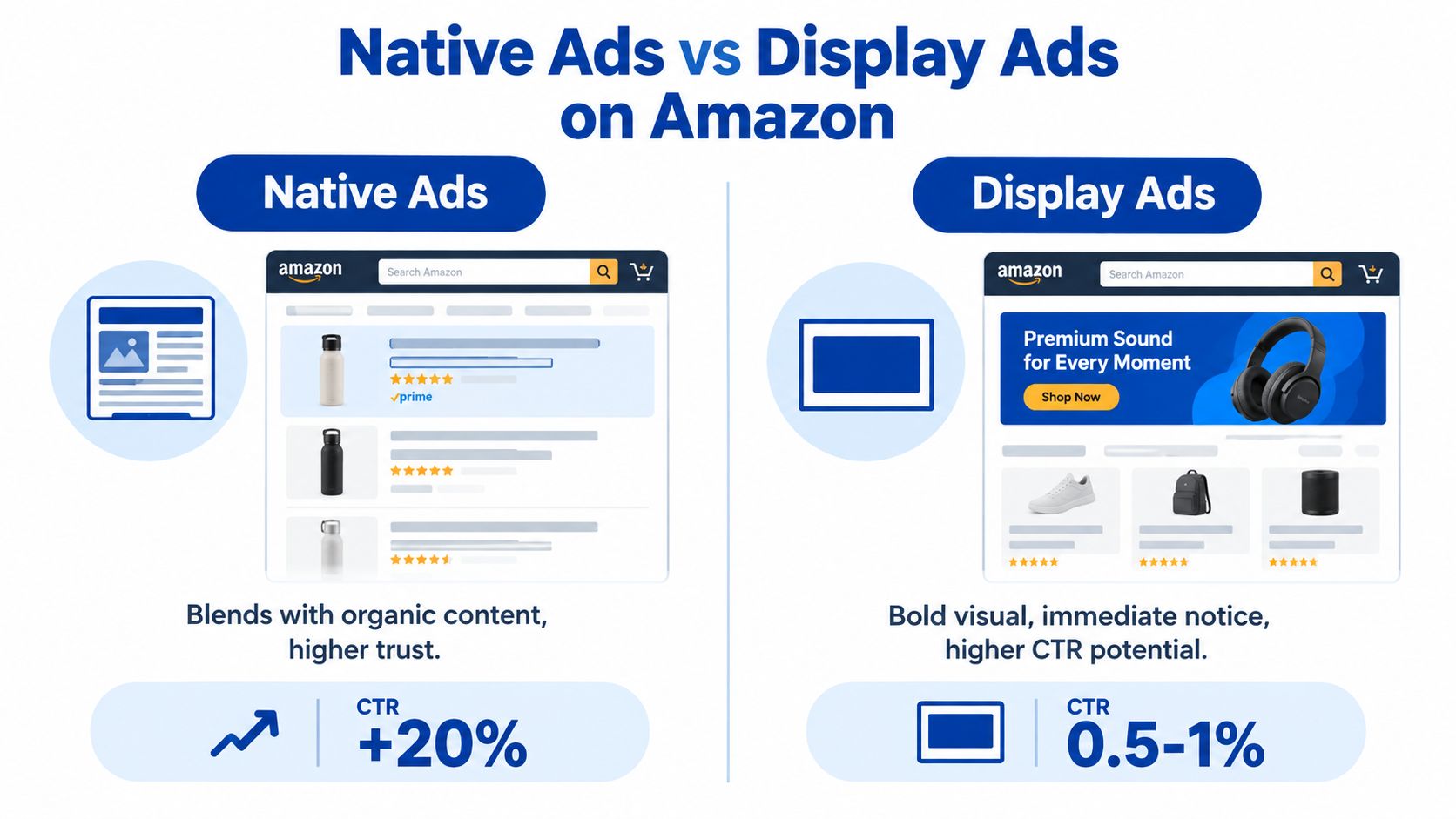
Native blends, display stands out
Native ads borrow the surrounding environment's look and feel. On Amazon and across the broader ad ecosystem, that usually means in-feed placements, recommendation widgets, or adjacent placements that feel like part of the browsing flow. Display units do the opposite. They're meant to be noticed as ads, which is exactly why they're useful for reach, repetition, and remarketing.
That distinction is not cosmetic. It affects shopper behavior. Native is strongest when the person already has some level of intent or curiosity. Display is stronger when the audience needs a reminder, a visual cue, or a reason to come back.
Native vs display placements on Amazon
| Placement Type | Creative Structure | Shopper Context |
|---|---|---|
| Native in-feed | ASIN-led, headline, image, product details | Shopper is scrolling or browsing content |
| Native recommendation widget | Product-led recommendation unit | Shopper is near an article, feed, or related content area |
| Standard display banner | Fixed image-based creative | Shopper is on a site, app, or publisher page and sees a clear ad unit |
| Retargeting display | Image-based or dynamic unit | Shopper has already visited, viewed, or engaged and needs a reminder |
That table is the simplest way to stop treating the two formats as the same thing. Native is usually the better answer when you want to match the surrounding shopping moment. Display is usually the better answer when you want scale, retargeting, or stronger visual separation.
If you're also evaluating retargeting alternatives worth testing, keep that lens in mind. The channel matters less than whether the format fits the job.
Native isn't a prettier banner. It's a different buying mechanism with a different user expectation.
Targeting, Measurement, and Buying Mechanics Compared
Native and display require separate optimization systems. Applying one scorecard to both formats overvalues clicks and hides the actions that create sustainable Amazon growth. Native earns attention and recall, while display expands reach, reinforces consideration, and brings previous visitors back.
Amazon says display advertising can be purchased on cost-per-click or cost-per-thousand viewable-impression pricing, with no minimum spend for self-service campaigns. Managed-service campaigns typically require at least $50,000, although the threshold varies by country. Amazon also notes that native display inventory can support share-of-voice, rotational-media, and auction buying through CPM, CPC, and cost-per-action models. See Amazon display and native buying options for the available mechanics.
Measure the funnel, not the format
| Funnel Stage | Native Metrics | Display Metrics |
|---|---|---|
| Awareness | Engaged attention, detail-page visits | Incremental reach, viewability |
| Consideration | Add-to-cart rate, detail-page-view rate | Assisted visits, re-engagement |
| Business impact | New-to-brand sales, profit ROAS, organic movement | Incremental conversions, contribution margin |
Use native metrics to assess whether creative moves shoppers deeper into consideration. Use display metrics to assess reach, remarketing, and assisted demand. A weak display click rate does not prove failure. The ad may influence a later purchase through search, an organic listing, or a direct return visit.
Best practice: Separate click-through from view-through before deciding what to cut.
Amazon DSP makes this distinction especially important. A shopper can see a display unit, return later, and purchase through another path. Last-click reporting may miss that contribution, so budget decisions based only on clicks can remove media that supports conversion. For a clear explanation of that measurement logic, use this Amazon view-through conversion guide.
Brands assessing how Amazon DSP campaigns integrate with native and display strategy should set attribution rules before launch. Define the role of each format, then compare results against that role rather than forcing both into the same conversion report.
Buying mechanics change the decision
Display offers more buying options, which demands tighter control. CPC and CPM shape the performance question. A reach campaign should not be judged only by last-click results, while an action campaign should not receive credit for impressions alone.
ACOS is not the master metric for Amazon brands. Profitability depends on media cost, downstream conversion, assisted demand, and organic effects. Set native targets around attention and consideration, and set display targets around scalable reach, re-engagement, and incremental business value.
Performance Trade-offs and Hidden Risks
Native often wins attention, but that advantage does not make it the better channel for every Amazon objective. Industry research found that consumers looked at native ads 53% more frequently than standard display ads. 32% of respondents said they would share a native ad, compared with 19% for a display ad. Benchmark summaries also commonly place native click-through rates around 0.20% to 0.50%, versus roughly 0.05% to 0.35% for standard display. Those figures explain native's engagement reputation, not its ability to produce profitable sales. Native advertising statistics and benchmarks
Attention helps, but disclosure can kill it
Native carries a trust risk that Amazon sellers cannot ignore. A 2025 eye-tracking and interview study of 152 participants found that sponsored posts received significantly less dwell time and fewer fixations than organic posts, despite their native appearance. The same study found that 24 of 31 tested effects were statistically significant, while disclosure labels or calls to action often triggered rapid dismissal. Eye-tracking study on native disclosure effects
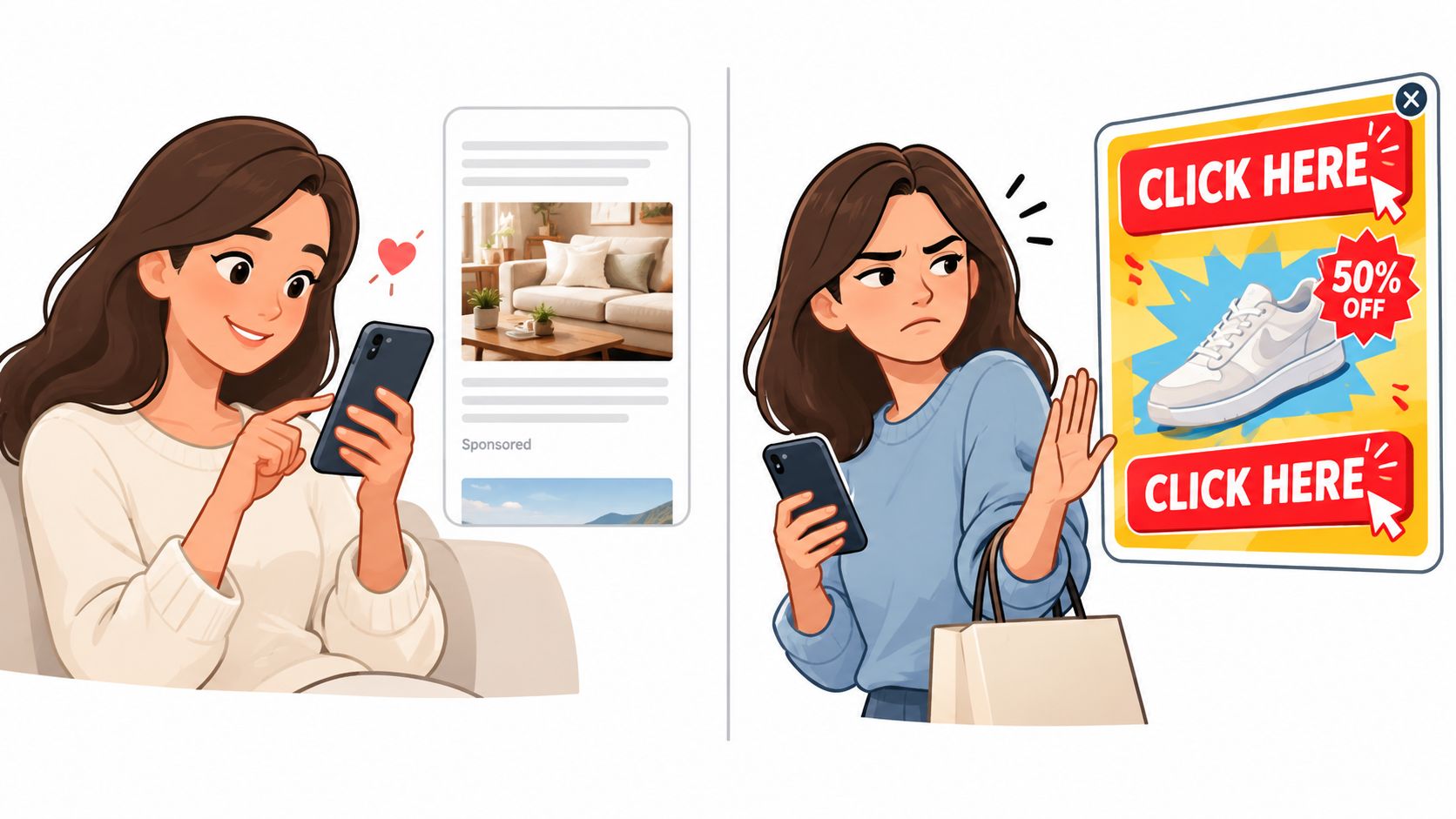
For an Amazon seller, the failure mode is easy to see. A shopper encounters an in-feed product recommendation that resembles editorial content, then notices a sponsorship label after clicking. If the product detail page does not match the ad's implied review or discovery context, the shopper may leave before adding to cart. That disclosure confusion can lower conversion even when the placement earns strong attention.
Lazy execution, not the format itself, undermines native performance. Make the sponsorship signal clear, align the creative with the product detail page, and set expectations the listing can fulfill. Native should earn attention and recall. Display should extend reach and reinforce demand. Judge each against its causal role rather than forcing both into one click score.
Native and display both need testing discipline
Mobile native has shown strong upside in effectiveness studies, but the result is not a universal benchmark. The cited industry report says native performed as much as 10 times better than mobile display at comparable frequency. Treat that figure as a study-specific upper bound, then test the placement, audience, and creative against Amazon outcomes. Mobile native advertising guidance report
Use a scorecard that separates attention, recall, attitude, reach, clicks, and sales. Include view-through and downstream orders, since a shopper may return through another path. Amazon's view-through conversion guide explains why click-only reporting can miss assisted demand.
Run controlled tests with matched audiences. Native may create stronger memory, while display may scale exposure and reinforce consideration. The profitable choice depends on which role improves the account's next business outcome.
When to Use Native Ads Versus Display Ads on Amazon
A useful comparison from controlled research is this. Native tends to generate more consumer gaze and stronger brand memory, while display can do a better job lifting brand attitude. That means native is usually the better choice for attention and recall. Display is usually the better choice for scalable reach and reinforcement. The formats aren't interchangeable, and the funnel role matters more than the aesthetic. Native vs display experimental findings
Match the format to the job
Use native ads when you want to capture shopping intent, drive product-detail traffic, or place a product inside a contextually relevant discovery moment. Use display ads when the job is audience expansion, remarketing, or broad awareness that needs visual separation from the page.
Amazon also expanded placement controls in late 2024, including above- versus below-the-fold options for display and video, plus native environments such as in-feed, in-article, and recommendation widgets. Those aren't just technical toggles. They're strategic levers. The same creative can perform very differently depending on whether you place it where attention is already warm or where it has to earn the whole interaction.
Campaign objective to format matching guide
| Campaign Goal | Recommended Format | Key Placement |
|---|---|---|
| Launch a new SKU | Native | In-feed and recommendation-style placements |
| Drive broad awareness | Display | High-visibility publisher and app inventory |
| Re-engage shoppers | Display | Retargeting across web and mobile |
| Capture active consideration | Native | Product-led placements near related content |
| Defend a category | Both | Native for depth, display for repetition |
If you're planning broader Amazon media, Amazon display advertising is the cleaner path when your objective is audience reach and retargeting. Native is the cleaner path when you need the shopper to keep moving toward the product page without the impression of a hard break in the experience.
Don't force one format to do both jobs. That's how budgets drift into vanity metrics.
Use this decision logic
- If the goal is discovery, choose native first.
- If the goal is retargeting, choose display first.
- If the goal is full-funnel growth, run both with separate KPIs.
- If the goal is organic lift, measure the post-click and post-view path, not just the click.
That's the practical answer. Native and display are complementary instruments. The best Amazon programs use each where it naturally wins, then connect them inside one media plan.
Building a Profitable Multi-Format Amazon Advertising Strategy
The cleanest way to run this is simple. Test native and display with identical audience definitions, bid constraints, landing destinations, and attribution windows. If you change too many variables at once, you won't know which format drove the lift. That's how brands end up scaling the wrong thing.
Amazon says its display ads can drive a 47% average increase in non-Amazon sales for brands using Amazon display ads, compared with 23% for brands using sponsored ads. That's a strong reminder that Amazon media can support demand outside the marketplace too, not just the last click inside it. Amazon Ads success guide
A practical operating model
Start by separating direct-response efficiency from broader demand creation. Then look at assisted conversions, repeat purchase behavior, and contribution margin alongside ROAS. If a campaign creates branded search and later organic sales, that's real value even if the immediate ad dashboard looks modest.
For teams building a broader retail-media system, this multi surface product visibility guide is useful context because the same product can win in different placements for different reasons. That's the mindset you need here too. Placement, not just platform, shapes outcome.
What to do next
- Run one native test and one display test against the same product family.
- Hold the audience constant so the format, not the targeting, explains the result.
- Track view-through and assisted conversions before you cut anything.
- Check new-to-brand behavior and repeat purchase, not just ACOS.
- Use the winner by objective, then keep the other format active where it adds a different kind of value.
The right recommendation is not native or display. It's native and display, used for different causal roles in the funnel and measured with a scorecard that respects profitability, not vanity metrics.
Headline Marketing Agency builds Amazon PPC and DSP programs around profitability, organic growth, and long-term scale, not just ACOS. If you want a media plan that uses native and display with discipline, visit Headline Marketing Agency and see how their team approaches Amazon growth with full-funnel measurement.
Get Your Free Amazon PPC Audit
Discover untapped growth opportunities and see how our data-driven approach can improve your ROAS.
Get Free Audit →Ready to Transform Your Amazon PPC Performance?
Get a comprehensive audit of your Amazon PPC campaigns and discover untapped growth opportunities.