Multiple Amazon Accounts: What Is Allowed in 2026
Learn when Amazon allows multiple Amazon accounts, what must stay separate, and how verification works to avoid losing every account at once.

Amazon generally allows one Seller Central account per selling region, and a second account requires a documented legitimate business need with every account in good standing.
The popular advice to open extra storefronts for growth or protection gets the decision backward. Multiple Amazon accounts are a business-structure decision, not a substitute for better advertising or an insurance policy against suspension. Brand leaders should ask whether another account reflects a distinct business, then weigh the extra compliance burden against the operational benefit.
When Amazon Allows Multiple Seller Accounts
Amazon's default is one Seller Central account per seller in each selling region; its Seller Code of Conduct permits another account when there's a legitimate business need and all accounts remain in good standing.
The important word is business. Amazon's examples concern distinct brands and businesses, manufacturing relationships, or participation in a program that requires separate accounts. They don't turn administrative convenience into a valid reason to duplicate a storefront.
Use this comparison to separate a defensible structure from a growth experiment.
| Situation | Status | Evidence to Keep |
|---|---|---|
| Several distinct brands owned by one company | Permitted with documented business need | Brand ownership records and entity documents |
| Separate legal entities or businesses | Permitted with documented business need | Company registration and ownership records |
| Manufacturing for two unrelated companies | Permitted with documented business need | Contracts with both companies |
| Joining an Amazon program that requires a separate account | Permitted when the program requires it | Program requirement from Amazon |
| Splitting one catalog to compare performance | Not permitted as a standalone reason | Not applicable |
| Same brand in a new region | Judged within that regional store | Regional registration and compliance record |
| New account after a violation or deactivation | Restricted; can deactivate related accounts | None; resolve the original issue first |
Business separation must exist before account separation
Say a parent company owns a cookware brand and a specialist industrial-supply business. Different ownership records, product portfolios, operating teams, and commercial obligations can support a coherent explanation for separate accounts.
Compare that with a cookware seller who wants another account to compare advertising results across identical products. That's a testing problem. Solve it through campaign design, reporting, and controlled experiments, not duplicate seller identities.
A regional expansion also needs its own registration and compliance assessment. Don't confuse entering another selling region with permission to create additional accounts wherever the business already operates.
Before proceeding, answer these questions:
- Separate business or brand: Does the proposed account represent a distinct commercial operation?
- Documented rationale: Can you prove that distinction through ownership, registration, contracts, or program records?
- Healthy existing operations: Is every existing account in good standing?
If any answer is no, stay with the current account structure. The burden is to explain why the business needs separation, not why another dashboard would be convenient.
What Each Account Must Keep Separate
| Setup Element | Requirement | Why It Matters |
|---|---|---|
| Email address | Unique to each account | A shared inbox ties accounts together |
| Credit card | Separate for each account | A shared card links the businesses |
| Bank account | Separate within the same region | Same-region duplicates are refused; cross-region sharing needs Amazon Global Selling |
| Product scope | Different products and services in each account | Overlapping catalogs undermine the case for a second account |
| Performance | Each account in good standing | One weak account can affect the others |
Amazon's published multiple-account exception guidance specifies separate email addresses, credit cards, and bank accounts, distinct products and services, and good performance standing. It also distinguishes same-region banking separation from cross-region sharing through Amazon Global Selling.
Use the setup checklist to catch convenience-driven shortcuts before registration.
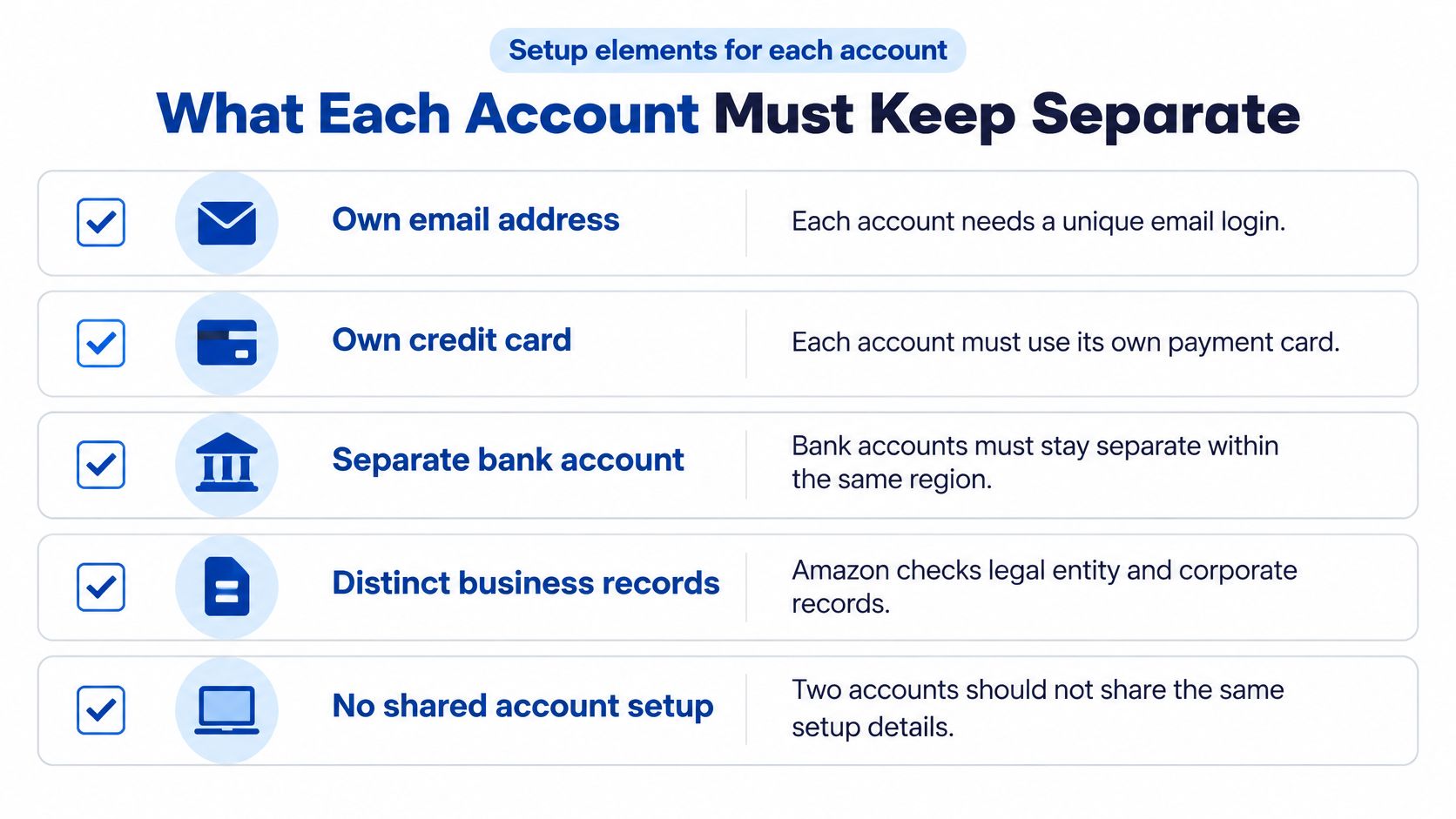
The common mistake is reusing an existing payment card or contact detail because finance already has it on file. That leaves the seller trying to explain a supposedly separate operation through records that haven't been prepared to support it.
Separation doesn't mean concealing common ownership. Keep ownership accurate, explain legitimate shared infrastructure, and distinguish the account-specific elements Amazon requires.
Prepare the account file before registration
Build a working file that an operations leader, finance manager, and compliance reviewer can all understand:
- Map the entity: Identify the legal business responsible for the account and explain any common ownership.
- Match the money: Record the account's payment card, settlement bank account, and supporting financial documents.
- Define the catalog: Write down which products and services belong to the proposed account.
- Record inventory ownership: Identify who owns the stock and which operation handles fulfillment and returns.
- Store the evidence: Keep registration records, brand documents, financial records, and the business rationale together.
Don't let the setup drift after launch. A replacement card, new bank account, or expanded catalog should trigger a check against the documented structure.
A clean file isn't immunity from review. It gives the business a consistent, evidence-based explanation when Amazon asks how the accounts operate.
How Amazon Verifies Who Owns Each Account
Amazon verifies identifiable people and businesses, not anonymous storefronts. Its identity-verification guidance calls for business and primary-contact information, government-issued photo identification, and, where applicable, financial statements and a business license.
Prepare the records as a connected ownership file, rather than a collection of unrelated uploads.
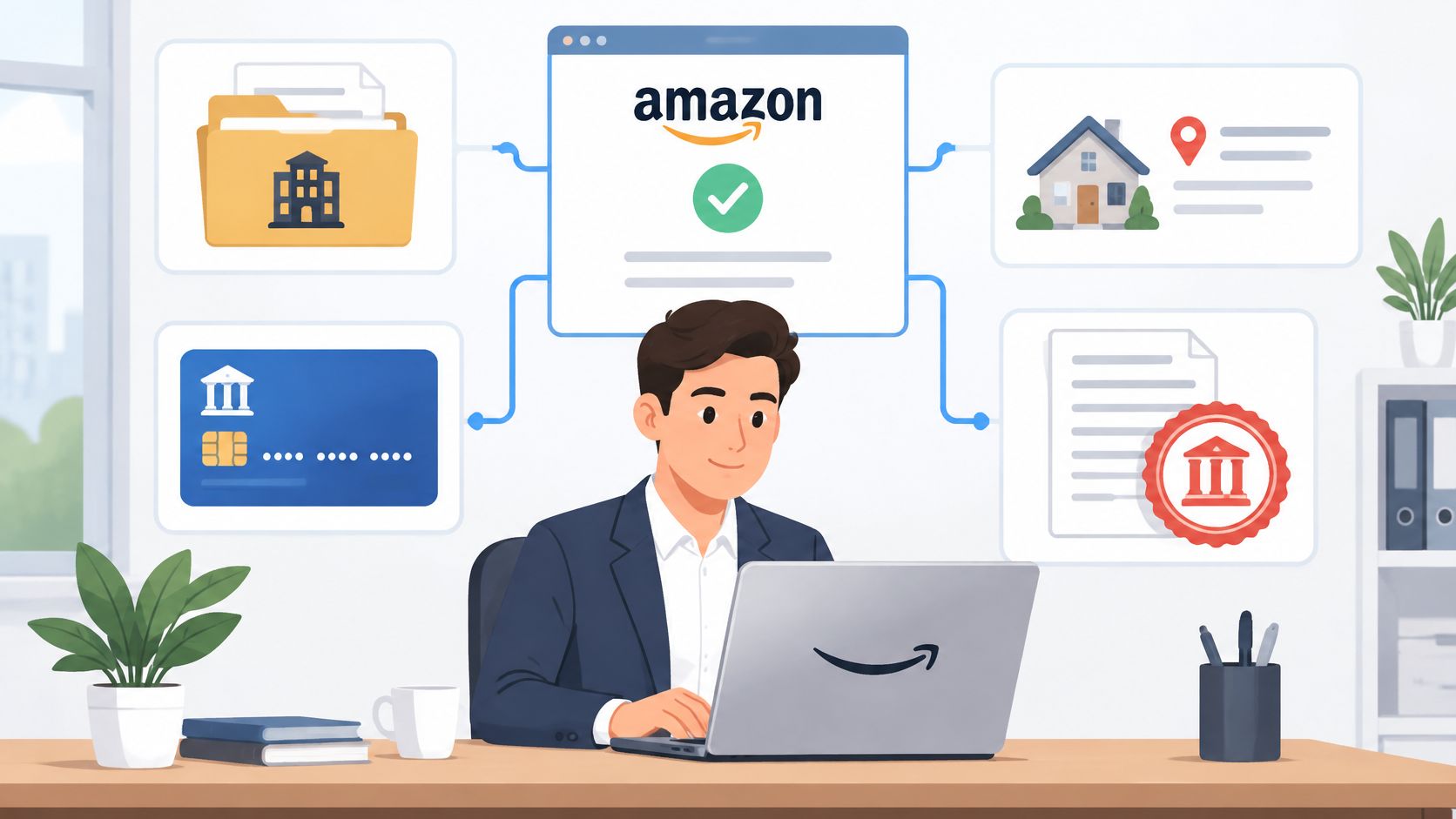
Global verification can also require proof of address, beneficial-owner information, business documents, tax or VAT records, and an official registry extract showing an active business. The practical implication is straightforward: names, addresses, ownership, and financial records must tell the same story.
Follow a consistent document sequence
- Gather the legal identity. Start with the exact registered business name and registration number. Use those details consistently in account records.
- Check the primary contact. Confirm their photo ID is current and their name and authority are consistent with the business documentation.
- Reconcile address and tax details. Resolve differences between the registry extract, proof of address, and tax records before submission.
- Prepare financial statements. Supply bank or card statements in the appropriate business name where Amazon requests them.
- Maintain verification after changes. Re-verify information when account details change, rather than treating registration as a completed administrative task.
Use the verification walkthrough alongside the document checklist.
Expired identification, mismatched legal names, and unclear beneficial ownership create avoidable delays. Don't upload another version of a document until you've identified the discrepancy it's supposed to resolve.
Practical rule: Maintain a coherent verified record for each legal entity. Document separate businesses as separate businesses, not as disconnected identities.
How One Account Problem Reaches Every Account
A separate brand name does not erase the operational links between storefronts. Shared phone numbers, business addresses, email addresses, IP addresses, and financial details can connect accounts. If one account faces enforcement, related accounts may also be affected.
Connections can also come through employees, service providers, shared access, or global-selling arrangements. Separate logins and browser profiles do not make a shared business relationship disappear. The right standard is straightforward: every connection should be authorized, accurately recorded, and explainable.
A realistic access problem
A former employee still has access to an old seller account and signs in from the office network. The current team knows its active brand accounts, but has not recorded the employee's history with the older business.
If that old account develops an enforcement problem, the team must establish who owns it, who controls access, and whether the relationship ended. Different browser profiles cannot answer those questions.
Resolve the account issue before trying to open or operate another storefront. If an account is suspended, use this guide to handling an Amazon seller account suspension to organize the investigation. Keep records that explain any change in ownership or access, such as relevant business-transfer documents or contract terminations.
Don't try to make a real relationship invisible. Make it accurate, authorized, and explainable.
Assign a named owner to each account. Keep a central register of the people, devices, and payment methods connected to it, then review access regularly. Remove access that is no longer authorized and record legitimate changes.
Product-level checks matter too. Teams selling printed merchandise can check merch trademarks with Trendlytic as part of their screening workflow. Treat a tool result as a screening aid, not legal clearance.
Portfolio Risk Versus Growth Benefit
| Option | Benefit | Main Risk | Verdict |
|---|---|---|---|
| One account for all brands | One health score and one compliance process | Shared enforcement risk across the catalog | Default choice unless a business need is documented |
| Two accounts for distinct brands or entities | Clear separation for real businesses | Duplicated compliance, banking, and access controls | Permitted with documentation |
| Second account after an enforcement notice | No legitimate benefit as an enforcement workaround | Can deactivate related accounts | Avoid |
| Old or forgotten account still linked | None | Hidden shared risk across linked accounts | Resolve issues and close if appropriate before expansion |
Separate accounts don't automatically create redundancy. Amazon's enforcement guidance describes consequences across related accounts, including deactivation, listing cancellation, or suspended payments, and warns against opening another account to avoid a violation.
Compare the operating benefit with the additional responsibility before committing.
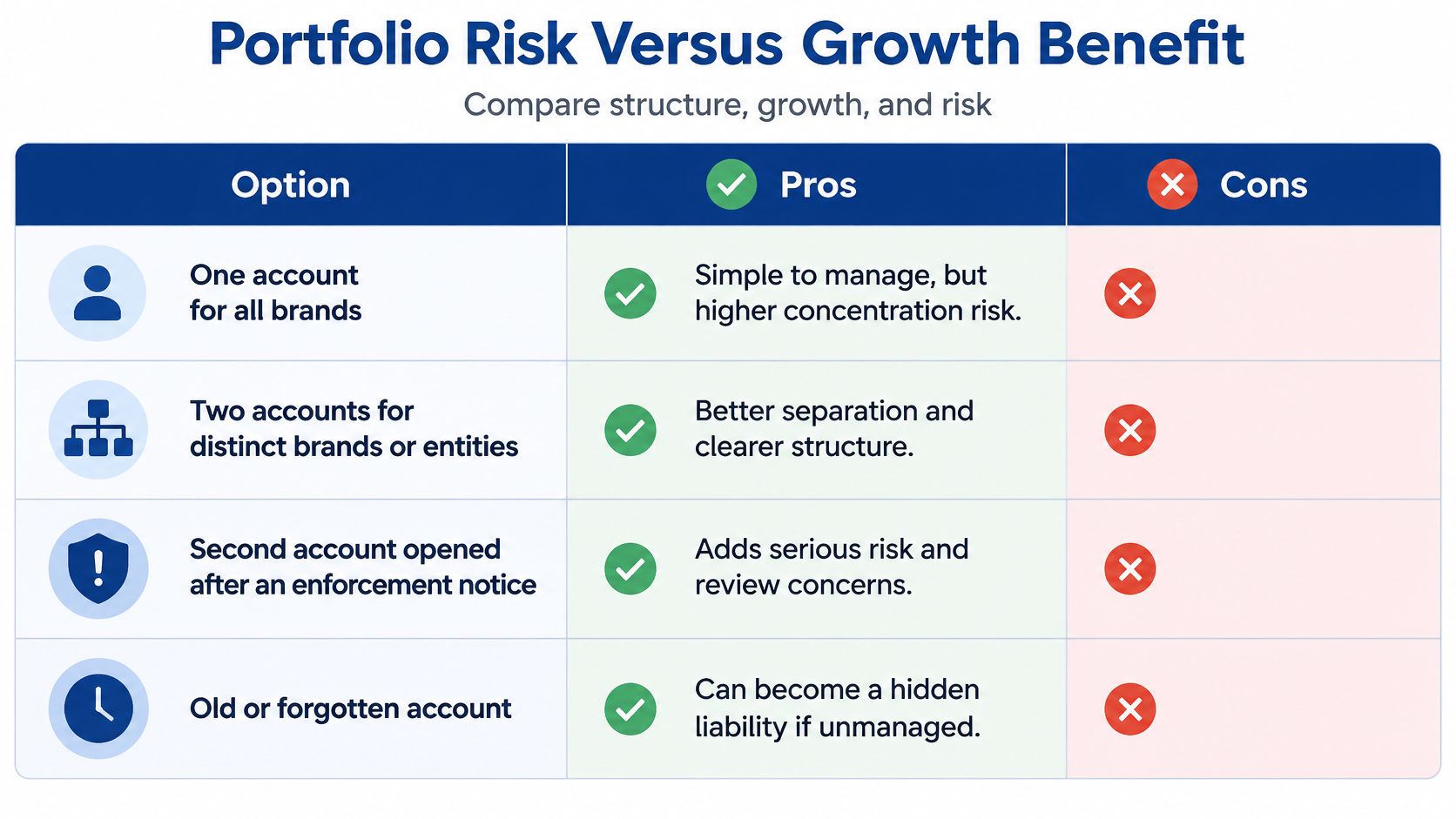
For distinct businesses, separation can clarify brand ownership, catalog responsibility, and performance reporting. A dedicated team can make decisions without blending another business's inventory or commercial priorities into its reporting.
The cost is duplicated compliance, inventory reconciliation, tax administration, identity maintenance, and customer-service processes. Leadership must fund those responsibilities, not just authorize another login.
Growth needs a different decision test
Headline's position is that PPC should support organic visibility, profitability, and sustainable scale, rather than serve as a reason to multiply accounts. Another storefront rarely fixes campaigns with confused objectives, weak product relevance, or budgets disconnected from margin.
That's a mechanism-based recommendation, not a promise of a ranking lift. Better query selection and stronger product-page relevance give the team a testable route to improving conversion economics within the existing business.
International expansion adds another concern: forgotten or previously deactivated regional stores can remain relevant to newer operations. Review the full regional footprint before approving expansion, including stores nobody currently manages.
The verdict: open another account for a documented distinct business that the team can govern. For growth alone, keep the existing structure and improve the advertising and retail operation.
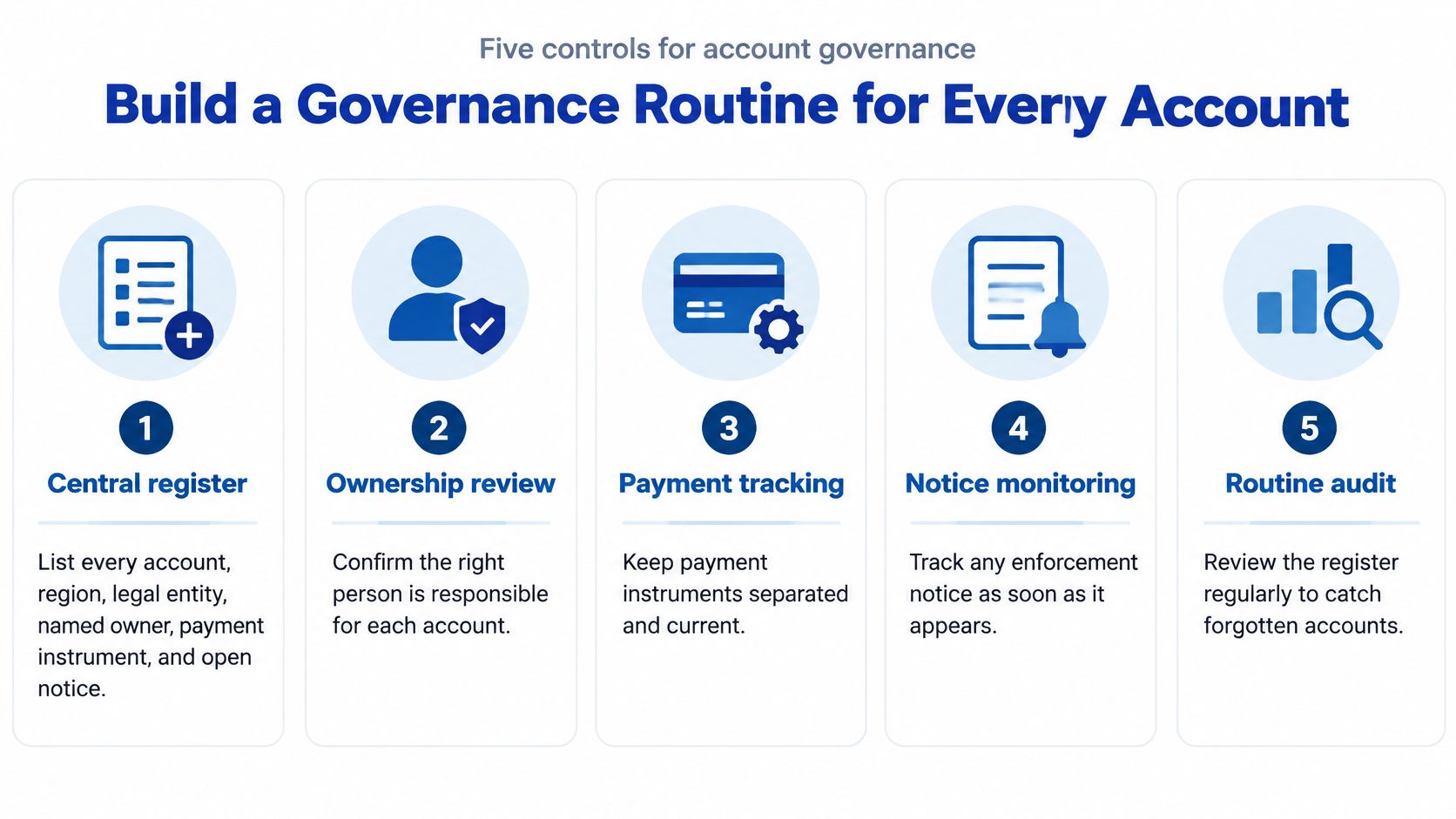
Build a Governance Routine for Every Account
Account governance needs an owner and a recurring schedule. A policy document nobody checks won't catch an expired payment card, a departed contractor, or a notice sitting in an abandoned regional store.
Use this routine to make responsibility visible.
Make the controls operational
Keep a central register. List every account, region, legal entity, named owner, payment instrument, and open notice. Include dormant stores so leadership can see the entire footprint, not just accounts generating revenue.
Assign responsibility in writing. Each account needs an accountable owner who checks health, documentation, and unresolved actions. Make reassignment part of employee departures and acquisitions so responsibility doesn't disappear with a person's access.
Run quarterly access reviews. Remove unused users and recheck agency, contractor, and virtual-assistant permissions. Compare actual permissions with current responsibilities, and track payment instruments for separation, validity, and authorized use.
Use a shared escalation path. Route enforcement notices to the accountable owner and a central compliance lead as soon as they arrive. Pause expansion decisions until the team understands the issue and has a documented resolution plan.
Block workaround account creation. Don't create another account while a related account is impaired. Require the person approving any new registration to check the register and confirm that unresolved enforcement isn't driving the request.
These are management controls, not a claim that Amazon mandates this particular review schedule. Choose clear deadlines and retain evidence that the reviews happened.
Require the same transparency from agencies
Require an agency-access register showing which people and systems touch each account, what permissions they hold, and how account data is used. Check that record during onboarding, personnel changes, and contract termination.
At Headline, we use Amazon data solely for campaign management, performance analytics, and client reporting, and comply with Amazon's Data Protection Policy and Acceptable Use Policy. Access and data handling should be explicit, not assumed.
Use a documented Amazon account management process to connect commercial decisions with access control, notice monitoring, and ownership changes. The outcome should be simple: leadership can identify who is responsible for any account without reconstructing its history during an incident.
Buyer Accounts and Shared Household Use
Buyer accounts require a separate decision from Seller Central accounts. Don't apply a seller-account exception to personal shopping, household sharing, or company purchasing.
A shopper account uses the account holder's email and payment details. For company purchasing, Amazon Business is the purpose-built option to evaluate, including its team purchasing, approval, and invoicing capabilities, rather than distributing purchases across extra personal accounts.
Separate ordinary use from manipulation
Several people buying for the same household is an ordinary purchasing situation. Creating additional accounts to manufacture reviews, repeatedly claim first-order offers, or bypass promotion eligibility is different.
Use these boundaries when deciding how to organize purchases:
- Household shopping: Use Amazon's available household-sharing arrangements and check current eligibility before relying on shared benefits.
- Company buying: Evaluate Amazon Business and configure purchasing responsibilities around the organization's needs.
- Reviews and promotions: Don't use additional identities to inflate feedback or repeat benefits intended for eligible customers.
Review and promotion manipulation can lead to removed reviews and account restrictions. A different email address doesn't make a coordinated purchasing or review scheme legitimate.
Keep purchasing arrangements easy to explain. If the setup only works because Amazon supposedly won't connect the participants, don't build it.
Review subscriptions separately
If the problem is duplicate subscription spending, fix the subscriptions rather than inventing another account arrangement. Compass+ explains how to cut recurring costs by canceling Prime, which is a more direct response to unused membership costs.
Check Amazon's current Conditions of Use, review policies, promotion terms, and household eligibility before relying on a buyer-side setup. Don't assume that a sharing feature, benefit, or purchase workflow applies identically across regions or remains unchanged.
Audit the Account You Have Before Opening Another
Audit the account already under your control before considering another. Start by testing whether the constraint is campaign structure, product-page relevance, inventory readiness, or contribution margin.
Sponsored campaigns can help identify which search terms attract buyers who convert. Use those findings to refine targeting and improve the relevance of the product pages receiving the clicks, while reducing spend on terms that don't support the commercial objective.
Diagnose the constraint with operating data
Use Search Query Performance to examine query-level visibility and purchasing behavior. Combine it with Amazon Marketing Cloud insights where appropriate to investigate advertising interactions, rather than relying on a campaign's reported return alone.
Look for these warning signs:
- Concentrated exposure: A narrow group of ASINs receives most impressions while relevant long-tail queries remain untested.
- Spend without broader progress: Advertising expenditure rises without a corresponding improvement in the organic visibility you're tracking.
- Misleading efficiency: An acceptable advertising cost of sales hides weak profitability after product costs and Amazon fees.
These are reasons to investigate, not automatic proof that advertising caused a particular organic outcome. Check stock availability, pricing, promotions, and listing changes before attributing movement to PPC.
For example, a brand may keep increasing bids on established terms while leaving relevant category queries unexplored. A controlled discovery campaign, a clear budget boundary, and product-level margin reporting offer a better test than opening another seller account.
Keep control while improving performance
Clients keep full ownership of their Amazon accounts, product listings, and advertising assets. They can revoke API access at any time through their Amazon account settings.
Headline offers a free comprehensive audit of current Amazon PPC campaigns to assess whether campaign structure is holding profit back. Use that review to identify the next operational test before introducing another account and its compliance obligations.
Headline Marketing Agency helps brands improve Amazon advertising with profitability, organic visibility, and sustainable growth as the decision criteria. Before adding another seller account, visit Headline Marketing Agency to request a campaign audit and identify what you can improve within the business you already operate.
Get Your Free Amazon PPC Audit
Discover untapped growth opportunities and see how our data-driven approach can improve your ROAS.
Get Free Audit →Ready to Transform Your Amazon PPC Performance?
Get a comprehensive audit of your Amazon PPC campaigns and discover untapped growth opportunities.