7 Million Dollar Sellers and Their Growth Lessons
Explore 7 million dollar sellers and communities shaping Amazon growth, with practical lessons on PPC, profitability, product-market fit, and scale.


Revenue alone doesn't explain why some Amazon brands reach seven figures while others stall. The popular advice, launch a product, optimize keywords, and increase ad spend, ignores the operating system behind durable growth. The strongest million dollar sellers combine product-market fit with disciplined execution across advertising, content, inventory, measurement, and peer learning.
Marketplace Pulse data shows the competitive shift clearly. Sellers generating at least $1 million annually grew from approximately 60,000 in 2021 to more than 100,000 in 2025, even as the broader active-seller population declined from about 2.4 million to 1.9 million, according to Marketplace Pulse reporting on Amazon's million-dollar sellers. More brands reached the milestone, but success became more concentrated among operators with stronger systems.
The communities and platforms below are useful for different reasons. Each strengthens a specific lever, from peer intelligence and Amazon execution to operational systems, tactical education, networking, or integrated tooling. The common thread is Headline's view of PPC. Advertising isn't only an ACOS exercise. It can capture profitable demand, improve organic visibility, and help a brand scale without buying revenue blindly. If you're deciding between private label and white label, the same principle applies: the model matters less than the quality of the operating decisions around it.
1. MDS, Million Dollar Sellers
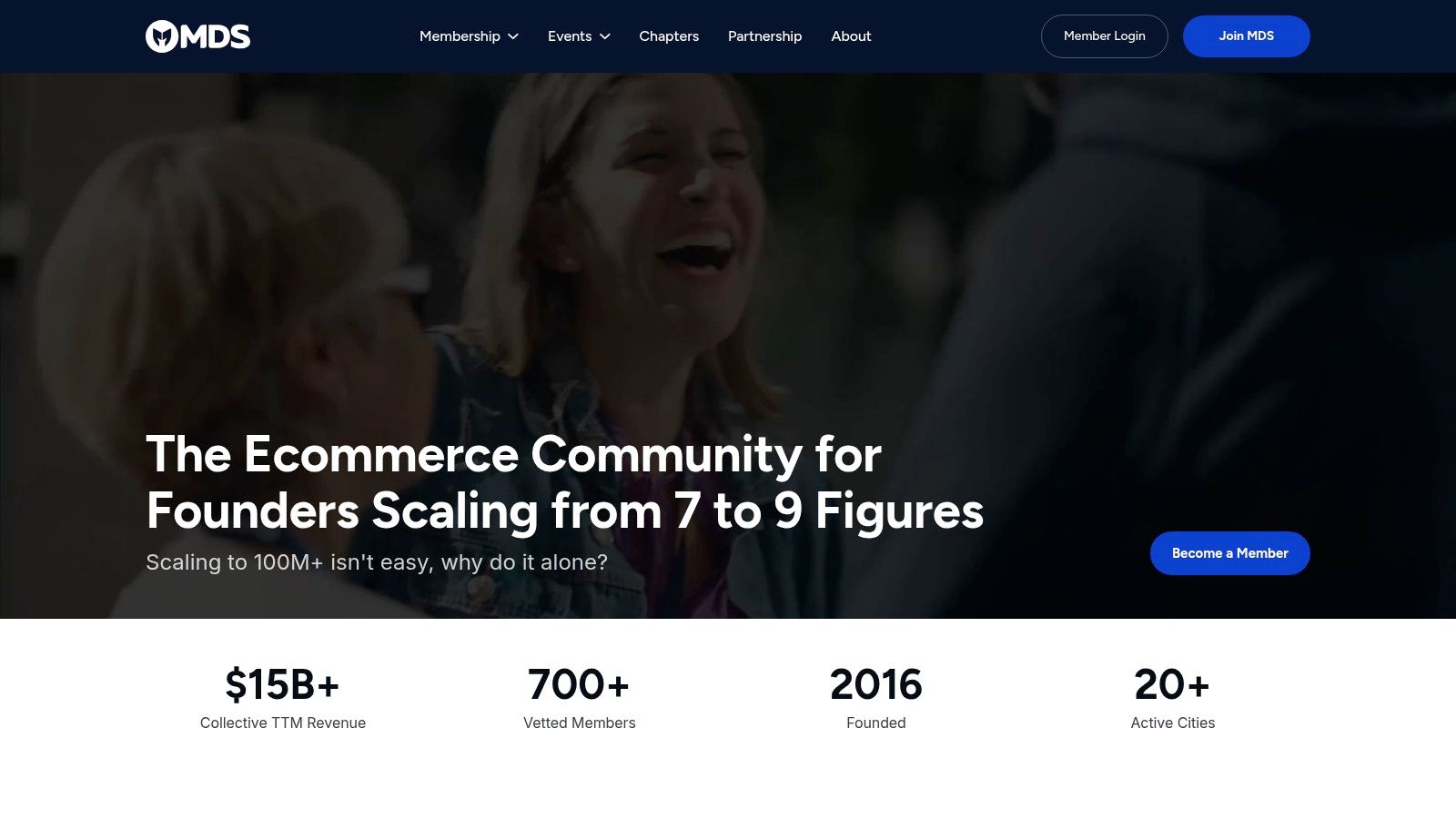
MDS is built for founders who have already demonstrated commercial traction. Its invite-only community serves operators generating $1 million to $500 million or more in annual revenue across Amazon, DTC, and emerging channels, with admission based on revenue verification and founder status. The MDS community combines small-group masterminds, private discussions, workshops, curated meetups, resource libraries, member spotlights, and a vetted partner network.
The operating lever is peer intelligence
MDS's value comes from density. A founder can discuss PPC structure, retail readiness, DSP, inventory pressure, or channel expansion with other operators who face similar commercial constraints. That makes the advice more useful than generic marketplace content, particularly when a decision involves trade-offs between growth and contribution profit.
Its offline events also matter. Workshops and meetups aligned with major industry shows create opportunities for direct conversations with founders and service partners. The partner network can shorten vendor discovery, but members still need to validate fit against their own data, margins, and operating model.
The limitations are material. Premium dues, a time-consuming application process, founder-only admission, and limited seats at some events make MDS a poor fit for early-stage teams or agencies seeking broad access. It also isn't a substitute for execution. A peer can identify a promising bid strategy, but the brand still needs clean search-term data, stable inventory, strong listings, and a measurement plan.
Practical rule: Use peer communities to improve the quality of your decisions, not to outsource them.
For a scaling brand, the MDS lesson is to turn peer intelligence into a testable growth hypothesis. If members suggest using PPC to support organic ranking, measure branded and non-branded sales, conversion, units per session, and marginal profit together. The insight becomes valuable only when it changes profitable execution.
2. eComFuel, formerly eCommerceFuel
eComFuel is a vetted private community and forum for established eCommerce owners. Its membership application sets revenue and owner-operator requirements, while the wider ecosystem includes an active forum, ECF Live, city meetups, virtual calls, benchmarking resources, and a directory of software, agencies, and vendors.
The operating lever is cross-channel judgment
eComFuel's value comes from widening the decision frame beyond Amazon. Members discuss DTC, technology, hiring, operations, vendors, and financial management. That perspective helps owners judge whether Amazon growth improves the company or merely increases dependence on one channel.
The vendor directory adds a practical research layer. Reviews cover software, agencies, and service providers, giving members a starting point before they compare capabilities, references, contract terms, and economics. Community recommendations can shorten discovery, but they do not replace diligence.
The qualification bar limits access for Amazon-only sellers. Applicants must meet a $5 million revenue threshold, and agencies cannot join. Participation also affects the return. Reading discussions may provide ideas, but better results come from sharing operating data, asking specific questions, and building relationships over time.
The distinction matters because a million-dollar Amazon seller is not automatically a mature multichannel operator. Amazon's 2025 small-business reporting says more than 75,000 U.S. independent sellers surpassed $1 million in Amazon sales, while U.S. independent sellers averaged more than $375,000 annually. The figures appear in Amazon's 2025 Small Business Empowerment Report. Revenue therefore needs context. Channel mix, operating processes, and financial resilience determine whether growth can withstand changes in advertising costs, inventory, or demand.
For PPC leaders, eComFuel's lesson is integration. Advertising should support organic growth and profitable scale, not merely produce additional Amazon revenue. A campaign can raise sales while weakening DTC economics, inventory availability, or cash flow. Use the community to test the commercial logic, then use account-level data, contribution margin, and cash requirements to decide whether to increase spend.
3. Titan Network
Titan Network takes a more structured, Amazon-specific approach. Its private community offers tiered membership paths, including Genesis for newer brands and core Titan membership for scaling sellers. The Titan Network combines mentor-led programming, workshops, playbooks, support calls, and accountability from experienced multi-seven- and eight-figure operators.
The operating lever is execution discipline
Titan is most relevant to teams that know what they want to improve but struggle to turn strategy into a weekly operating rhythm. Workshops and playbooks can make broad ambitions more concrete. Support calls add accountability, while mentor access gives members a way to pressure-test decisions with sellers who have worked through comparable Amazon problems.
The tiered structure is useful because a newer brand doesn't need the same playbook as a scaling one. Early-stage teams may need product validation, listing fundamentals, and controlled advertising tests. More established brands may need portfolio planning, catalog expansion, retail readiness, and full-funnel measurement.
The trade-off is transparency. Pricing isn't publicly listed and often requires a sales call. External commentary on value is mixed, which means prospective members should ask for a clear explanation of deliverables, mentor access, implementation support, and the expected time commitment. Community value also depends heavily on engagement. A brand that doesn't bring data and complete assigned work won't receive much from an accountability model.
Amazon's seller data supports the case for treating advertising as infrastructure rather than an optional traffic source. Jungle Scout found that 80% of sellers generating more than $2 million annually used some form of Amazon advertising or marketing, compared with 63% of lower-earning sellers, a 17-percentage-point difference. The finding is documented in Jungle Scout's analysis of successful Amazon sellers.
Execution test: Every advertising recommendation should produce a defined action, owner, time frame, and success measure.
Titan's practical lesson is to make PPC part of the operating cadence. Build campaigns around the role each search term plays, connect bid changes to conversion and organic movement, and review outcomes with the same discipline used for inventory or pricing. Teams needing a more technical overview of partner selection can also use Headline's guide to the Amazon Service Provider Network.
4. Catalyst88
Catalyst88 is designed for founders moving from tactical marketing decisions to company-wide operating control. Its founder-led community uses tiered access, from a free Clubhouse to paid Founder, Chairman, and Pro tiers. The Catalyst88 platform includes bi-weekly masterminds, strategy hot seats, a Founder OS system, playbooks, a resource vault, and operating frameworks that incorporate AI and analytics.
The operating lever is systems
Catalyst88's appeal is its workmanlike cadence. The community focuses less on event energy and more on repeatable management practices, accountability, and cross-functional execution. That makes it a fit for leaders who already understand Amazon tactics but need better coordination across marketing, operations, finance, and people.
The Founder OS concept is strategically relevant to million-dollar sellers because scale introduces more dependencies. A PPC decision can affect inventory velocity. A listing change can affect conversion and advertising efficiency. A pricing move can change contribution margin while altering organic competitiveness. A system that forces leaders to review these relationships is more valuable than a collection of isolated growth hacks.
The tiered entry points reduce the commitment risk, but the higher-touch experience requires active participation. Chairman-level hot seats and accountability aren't passive content products. Leaders need to bring real problems, expose weak assumptions, and follow through between sessions.
A personal-care manufacturer profiled by Amazon scaled annual revenue from approximately $1 million to $50 million over seven years. Monthly sales rose from $70,000 to $4.3 million, and monthly units increased from 1,400 to 74,577. The same Amazon case-study collection reports product-page conversion improving from 21% to 38% and ACOS declining from 97% to 43%.
The lesson isn't that every brand can reproduce those results. It's that revenue should be reviewed alongside conversion, units, and paid-media efficiency. Catalyst88's systems orientation helps leaders establish that discipline. For Headline, it reinforces a core principle: PPC should create demand while content and retail readiness convert it efficiently.
5. 7 Figure Seller Summit
The 7 Figure Seller Summit is a recurring online event created by Gary Huang. It brings together seven- and eight-figure sellers and specialists for more than 25 masterclasses, with recent programming focused on AI workflows for Amazon PPC, inventory, listings, and margin. The 7 Figure Seller Summit offers free live viewing during its event window and an optional All-Access Pass for recordings and bonuses.
The operating lever is tactical learning
This format works when a team needs concentrated exposure to current ideas without joining a year-round community. A PPC manager can study campaign workflows, an operator can review inventory practices, and a content lead can examine listing processes in the same event series. The remote format also makes it easier to involve specialists who can't travel.
The trade-off is implementation. A summit gives teams access to ideas, not ongoing diagnosis or execution support. Speaker quality and applicability can vary, and recordings don't create accountability. Leaders should assign an owner to each relevant session and translate useful tactics into controlled experiments rather than copying a speaker's framework wholesale.
Amazon's reporting offers a useful example of why controlled testing matters. Veteran entrepreneur Thereasa Black invested $10 per day in Amazon Ads, after which sales climbed 3,000% in a matter of months, according to Amazon's seller impact reporting. The example doesn't establish a typical return. It demonstrates a more defensible mechanic: set a measurable spending ceiling, observe traffic and conversion, and expand only when the listing, inventory, and economics support more volume.
Don't scale the budget because a tactic sounds current. Scale it because the test produced evidence your business can support.
The summit's best lesson for PPC teams is to separate learning velocity from spending velocity. You can adopt better query mining, creative testing, or automation practices before increasing total investment. That sequence protects margin and makes new tactics easier to evaluate.
6. Sellers Summit
Sellers Summit is a small-format, operator-led eCommerce conference with Amazon and DTC tracks. Attendance is capped at approximately 200 people, and the optional Mastermind Day groups participants by revenue, including a dedicated $1 million-plus room. Pass holders receive lifetime access to session recordings, and a virtual pass is available through the Sellers Summit format.
The operating lever is relevant networking
The conference's small scale supports deeper conversations than a large expo floor. Revenue-matched mastermind rooms can also improve the quality of questions. A brand at the million-dollar stage may need to discuss stockout risk, catalog complexity, ad efficiency, or team structure, while a much larger operator may be focused on different constraints.
The Amazon and DTC balance is another advantage. Diversification conversations help leaders evaluate whether Amazon growth is creating a durable brand or concentrating risk in one channel. That matters because marketplace growth can be operationally demanding even when sales are rising.
Access has practical limits. In-person seats can sell out months in advance and require travel. Mastermind participation requires revenue verification and has limited capacity. Agencies generally can't join those rooms unless they qualify as sellers, so service providers should treat the event as a client-side learning opportunity rather than a standard networking channel.
Marketplace Pulse reported that sellers exceeding $100 million in annual sales on a single marketplace rose from approximately 50 in 2021 to 235 in 2025, while traffic per seller improved by 31% since 2021, according to Brandwoven's summary of the Marketplace Pulse analysis. Those figures point to uneven scale. A small group is capturing a larger share of opportunity, so networking should focus on the operating choices behind that concentration, not motivational success stories.
The actionable takeaway is to bring a specific commercial question to every conversation. Ask how a seller measured incremental sales, organic lift, or marginal profit after advertising. General networking creates contacts. Revenue-matched problem solving creates decisions.
7. Helium 10 Elite
Helium 10 Elite combines advanced Amazon software with an exclusive mastermind community. Elite members receive expanded tool limits, early or priority access to new features, quarterly workshops, advanced community channels, product education, and ongoing training. The Helium 10 pricing page positions the tier for experienced sellers that want tooling and peer access in one environment.
The operating lever is integrated tooling
The model suits teams that want seller intelligence and execution tools close together. Helium 10 includes capabilities relevant to keyword research, listing operations, analytics, and PPC through Adtomic. That combination can reduce the distance between identifying an opportunity and acting on it.
The advantage comes with a boundary. The community is tied to Helium 10's software ecosystem, so it isn't vendor-agnostic. A team should evaluate whether the platform's workflows, data access, and campaign controls fit its existing stack before paying for the higher tier. The price is also higher than standard Helium 10 plans, making the decision more commercial than educational.
Teams considering the product should distinguish tool access from strategic capability. A dashboard can surface search-term performance, but it won't decide whether a term deserves more spend, a listing test, a content investment, or no action. That judgment depends on conversion, margin, inventory, branded demand, and organic position.
For brands evaluating the software side of Amazon operations, Headline's overview of the Helium 10 Chrome extension provides additional context. Helium 10 Elite is strongest when a team already has an analytical culture and will use the data in recurring decisions. It is less compelling for a business hoping software alone will create a growth strategy.
The broader lesson is that integrated tooling should connect paid and organic outcomes. Track whether PPC exposes new demand, improves branded search, supports organic ranking, and produces incremental profit. ACOS remains useful, but it can't answer those questions alone.
Top 7 Million-Dollar Seller Communities Compared
| Community / Program | Implementation complexity | Resource requirements | Expected outcomes | Ideal use cases | Key advantages |
|---|---|---|---|---|---|
| MDS – Million Dollar Sellers | High, invite/application with strict revenue verification; founder-only admission | High dues; time for events and peer commitments | High-signal strategic advice and partnerships for scaling 7–9 figure brands | Founders of $1M–$500M+ brands seeking elite peer strategy and vendor connections | Curated founder peer set; Amazon operator density; exclusive in-person/virtual events |
| eComFuel (formerly eCommerceFuel) | Medium, vetted application; owner/operator rules (higher $5M+ threshold for Amazon sellers) | Membership fee; active forum participation; time for benchmarking and meetups | Fast operator-led responses, benchmarking and large unbiased vendor review directory | 7–8 figure DTC/eCommerce owners needing benchmarking and vendor comparisons | Large, active forum; extensive review directory; transparent qualification rules |
| Titan Network | Medium, tiered membership; often requires sales call for pricing/details | Paid membership; engagement in mentor-led programs and workshops | Amazon-specific playbooks, execution frameworks and accountability support | Amazon sellers at various growth stages seeking mentor-led execution | Mentor access from top sellers; tiered paths; practical execution focus |
| Catalyst88 | Low–Medium, multi-tier access with free entry point (Clubhouse) | Tiered fees up to high-touch tiers; time for hot seats and accountability | CEO-level operating system, playbooks and cross-functional scaling frameworks | Teams/CEOs moving beyond marketing tactics to systems and operational excellence | Transparent pricing and tiers; founder-led systems; AI/analytics-infused frameworks |
| 7 Figure Seller Summit | Low, free live windows with optional paid All-Access Pass | Low cost for live attendance; optional paid recordings/bonuses; one-off time investment | Tactical masterclasses (AI workflows, PPC, inventory) for self-driven implementation | Operators seeking concentrated, low-cost tactical updates and AI practices | Affordable access to many expert sessions; strong AI and tactical focus; flexible remote format |
| Sellers Summit | Medium, in-person event with revenue-verified mastermind segmentation | Ticket and travel costs; time on-site; revenue verification for mastermind passes | Intimate tactical sessions, deep networking and revenue-matched mastermind groups | Hands-on sellers wanting small-format networking and revenue-segmented masterminds | Small attendee size for deeper networking; balanced Amazon/DTC tracks; focused masterminds |
| Helium 10 Elite | Medium, upgrade to top-tier plan; membership tied to software platform | Higher subscription cost than standard plans; reliance on Helium 10 tooling | Advanced PPC/SEO tooling plus mastermind collaboration and priority product access | Multi-7/8-figure brands needing integrated tooling and high-level peer access | Combines enterprise-grade tools with curated mastermind and early feature access |
Turn Million-Dollar Lessons Into Profitable Scale
The seven ecosystems differ in format, but their strongest lessons converge. Choose peer access that matches your stage. MDS fits founders seeking high-signal conversations with established operators. eComFuel is better suited to owners who need broader eCommerce and DTC judgment. Titan emphasizes Amazon execution and accountability. Catalyst88 addresses operating systems. The two summits concentrate tactical learning and networking, while Helium 10 Elite combines software with an advanced seller community.
The right choice depends on the constraint holding back growth. A team with weak decision quality needs better peer intelligence. A team with inconsistent follow-through needs systems and accountability. A team with fragmented data needs integrated tooling. A team with narrow channel exposure needs cross-channel perspective. Paying for a community that doesn't address the bottleneck creates activity, not progress.
The most important shared principle is measurement. Amazon reported more than 11,000 U.S.-based independent sellers grew sales by over 10 times during 2025, while the same reporting showed that more than 75,000 independent sellers surpassed $1 million in sales through the store. The figures in Amazon's small-business report demonstrate that rapid growth can happen, but they don't prove that revenue growth alone creates a healthy business.
Before increasing spend, audit five areas: product-market fit, listing conversion, search-term performance, PPC structure, and measurement. Review branded versus non-branded sales, units per session, conversion rate, TACoS, contribution margin, inventory exposure, and cash conversion. The objective isn't to force every metric upward. It's to understand whether additional advertising creates profitable incremental demand or merely shifts sales into a more expensive channel.
Headline's position is straightforward. Sponsored Products, Sponsored Brands, Sponsored Display, and DSP should work with content testing and Amazon data, not operate as isolated media functions. Search Query Performance and Amazon Marketing Cloud insights can help teams connect advertising exposure with query behavior, conversion, audience movement, and organic opportunity. Custom dashboards and automated bid management can reduce manual work, but human judgment still decides where profitable growth exists.
Million-dollar sellers aren't defined by a sales badge. They build repeatable systems that turn demand capture into stronger rankings, better conversion, healthier margins, and defensible market position. That is the standard leaders should use when choosing a community, summit, or software platform.
Headline Marketing Agency offers Amazon PPC management across Sponsored Products, Sponsored Brands, Sponsored Display, and DSP, supported by analytics, automation, and content testing. If your brand needs to connect advertising with organic growth and profitability, visit Headline Marketing Agency to discuss a data-driven growth approach.
Get Your Free Amazon PPC Audit
Discover untapped growth opportunities and see how our data-driven approach can improve your ROAS.
Get Free Audit →Ready to Transform Your Amazon PPC Performance?
Get a comprehensive audit of your Amazon PPC campaigns and discover untapped growth opportunities.