Amazon Launchpad: The Performance-First Growth Playbook
Is Amazon Launchpad benefits worth the commission? Our analysis covers the real costs, benefits, and better alternatives.

Navigating Amazon's vast marketplace can feel like shouting into the void, especially for new and innovative products. That’s where Amazon Launchpad comes in. It’s not just another listing option; it's a dedicated program designed to give unique, early-stage products a significant performance advantage. Think of it as a launch accelerator built to turn ad spend into a lever for organic growth and sustainable scale.
What Is Amazon Launchpad and Is It the Right Move for Your Brand?
So, what exactly is Amazon Launchpad? Instead of just throwing your new product onto the digital shelf and hoping for discovery, Launchpad offers a structured path to gaining visibility and crucial sales velocity.
Amazon rolled out the program back in 2015 to help startups and inventors scale their launches. The core idea was to give fresh, exciting consumer products access to Amazon's massive audience and powerful marketing tools. With Amazon's net revenue hitting over $574 billion in 2023, just getting noticed is a monumental challenge. You can dig into Amazon's growth on Statista.com, but the bottom line is that visibility requires a strategic edge.
Launchpad is much more than just a shiny badge on your product page. It's about unlocking a suite of performance-driving benefits—like A+ Premium Content and exclusive marketing placements—that are typically out of reach for a brand just starting out.
Who Is the Ideal Launchpad Candidate?
While the program sounds appealing, it's highly selective. Amazon is looking for partners with true product innovation, not just another "me-too" item.
The ideal candidate usually falls into one of these buckets:
- Venture-Backed Startups: External funding signals you have the inventory and marketing budget to capitalize on the visibility Launchpad provides.
- Crowdfunded Success Stories: Brands from Kickstarter or Indiegogo have already validated market demand and arrive with a compelling origin story.
- Unique, Patented Products: A product with a genuine competitive moat—like a patent or proprietary design—is exactly what the program is designed to showcase.
At its core, Amazon wants brands that offer something genuinely new. These products require strong storytelling and rich visuals to connect with customers, and the Launchpad stamp of approval adds instant credibility that can significantly boost conversion rates.
Key Takeaway: Amazon Launchpad is a powerful amplifier, not a magic wand. It's a strategic fit for brands that have a validated, innovative product, a compelling story, and a clear plan to leverage the program's tools for aggressive growth.
For the right brand, the program can dramatically compress the timeline from launch to profitability. The enhanced content and marketing opportunities build shopper trust—the most valuable currency for a new product. It also sets you up for long-term growth and defensibility, further strengthened by the benefits of Amazon Brand Registry.
Before applying, be brutally honest: does your product’s DNA scream innovation? This is the most critical hurdle.
To guide your decision, here's a quick cheat sheet.
Amazon Launchpad At a Glance: Is It Your Best Move?
This table provides a high-level summary to help you quickly assess if your brand's profile and goals align with the Launchpad program or if another path might be a better fit.
| Brand Profile | Ideal for Launchpad | Alternative Strategy May Be Better |
|---|---|---|
| Product Type | Genuinely innovative, unique, or patented products. | Standard products, private label, or commodity goods. |
| Funding Stage | Venture-backed, successfully crowdfunded, or well-capitalized. | Bootstrapped, limited startup capital, or smaller-scale operations. |
| Brand Story | Strong, compelling narrative that can be told through rich media. | Products that are primarily functional and don't require deep storytelling. |
| Marketing Goals | Focused on rapid brand awareness, visibility, and market validation. | Centered on slow, steady organic growth and lean marketing spend. |
| Business Goals | Aiming for aggressive scaling and establishing a premium brand presence. | Focused on maintaining high margins and controlling costs from day one. |
Ultimately, this isn't just a tactical choice—it's a strategic one. Choosing Launchpad means committing to a specific growth trajectory that requires investment and a product truly worthy of the spotlight.
Weighing the Real Costs and Benefits of Launchpad
Jumping into Amazon Launchpad isn't just a marketing play—it's a serious financial commitment. You gain access to powerful tools, but they come at a price. Before signing on, you must analyze the numbers to determine if the ROI is there.
The most significant cost is the additional 5% referral fee tacked onto your standard category fee. This is not a one-time charge; it's deducted from every sale for at least 12 months. If your category fee is 15%, you're now paying 20%, which directly erodes your gross margin on every unit sold.
That immediate hit to your bottom line means the benefits must drive enough incremental sales to more than cover the 5% premium. The only way the math works is if the program's features generate a significant lift in profitable revenue.
What Are the Tangible Benefits Worth?
Launchpad gives you access to premium perks designed to accelerate growth. The key is to tie these features to measurable performance outcomes.
A+ Premium Content: This is the headline benefit. While standard A+ Content can boost conversion rates by up to 10%, A+ Premium supercharges your detail page with video modules, interactive hotspots, and enhanced comparison tables. For a new product, a 2-3 point lift in conversion rate is a game-changer, making every dollar of PPC spend more efficient. A real-world example: a tech gadget brand used A+ Premium video to demonstrate a key feature, resulting in a 22% increase in CVR and a corresponding drop in their Advertising Cost of Sale (ACOS) by 15% within the first month.
Exclusive Marketing Placements: Launchpad products get featured in the Launchpad storefront, holiday gift guides, and targeted email campaigns. While direct attribution is difficult, this is essentially free, top-of-funnel brand exposure that you don't have to rely solely on paid ads to achieve.
Onboarding and Strategic Support: A dedicated Amazon onboarding manager helps you navigate the complexities of a launch, from listing optimization to Prime Day preparation. This is an insurance policy against common, costly mistakes.
The math boils down to one question: Will the boost in conversion, traffic, and sales from these perks generate more gross profit than the 5% fee costs you?
To get a clear answer, you need to model the scenarios. A good Amazon seller profit calculator is invaluable here. It lets you model out your P&L—with and without the Launchpad fee—to see how a potential lift in conversion impacts your net profit.
The Strategic Costs and Trade-Offs
Beyond the hard costs, there are strategic trade-offs. Launchpad provides a massive boost but also pulls you deeper into Amazon's ecosystem. This may not align perfectly with a long-term vision that includes a strong D2C presence or broader retail distribution.
Also, the initial 12-month commitment is binding. You’re locked in for a full year, regardless of performance. If the launch falters, that 5% fee becomes a heavy burden, draining cash that could be allocated to advertising or inventory.
Ultimately, the decision rests on your confidence that the benefits will crush the costs. For a genuinely innovative product with a compelling story and a solid ad budget, Launchpad can be a powerful accelerator. But for brands with thin margins or unproven product-market fit, the mandatory fee is a significant financial gamble.
Your Step-by-Step Guide to a Winning Application
Getting into Amazon Launchpad can feel like a black box. You submit your brand’s story and product details, and then you wait. This is an actionable guide to demystify the process, from the first eligibility check through onboarding.
Think of the application less as filling out a form and more as making a business case. Amazon isn't just looking for cool products; they're looking for partners with potential. Your job is to prove you possess the three things they care about most: genuine product innovation, a compelling brand story, and the operational readiness to scale.
Do You Qualify? Cracking the Eligibility Code
Before you spend a minute on the application, conduct an honest assessment. The Launchpad team is inundated with submissions, so they filter aggressively.
You need to demonstrate strength in these areas:
- Product Innovation: Is your product truly differentiated? Articulate what makes it special and how it solves a customer problem in a new way. Patented technology, a unique design, or a fresh approach to an existing category will capture their attention.
- Brand Story: Why should anyone care? A strong, authentic narrative is non-negotiable. Brands born from a personal struggle, a successful Kickstarter campaign, or a clear social mission have a distinct advantage.
- Funding and Operational Readiness: If demand surges, can you deliver? Amazon needs to see that you have the capital (from VCs, crowdfunding, or self-funding) and a reliable supply chain ready to execute.
Amazon's third-party marketplace is a massive engine for growth, with an ecosystem that included roughly 9.7 million sellers worldwide by early 2025. Launchpad is designed to find the brands that can make a real impact in that ecosystem. For a closer look at the data behind Amazon’s marketplace, Analyzer.tools has some great seller statistics.
Key Application and Onboarding Milestones
Understanding the timeline helps you set realistic expectations and prepare for each stage. While every case varies slightly, the path from application to launch is fairly consistent.
This timeline provides a bird's-eye view of the entire process.
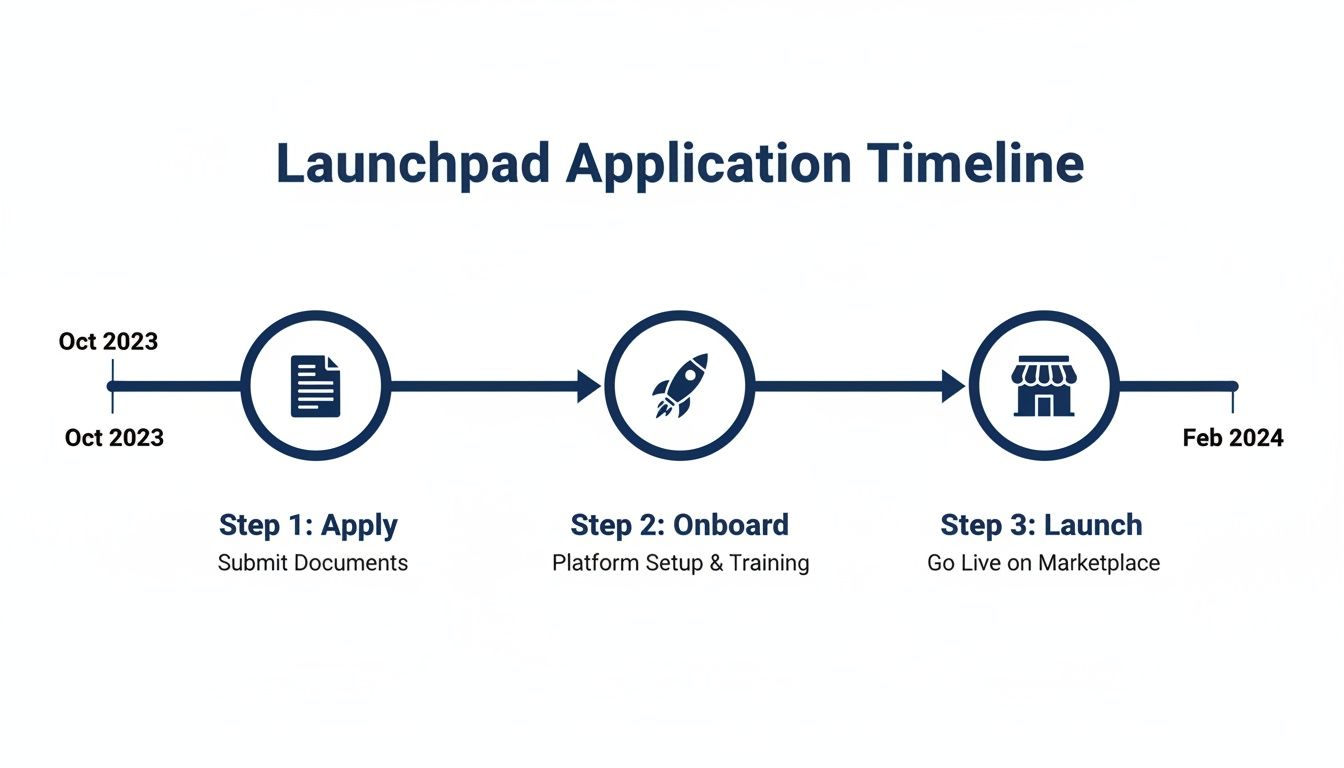
As you can see, this is not an overnight process. It requires careful planning at every step, from the moment you apply to the day you launch.
Once accepted, the real work begins. The onboarding phase is where you set up the premium tools that make Launchpad so powerful. You'll work directly with a dedicated onboarding manager to build out your A+ Premium Content and brand store.
My two cents: Your application is a sales pitch to Amazon. Lead with what makes your product innovative, then back it up with an authentic story and solid proof that you’re ready to scale from day one.
This is your chance to align all creative assets for a coordinated launch. Nailing this part is crucial and is a core component of broader product launch strategies that build long-term momentum. Applying isn't just about getting in—it's about being ready to execute once you're approved.
The Performance Playbook to Maximize Your Launch
Acceptance into Amazon Launchpad isn’t the finish line—it’s the starting gun. The program provides premium tools, but success requires a performance-first mindset. Your strategy must merge with sharp execution, turning Launchpad’s perks into a springboard for an aggressive and profitable launch.
This playbook isn't about "running ads." It's about creating a flywheel where paid media directly fuels organic growth. The objective is to use targeted ad spend as a strategic investment to ignite sales velocity, signal relevance to Amazon's A9 algorithm, and build sustainable momentum from day one.
Building the Foundation with Sponsored Ads
Your first move must be a surgically precise PPC strategy using Sponsored Products and Sponsored Brands. These ad types are your core tools for capturing high-intent shoppers actively searching for solutions like yours. The goal is twofold: drive initial sales and start ranking for your most critical keywords.
For a new product, initial campaigns must be aggressive. A case study from a consumer electronics brand in Launchpad showed they allocated 70% of their initial ad budget to conquesting competitor ASINs, which drove a 30% New-to-Brand customer rate in their first 60 days. Focus on a mix of keyword targets:
- Exact Match Keywords: Target your most relevant, high-conversion terms to capture customers ready to buy now.
- Competitor ASINs: Target your direct competitors' product pages—the digital equivalent of setting up a booth right outside their store.
- Broad Match & Category Targeting: Use these to cast a wider net, discover new search terms, and expand your reach once you have initial conversion data.
The credibility of the Launchpad badge and the conversion power of A+ Premium Content mean your ad spend works harder. A higher conversion rate lets you bid more competitively while maintaining a healthy Advertising Cost of Sale (ACOS), accelerating your product up the search rankings.
The Takeaway: Use Sponsored Ads as your primary engine for sales velocity. A strong start signals to Amazon that your product is a winner, a crucial first step toward building the organic rank that sustains your business long after the launch hype fades.
Expanding Reach with Amazon DSP
Once your foundational PPC campaigns are driving consistent sales, layer in Amazon DSP (Demand-Side Platform). Think of DSP as your top-of-funnel machine. While Sponsored Ads capture existing demand, DSP creates new demand by reaching your ideal customers before they even begin their search.
With DSP, you can build audiences using Amazon’s unparalleled first-party data. This means targeting shoppers who have browsed competitor products, visited related categories, or fit specific lifestyle segments. It's your ticket to introducing your brand across Amazon-owned sites, apps, and the wider web.
For a Launchpad brand, this is a game-changer. You can run retargeting campaigns to shoppers who visited your premium product page but didn't buy. More importantly, you build brand awareness far beyond a simple keyword search, creating a halo effect that lifts the performance of all your channels. The sheer scale is undeniable; Amazon’s global ad revenue was projected to hit $52–56 billion in 2024–2025, highlighting advertising's central role in product discovery.
Integrating Influencers for Authentic Reach
No modern playbook is complete without social proof. Influencers add a layer of authenticity that traditional advertising cannot replicate. Weaving them into your launch strategy fast-tracks trust and drives high-quality, motivated traffic to your Amazon listing.
A key part of your plan should involve actively finding influencers on Amazon to connect with trusted voices who can showcase your product. This not only generates immediate buzz but also provides a library of valuable user-generated content to repurpose in your A+ Premium modules and social media campaigns, feeding directly back into the flywheel effect.
Integrated Launch Timeline: PPC and Organic Milestones
A successful launch requires careful coordination between paid and organic efforts. This sample 90-day timeline shows how to sync advertising focus with specific growth goals to build momentum effectively.
| Phase (Days) | PPC & DSP Focus | Organic Growth Goal | Key Performance Indicator |
|---|---|---|---|
| 0–30 | Aggressive Sponsored Products (Exact Match & Competitor ASINs). Initial Brand Awareness DSP campaigns. | Secure first 15–20 reviews. Rank on page 1 for 3–5 core keywords. | CVR > 10%, TACOS stabilizing, daily review count. |
| 31–60 | Scale Sponsored Brands (Video & Store Spotlight). Expand DSP retargeting. Test broad match keywords. | Achieve "Best Seller" or "Amazon's Choice" badge. Double keyword rankings. | Increase in organic sessions, improved keyword rank tracking, lower ACOS. |
| 61–90 | Optimize for profitability (ACOS/TACOS). Launch DSP campaigns for loyalty (e.g., targeting past purchasers). | Defend keyword rankings. Grow organic sales to 40%+ of total sales. | Stable organic rank, positive month-over-month sales growth, TACOS reduction. |
Think of this table as a roadmap, not a rigid set of rules. Constantly monitor your data and adjust your strategy based on what the numbers are telling you. The goal is to transition from an aggressive acquisition phase to a sustainable, profitable growth model by the end of your first three months.
Measuring Success And Planning For What’s Next
A big launch is exciting, but it’s just the starting line. The real work begins after the initial buzz of joining Amazon Launchpad. Your focus must shift to data analysis and relentless optimization. Success isn't measured in first-week sales; it's proven by building a brand with the legs for sustainable, long-term growth.
It's time to move past surface-level metrics and dig into the KPIs that reveal the true health of your business. This data-driven feedback loop should inform every decision, from scaling an ad campaign to reordering inventory. Get this right, and you’ll do more than just survive—you’ll thrive.

Beyond ACOS: The Metrics That Truly Matter
For too long, brands have obsessed over Advertising Cost of Sale (ACOS). While it's a useful campaign efficiency metric, ACOS tells only a fraction of the story. A low ACOS doesn't guarantee profitability, and a high ACOS during a product launch is often a necessary investment, not a red flag.
To see the whole picture, you must track a more powerful metric: Total Advertising Cost of Sale (TACOS).
TACOS measures your ad spend against your total sales—both paid and organic. This one KPI reveals the true impact of advertising on your overall business. It tells you if your PPC investment is creating a halo effect that lifts organic sales, which is the ultimate goal of a performance-first strategy.
If your TACOS trends down over time while total sales increase, it's the clearest sign your strategy is working. It means your brand is becoming less dependent on ad spend as organic rank improves and customers begin searching for you by name.
Building Your Performance Dashboard
To steer the ship effectively post-launch, you need a dashboard tracking the right KPIs. This provides the clarity to make smart, proactive decisions instead of just reacting.
Here are the essential metrics to watch:
- Organic vs. Paid Sales Ratio: Initially, paid sales will likely dominate your revenue. That’s expected. The goal is to see the organic sales percentage climb steadily as your product ranks for its most important keywords.
- Sessions and Conversion Rate (CVR): Are shoppers finding your listing, and are they converting? High traffic (sessions) with a poor CVR suggests a listing optimization issue. Low traffic could signal a problem with your ad targeting or keyword strategy.
- Customer Reviews and Ratings: Monitor your review velocity and average star rating daily. Negative reviews can halt a launch, so you must address them immediately to identify product or listing issues.
These numbers don't exist in a silo. They work together to give you a complete picture, guiding decisions on whether to increase ad spend, A/B test your main image, or adjust your pricing strategy.
Planning for Profitable Growth
As you analyze performance data, you must also protect your brand's value. Nothing kills momentum and damages your premium positioning faster than price erosion from unauthorized third-party sellers. This is where tools like MAP policy monitoring software become invaluable for protecting your margins and brand equity.
Your first 90 days in the Launchpad program are critical for setting the stage for long-term success. By focusing on smart metrics like TACOS and maintaining tight brand control, you’re not just launching a product—you're building a profitable, scalable business on Amazon.
The Headline Takeaway: A launch isn't a one-time event; it's the beginning of a continuous optimization cycle. By tracking the right KPIs—especially TACOS—you can measure the true ROI of your ad spend and make data-backed decisions that drive real, profitable growth long after the launch-day confetti has settled.
Knowing When It's Time to Graduate from Launchpad
Think of Amazon Launchpad as a powerful incubator. It's designed to get you off the ground, but it isn’t meant to be a permanent home. The goal is to build enough momentum to achieve escape velocity. Deciding when to graduate is a critical strategic decision that directly impacts your long-term profitability and scale.
Graduating from the program isn't a failure—it's the ultimate mark of success. It signifies that you've achieved what Launchpad was designed to help you do: build a self-sustaining sales engine. The biggest benefit? You stop paying the additional 5% referral fee, immediately boosting your margin on every single sale.
Key Indicators of Brand Maturity
How do you know when it's the right time? This shouldn't be a gut decision. Your performance data will tell you when your brand is strong enough to thrive without Launchpad's support.
Look for these clear signals:
- Strong Organic Sales: Your organic sales consistently account for more than 50% of total revenue. This indicates strong keyword rankings and sustainable market demand.
- Established Brand Recognition: You see a high volume of branded searches. Customers are now actively seeking your brand by name.
- Healthy Profit Margin: Your business is profitable even with the extra 5% fee. This demonstrates a solid financial footing that will only strengthen post-graduation.
- Consistent Sales Velocity: Your sales are stable and predictable, no longer reliant on launch hype or promotional placements from the program.
Making the Strategic Decision
Leaving Launchpad is a calculated move toward greater independence and profitability. If you've used the program to build a powerful foundation—strong brand awareness, high organic rankings, and a loyal customer base—the benefits of graduating will easily outweigh the perks you're leaving behind.
The Headline Takeaway: Treat Amazon Launchpad like a rocket booster. It’s essential for getting off the ground but designed to be jettisoned once you reach a stable orbit. When your data shows strong organic sales and brand recognition, it's time to graduate, cut the extra fee, and use that improved profitability to fuel your next phase of growth.
Frequently Asked Questions About Amazon Launchpad
Brand leaders always have sharp questions about Amazon Launchpad. Here are direct, no-nonsense answers to help you decide if it's the right strategic move for your business.
What's the Real Cost of Joining Amazon Launchpad?
The primary cost is a 5% premium on top of your standard referral fee. This is the price for the program's performance-driving perks, like access to A+ Premium Content, exclusive marketing placements, and dedicated onboarding support.
The critical question to answer is this: will the incremental sales and improved ad efficiency from these features generate more net profit than the 5% fee costs you? If the financial model proves out, it's a smart investment.
I'm Already Selling on Amazon. Can I Still Join Launchpad?
Typically, Launchpad targets new, innovative products making their Amazon debut. However, exceptions can be made.
If you are an established seller launching a genuinely differentiated product line, you may qualify. The decision hinges on your brand's story and the uniqueness of the new product. Your best approach is to connect with the Amazon Launchpad team and present a compelling business case.
How Does Launchpad Help with My PPC and Advertising?
Launchpad does not manage your PPC campaigns for you. It provides the tools to make your advertising strategy more effective. You still own the execution.
Think of it this way: Features like A+ Premium Content and the "Amazon Launchpad" badge inherently boost credibility and conversion rates. This means your ads become more efficient, your ACOS improves, and you achieve a higher return on every ad dollar spent.
Is Amazon Launchpad Available Everywhere?
No. Launchpad operates in major markets, including North America (USA, Canada, Mexico), Western Europe (UK, Germany, France, Italy, Spain), and select countries in Asia and Australia.
Crucially, the program is not identical in every marketplace. Features, benefits, and the application process can vary. Before building a global launch strategy around the program, always verify that Launchpad is active and accepting applications in your target country. This due diligence can prevent significant strategic headaches.
Your brand deserves a strategy that turns ad spend into profitable growth. At Headline Marketing Agency, we go beyond vanity metrics to build data-driven PPC and DSP campaigns that create sustainable marketplace dominance. Schedule a consultation to unlock your brand’s potential on Amazon.
Get Your Free Amazon PPC Audit
Discover untapped growth opportunities and see how our data-driven approach can improve your ROAS.
Get Free Audit →Ready to Transform Your Amazon PPC Performance?
Get a comprehensive audit of your Amazon PPC campaigns and discover untapped growth opportunities.