How to Reduce ACoS on Amazon and Boost Your Profitability
TACoS tells a richer story than ACOS. Here's the reduce ACoS framework we use across 50+ brand accounts.

To truly control your Amazon ACoS, you need to stop thinking about simply cutting a percentage. The real objective is to define a profitable ACoS that serves as a lever for both paid efficiency and total business growth. This isn't about slashing costs; it's about deploying ad spend as a strategic investment to build a defensible, scalable brand on Amazon.
Thinking Beyond ACoS: PPC as a Growth Lever
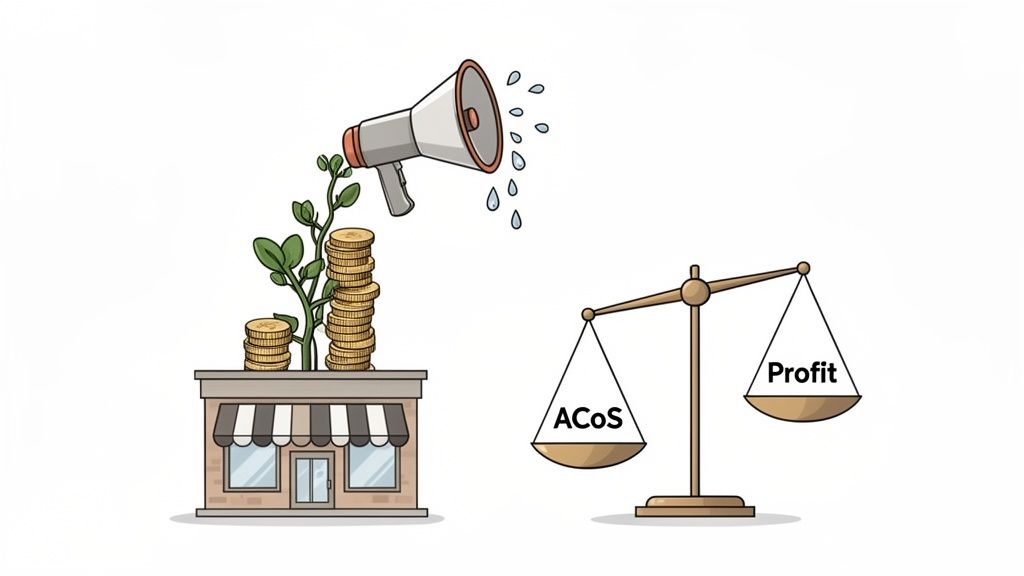
It’s a classic trap: leadership fixates on driving Advertising Cost of Sale (ACoS) as low as possible. While this might look good on a spreadsheet, an obsessive focus on this single metric often means pulling back on spend, missing sales volume, and stalling growth. The strategic objective isn't the lowest ACoS—it's the optimal ACoS for your specific business goal, whether that's market penetration, profitability, or brand defense.
This is a critical mindset shift for any senior e-commerce leader. Instead of just tweaking bids to shave points off ACoS, the most sophisticated brands we work with use their PPC campaigns as a powerful engine for organic rank improvement and category dominance. This often requires a deliberate, temporary increase in ACoS. It's a calculated investment, not a P&L loss.
The Power of a Profitable ACoS
Consider a new product launch. An aggressive launch campaign might result in a 60% ACoS. On the surface, that looks unsustainable. But if that spend generates significant sales volume, it's also building the sales velocity that is a primary ranking signal for Amazon's A9 algorithm.
This initial investment in paid visibility directly fuels organic search performance. Over time, an increasing share of sales will come from organic traffic, significantly lowering your blended marketing cost per sale.
This is where a more sophisticated metric, Total ACoS (TACoS), provides the true performance narrative. TACoS measures total ad spend against total sales (paid + organic), revealing how PPC is impacting the entire business. A consistently decreasing TACoS indicates your ad spend is creating a powerful flywheel effect: paid ads are driving organic rank, which in turn drives more profitable, organic sales.
Takeaway: A low ACoS with flat or declining total sales is a vanity metric. A healthy, even temporarily high, ACoS that leads to growing market share and a falling TACoS is the signature of a winning Amazon strategy.
When a Higher ACoS is a Strategic Imperative
Chasing a rock-bottom ACoS can be detrimental to long-term growth. Here are specific scenarios where accepting a higher ACoS is the correct strategic decision:
- Product Launches: Aggressive spend is non-negotiable for securing initial sales, reviews, and sales history. This is the cost of entry for telling Amazon your product is relevant.
- New Market Entry: When entering a crowded category, you must invest to gain visibility and steal market share from established competitors.
- Competitive Defense: If a competitor begins bidding aggressively on your core brand and category keywords, you must increase spend to protect ad placements and defend your sales volume.
This approach shifts the conversation from narrow campaign metrics to a holistic strategy for long-term, profitable market share. To execute this effectively, it's critical to have a deep understanding the interplay between paid and organic search.
Mastering Keywords to Control Ad Spend
Your keyword strategy is the most powerful lever for controlling ACoS. This isn't about broad-stroke targeting; it's about surgically aligning ad spend with high-intent customer queries to ensure every dollar is deployed against shoppers ready to convert.
A poorly managed keyword strategy is a silent budget killer. You might generate clicks, but if they come from broad, research-phase terms, your ACoS will climb without a corresponding lift in revenue. The goal is to pivot from chasing low-quality traffic to capturing high-conversion, purchase-ready searches.
This process starts by treating Automatic campaigns as a strategic R&D tool, not just a sales channel. They are your front-line intelligence operation, revealing how real customers are searching for your products.
Harvesting High-Intent Keywords
The most valuable keywords are often hidden within your Search Query Performance and campaign reports. The discipline is not in glancing at these reports, but in systematically harvesting customer search terms that are already converting at or below your target ACoS.
Focus on long-tail keywords—the longer, more specific phrases that signal a buyer is at the end of their decision-making process.
- A search for "running shoes" indicates browsing.
- A search for "women's trail running shoes size 8 waterproof" indicates clear purchase intent.
The second query is where you find profitability. It's less competitive, carries a lower cost-per-click (CPC), and has a significantly higher probability of conversion. These are the assets you must "graduate" into manual campaigns for precise bid and budget control. For a deeper dive into building these high-value lists, explore our guide to creating a performance-driven Amazon keywords list.
Structuring Campaigns for Precision Control
Once you've identified winning keywords, campaign structure becomes paramount. A common mistake is lumping Broad, Phrase, and Exact match types into a single ad group. This structure makes granular bid optimization and budget allocation nearly impossible.
A more sophisticated approach is to segment campaigns by match type and intent.
Your highest-performing, long-tail keywords belong in dedicated Exact Match campaigns. This provides maximum control, allowing you to bid confidently on terms with a proven track record. Broader terms can then be isolated in separate Broad or Phrase Match campaigns, where they continue to function as discovery tools but with more control than a pure automatic campaign.
To manage ACoS effectively, your campaign structure is everything. Different setups offer varying levels of control and are suited for different goals, from broad discovery to surgical precision. Here’s a quick breakdown of how to think about it:
Campaign Structures for ACoS Management
| Campaign Structure Type | Primary Goal | ACoS Control Level | Best Use Case |
|---|---|---|---|
| Single Campaign, Mixed Match Types | Simplicity | Low | Not recommended for serious sellers; difficult to isolate and optimize top performers. |
| Separate Campaigns by Match Type | Performance Isolation | Medium | A solid starting point for isolating Broad/Phrase/Exact to manage bids more granularly. |
| Single Keyword Ad Campaigns (SKAGs) | Maximum Precision | High | Isolating one top-performing exact match keyword per campaign for ultimate budget and bid control. |
| Tiered/Waterfall Structure | Keyword Harvesting & Control | High | Using Auto/Broad campaigns to find new keywords, then "graduating" them to Phrase and finally to Exact match campaigns. |
Adopting a tiered or match-type-specific structure is a game-changer. It allows you to protect your most profitable keywords and ensure your budget is fueling what works, not just what's getting clicks.
Takeaway: By isolating your most profitable keywords in dedicated Exact Match campaigns, you can allocate budget confidently and protect your most efficient ad spend from being wasted on lower-performing, exploratory terms.
The Power of a Negative Keyword Strategy
Just as important as identifying winning terms is aggressively eliminating waste. Your Search Term Report will reveal a host of irrelevant queries consuming your budget with no chance of conversion. These must be added to your negative keyword lists.
For example, if you sell premium leather wallets, you cannot afford to spend on clicks from searches like "cheap kids fabric wallet."
By adding terms like "cheap," "kids," and "fabric" as negative keywords, you prevent your ad from showing to an audience that was never your target customer. A rigorously maintained negative keyword list is your first line of defense against inefficient spend and is one of the fastest ways to improve ACoS.
Adapting Your Bids to Amazon's Algorithm
To win on Amazon Ads, you must operate within the framework of its algorithm. A common strategic error we see is clinging to an "Exact match only" strategy under the assumption that it offers maximum control. While historically true, today this approach severely limits reach and cedes profitable sales to competitors who have adapted.
The landscape has fundamentally changed. Amazon's algorithm now heavily favors discovery, pushing a greater share of traffic to Auto and Broad match campaigns. This is how the platform learns and adapts to evolving consumer search behavior. Resisting this shift is a losing battle—you'll burn budget competing for a shrinking pool of traffic.
The New Rules of Bidding: Embrace Broader Match Types
Based on the data across the accounts we manage, a significant algorithmic shift in mid-2023 re-wrote the bidding playbook. Since that time, Auto campaigns have consistently captured a larger impression share, now accounting for nearly 40% or more of ad-driven traffic in many categories. Simultaneously, Broad match has seen a resurgence, often driving more volume than Exact match.
This requires a fundamental change in strategy. A winning approach today must blend the precision of Exact match with the powerful discovery capabilities of Broad and Auto campaigns. The goal is no longer just to convert on known keywords, but to own the entire customer journey, from initial broad search to final purchase-driven query.
This means your keyword management must evolve into a continuous process of harvesting, refining, and blocking.
Think of it as a perpetual cycle of optimization, not a one-time setup.
A Blended Strategy for Profit and Scale
How do you adapt to this new reality without ACoS spiraling out of control? By implementing a blended strategy that balances broad-net discovery with ruthless efficiency. Your Auto and Broad match campaigns become your R&D engine, constantly unearthing new, profitable customer search terms.
A simple, three-part system makes this work:
- Bid Low for Discovery: Maintain conservative bids on Auto and Broad match campaigns. Their primary function is data collection and keyword discovery, not immediate profitability.
- Harvest and Promote Winners: Regularly analyze your search term reports. When a term from a discovery campaign converts profitably, promote it to a dedicated Phrase or Exact match campaign where you can bid more aggressively to capture and own that traffic.
- Be Ruthless with Negative Keywords: For every winner you find, you'll find dozens of irrelevant terms. Any search query that generates clicks but no sales must be immediately added as a negative keyword to stop budget leakage.
Takeaway: By leaning into Amazon’s preference for broader match types, you uncover new pockets of customer demand. By maintaining strict discipline in your keyword harvesting and negative targeting, you ensure that this expanded reach translates directly into profitable growth, not just a higher ad bill.
This balanced approach transforms your ad campaigns from a simple sales channel into a powerful market intelligence engine. You're constantly finding new sources of demand while doubling down on what's already proven to work. It’s a more advanced way to operate, and if you want to dig deeper, our team has a complete guide on how to bid on Amazon in this new algorithmic landscape.
Setting Profitable ACoS Targets with Your Own Data
Forget generic benchmarks. Relying on an "average" ACoS for your category is a critical error. The only ACoS target that matters is the one derived from your own product-level profit margins. Every optimization decision must be anchored in your unit economics.
Without this data, you are making decisions in a vacuum. You must know your break-even ACoS—the maximum you can spend on ads for a given product before that sale becomes unprofitable.
Calculating Your Break-Even ACoS
Your break-even ACoS is your pre-ad profit margin. It represents the absolute ceiling for your advertising costs. An ACoS above this number means you are paying Amazon for the privilege of selling your product at a loss.
The formula is straightforward:
Break-Even ACoS = (Sale Price - Cost of Goods Sold - Amazon Fees) / Sale Price
For example: a product sells for $50. Your COGS is $15, and Amazon's fees total $10. This leaves a $25 pre-ad profit.
Your break-even ACoS is 50% ($25 / $50).
Knowing this number empowers you to set intelligent bids and budgets, ensuring that ad spend is directly tied to profitability. While essential, calculating this for a large catalog can be tedious, which is why sophisticated teams use tools like an Amazon seller profit calculator to automate and scale this analysis.
Why Static Targets Lead to Failure
Calculating your break-even ACoS is step one. Step two is recognizing that a "set it and forget it" target is a recipe for missed opportunities and unprofitable spend.
The Amazon marketplace is dynamic. Ad costs fluctuate with seasonality, competitive pressure, and shifts in consumer demand. A rigid ACoS target will cause you to overspend in quiet periods and under-invest during peak demand, leaving significant revenue on the table.
For example, data from our client portfolio consistently shows that average ACoS can fluctuate by 5-10 percentage points between a slow month like July and a high-competition month like November. Brands that adjust their targets dynamically based on market conditions and strategic goals consistently outperform those who adhere to a static annual target.
Your ACoS target must be flexible. You might aim for a lean 15% on a mature product in a slow month but be willing to push that to 35% during Q4 to maximize holiday sales volume.
The goal is to be strategic, not reactive. Start with your own profitability data, then layer on market realities and business objectives. This is how you move from simple cost-cutting to making smart investments that drive scalable growth.
Optimize Your Listings to Lower Ad Costs
Here's a hard truth for advertisers: you can have the most sophisticated PPC strategy in the world, but if you're driving traffic to a poorly optimized product detail page, you are simply paying to acquire data on why customers don't buy your product. A high ACoS is often a symptom of a deeper issue: a low conversion rate (CVR).
Your ad campaigns and your product listings are inextricably linked.
When your CVR is low, Amazon's ad algorithm penalizes you with higher CPCs and lower ad placements, forcing you to bid more aggressively just to maintain visibility. Conversely, a high-converting listing is rewarded with lower CPCs and better ad ranks, which inherently reduces your ACoS.
Turn Your Listing Into a Conversion Machine
Your product page has one objective: to convert a click into a sale. Every element—from title to A+ Content—must be engineered to answer customer questions, overcome objections, and build trust.
Start with your visuals. Your primary image must be flawless, but your secondary images and video are where you can close the sale.
- Show the product in context. Help the customer visualize it in their life.
- Highlight key features. Use infographics and text callouts to communicate value propositions quickly.
- Answer questions visually. A graphic showing precise dimensions can prevent a page exit.
Next, audit your copy. Your title and bullet points are your primary sales pitch, not just a container for keywords. Lead with powerful benefits and integrate keywords naturally. Speak directly to the customer's problem and present your product as the clear solution.
Takeaway: Your listing isn't just a static page; it's a dynamic sales tool that directly impacts your advertising efficiency. Continuous testing and optimization of your creative assets is one of the highest-leverage activities for reducing ACoS without ever touching a campaign bid.
The Power of A+ Content and Non-Stop Testing
For Brand Registered sellers, A+ Content is a non-negotiable asset. It is your opportunity to communicate brand story, display comparison charts, and visually explain complex features in ways your bullet points cannot. A well-designed A+ layout can directly increase CVR, making every ad dollar more effective.
Finally, you must commit to a culture of testing. Amazon’s "Manage Your Experiments" tool allows for A/B testing of titles, main images, and A+ Content. Move from assumption to data-driven decision-making.
Isolate one variable per test and allow the experiment to run to statistical significance. Even a 5% lift in CVR from a new main image can have a compounding, positive effect on your ACoS over time.
For an extra edge, think about how regional demand might influence your listings. Using the best geo tools for Amazon sellers can give you insights to tailor your strategy for specific locations, cutting down on wasted ad spend and further reducing your ad costs.
Answering Your Top ACoS Questions
Even sophisticated sellers grapple with the nuances of Amazon advertising. When real budgets are on the line, clear, data-backed answers are essential for making sound decisions. Here are no-nonsense answers to common ACoS challenges.
What Is a Good ACoS on Amazon?
This is the most common question, and the answer is always the same: there is no universal "good" number. A good ACoS is entirely dependent on your product's profit margin and your strategic objective for that specific product.
The foundational metric is your break-even ACoS, which is simply your pre-ad profit margin. If your margin is 30%, your break-even ACoS is 30%. Any ACoS below this threshold is profitable on a per-sale basis.
However, your target ACoS must be dynamic.
- For a product launch: A high ACoS, even 50-70%, is often a necessary investment. You are buying sales velocity, initial reviews, and keyword data that will fuel future organic ranking.
- For a mature, profitable ASIN: The goal shifts to efficiency. A target ACoS in the 15-25% range is more appropriate, focusing on maximizing profit from an established product.
Takeaway: A "good" ACoS is never a static number; it's a dynamic target that aligns with your product's lifecycle and business objectives. Chasing an industry benchmark without knowing your own margins is a recipe for unprofitable ad spend.
Why Did My Amazon ACoS Suddenly Spike?
An overnight ACoS spike is an alarm, and it's typically caused by one of three factors. The first place to look is the competitive landscape. A new, aggressive competitor or an existing one increasing their bids can drive up your cost-per-click (CPC) instantly.
Second, consider seasonality. ACoS naturally increases during competitive periods like Q4 or Prime Day as more advertisers compete for limited ad inventory, driving up auction prices.
Finally, diagnose internal factors. A sudden drop in your conversion rate, caused by a negative one-star review or losing the Buy Box, will cause ACoS to spike even if your traffic and ad costs remain stable.
Should I Pause Campaigns with High ACoS?
Pausing a campaign should be the last resort, not the default reaction. Before taking drastic action, re-evaluate the campaign's strategic purpose.
Is it a top-of-funnel Sponsored Brands campaign designed for brand awareness and new-to-brand customer acquisition? These campaigns are often designed to run at a higher ACoS. Their role is to feed the top of your sales funnel; killing them could starve your more efficient, bottom-of-funnel campaigns.
Instead of pausing, optimize.
The first action is a deep dive into the Search Term Report. Aggressively add all irrelevant, budget-wasting search terms as negative keywords. This is the fastest way to stop inefficient spend. From there, begin reducing bids on specific keywords or targets that are underperforming. Targeted optimization can almost always bring a campaign back into an acceptable ACoS range without sacrificing its strategic value.
At Headline Marketing Agency, we transform these complex challenges into clear, data-driven strategies for profitable growth. We move beyond simplistic ACoS management to build sustainable market leadership for ambitious brands. Discover how our expert team can help you scale on Amazon.
Get Your Free Amazon PPC Audit
Discover untapped growth opportunities and see how our data-driven approach can improve your ROAS.
Get Free Audit →Ready to Transform Your Amazon PPC Performance?
Get a comprehensive audit of your Amazon PPC campaigns and discover untapped growth opportunities.