An Amazon Product Launch Strategy That Drives Sustainable Growth
Launch velocity determines long-term organic rank. We've tested every Amazon product launches strategy — here's what actually works.

Launching a product on Amazon is no longer about short-term, flashy tactics. A modern Amazon product launch strategy is a calculated investment in long-term profitability, driven by deep market analysis, a retail-ready listing, and intelligent advertising from day one. The outdated "launch and rank" mindset is dead. Today, we use PPC as a strategic lever to generate initial sales velocity that fuels sustainable organic growth.
The New Blueprint for a Profitable Amazon Launch
Let's be blunt: the old Amazon playbook is broken. For years, the prevailing wisdom was a brute-force approach—massive giveaways and deep discounts to manipulate the A9 algorithm. This "rank at all costs" strategy torched cash, created unsustainable sales spikes, and left brands with disastrous unit economics.
Today’s marketplace is far too saturated for that. With ad costs rising and over 60% of sales coming from third-party sellers, performance-first thinking is non-negotiable. A successful launch isn't a singular event; it's the foundational first step in a long-term growth plan.
From Vanity Metrics to Profitable Scale
The new model for launching on Amazon is built on profitability, not just rank. Every action—from keyword selection to bid management—must tie directly to the bottom line. This means moving past the obsession with vanity metrics like a low Advertising Cost of Sale (ACoS), which can be dangerously misleading during a product's initial weeks.
So, what does this performance-first model look like?
- Data-Driven Pre-Launch Groundwork: The most critical work happens before your product goes live. This involves in-depth competitive analysis, meticulous keyword research, and ensuring your listing is 100% "retail-ready" with optimized content and sufficient inventory to handle launch velocity.
- Strategic PPC as a Growth Engine: Treat advertising as more than a sales channel; it’s the primary tool for feeding Amazon's algorithm the performance data it needs. A well-structured PPC campaign creates the sales velocity required to earn organic placement.
- A Phased, Data-Informed Approach: A launch isn’t chaos. It is a structured process with distinct phases—pre-launch, launch, and post-launch optimization. Each phase has clear objectives, tactics, and KPIs.
The Takeaway: A modern Amazon launch uses paid advertising as a direct investment in your organic future. You’re not just buying today’s sales; you are acquiring the data and velocity needed to secure high-ranking keyword positions that will deliver profitable, organic traffic for years to come. This guide outlines that exact process.
Mastering Your Pre-Launch and Market Analysis
Winning on Amazon is decided long before you make your first sale. The launches that achieve scale are built on a foundation of rigorous data analysis, obsessive planning, and a granular understanding of the competitive landscape. Attempting to "wing it" at this stage is the fastest way to become another forgotten ASIN in a hyper-competitive marketplace.
The objective isn't just to find a viable product; it's to reverse-engineer what it takes to own a niche. Your goal is to enter the market with such a clear data advantage that your launch feels less like a gamble and more like a calculated execution. Know your numbers, your audience, and your competitors' vulnerabilities before you invest a single dollar in ad spend.
Conducting Advanced Competitive Analysis
Before you can win, you must define the victory conditions. That means benchmarking the top performers for your most critical keywords. Using robust platforms can provide the essential data points needed to size up the competition. For a deeper dive, check out our guide on the best Amazon product research tools.
Focus on these three core metrics:
- Sales Velocity: How many units are the top 5-10 competitors actually selling per day? This number establishes your initial target. It's the sales volume required to signal relevance to Amazon's A9 algorithm.
- Review Count and Velocity: Analyze the average review count for sellers on page one. More importantly, how quickly are they acquiring new ones? This provides a realistic target for your own review acquisition strategy, especially when using programs like Amazon Vine.
- Pricing Strategy: Map the pricing landscape. Are competitors maintaining a stable price point, or are they constantly running discounts and coupons? In our experience, holding a consistent price for the first 30 days post-launch generates better ranking momentum than immediately resorting to discounts.
Building Your Foundation with Meticulous Keyword Research
Your keyword strategy is the bedrock of your entire launch. These aren't just terms for a PPC campaign; they are the direct language your customers use to find solutions. Nailing this ensures you capture high-intent traffic from day one—the fuel for both paid and organic growth.
The key is to build a diversified keyword portfolio. Target high-volume "head" terms to establish broad relevance, but don't overlook lower-competition, long-tail keywords. These are often easier to rank for and can yield surprisingly high conversion rates. Diversify your targets to balance risk and reward.
Here's a hard truth: you have to rank, and you have to do it fast. Data shows products that achieve page-one visibility in the first month are 4.2 times more likely to achieve long-term profitability. Yet, a staggering 78% of new products fail within their first year, underscoring why a methodical, data-backed launch is non-negotiable.
Achieving Total 'Retail Readiness'
A product is "retail ready" when its listing is optimized to convert traffic into sales from the moment it goes live. Launching with an incomplete or unoptimized listing is like opening a retail store with empty shelves—you might generate traffic, but no one will buy. This kills your momentum and signals to the algorithm that your product is not relevant.
Getting your product retail ready is an absolute must. For example, fully optimized backend search terms alone can accelerate ranking by up to 35%. Every element on your listing has a distinct role in driving conversion.
To ensure nothing is missed, we've developed a checklist of the essentials. Completing this before launch can be the difference between a product that scales and one that stalls.
Pre-Launch Retail Readiness Checklist
| Checklist Item | Why It Matters for Your Launch | Actionable Pro Tip |
|---|---|---|
| High-Quality Imagery | Your images are your digital salesperson. They must answer questions visually and communicate your product's value proposition in seconds. | Maximize all image slots. Include infographics, lifestyle photos, and a competitive comparison chart to build trust and overcome purchase barriers instantly. |
| Compelling A+ Content | This is your opportunity to tell a brand story, detail key features, and proactively address common customer objections. | Analyze your top competitors' negative reviews. Build your A+ Content modules to specifically counter the top 3-5 complaints or questions you identify. |
| Sufficient Inventory | Stocking out during a launch is catastrophic. It halts sales velocity, and our data shows it can trigger a 42% ranking penalty. | Ensure you have at least 30-60 days of forecasted sales volume in an FBA warehouse before activating your first PPC campaign. |
Once you’ve nailed this analysis and checked every box for retail readiness, your product isn't just live—it's primed to perform. You have a clear picture of the required sales velocity, the keywords to dominate, and a high-converting listing ready for traffic.
Executing a High-Velocity PPC Launch
All the meticulous prep work culminates here: the launch. This is where strategic planning translates into tangible sales velocity. A powerful advertising strategy during the "honeymoon" period is not about setting a single auto-campaign and hoping for the best. It's a multi-layered, full-funnel operation designed for impact.
Your primary objective is to manufacture momentum. Your paid ads are the fuel for Amazon's organic ranking engine. You need a full-funnel approach that is both aggressive in acquiring new customers and intelligent in defending your position. This is how you propel your new product into the spotlight and ensure it stays there.
The groundwork you laid in the pre-launch phase is what makes a successful execution possible.
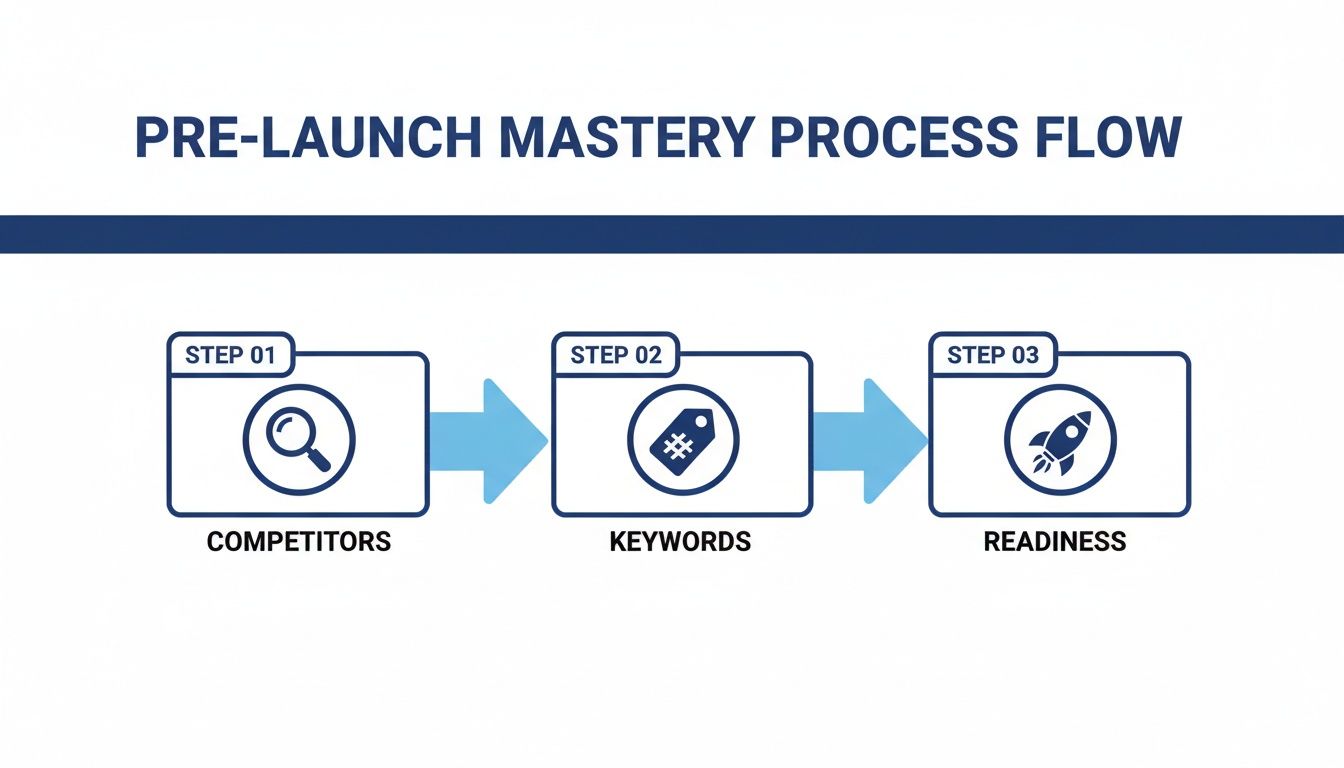
As illustrated, understanding your competitors, mastering your keywords, and achieving retail readiness are the foundational pillars of a powerful PPC launch.
Structuring Your Full-Funnel Launch Campaigns
One of the costliest mistakes sellers make is launching with a single, broad auto-campaign. This is an efficient way to burn through your budget on irrelevant search terms. A far more effective approach is to deploy several distinct campaigns, each with a specific mission.
Think of it as deploying a coordinated tactical team:
- Aggressive Keyword Campaigns (The Vanguard): These are your front-line offensive units. Structure Sponsored Products campaigns targeting the top 5-10 high-intent keywords identified in your research. Use exact match for maximum control and bid aggressively for top-of-search placement. The mission: drive sales on the keywords that matter most.
- Defensive Product Targeting (The Guards): The moment you gain traction, competitors will target your detail page to siphon off customers. Preempt this by setting up a Sponsored Products campaign targeting your own ASIN. This defensive play ensures you control the ad real estate on your listing.
- Brand Awareness Campaigns (The Air Support): Leverage Sponsored Brands and Sponsored Display to build top-of-funnel awareness. A Sponsored Brands ad featuring your new product alongside established bestsellers is highly effective for capturing broader category searches. Use Sponsored Display to retarget shoppers who viewed your listing but did not purchase, bringing them back to complete the transaction.
Choosing Your Bidding and Budgeting Strategy
During a launch, your mindset must shift. Forget about chasing a low ACoS. You are investing in visibility, data acquisition, and sales velocity. Your bidding strategy must reflect this.
For your primary keyword campaigns, we recommend a Fixed Bids strategy. While dynamic bidding is useful for optimization later, fixed bids provide predictable control over ad placement during the critical first few weeks. You are telling Amazon precisely what you are willing to pay for a click, which is essential for dominating your most important search terms.
Expert Takeaway: We typically allocate 60-70% of the initial PPC budget to aggressive, exact-match keyword campaigns. Another 15-20% is dedicated to defensive product targeting, with the remaining 10-15% reserved for top-of-funnel brand campaigns. This structure prioritizes the sales velocity needed to climb the rankings.
Amplifying Your Reach with Amazon DSP
While PPC is your workhorse within the Amazon ecosystem, do not overlook Amazon DSP (Demand-Side Platform). For brands with the budget, DSP is a launch game-changer, enabling you to reach shoppers both on and off Amazon. It allows you to build audiences based on lifestyle interests, in-market segments, and views of competitor products.
Imagine you're launching a high-end coffee maker. With DSP, you could serve ads to users who recently purchased premium coffee beans, searched for competing brands, or browsed coffee-related blogs off-Amazon. This creates a powerful flywheel, driving highly qualified external traffic to your new listing and sending strong relevance signals to the A9 algorithm.
Amazon itself provides the perfect case study. The company became a behemoth by opening its platform to third-party sellers, who now drive 60% of all sales. The lesson for brands is clear: leverage every available tool. A robust Amazon product launch strategy combined with aggressive PPC creates the momentum to reach page one, making your product 4.2 times more likely to achieve long-term profitability.
Ultimately, a data-driven launch comes down to precision. Every campaign, keyword, and bid should serve one goal: generating the initial sales spike needed to begin climbing the organic ranks. For an even deeper dive into these tactics, check out our complete guide on how to launch a product on Amazon.
Time to Optimize: Scaling for Long-Term Profit
The launch is complete. The initial push is over, but this is where the real work begins. The first 30 to 90 days are critical for transitioning from a "sales at all costs" mindset to building a sustainable, data-driven growth engine.
Think of the launch as getting the flywheel spinning. Now, it's about making smart, calculated adjustments to accelerate its momentum. We are shifting from simply getting seen to getting seen by the right shoppers and converting that traffic as efficiently as possible.
What the Early Data is Telling You
After a few weeks of running aggressive launch campaigns, you are sitting on a goldmine of performance data. Your advertising console, particularly the Search Query Performance report, is your new command center. It reveals exactly how real customers are finding and purchasing your product.
It’s tempting to fixate on ACoS, but you must go deeper.
- Search Query Reports: This is where you find actionable intelligence. Hunt for the exact search terms that are converting into sales. These are your proven winners.
- Click-Through Rate (CTR): High impressions but low clicks on a core keyword indicate a relevance disconnect. Your main image or title may not align with shopper expectations for that search.
- Conversion Rate (CVR): If you're generating clicks but not sales, the issue likely lies on your product detail page. Is your price point wrong? Are your bullet points unconvincing? Do you have enough reviews to establish trust?
This data is not for spreadsheets; it's your strategic roadmap. It points directly to where your ad spend is delivering ROI and where you're simply burning cash.
Harvesting Keywords and Refining Your PPC
Those initial auto and broad match campaigns served their purpose: they cast a wide net to discover what works. Now, it's time to pull in that net and sort the catch. This process, known as "search term harvesting," is the foundation of long-term PPC profitability.
The process is simple but incredibly powerful. You take what works and move it into a controlled environment where it can scale.
- Analyze your auto campaign search query reports. Identify every query that has generated two or more sales.
- Move these proven terms into a manual campaign as exact-match keywords. This gives you precise bid control over the terms that generate revenue.
- Critically, once a term is moved, add it as a negative exact match in the original auto campaign. This prevents you from bidding against yourself and ensures every dollar is spent with maximum efficiency.
A disciplined negative keyword strategy is non-negotiable. On average, sellers can reduce wasted ad spend by 18% simply by continuously pruning irrelevant search terms. This forces your budget toward high-intent shoppers, directly boosting your bottom line.
This is not a one-time task but a continuous cycle of refinement. It sharpens ad performance, lowers your Total ACoS (TACoS), and strengthens the crucial link between ad spend and organic rank.
Building Trust with Social Proof and Early Reviews
Shoppers trust other shoppers. Data consistently shows that reviews are a primary driver of purchase decisions. During the post-launch phase, building this social proof is a top priority. All the traffic in the world won't convert if your listing lacks credibility.
You absolutely need a game plan for acquiring those first critical reviews.
- Amazon Vine Program: This is one of the fastest and most reliable methods for securing your first batch of honest, detailed reviews. Vine reviewers are trusted by Amazon, and their early feedback provides the confidence other shoppers need to convert.
- "Request a Review" Button: It’s simple but effective. Make it standard operating procedure to use the "Request a Review" button in Seller Central for every order. It's free, compliant, and a direct way to solicit feedback.
Acquiring a solid review base isn't just about appearances. Listings with strong social proof and premium content regularly see conversion rate increases of 10–15%. That lift not only means more sales but also improves overall profitability and sends positive signals to Amazon's algorithm, boosting your rank. A strong review foundation is a core pillar of any serious Amazon product launch strategy.
The post-launch period is about making smart, incremental optimizations. By analyzing your data, refining your ad campaigns, and actively building social proof, you will pivot from an aggressive launch to a profitable, scalable business poised for long-term success.
Using Amazon's Ecosystem to Amplify Growth
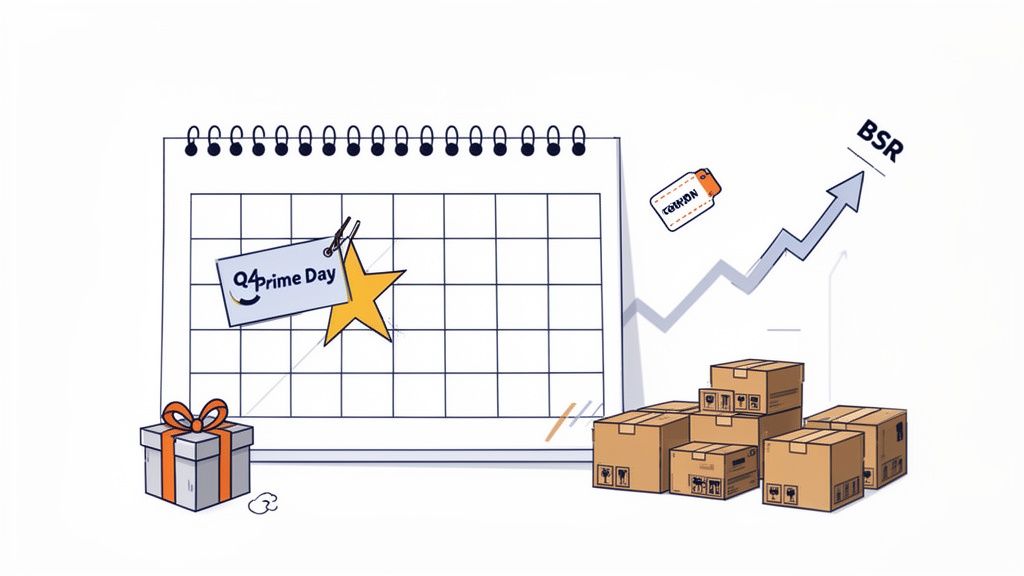
A truly strategic Amazon product launch strategy doesn’t operate in a vacuum. The most successful brands synchronize their launches with Amazon's own marketing calendar. Massive events like Prime Day and the Q4 holiday season are not just sales days; they are force multipliers for a new product.
Launching into a pre-existing flood of high-intent traffic is exponentially more effective than attempting to generate demand from a standstill. These tentpole events bring millions of motivated shoppers to the platform, creating a powerful wave you can ride to gain immediate traction and accelerate your product's ranking.
Timing Your Launch for Maximum Impact
The question isn't if you should leverage these events, but how. Timing is everything.
Launching a brand-new product during the week of Prime Day is a recipe for failure; it will be lost in the noise. The objective is to build a solid foundation before the event begins, allowing you to capitalize on the traffic surge rather than being drowned by it.
A more strategic approach involves two phases:
- The Pre-Event Warm-Up: Launch your product 30-60 days prior to a major event. This provides a critical window to generate initial sales, acquire early reviews (using programs like Amazon Vine is ideal here), and establish a baseline sales history.
- The Main Event Velocity Boost: When the event arrives, you use it as a massive amplifier. With sales history and social proof, your product is now primed to convert the huge influx of shoppers at a much higher rate.
This methodology effectively turns Amazon's marketing machine into your personal launchpad. You are strategically placing your product in the path of millions of consumers who are already in a buying mindset.
Prepping Your Product for the Big Stage
To truly leverage an event like Prime Day as a growth lever, your product listing must be performance-ready. This means dialing in your inventory, pricing, and advertising plans well in advance.
Amazon has mastered these timed events. Prime Day has become a global retail phenomenon, generating $14.2 billion in sales. It began as a perk for Prime members—a group projected to reach 176 million in the U.S. by 2025—and has evolved into a major shopping holiday.
For a new product, this means your goal should be to achieve a Best Seller Rank (BSR) of 1,000-5,000 in your sub-category before the event kicks off. This requires careful inventory planning and a smart PPC strategy in the weeks leading up to the main event.
The Takeaway: The goal is to enter a peak traffic period with momentum, not from a standing start. An established BSR and a handful of positive reviews dramatically increase your product's credibility and conversion potential when millions of new shoppers land on your page.
Executing Your Event-Driven Promotion Strategy
When the event arrives, it’s time to execute. This is where you layer promotions on top of your existing ad campaigns to maximize visibility and drive sales velocity.
Your promotional toolkit should be ready to deploy:
- Coupons: The green coupon badge is a powerful attention-grabber on a crowded search results page. It is highly visible and can significantly increase your click-through rate.
- Prime Exclusive Discounts: For events like Prime Day, these are essential. They get your product featured on Amazon's dedicated deals pages, providing a massive visibility boost that is otherwise unattainable.
- Aggressive PPC Bids: Traffic and competition are at an all-time high. You must increase bids on your top keywords to maintain visibility. The good news is that conversion rates are typically much higher, often justifying the increased ad spend.
Launch Phase vs Growth Phase PPC Strategy
Your PPC strategy must evolve as your product transitions from launch to maturity. Initially, the focus is on aggressive visibility and data acquisition. Later, it shifts to profitability and scale.
Here’s how those strategies differ:
| Strategy Component | Launch Phase (First 30 Days) | Growth Phase (Day 31+) |
|---|---|---|
| Primary Goal | Maximize visibility, drive initial sales velocity, and gather keyword data. | Optimize for profitability (ACOS/TACOS), scale winning campaigns, and expand keyword targeting. |
| Campaign Types | Broad, Phrase Match, and aggressive Auto campaigns to discover keywords. | Exact Match campaigns for proven keywords, Product Targeting (PAT) campaigns, and Brand Defense. |
| Bidding Strategy | Higher bids to secure Top of Search placement. Focus on impressions and clicks. | More controlled bids based on conversion rates. Focus on ACOS and ROAS. |
| Budget Allocation | Higher daily budgets, often accepting a higher ACOS to fuel the algorithm. | Budgets are set based on profitability targets. Unprofitable campaigns are paused or optimized. |
| Key Metrics | Impressions, Clicks, Click-Through Rate (CTR), and initial sales volume. | Advertising Cost of Sales (ACOS), Total ACOS (TACOS), and Conversion Rate. |
| Keyword Harvesting | Actively pulling converting search terms from Auto and Broad campaigns to test in new ones. | Refining keyword lists, adding negative keywords, and focusing spend on top-performing terms. |
Understanding this strategic shift is crucial. Applying a "growth phase" strategy during your launch will render you invisible, while running a "launch phase" strategy for too long will destroy your profitability.
By aligning your launch and promotional calendar with Amazon's, you tap into a powerful system built for growth. For a deeper dive into building this kind of sales velocity, you can check out our detailed look at Amazon Launch Pad strategies. This is not just about generating high sales volume during a holiday; it's about leveraging that event to permanently elevate your product's organic rank and secure its long-term position in the market.
Got Questions About Your Amazon Launch? We've Got Answers.
Even the most well-architected launch plans come with questions. When you're managing budgets, timelines, and the inevitable complexities of the Amazon platform, it's critical to have clarity. Let's address some of the most common questions we hear from eCommerce leaders preparing for a launch.
What's a Realistic Budget for an Amazon Product Launch?
There is no universal answer—your budget is a function of category competitiveness and your sales objectives. However, a sound rule of thumb is to budget for enough ad spend to generate 10-20 sales per day from your most critical keywords. Plan to sustain this for the first two to four weeks.
Frame this not as a cost, but as an investment in data and momentum. These early sales send powerful relevance signals to Amazon's A9 algorithm, which is essential for beginning your ascent in the organic rankings.
For a product in a moderately competitive category, a daily PPC budget of $100-$300 is a reasonable starting point. In hyper-competitive categories, that figure can be significantly higher. Before finalizing a budget, perform a competitive analysis to estimate the daily sales volume of top performers and build your budget to achieve a similar target.
How Long Until I Actually See Results?
Assuming a fully optimized listing and properly structured ad campaigns, you should begin generating sales and collecting valuable data within the first 7-14 days. However, the most significant progress occurs during the "honeymoon period"—the first 30-60 days when Amazon's algorithm gives new products preferential treatment.
Your primary objective during this window is to secure a page-one position for your top 3-5 keywords. While you will see early traction, achieving consistent, profitable sales and organic dominance is a marathon. Expect this to take approximately 3-6 months. This timeframe allows for ad optimization, review acquisition, and the establishment of a steady sales history that the algorithm rewards.
Key Insight: A launch is not a singular event; it's the start of a continuous optimization process. Monitor your keyword rankings, traffic (sessions), and conversion rates daily to ensure your strategy is performing and you are progressing toward long-term, profitable growth.
What Are the Biggest Mistakes I Should Avoid?
Time and again, the costliest launch failures stem from a single source: a lack of preparation. These are the unforced errors that can derail a product with high potential before it ever has a chance to scale.
Here are the top five landmines we see brands encounter:
- Stocking Out: This is the cardinal sin of a product launch. Going out of stock completely erases your sales momentum. Once that ranking velocity is lost, it can take weeks—or longer—to recover.
- Underinvesting in PPC: Insufficient ad budget is like trying to start a fire with damp wood. You starve the algorithm of the sales data it needs to learn where to rank your product.
- A Poorly Optimized Listing: Launching with weak imagery, incomplete keyword research, or thin A+ Content is a waste of capital. It leads to low click-through and conversion rates, reducing the effectiveness of every ad dollar spent.
- Obsessing Over ACoS Too Soon: During the launch phase, your objective is market share and visibility, not immediate profitability. Focusing too heavily on achieving a low ACoS in the first 30 days will suffocate your growth potential.
- Neglecting Reviews: Social proof is a primary conversion driver. Failing to actively pursue initial reviews through programs like Amazon Vine creates a trust deficit that will deter potential buyers.
A comprehensive pre-launch checklist is your best defense. It helps you sidestep these common—and costly—blunders, giving your investment the highest probability of success.
At Headline Marketing Agency, we remove the guesswork from these complex launch variables, creating a clear, data-backed plan for execution. We build and manage comprehensive PPC and DSP strategies engineered for profitable, sustainable growth, transforming your product launch into an engine for long-term brand success. Learn how we can build your tailored Amazon advertising strategy.
Get Your Free Amazon PPC Audit
Discover untapped growth opportunities and see how our data-driven approach can improve your ROAS.
Get Free Audit →Ready to Transform Your Amazon PPC Performance?
Get a comprehensive audit of your Amazon PPC campaigns and discover untapped growth opportunities.