Affordable PPC Management for Amazon Brands
Cut waste, not growth. Learn how Amazon brands approach affordable PPC management with margin-based budgeting, vendor checks, and transparency.

The popular advice is simple: find the lowest PPC management fee and force ACOS down. That advice is wrong for most Amazon brands. A cheap retainer can leave search terms unharvested, irrelevant traffic unchecked, listings under-tested, and profitable campaigns cut before they create organic demand.
Affordable PPC management means the lowest total cost of profitable growth, not the smallest invoice. Your evaluation should connect contribution margin, incremental sales, TACOS, organic unit share, new-to-brand outcomes, and fee transparency. A partner charging more can be less expensive if the account produces stronger contribution profit and better organic momentum.
PPC remains accessible because advertisers pay when shoppers click rather than when an ad appears. Brands can define budgets, bids, keywords, geographic targeting, and audiences without committing to a large upfront media purchase, a model whose early history includes Planet Oasis experiments in 1996 and Google AdWords' launch on October 23, 2000, as documented in the history of PPC and Google Ads. That control is valuable, but only when someone manages the spend intelligently.
Why Cheap PPC Management Gets Expensive
A low agency fee tells you what the provider charges for labor. It tells you nothing about what the account costs to operate.
An under-managed Amazon account often looks efficient in a narrow dashboard. ACOS may fall after bids are cut, but sales volume, organic visibility, and total contribution profit can fall with it. The account saves on media while losing demand. That is deferred cost, not affordability.
The correct question is:
What does each additional advertising dollar contribute after product economics, management fees, and lost opportunity are included?
The invoice is only one cost
A percentage-of-spend agreement can look attractive when an account is small, yet the fee may obscure whether the agency is doing enough work to justify it. A flat retainer can look expensive, yet rigorous search-term analysis, listing recommendations, experimentation, and retail-readiness checks may prevent much larger waste.
Consider the difference between a 12% fee on a $50,000 account with poor incrementality and a 20% fee on a tightly managed $20,000 account. The first fee is $6,000, while the second is $4,000. The larger account still loses if much of its spend captures sales that would have happened anyway, or if weak conversion damages organic momentum. Fee percentage alone cannot answer the affordability question.
Amazon benchmark data reinforces why simple comparisons fail. A Q1 2025 report found that Sponsored Brands CPC rose 8.3% year over year in the EU, while Pet Supplies CPC rose 23% year over year, showing that media conditions can change even when management fees don't. The figures come from Pacvue's Q1 2025 retail media benchmark report.
Use a margin-first scorecard
Start with contribution profit per dollar of advertising, then monitor:
- TACOS: Advertising spend divided by total Amazon revenue, including organic sales.
- Organic unit share: Whether paid activity is helping the catalog sell more units without paid placement.
- New-to-brand sales: Whether campaigns are acquiring customers rather than only defending existing demand.
- Incrementality: Whether advertised orders exceed the sales that would have occurred without the ads.
- Retail readiness: Whether price, inventory, reviews, content, and fulfillment can convert the traffic you buy.
External operating philosophies help here too. If you're comparing hands-on approaches, how Bluelight handles PPC offers a useful reference point for evaluating the relationship between campaign management and broader performance work.
A low-cost provider that only changes bids is cheap to retain and expensive to keep. Your standard should be decision quality. The right partner protects profitable demand, removes waste, tests growth opportunities, and explains how paid media affects the whole Amazon business.
Set Your Real Budget From Contribution Margin, Not ACOS
ACOS is a reporting ratio. It isn't a budget strategy.
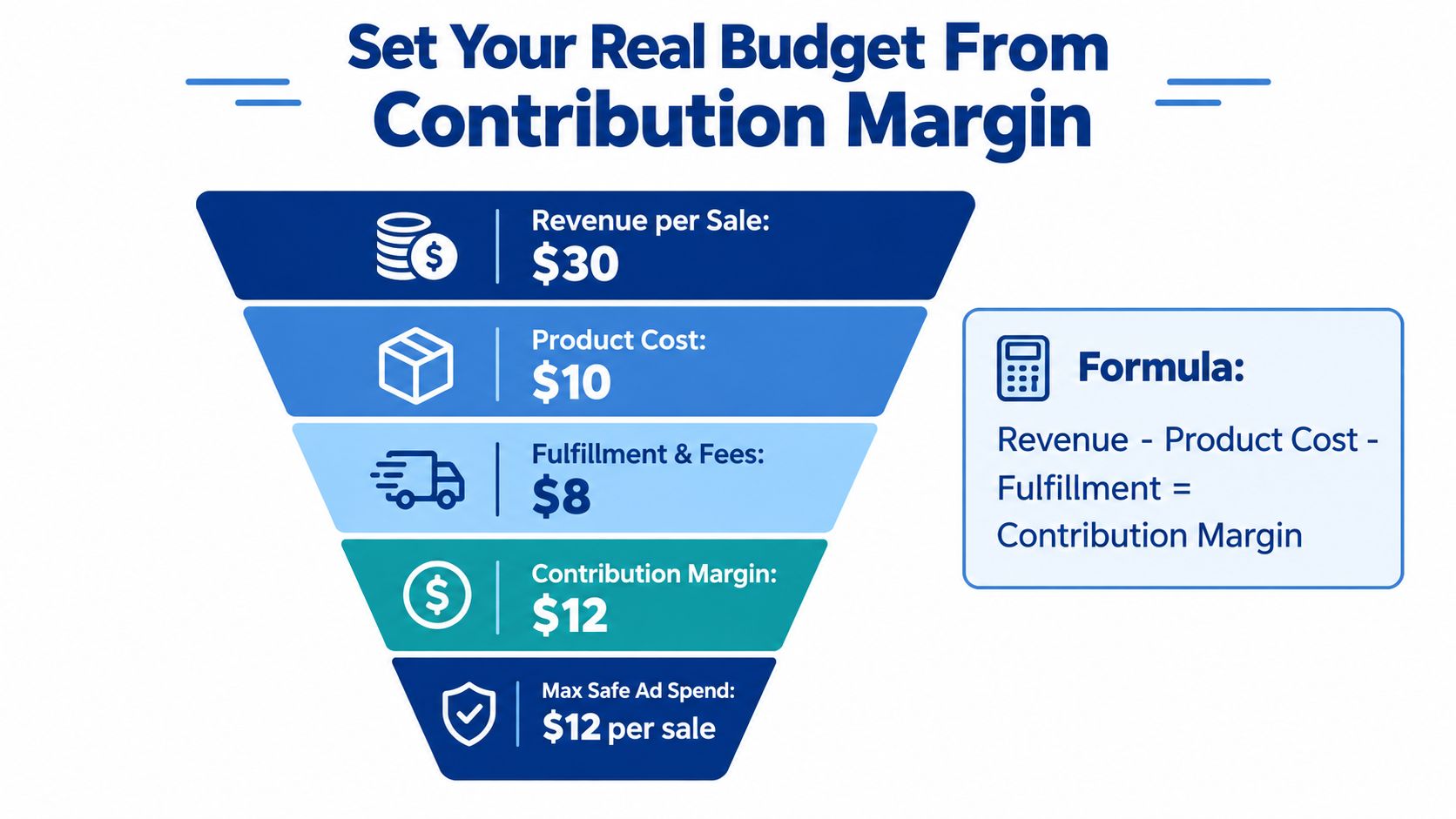
Before selecting an agency or setting bids, calculate what each sale can contribute before advertising. Subtract product cost, fulfillment, marketplace fees, returns, and discounts from selling price. The remaining percentage is your approximate break-even ACOS.
A product with a 35% pre-ad contribution margin breaks even at 35% ACOS, according to the margin framework documented by Trellis's Amazon advertising benchmarks. A target below that level creates room for profit, although a brand may deliberately accept weaker short-term efficiency when funding acquisition, ranking growth, or new-product discovery.
Build the ceiling before the campaigns
Use this sequence:
- Calculate pre-ad contribution. Selling price minus product cost, fulfillment, marketplace fees, returns, and discounts gives you the contribution dollars available to fund advertising and profit.
- Set an operating target. Don't manage at the break-even ceiling. Leave room for reporting variance, conversion changes, inventory conditions, and testing.
- Separate objectives. Branded defense, non-branded discovery, competitor targeting, and product or category targeting shouldn't share one efficiency expectation.
- Match query control to evidence. Use exact match for proven converting terms. Use phrase and broad match for controlled discovery. Add negative keywords and product targets when traffic repeatedly fails to convert.
- Review economics on a fixed cadence. Move converting search terms into exact campaigns, and reduce bids on expensive terms with no orders after a meaningful decision window.
For practical support on the underlying calculation, use this guide to calculate profit margins. The math should sit in the same operating document as your budget, not in a separate finance file nobody checks during optimization.
Keep ACOS in context
A benchmark panel covering more than 2,800 brands reported a blended Amazon advertising CTR of 0.56%, conversion rate of 10.77%, and ROAS of 3.08%, as reported by Trellis. These are diagnostic reference points, not universal targets. Category, price, review strength, listing quality, and retail readiness can move performance materially.
A campaign can have an unattractive ACOS and still be valuable if it improves organic sales. Conversely, a low ACOS campaign can be unproductive if it only captures branded demand that already existed.
Track ACOS beside TACOS, organic-unit share, new-to-brand sales, impression share, and contribution profit. If the campaign improves total economics, don't kill it just to make one dashboard ratio look cleaner.
Comparing Pricing Models Without Falling for the Lowest Fee
A pricing model shapes behavior. It determines what the provider can afford to do, what gets prioritized, and where incentives may diverge.
| Pricing Model | How It Bills | Best Fit | Main Risk |
|---|---|---|---|
| Flat monthly retainer | Fixed fee for a defined scope | Predictable account structure and stable workload | Scope may be too narrow for changing needs |
| Percentage of ad spend | Fee rises with media investment | Expanding catalogs and flexible media levels | Can reward higher spend instead of better efficiency |
| Performance or hybrid | Base fee combined with outcome-based compensation | Brands willing to share upside and define measurement carefully | “Performance” may exclude margin, incrementality, or organic impact |
| In-house blended cost | Salaries, tools, training, and management time | Brands with enough complexity and internal capability | Hidden overhead and dependence on a small team |
What each model really buys
A flat retainer works when deliverables are explicit. Ask whether it includes campaign architecture, search-term analysis, bid management, negative coverage, listing recommendations, testing, reporting, and strategy calls. If it only covers routine bid changes, the brand may need to pay separately for the work that creates growth.
A percentage-of-spend model can scale with account complexity, but it creates a potential conflict. The provider earns more as spend rises, even when additional investment doesn't improve contribution profit. Require a clear explanation of how the team decides whether to increase or reduce media.
Performance and hybrid pricing can align incentives, but only when the contract defines the outcome. Is it attributed revenue, contribution profit, new-to-brand sales, total revenue, or incremental revenue? General discussions of outcome based pricing are useful here, but Amazon brands need platform-specific definitions and access to the underlying data.
An in-house model offers control and context. It also carries costs that rarely appear in the media plan, including hiring, training, tools, management coverage, and continuity during staff changes. Internal ownership is valuable, but it isn't automatically cheaper.
Read the scope line by line
Demand written answers to these questions:
- Does the team audit retail readiness before scaling traffic?
- Who owns listing tests and content recommendations?
- How often are search terms reviewed?
- Are Sponsored Products, Sponsored Brands, Sponsored Display, and DSP evaluated by role?
- Does reporting separate branded and non-branded performance?
- Are experiments and incrementality analysis included?
- Are third-party fees, technology costs, and media markups disclosed?
The lowest retainer wins only when the scope is sufficient and the decisions are good. Otherwise, the brand pays through wasted spend, delayed learning, and missed organic growth.
A Vendor Evaluation Checklist That Exposes Under-Management
A capable PPC partner should make the account easier to understand and harder to waste. If the monthly report only shows spend, sales, ACOS, and ROAS, you're receiving a scoreboard, not management.
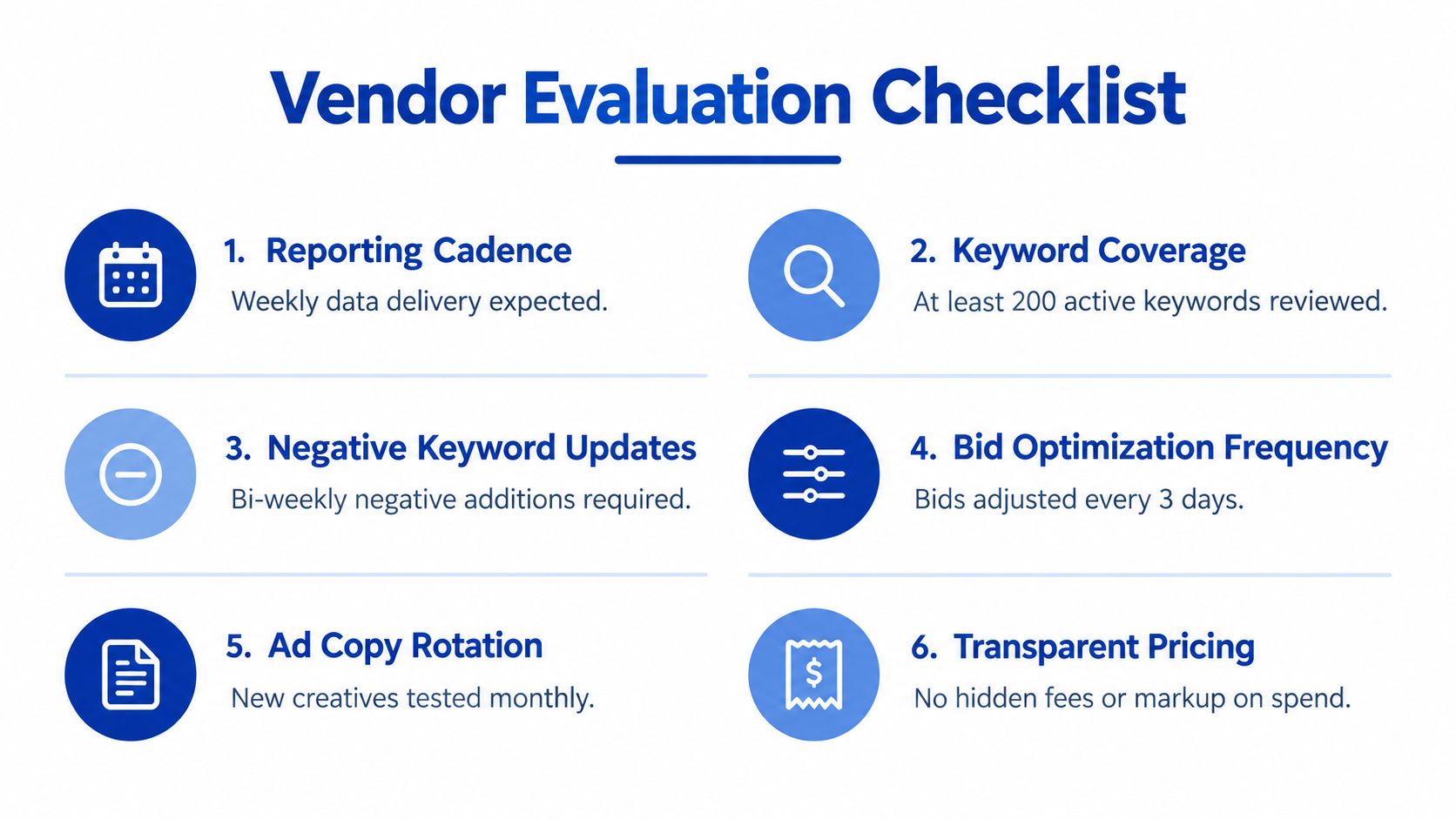
Start with the first 60 days. The provider should establish account structure, identify waste, document campaign roles, review search terms, assess listing readiness, and create a testing roadmap. You should know which changes were made, why they were made, and what evidence will determine the next move.
What should appear in the operating review
Look for these outputs:
- Branded versus non-branded TACOS: This shows whether efficiency depends on existing demand or genuine category capture.
- New-to-brand performance: Use the metric where available to distinguish acquisition from defense.
- Organic unit trends: A paid campaign can support organic growth even when direct attribution looks modest.
- Search-term harvesting: Converting queries should move into controlled exact-match structures.
- Negative keyword coverage: Repeated irrelevant traffic should have a documented resolution.
- Experiment status: Each test needs a hypothesis, comparison period, decision rule, and owner.
- Retail-readiness recommendations: The provider should flag content, pricing, inventory, reviews, and offer issues that limit conversion.
The red flags are predictable. Vague monthly commentary, no search-term evidence, no listing recommendations, no explanation for budget shifts, and no testing calendar all point to under-management. A vendor that can't show the work may still be making good decisions, but you have no reliable way to verify it.
Score transparency instead of presentation quality
Use a simple review table during pitches and quarterly evaluations:
| Signal | What it tells you | Follow-up question |
|---|---|---|
| Detailed search-term actions | Whether the team manages query quality | Which terms were promoted, reduced, or excluded? |
| Branded and non-branded segmentation | Whether reported efficiency hides demand capture | What happens when branded spend is separated? |
| Experiment log | Whether recommendations are testable | What was the hypothesis and comparison period? |
| Fee breakdown | Whether management cost is auditable | Are media markups, technology, and third-party costs separate? |
| Listing feedback | Whether the partner manages conversion, not only traffic | Which content or offer change should happen next? |
A cheap account manager can produce a polished deck. A strong operator can connect every major budget decision to margin, funnel evidence, and a documented action. Choose the second.
Using Search Query Funnel Data to Spend the Next Dollar Right
“Add negatives and tighten keywords” is useful advice, but it's incomplete. Amazon's Search Query Performance reporting lets brands inspect the path from demand to purchase, including query volume, impressions, clicks, add-to-cart activity, purchases, and each stage's share across weekly, monthly, and quarterly periods, as described in this Search Query Performance analysis.
That changes the budget question. Instead of asking whether a campaign has enough impressions, ask where the product loses shoppers and whether advertising or retail readiness can fix the loss.
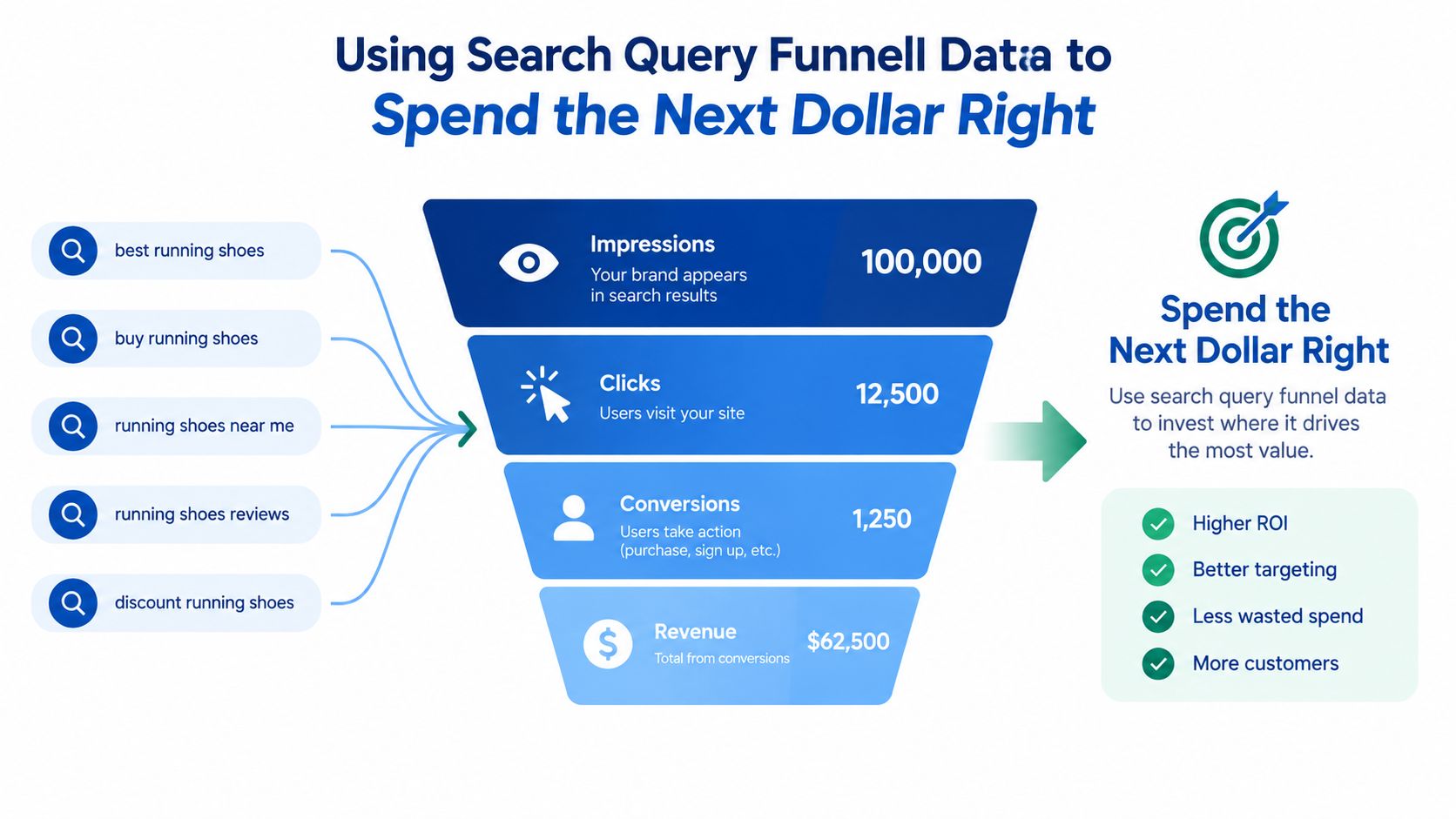
Diagnose the bottleneck
High impressions, weak clicks usually points to a relevance, creative, pricing, or placement problem. More bids won't solve a shopper who sees the product and ignores it. Review the main image, title, price position, and query alignment before buying more exposure.
Strong clicks, weak add-to-cart activity indicates a product detail page or offer problem. Check image sequencing, reviews, variation structure, bundle logic, delivery promise, and the clarity of the value proposition. Traffic is arriving. The page isn't earning the next step.
Strong add-to-cart activity, weak purchases points toward purchase friction or price resistance. Compare the offer against competing products, inspect coupon and delivery conditions, and check whether inventory or buy box issues are interrupting checkout.
Make the next-dollar decision explicit
Use a query-level workflow:
- Pull the relevant Search Query Performance period and identify where the product loses share.
- Separate branded, non-branded, competitor, and category queries.
- Match each bottleneck to an action, such as bid change, keyword transfer, creative revision, offer adjustment, or listing test.
- Protect queries with healthy economics while limiting spend on traffic that repeatedly fails to advance.
- Recheck the same funnel stage after the decision window, rather than reacting to daily noise.
This prevents a common waste pattern: funding more traffic to a page that can't convert it. Sometimes the best use of the next advertising dollar is no additional advertising. It's a better image, stronger offer, clearer content, or improved retail readiness.
For search-term execution, keep the account connected to a structured Amazon search terms workflow. A well-managed account doesn't just collect clicks. It turns query evidence into tighter targeting and better conversion conditions.
The performance-first rule is straightforward: spend where the funnel proves that more traffic can create more profitable demand.
Incrementality, Attribution Honesty, and DSP Fee Transparency
Cheap PPC management gets expensive fast when the account takes credit for demand it did not create. If you cannot separate assisted conversions from incremental lift, you are not managing growth cost. You are just reporting platform wins.
Rules-based attribution still has a place for day-to-day optimization, but it does not prove causality. A reported Meta analysis found that advertisers undervalued Meta's contribution by a median 31% when they relied on rules-based attribution instead of incrementality measurement, as covered in Meta's measurement framework coverage. The broader point applies on Amazon too. Platform dashboards can under-credit upper-funnel media, over-credit remarketing, and make blended performance look cleaner than the business reality.
Measure against the counterfactual. Ask what would have happened without the ad, then use the strongest test your setup can support.
- Randomized holdouts: The best option when the platform and audience design allow it.
- Geographic tests: Compare exposed and unexposed markets while controlling for major commercial differences.
- Time-based tests: Pause or change defined campaigns, then track organic sales, total sales, contribution profit, and rank trends.
- AMC path analysis: Review audience paths and exposure patterns to understand how shoppers move through the funnel.
- Pre-period comparisons: Use for directional evidence only, and document price, inventory, seasonality, and content changes.
Run each test with one hypothesis. Freeze comparison conditions. Change one major variable. Wait for enough click and conversion volume to judge the result. Daily edits do not make you agile here. They contaminate the read.
DSP makes this more important, not less. Once off-Amazon inventory or managed service enters the mix, fee opacity and attribution gaps can turn an apparently efficient program into an expensive one.
Audit the cost stack, not just the reported outcomes. Amazon's pricing-transparency reporting for eligible EU DSP campaigns separates supply cost, demand-side fees, third-party fees, and managed-service fees. Amazon also states that its managed-service fee is 15% of supply cost, according to Amazon's DSP pricing transparency documentation.
Ask for that breakdown every time DSP appears in the media plan. You should be able to answer:
- What did supply cost?
- What demand-side, third-party, and managed-service fees were added?
- Which sales were attributed?
- Which outcomes were incremental?
- What new-to-brand result did the activity generate?
- What evidence justifies the next budget increase?
If your agency cannot show that level of transparency, the retainer is not affordable. It is incomplete.
Use this Amazon DSP advertising guide to assess channel role, measurement approach, and execution quality. Automation can reduce labor. It can also hide weak decisions. Affordable management requires auditability.
Sample Budget Templates for Small, Mid, and Growing Brands
Use these templates as operating structures, not universal spending rules. The right allocation depends on contribution margin, inventory, retail readiness, category competition, and the evidence from your account.
Small brand
For $1,500 to $5,000 in monthly ad spend, keep the system narrow:
- Sponsored Products: Fund branded defense, exact-match winners, and close product targets.
- Sponsored Brands: Use selectively for branded protection or proven category capture.
- Sponsored Display: Keep tightly capped and tied to a clear retargeting or product-targeting role.
- DSP: Avoid until the brand can measure the activity and support the required learning period.
- Experiment line: Reserve a defined portion for one hypothesis at a time.
- Kill switch: Reduce or pause targets that consume budget without advancing toward orders or contribution profit.
- Review trigger: Reassess allocation when organic unit share, TACOS, inventory, or conversion conditions materially change.
Mid-market brand
For $10,000 to $30,000 monthly, add structured discovery:
- Protect branded defense and proven exact-match campaigns.
- Expand non-branded discovery through phrase and broad match with active negative coverage.
- Use Sponsored Brands for category capture where the listing and offer can convert.
- Add Sponsored Display only when the audience or product-targeting role is clear.
- Fund a quarterly listing test rather than increasing bids against a weak detail page.
- Require branded and non-branded reporting, search-term harvesting, and an experiment log.
- Set a review trigger around contribution profit and TACOS, not ACOS alone.
Growing brand
For $40,000 or more monthly, separate growth from measurement:
- Give Sponsored Products the role of efficient demand capture and harvesting.
- Use Sponsored Brands to build category and branded demand where incrementality supports it.
- Use Sponsored Display for defined audience and product-path objectives.
- Add Amazon DSP with transparent supply, platform, third-party, and managed-service costs.
- Create a dedicated measurement reserve for holdouts, geographic tests, time tests, or AMC analysis.
- Keep a separate incrementality test reserve before scaling upper-funnel activity.
- Pause expansion when inventory, content, conversion, or measurement quality fails the readiness check.
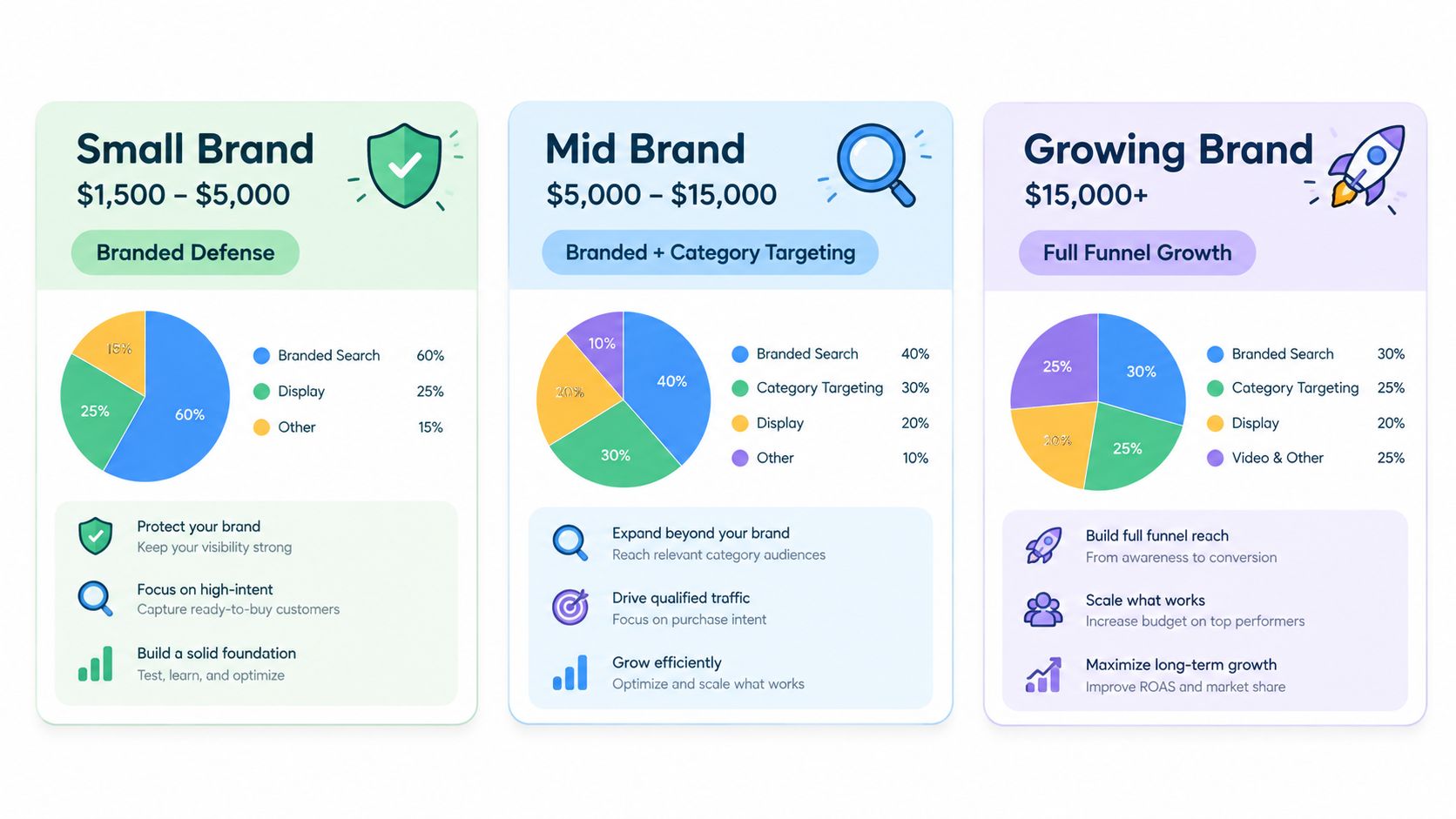
The principle is consistent across all three tiers: match spend to contribution margin, incrementality, and retail readiness. Amazon advertising can support organic growth, but only when the account captures profitable demand and the listing converts it. A low fee is irrelevant if the total cost of growth keeps rising.
Headline Marketing Agency manages Amazon PPC and DSP across Sponsored Products, Sponsored Brands, Sponsored Display, and broader full-funnel programs, with audits, search-term analysis, profitability reporting, and measurement tied to organic growth. If your current partner reports ACOS without proving contribution profit or incrementality, visit Headline Marketing Agency to evaluate a more transparent management approach.
Get Your Free Amazon PPC Audit
Discover untapped growth opportunities and see how our data-driven approach can improve your ROAS.
Get Free Audit →Ready to Transform Your Amazon PPC Performance?
Get a comprehensive audit of your Amazon PPC campaigns and discover untapped growth opportunities.