Ads Optimization Algorithm for Amazon Profit
See how an ads optimization algorithm uses Amazon data to set bids, budgets, and targeting for profit and organic rank, not ACOS alone.

The most popular advice about ad optimization is also the easiest to misuse: keep adjusting bids until ACOS falls. That can make a dashboard look healthier while leaving the business smaller, more dependent on branded demand, and no more profitable. A better approach treats the ads optimization algorithm as a tool for incremental profit and durable organic visibility, not cheaper attributed sales.
What an Ads Optimization Algorithm Decides
An ads optimization algorithm doesn't hunt for one perfect bid. Across auction ranking and campaign delivery, automated systems evaluate whether an ad should appear, where it might perform, and how aggressively to pursue the opportunity. Your bid matters, but so do relevance, expected engagement, and the likelihood that a shopper converts.
Don't confuse that operating model with a published Amazon formula. Amazon PPC bidding, auction ranking, budget delivery, and DSP optimization aren't one interchangeable mechanism. The useful distinction is between what the system estimates and what your team still controls.
What the algorithm decides and what you still own
| Decision | Data the algorithm uses | Lever you still own | ACOS trap |
|---|---|---|---|
| Bid on the click | Predicted CTR, CVR, your bid, rival bids, across bidding and auction systems | Match type, bid caps, placement modifiers | Branded exact looks cheap while it only harvests demand |
| Daily budget | Spend pace and conversion probability, where supported by the optimization setting | Split by awareness versus conversion role | Branded campaigns spend easily and starve nonbrand |
| Placement | Expected engagement by slot | Top-of-search bid adjustments | The top position on a weak listing wastes the premium |
| Targeting | Query history and audience behavior | Negatives and harvest rules into manual campaigns | Auto looks wasteful but is the discovery layer |
| Creative and detail page | Relevance and conversion quality | Images, reviews, price, and offer | Rising CPC amplifies a page that doesn't convert |
Bid on the click. Predicted click-through rate, or CTR, describes the chance of a click. Predicted conversion rate, or CVR, describes the chance of an order after that click. Neither tells your team whether the resulting order leaves enough margin, so bid caps must reflect economics outside the auction.
Daily budget. A budget controls how much delivery you can buy, not whether that delivery serves the right commercial purpose. Separate demand creation from demand capture before reallocating money toward whichever campaign spends most easily.
Placement. A top-of-search adjustment changes how aggressively you compete for that placement. Review the placement report alongside the product's conversion performance before paying more for visibility.
Targeting. Search terms reveal what shoppers typed, which isn't always the keyword you selected. Use the search-term report to distinguish relevant discoveries from traffic that should be excluded.
Creative and detail page. Images, review strength, price, and the offer influence whether attention becomes a purchase. Treat retail readiness as an input to advertising decisions, without assuming every listing attribute is a disclosed auction-ranking factor.
The common mistake across every row
A branded exact campaign can look efficient because it reaches shoppers already looking for you. An automatic campaign can look untidy because it explores unfamiliar queries. Comparing them only on ACOS can push your team toward harvesting existing demand and away from discovering new demand.
Tomorrow's action: Pick a row, name the report your team isn't exporting, and pause bid edits tied to that decision until the missing input is visible.
For placement, that might be the placement report. For targeting, it's the search-term report. For commercial value, it's a SKU-level contribution-margin view, not another campaign dashboard.
How Ranking Moved Past the Highest Bid
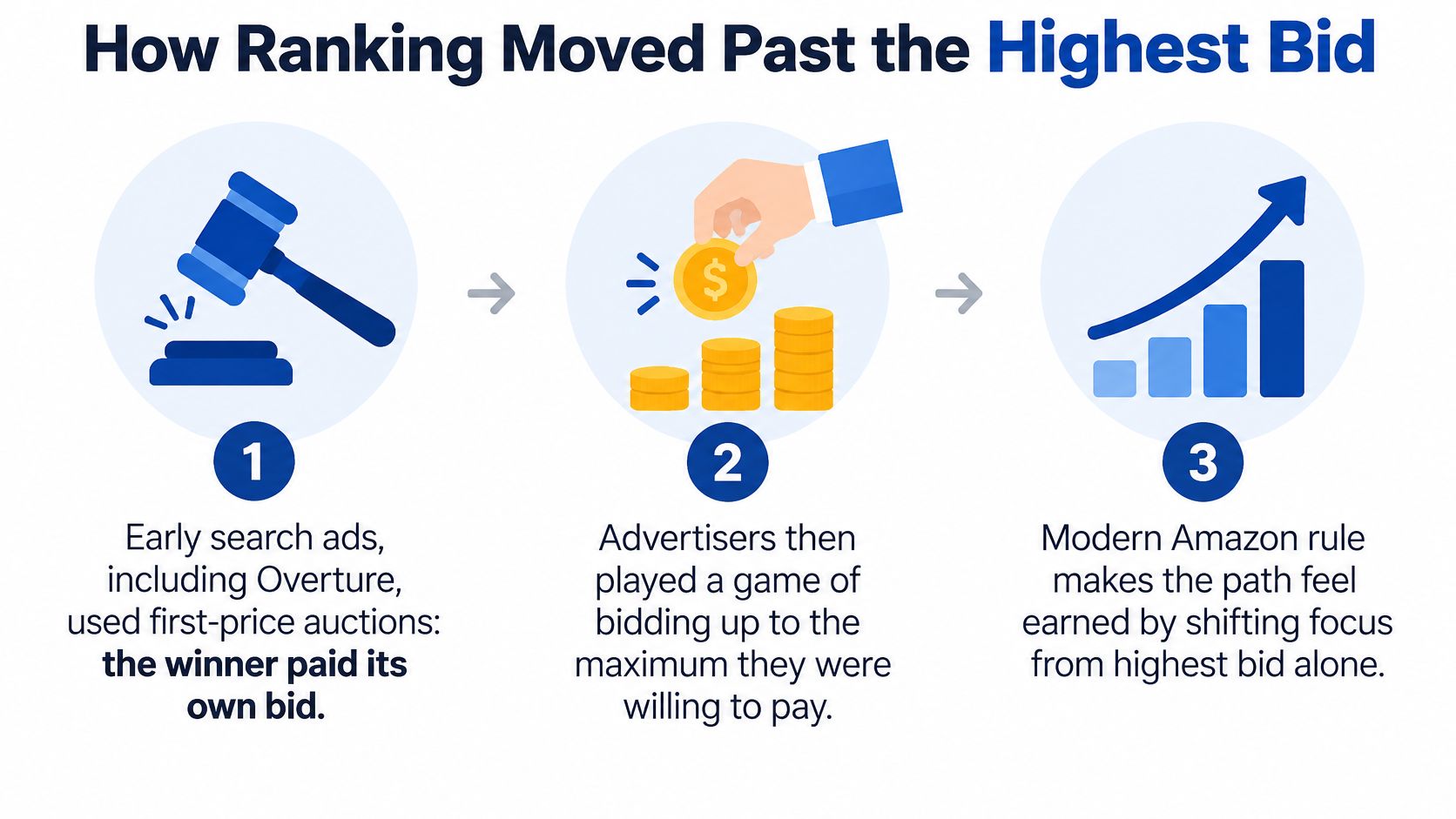
Early search advertising made the auction sound straightforward: offer more than the next advertiser and take the better position. But advertisers weren't passive buyers. They kept changing bids to work out what competitors would pay and how little they could spend while holding their place.
The NBER working paper on search-advertising auctions describes Overture's first-price auctions, unstable sawtooth bidding, the industry's mid-2000s shift toward generalized second-price mechanisms, and the models published by Varian in 2007 and Edelman, Ostrovsky, and Schwarz in 2007 that incorporated bids and expected click-through rates.
From price probing to quality-adjusted ranking
Under a first-price auction, the winning advertiser paid its own bid. Advertisers could therefore gain by repeatedly probing competitors' prices, then bidding just enough to preserve position. Those adjustments produced jumpy bidding rather than a settled assessment of what the traffic was worth.
Generalized second-price auctions changed the incentive. Advertisers typically paid enough to beat the next-ranked competitor rather than automatically paying their full bid. Expected clicks also mattered when allocating sponsored positions.
The timeline illustrates that broad progression.
Think of seats at an event. You no longer necessarily pay the price you shouted for the front row. You pay enough to sit ahead of the next eligible person, while the venue also considers how likely you are to show up and stay.
The analogy explains the economic logic. It isn't a claim that every Amazon ad product uses an identical auction formula.
For an Amazon operator, the implication is narrow and useful: a bid isn't a price you set in isolation. A larger bid doesn't repair a poor query match, and a cheaper click isn't automatically a better purchase.
Evaluate a bid against the shopper's intent, the product's expected conversion behavior, and the query's actual performance. Your commercial question isn't whether you can win the seat. It's whether that seat brings the right customer at a cost the business can support.
Quality Signals That Change Your Cost
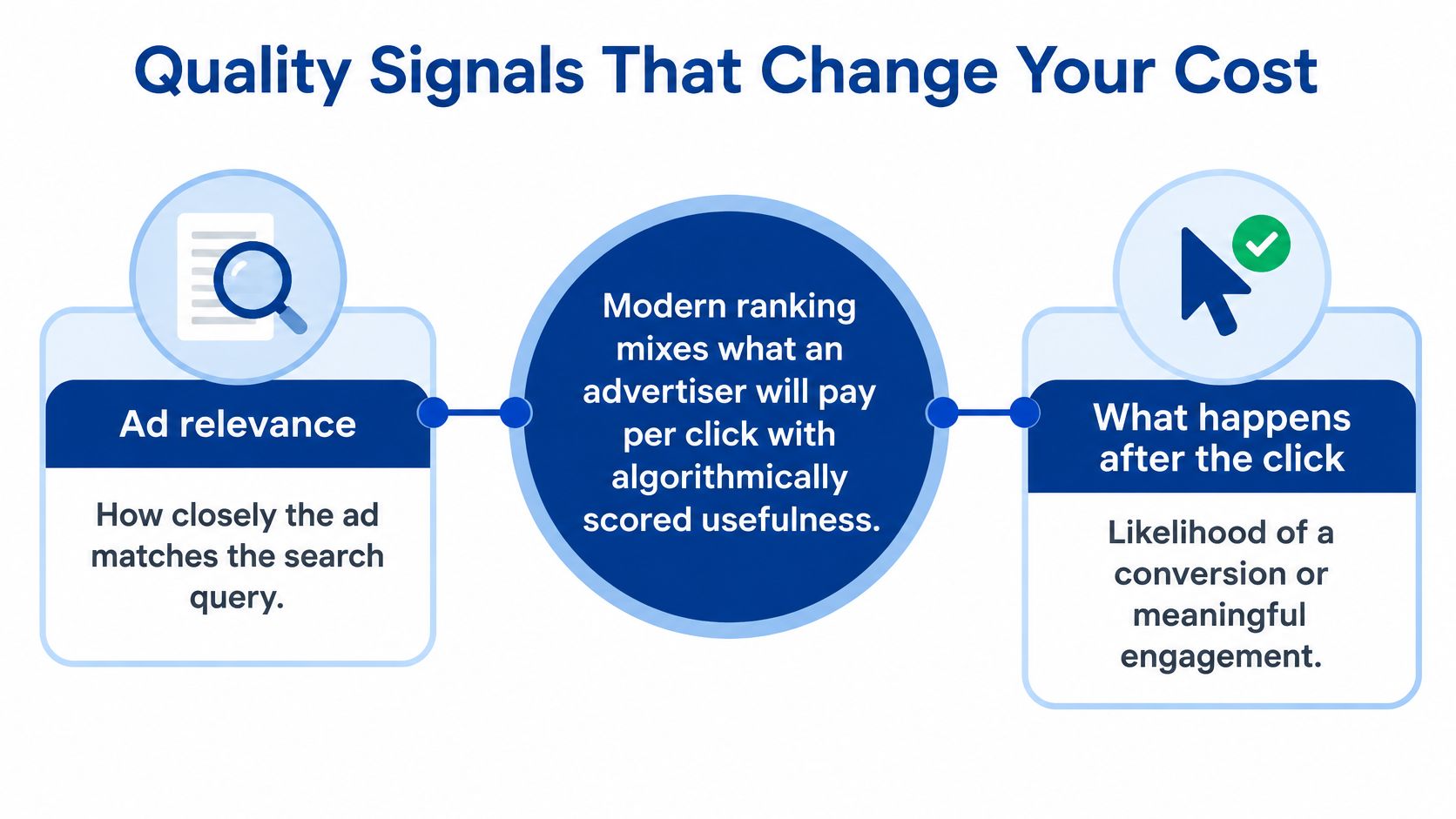
Quality is the other side of auction economics. If advertisers could buy attention solely by offering more money, shoppers would have little protection against irrelevant ads. Quality-adjusted systems give the platform a way to consider usefulness alongside willingness to pay.
A 2025 academic study of quality-score incentives describes relevance, click-through rate, and landing-page quality as central signals, discusses Google's use of quality in ranking and eligibility, and finds that incentives to improve landing pages can increase advertiser profit while intensifying competition.
Think of quality as economic leverage
A stronger match can improve auction position or effective cost without requiring the largest bid. That's why quality can behave like a discount on competitive effort, while weak relevance can behave like a penalty. It isn't a guaranteed rebate or a universal pricing equation.
The relationship is easier to understand when you separate the click from what follows it.
Say a shopper searches for an insulated lunch bag. Your ad shows a product that looks relevant, but the detail page doesn't clearly establish internal dimensions or whether food containers fit. You might win the click and still lose the purchase.
Raising the bid addresses access to the shopper. Clarifying the page addresses the shopper's objection. Those aren't interchangeable fixes.
Diagnose the failure before increasing spend
For Amazon PPC and DSP, retail readiness connects targeting, creative, and conversion performance. Don't import Google's quality-score terminology as though Amazon exposes the same score. Use the underlying principle to diagnose where shoppers disengage.
- Weak engagement: Check query fit, the main image, the title, and whether the advertised benefit matches the shopper's need.
- Clicks without orders: Review dimensions, variation selection, review concerns, price, delivery expectations, and offer clarity.
- Good conversion but thin returns: Examine unit economics before trying to buy more traffic.
- Mixed performance by target: Separate distinct shopping intents rather than averaging them into a single campaign conclusion.
Our guide to improving ad relevance provides a practical starting point for tightening the connection between the search and the offer.
Read CTR and CVR together. Strong CTR with weak CVR suggests a different problem from low engagement with healthy conversion among the shoppers who do click. Pair both with profitability and organic visibility so your team doesn't mistake a cheaper-looking campaign for a stronger business.
Incremental Profit Instead of Reported ROAS
Reported ROAS shouldn't be the final optimization target. It measures attributed return, not the sales that disappear if advertising stops. A branded campaign can claim orders from shoppers who already intended to buy, while a less flattering acquisition campaign may introduce new demand.
Mass Market Retailers' reporting on retail-media measurement identifies transparency and incrementality as persistent barriers. The distinction matters because attribution assigns credit, whereas incrementality asks what advertising caused.
Ask the commercial questions first
Before approving a bid increase, answer these questions:
- Baseline demand: How likely was the shopper to buy without the ad?
- Order economics: What contribution remains after Amazon fees, COGS, discounts, and other relevant variable costs, and what repeat purchasing can you credibly support?
- Brand demand: Does the activity expand branded search rather than merely capture it?
- Organic progress: Does visibility improve on the queries you're investing in?
- Cannibalization: Is the order additional, or did paid placement replace an organic purchase?
Use incremental revenue as the commercial starting point, then subtract the costs needed to generate it. Don't convert a plausible future repeat purchase into certain profit.
Which metric should steer the algorithm
| Signal | What it counts | What it misses | Use it when |
|---|---|---|---|
| ACOS | Ad spend versus attributed sales | Fees, margin, organic sales, incrementality | As a guardrail, never as the goal |
| Platform ROAS | Attributed return on ad spend | Orders that would've happened anyway | Comparing tactics inside one funnel stage |
| New-to-brand orders | Purchases classified as new to the brand within the reporting definition | Repeat margin and later organic demand | Judging upper-funnel and DSP reach |
| Contribution margin | Revenue remaining after relevant variable costs | Causal impact unless paired with an experiment | Setting the real bid ceiling |
| Organic rank movement | Changes in query-level organic visibility | Short-term noise and proof of causation | Deciding whether paid velocity should continue |
Contribution margin needs a consistent definition. If your calculation excludes advertising, subtract media cost before calling the outcome incremental profit.
Choose an experiment your delivery controls can support: geo holdouts, audience suppression, or matched controls. Define the test window, primary outcome, and confidence threshold before launch, and keep material offer changes consistent between groups. Not every Amazon ad format supports every holdout design.
Amazon Marketing Cloud can inform audience and path analysis; Search Query Performance can inform query-level behavior. Neither replaces a credible counterfactual. Feed supported findings into campaign rules gradually, rather than rebuilding delivery around a noisy result.
If a higher bid doesn't create profitable incremental orders, leave it unchanged, even when the platform recommends more spend.
Paid Clicks as a Path to Organic Rank
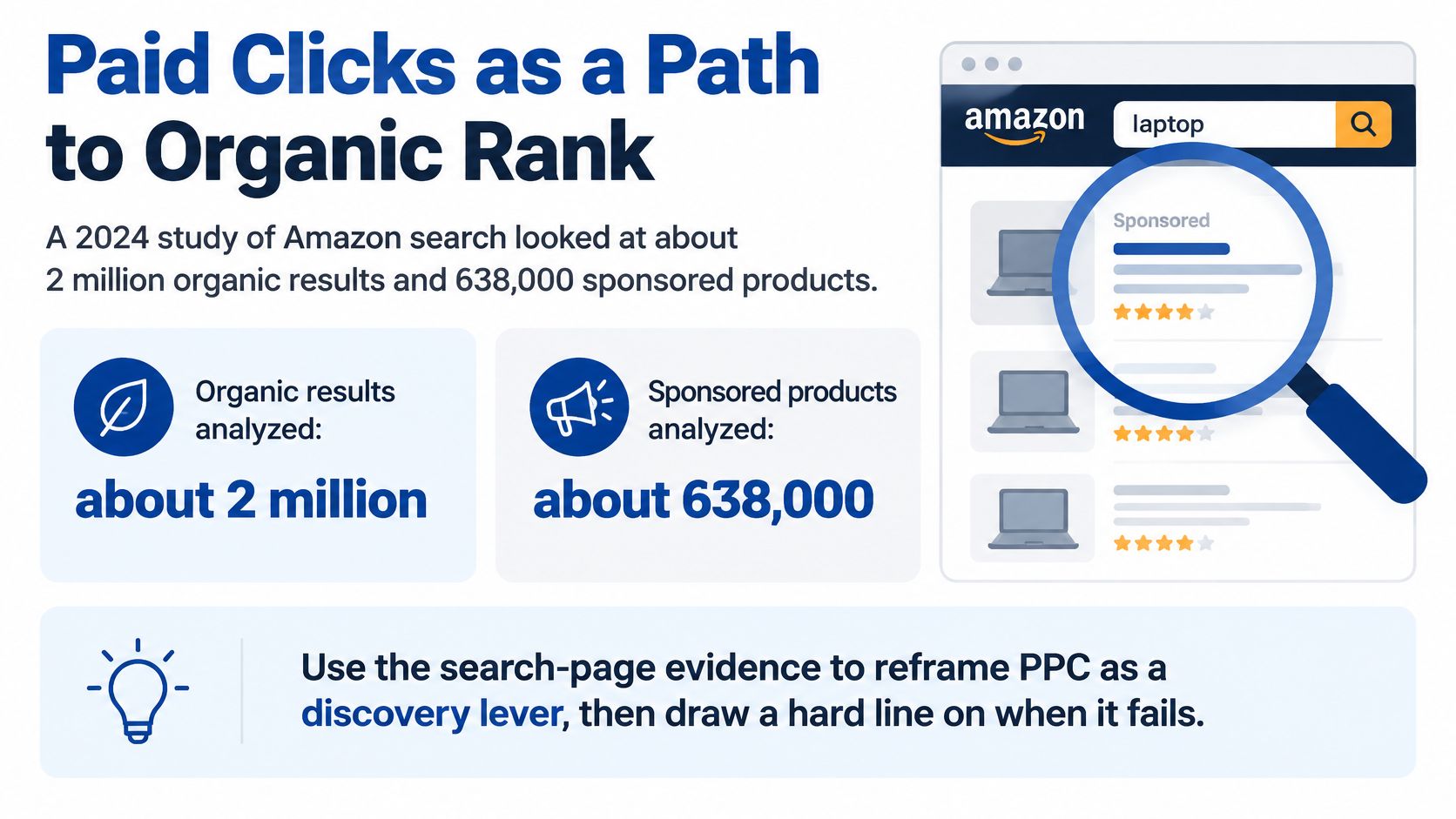
Paid placement can expose products that shoppers wouldn't otherwise encounter. A 2024 study of Amazon search results analyzed approximately 2 million organic results and 638,000 sponsored results across four marketplaces; sponsored placements represented nearly 30% of observed results, at least one sponsored listing preceded the top organic result in 84.5% of sampled queries, and products beyond organic position 100 could appear ahead of first-page organic results.
Those findings establish the visibility opportunity, not a promise of organic improvement. Paid placement changes where a shopper encounters a product. It doesn't establish that the product deserves the order or that its organic position will rise.
The search-page evidence makes that distinction concrete.
Prominence can win attention without proving relevance
A University College London research showcase examined 151,516 Amazon products across 2,250 queries over eight days in June 2023 and found that, on an average page of 69 results, a poorly relevant product in the bottom 10 could be as likely to become one of the three most-clicked products as an organic top-five product when the former held the top 1% of visual attention and the latter appeared near overall position 35; the showcase also cited average Amazon CPC rising from $0.56 in 2018 to $1.20 in 2021, more than doubling.
The practical risk is paying for prominence that doesn't survive scrutiny. A shopper may notice the ad, click, and then discover the wrong size, material, or use case. Visibility bought the visit, but the offer didn't earn the purchase.
Choose queries worth building around
Fund paid visibility where the product fits the shopping task and where sustained discovery would matter to the brand. Don't select strategic queries solely because they have attractive campaign averages.
- Define the intent: State what the shopper needs and why this SKU satisfies it.
- Establish a baseline: Record organic position, query-level performance, and total product sales before changing investment.
- Monitor blended outcomes: Read paid and organic performance together, with consistent time windows and attention to promotions or availability changes.
- Set an exit condition: Stop increasing exposure when conversion remains weak and organic progress doesn't justify continued investment.
Track organic search ranking on the same queries receiving deliberate paid support. A category-wide sales increase isn't enough to establish progress on a specific search term.
The accompanying video provides another format for considering paid and organic growth.
Paid clicks are a route to qualified discovery, not a substitute for relevance. If your team keeps purchasing visits without improving conversion or durable visibility, you're renting attention rather than building a stronger marketplace position.
Campaign Results That Show the Loop
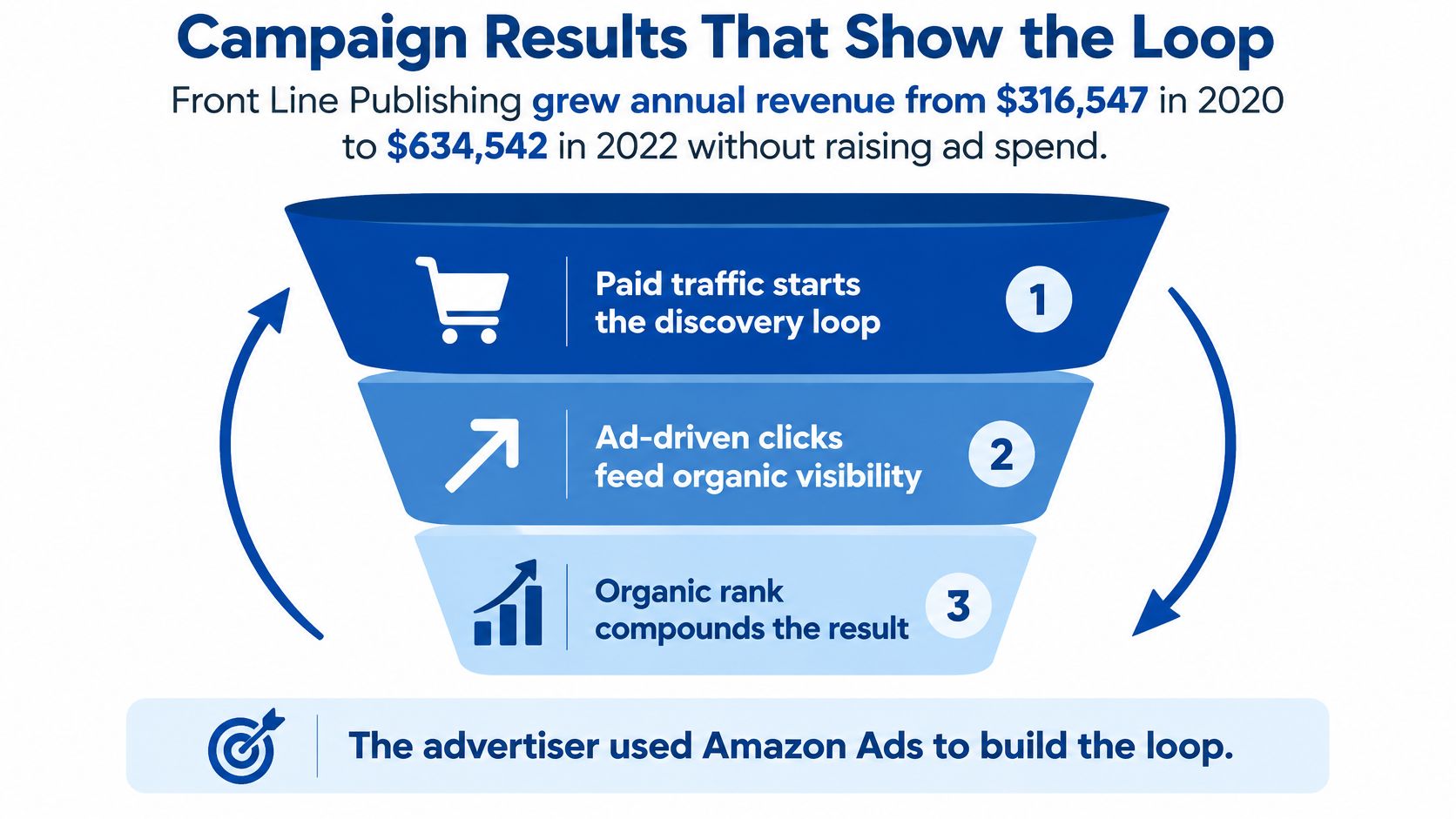
Front Line Publishing shows what happens when campaign observations get turned into deliberate structure. The Amazon Ads case study reports annual revenue rising from $316,547 in 2020 to $634,542 in 2022 without increased advertising spend, alongside a 53% ROAS improvement for conversion-focused tactics and a 2% improvement for awareness tactics.
Two details in that report deserve attention. Revenue doubled while spend stayed flat, which is the profile of an account gaining efficiency rather than buying volume. And the results were split by campaign role: conversion tactics improved sharply while awareness tactics barely moved. Blending those into one account-level ROAS would have hidden both facts.
Harvest what works without confusing campaign roles
Automatic targeting can surface queries and product targets your team wouldn't have selected in advance. Manual campaigns let you give those discoveries explicit budgets, bids, and evaluation criteria. Moving a term isn't the accomplishment, though. The new structure must improve your ability to manage it.
A promoted query earns its keep only if controlling its bid and budget produces better decisions than leaving it in the discovery campaign. Otherwise you've added a campaign without adding control.
The operating loop below illustrates the intended relationship between discovery, visibility, and growth. The case's reported results don't independently establish an organic-rank lift.
The Front Line figures also demonstrate funnel-appropriate scoring. An awareness campaign belongs on reach and customer acquisition; a conversion campaign belongs on sales and ROAS. Score an upper-funnel campaign only on immediate purchase behavior and healthy acquisition spending looks like waste. Score a conversion campaign on reach and an expensive campaign looks productive.
Copy the operating discipline, not the forecast
The transferable lesson is a measurement structure your team can reproduce:
- Discover deliberately: Give broad and automatic targeting a defined exploration role.
- Promote evidence: Move proven queries and product targets into structures where bids and budgets can be managed explicitly.
- Evaluate by purpose: Assess reach and customer acquisition separately from conversion efficiency.
- Validate downstream: Check whether acquisition activity is followed by stronger total demand, branded search, or organic visibility.
A reported ROAS or revenue figure shows what the platform attributed. It doesn't show what the spend caused. What makes this case worth copying is the discipline underneath the numbers: each campaign gets a defined job, a matching scorecard, and a downstream check on whether paid activity is compounding into organic position and total profit. That structure transfers. The specific percentages almost never do.
Set Rules That Protect Margin and Rank
Install a monthly operating cadence that gives the team clear decision rights. Monitor ACOS for deterioration, but don't let a daily efficiency fluctuation rewrite the commercial strategy.
Put the controls in operating order
Set the ceiling before editing bids. Calculate contribution after Amazon fees, COGS, discounts, and relevant variable costs. Use expected conversion behavior to translate that allowance into a defensible click cost, with explicit assumptions about incrementality.
Protect budgets by role. Give awareness, consideration, and conversion distinct allocations and KPIs. Use reach and new-to-brand measures for acquisition, then sales and margin for conversion, so branded exact demand can't automatically absorb the nonbrand budget.
Run a weekly search-term review. Promote relevant, converting queries and product targets into controlled manual campaigns. Add negatives for clear mismatches, but don't label a discovery term wasteful because it hasn't converted before sufficient evidence exists.
Pair bid increases with listing checks. Review the main image, reviews, price, and offer before approving more expensive traffic. Record the reason for each material change so the next review can distinguish a targeting decision from a retail-readiness fix.
Review rank and incrementality together. On strategic queries, stop escalating bids when organic progress is absent and additional orders aren't profitable. Investigate the cause rather than assuming a larger budget will solve it.
Keep the commercial standard explicit
At Headline, our approach centers on contribution margin optimization and profit-based bidding. A customer account of our audit describes targeting inefficiencies costing thousands and a 42% increase in ROAS within weeks after implementing recommendations. That's a reported customer outcome, not a forecast or proof of incremental profit.
Our free audit evaluates organic visibility and ranking trends, brand share growth and competitive positioning, inefficient spend, targeting coverage and gaps, target starvation and missed opportunities, and campaign structure and bid strategy.
Aim the ads optimization algorithm at profitable additional demand and durable rank. A lower ACOS is a constraint, not the finish line.
Headline Marketing Agency offers Amazon PPC and DSP management built around profitability, organic visibility, and sustainable growth. Visit Headline Marketing Agency to request a free audit and identify where targeting, budget allocation, or bid strategy is limiting your next profitable stage of growth.
Get Your Free Amazon PPC Audit
Discover untapped growth opportunities and see how our data-driven approach can improve your ROAS.
Get Free Audit →Ready to Transform Your Amazon PPC Performance?
Get a comprehensive audit of your Amazon PPC campaigns and discover untapped growth opportunities.