
How to Use Amazon Product Videos to Drive Performance and Scale
A data-driven guide to using product video amazon on Amazon. Learn to plan, produce, and optimize videos to boost PPC, conversions, and organic growth.
An Amazon product video is more than just a moving picture on your listing. It's a performance marketing asset engineered to demonstrate features, prove benefits, and show your product solving a real-world problem. Placed strategically on product detail pages and within ad campaigns, these videos are one of the most powerful levers for boosting conversion rates and profitable growth. They deliver a dynamic understanding of a product that static images simply cannot replicate.
Why Amazon Product Videos Are a Growth Engine (When Used Correctly)
Let's get straight to the point. You already know video is engaging. The real question is how to leverage it as a strategic tool for sustainable, profitable scale on Amazon. Too many brands treat video as a creative afterthought—a box to check on their listing optimization for Amazon checklist. This is a critical error that leaves significant revenue on the table.
When you adopt a performance-first approach, your product video becomes a core business asset that directly fuels the Amazon flywheel. A well-executed video doesn’t just improve aesthetics; it measurably improves the KPIs that drive organic ranking and profitability.
Connecting Video to Performance Metrics
Static images show what a product is. Video shows what it does and the value it delivers. This distinction has a direct, quantifiable impact on shopper behavior and your bottom line.
Consider the compounding effect on your core metrics:
- Increased Conversion Rate: It’s simple—product pages with video convert at a higher rate. According to a study by Wyzowl, 73% of consumers were convinced to buy a product after watching a brand's video. A higher conversion rate is a primary signal to Amazon's A9 algorithm, directly contributing to improved organic rank and visibility over time.
- More Efficient PPC Spend: A compelling video in your Sponsored Brands and DSP campaigns will always outperform a static image. The result is higher click-through rates (CTR) and, when that qualified traffic lands on a video-optimized detail page, a significantly better return on ad spend (ROAS). Your ad dollars work harder, driving down your ACoS and improving your TACoS.
- Reduced Product Returns: Video excels at setting accurate expectations. By demonstrating size, functionality, and real-world application, you drastically reduce the likelihood of a customer being disappointed. Fewer returns mean higher net margins, a better product reputation, and fewer negative reviews.
A product video is not an expense; it's an investment in your conversion rate. It's the most effective tool for bridging the gap between a shopper's uncertainty and their decision to click "Add to Cart."
The Strategic Placement Advantage
An effective video strategy isn't confined to a single placement. To drive meaningful growth, you need an integrated plan across the product detail page, Sponsored Brands Video ads, and Amazon DSP campaigns. Each placement serves a distinct role in the marketing funnel, from capturing top-of-funnel awareness to closing sales with high-intent, bottom-funnel shoppers.
This guide is your data-driven playbook for building a video strategy that pays for itself. If you want to dive deeper into turning window shoppers into paying customers, check out these product video strategies that convert browsers. We'll walk you through how to plan, produce, and deploy video content that makes your entire Amazon operation more profitable.
Don't Hit Record Until You Have a Plan
Jumping straight into production is tempting, but a beautiful video that doesn't drive sales is just an expensive liability. The foundation of a successful Amazon video isn't cinematography; it's a data-informed strategy.
Before you consider scripts or lighting, you need a crystal-clear objective. A product video isn't a one-size-fits-all asset. Its purpose must be directly tied to a specific business problem you're solving.
Are you battling a low conversion rate? Attempting to mitigate negative reviews by clarifying a complex feature? Or is this video a top-of-funnel asset for a Sponsored Brands ad designed to capture new-to-brand customers? Each goal dictates a fundamentally different creative approach.
Let Your Customers Write Your Script
The most potent creative brief is already waiting for you in your customer reviews, Q&A section, and return comments. This is a direct line into your shopper’s mindset. Stop guessing what they care about and start listening.
Mine your one- and two-star reviews for recurring themes. If multiple customers complain, "It was much smaller than I expected," your video needs a shot showing the product next to a common object for scale. If "assembly was a nightmare" is a frequent pain point, your video should demonstrate the setup process in under 30 seconds to prove its simplicity.
The most powerful Amazon videos don't just sell; they solve problems before they happen. When you tackle the biggest customer complaints head-on in your video, you build instant trust and dismantle doubt.
Don't neglect your five-star reviews. What features or benefits do your brand advocates consistently praise? These are your "aha!" moments. Make them the heroes of your video. This data-first approach removes the guesswork from scripting and ensures you're addressing what actually influences a purchase decision.
Find Your Edge by Analyzing the Competition
Once you understand your own customers, it's time to conduct a competitive analysis. Search for your primary keywords on Amazon and analyze the videos from the top-ranking products.
Deconstruct their approach:
- How do they hook the viewer in the first three seconds?
- What is their core value proposition? Is it clear and compelling?
- Who is their target audience? Does the tone and style resonate?
- What did they fail to address? What questions remain unanswered? That's your opportunity.
The goal isn't imitation; it's differentiation. If every competitor's video is a sterile, white-background product spin, you can immediately stand out with a lifestyle video demonstrating your product in a relatable, real-world scenario. Their weakness becomes your competitive advantage.
Script for the First 3 Seconds (Because That’s All You Get)
On Amazon, there is no time for a slow, cinematic introduction. Consumer attention is fleeting; you have to capture it from the first frame. Your script must be ruthlessly efficient.
The first three to five seconds have two non-negotiable jobs:
- Show the product. No ambiguity. The customer must instantly recognize what the video is about.
- State the #1 benefit. Immediately answer their core question: "Why should I care?"
Instead of a branded logo animation, open with a tight shot of your blender pulverizing ice. Overlay text that reads: "Crushes Ice in 3 Seconds." You've instantly demonstrated the product's power and core benefit. This performance-first scripting is how you create a product video for Amazon that is engineered to sell from frame one.
Your Production Checklist for High-Impact Videos
With your strategy defined, it's time for production. The objective isn't to win a creative award; it's to produce a practical, hard-working asset that converts viewers into customers on Amazon. Whether you're using an iPhone or a professional crew, the core principles of effective visual communication remain the same.
The key is to build your video around Amazon's technical requirements and, more importantly, the real-world viewing habits of customers. A video that's too long, improperly formatted, or unwatchable on a mobile device is dead on arrival. Getting these details right is the difference between a video that gets approved and one that drives performance.
This simple workflow shows how we approach it: first goals, then research, and only then do we even think about writing a script.
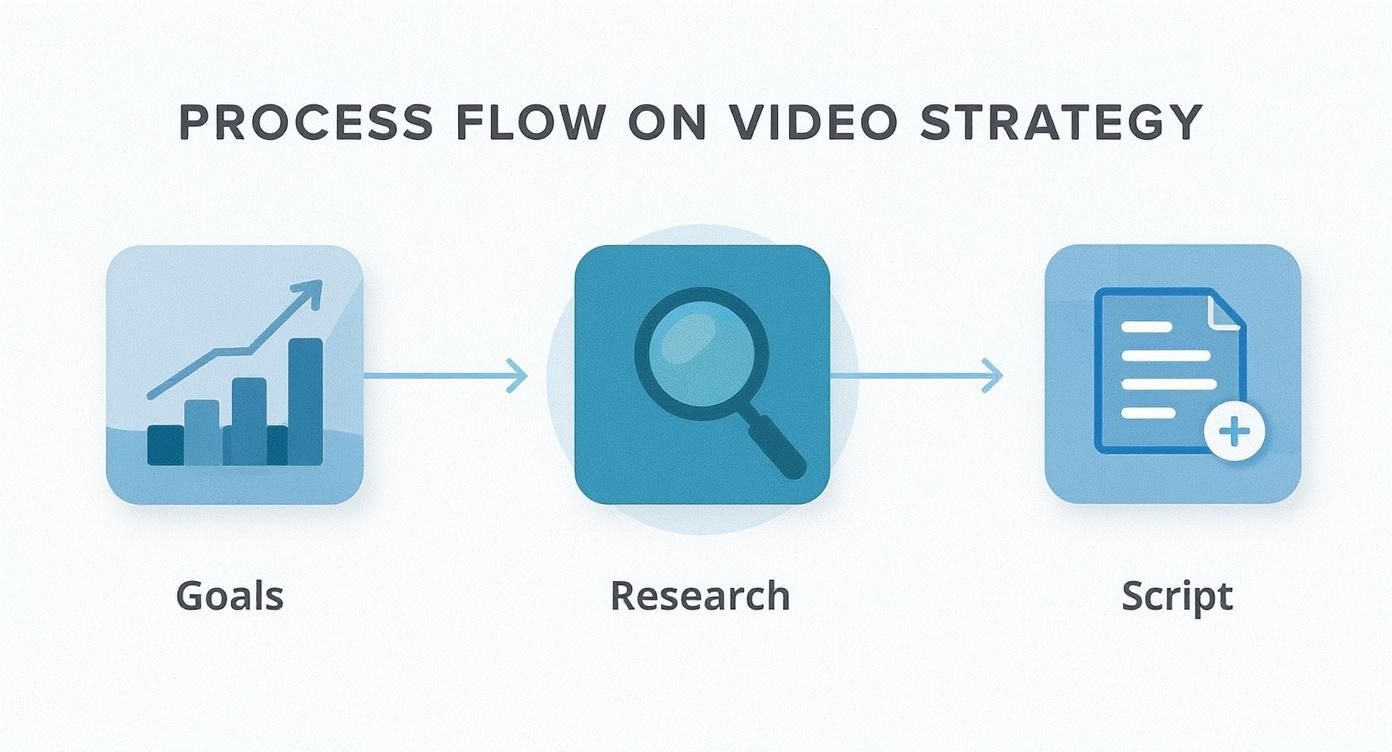
This process forces you to build your video on a solid foundation. A great video starts with clear goals and deep customer understanding, long before you ever hit "record."
Mastering Amazon's Technical Specifications
Amazon is notoriously strict about its technical specifications. Ignoring them will lead to rejection or a poor user experience. It's crucial to understand the different requirements for the two primary placements: the product detail page and Sponsored Brands Video ads.
Here’s a quick-reference table to avoid common technical pitfalls.
Amazon Video Placement Technical Specifications
| Placement Type | Aspect Ratio | Resolution (Minimum) | Max Length | File Size |
|---|---|---|---|---|
| Product Detail Page | 16:9 | 1920x1080 (HD) | 3-5 minutes | < 5 GB |
| Sponsored Brands Video | 16:9 | 1920x1080 (HD) | 45 seconds | < 500 MB |
Note the differences. Ad videos must be significantly shorter and smaller in file size. A common mistake is attempting to upload a long-form product page video into an ad slot. The best practice is to produce a longer "master" video for the detail page and then edit a concise, high-impact version specifically for ad campaigns.
And remember, video is just one piece of the puzzle. For a deeper look at optimizing everything on your product page, our guide on listing optimization for Amazon is a great resource.
Choosing the Right Creative Style
The style of your video should be a direct extension of the goals you set in the planning phase. Different formats excel at different objectives. Don't default to a generic product demo; select the style that will best connect with your target customer and solve your specific business problem.
Here are a few styles that consistently deliver results on Amazon:
- Lifestyle Demo: Shows your product in a relatable, real-world context. This is ideal for building an emotional connection and helping shoppers visualize themselves using the product. Think a portable speaker at a park picnic or a kitchen gadget being used during a chaotic family dinner.
- Unboxing Video: Creates anticipation and clearly shows the customer everything included in their purchase. This style is highly effective for electronics, subscription boxes, or products with multiple components, as it can significantly reduce returns related to "missing parts."
- Animated Explainer: If your product is complex, software-based, or has an invisible benefit (like a nutritional supplement), animation is your best tool. It simplifies complex ideas and can make a potentially dry subject engaging.
- Problem/Solution Format: A classic for a reason. Start with a common customer pain point, agitate it, and then introduce your product as the definitive solution. This format is incredibly effective for Sponsored Brands ads because it hooks viewers in the first three seconds.
Production Essentials for Sound-Off Viewing
This is the single most critical production consideration: the majority of shoppers on Amazon watch videos with the sound off, especially on mobile. If your video relies on a voiceover to be understood, it has already failed.
Your video's story must be understandable in complete silence. Use strong visuals, clear on-screen text, and intuitive demonstrations to convey your message. Think of it as a silent film that sells.
This demands crisp, well-lit visuals. A high-end studio is unnecessary; natural light from a window often provides the best results. A simple ring light can also dramatically improve quality. Ensure your background is clean and non-distracting—the product must be the hero of every shot.
Finally, on-screen text is your most valuable asset. Use large, legible text overlays to highlight key benefits and features. Ensure they remain on screen long enough to be read easily. To maximize accessibility and comprehension, using a good subtitle generator is a non-negotiable step. It’s a simple action that ensures your key messaging lands every single time.
Bringing Video into Your PPC and DSP Campaigns
This is where your video strategy evolves from "content creation" into a powerful amplifier for your paid media investments. A high-converting video on your product detail page is essential, but its true potential is unlocked when integrated directly into your PPC and Amazon DSP campaigns. This transforms a one-time creative asset into a scalable engine for profitable growth.
Video ads on Amazon are not just a different format; they behave differently. They enhance the shopping experience by delivering information in a preferred, easily digestible format. Executed correctly, a strong product video in your ads will measurably lower your Cost-Per-Click (CPC) and increase your Click-Through-Rate (CTR), leading directly to a healthier Return on Ad Spend (ROAS).
The data is clear. For example, a case study for snack brand Whisps showed that adding video to their Sponsored Brands campaigns resulted in a 469% increase in detail page view rate and a 50% increase in sales.
Using Sponsored Brands Video to Win at the Top of the Funnel
Sponsored Brands Video is your primary tool for capturing the attention of new-to-brand customers at the top of search results. These videos auto-play silently in some of the most valuable digital real estate on Amazon, providing a crucial opportunity to cut through the noise of static product images. The objective is simple: stop the scroll and make an immediate impact.
To maximize performance, your video must be purpose-built for this ad placement:
- Nail the First Three Seconds: Immediately show the product's primary benefit. Eliminate slow-fade logos and artistic pans. Get straight to the point by showing the product solving a tangible problem.
- Design for Silence: Always operate under the assumption that the sound is off. Use bold, high-contrast text overlays to communicate key features and benefits. The narrative must be entirely visual.
- Keep It Focused: This is not the place for a comprehensive feature list. Isolate one or two of the most compelling benefits and drive them home with conviction.
An effective tactic is to align video creative with specific keyword clusters. For a premium coffee grinder, you could create one video focusing on its quiet motor for "quiet coffee grinder" searches, and a second version highlighting its consistent grind size for "burr grinder for espresso" searches. This level of targeting increases relevance and consistently improves ad performance.
Video in your paid campaigns isn't just about getting a click. It's about getting a better quality click. A shopper who watches your video and then clicks through to your product page is more informed, more engaged, and far more likely to convert.
Closing the Deal with Amazon DSP Retargeting
While Sponsored Brands Video excels at customer acquisition, Amazon DSP is where you re-engage those shoppers and close the sale. DSP allows you to run video ads both on and off Amazon, enabling highly specific audience targeting. This is where your full-funnel strategy comes to life.
Consider this scenario: a shopper visits your product page, watches 75% of your video, but leaves without purchasing. With DSP, this is not a lost lead; it's a warm prospect. You can create a "video viewers" audience and retarget them with a different video ad—perhaps one that addresses a common objection, features a customer testimonial, or promotes a limited-time offer. For a full breakdown, check out our deep dive into how Amazon DSP ads work.
Here are a few powerful ways to use your videos with DSP retargeting:
- Retarget Engaged Viewers: Serve follow-up video ads to people who watched most of your product page video but didn't buy.
- Cross-Sell and Upsell: Show video ads for related products to customers who have already purchased from your brand.
- Go After the Competition: Target shoppers who have recently viewed your competitors' product pages with a video that proves why your product is the better choice.
By integrating your video assets with your PPC and DSP campaigns, you build a powerful, connected marketing funnel. You're using video to attract new customers, educate them on your product page, and then intelligently re-engage them until they convert. This integrated approach ensures every dollar invested in creative and ad spend is maximized to scale your business profitably.
How to Measure and Optimize Video Performance
You've launched your Amazon product video. The work is not over; it's just beginning. Real growth comes from treating your video not as a static, finished project, but as a dynamic asset that requires continuous optimization. This means adopting a performance-first mindset where data—not creative whim—guides every decision.
Many brands fixate on vanity metrics like view counts. Views are irrelevant if they don't translate to revenue. To understand your video's true impact, you must analyze the KPIs directly tied to profitability and organic growth on Amazon. This creates a powerful feedback loop for iterative improvement.
Let's move beyond the basics and focus on the metrics that actually drive business results.
Key Performance Indicators That Actually Matter
To accurately assess your video's effectiveness, you must track a specific set of metrics within Amazon's advertising console and Brand Analytics. These numbers reveal precisely how shoppers engage with your video and how that engagement translates into sales.
Here are the core KPIs you should be focused on:
Conversion Rate (CVR) Lift: This is the ultimate measure of success. Track your CVR before and after adding a video to your product detail page. We've seen product listings with video experience a CVR increase of up to 80%. This lift sends a powerful signal to Amazon's A9 algorithm, which can significantly boost your organic search ranking. You can find more insights on how video impacts Amazon conversions on welpix.com.
Unit Session Percentage: Found in your Business Reports, this metric shows the percentage of sessions that result in a sale. A sustained increase in this metric after launching a video is a rock-solid indicator that your creative is effectively persuading shoppers to purchase.
Video Ad Click-Through Rate (CTR): For Sponsored Brands Video campaigns, CTR is your primary engagement metric. A low CTR is a clear sign that the first three seconds of your video are failing to capture attention and stop the scroll.
Video Completion Rate (VCR): This metric tells you how much of your video people are actually watching. A high VCR indicates your content is engaging. A significant drop-off at a specific timestamp pinpoints exactly where your video becomes uninteresting or confusing.
A Framework for Continuous A/B Testing
Data is only valuable when acted upon. A systematic A/B testing plan is how you translate insights into action, making small, data-backed improvements that compound over time. The key is to test one variable at a time to ensure clean, reliable results.
Here are several high-impact elements to start testing:
- The Opening Hook: Your first 3-5 seconds are critical. Test two different openings against each other in an ad campaign. For example, pit a problem/solution setup against a dynamic shot of the product in action and see which one drives a higher CTR.
- The Thumbnail: The video thumbnail is its first impression. Test a lifestyle shot of the product in use against a clean studio shot of the product itself to determine which image entices more users to press play.
- On-Screen Text and CTA: Test different text overlays. For instance, compare a benefit-driven headline like "Never Chop Onions Again" against a feature-focused one like "Razor-Sharp Stainless Steel Blades." You can also test your call-to-action—does "Shop Now" outperform "Learn More"?
Optimization isn't a one-time task; it's a continuous process. Use performance data to form a hypothesis, run a clean test, analyze the results, and implement the winner. This iterative cycle is the engine that drives sustainable growth.
Using Amazon Analytics to Drive Your Next Move
Amazon's own reporting tools are your source of truth. Dive into your Sponsored Brands Video ad reports and analyze metrics like view-through conversions. This tracks sales from shoppers who saw your video ad but did not click, which is crucial for understanding the full halo effect of your video creative. If you're unfamiliar with the term, our guide explains what a view-through conversion is.
Next, use Amazon Brand Analytics to see how your video impacts customer search behavior. Pull the Search Query Performance report. After launching your video, are you seeing an improvement in your click share or conversion share for your most important keywords? This indicates your video isn't just improving a single listing—it's strengthening your overall market position.
By combining ad performance reports with Brand Analytics, you get a holistic view of how your product video for Amazon influences the entire customer journey. This data-backed approach removes subjectivity from creative decisions and ensures every choice is optimized for performance and scale.
A Few Common Questions We Get About Amazon Videos
Even with a solid game plan, you're bound to have some questions once you start getting into the weeds. I've been there. Let's tackle some of the most frequent questions brand leaders ask us about putting their Amazon video strategy into action.
What's the Ideal Length for an Amazon Product Video?
This is a great question, and the answer is: it completely depends on where the video lives.
For your main product detail page, you've got a bit more breathing room. You should shoot for a video that's somewhere between 30 and 60 seconds. That's usually the sweet spot to really show off the key features and prove your product's worth without your audience's attention wandering.
But when it comes to Sponsored Brands Video ads, you have to be way more direct. Think short and snappy—under 30 seconds is a must. You absolutely have to get your main point across in the first 5-10 seconds to stop someone from scrolling right past.
Can I Just Use the Same Video on My Product Page and in My Ads?
You could, but I’d strongly advise against it. It's a classic mistake. Creating different versions for each placement is just a smarter way to play the game.
Think of it like this: your ad video is the hook. Its only job is to be so compelling and quick that it earns a click. It has to make sense without any sound and be incredibly efficient.
Your product page video, on the other hand, is the closer. It’s for the shopper who is already interested and wants to go deeper. Here, you can take a moment to educate, build trust, and seal the deal. We always recommend testing different cuts to see what resonates in each spot.
What's the Biggest Mistake You See Brands Making?
Hands down, the most common pitfall is making a generic "brand story" video instead of focusing squarely on the product. Shoppers on Amazon aren't there for a history lesson on your company; they have a problem and are actively looking for a solution. Your video needs to show them, in no uncertain terms, why your product is that solution.
Your product video is a sales tool, not a brand manifesto. Every single second should be dedicated to showing the product in action and highlighting the real-world benefits for the customer. Anything else is a waste of their time and your money.
This direct, product-first approach is what really moves the needle. It's not just a theory; shoppers who watch a product video on Amazon are about 1.8 times more likely to buy. With stats showing video will account for 82% of all internet traffic by 2025, you just can't afford to get this wrong. If you want to dig deeper, you can discover more about the impact of video advertising and why it’s so critical.
At Headline Marketing Agency, we believe PPC is a lever for organic growth, profitability, and sustainable scale. We build data-backed video strategies and integrate them into performance-focused PPC and DSP campaigns to drive conversions, improve organic rank, and deliver measurable results.
Ready to Transform Your Amazon PPC Performance?
Get a comprehensive audit of your Amazon PPC campaigns and discover untapped growth opportunities.