Sponsored Brands Custom Image: Boost Your Amazon Ad ROI
Learn how a sponsored brands custom image drives clicks and sales on Amazon Ads. Get practical sizing, design, and optimization tips to improve campaign

Amazon book advertisers using custom images saw an average 48% higher mobile click-through rate than ads using product images alone. That does not mean a custom image automatically improves profitability, conversion rate, or organic growth.
You can see the trap on launch day. A consumer brand uploads a polished lifestyle photograph, increases the budget, and watches clicks arrive. The campaign looks active in the dashboard, but detail-page conversion stays flat, contribution margin deteriorates, and the product earns no visible lift in organic discovery. The creative worked as an attention device, not as a business asset.
Why Your First Sponsored Brands Custom Image Might Be Wasted Budget
A Sponsored Brands custom image changes the first thing shoppers notice. That can be valuable, but attention is only the beginning of the buying journey. If the image attracts people who don't understand the product, the offer, or the destination page, the brand pays for curiosity without gaining qualified demand.
Amazon's historical data for book advertisers provides a useful benchmark, not a promise. Those advertisers using custom imagery achieved an average 48% higher mobile CTR than advertisers using product images only, according to Amazon's report on custom images for book advertisers. The data covered a specific category and historical period, so consumer brands should treat the result as a test hypothesis rather than a forecast.
Replace attractive creative with a measurable question
Start with a clear hypothesis. For example, an in-use scene might make a product benefit easier to understand, while a human-scale image might help the brand stand out in a crowded mobile result. Record the exact visual claim before launch, then decide which downstream outcome would validate it.
Track more than CTR:
- Qualified traffic: Monitor detail-page views and the quality of the sessions generated.
- Commercial response: Compare conversion rate, cost per order, sales, and contribution margin.
- Customer value: Review new-to-brand orders and whether first-time shoppers become branded-search users.
- Organic effect: Look for branded-search movement and ranking changes where reliable reporting is available.
Practical rule: A higher CTR is evidence that the image changed attention. It isn't evidence that the image created profitable demand.
The useful discipline is to treat creative as a controlled variable, not decoration. A governed workflow matters because a brand that produces many variants without consistent naming, approvals, and learning records can't tell which visual decision caused the result. Teams that need structure around this process can use guidance on building a governed production system before scaling asset volume.
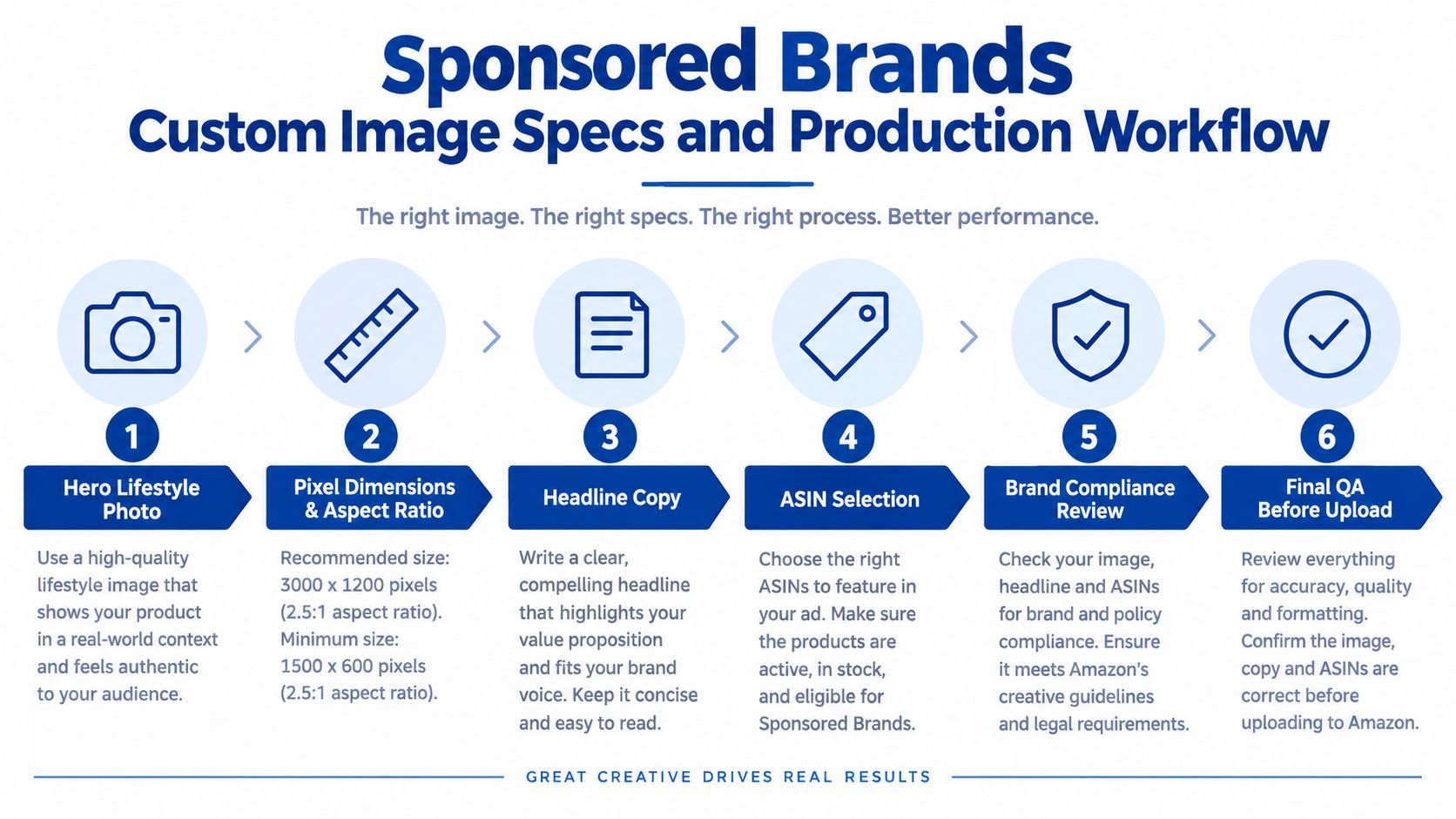
Sponsored Brands Custom Image Specs and Production Workflow
A beautiful asset can fail before it reaches a shopper. The product may disappear in a crop, the use case may become unclear on mobile, or the image may pass a design review while conflicting with the detail page. Treat each format as a controlled creative variable, then preserve the visual idea while adapting its composition.
Amazon supports three core formats: a wide 1.91:1 image at 1200 × 628 pixels, a square 1:1 image at 1200 × 1200 pixels, and a tall 9:16 image at approximately 900 × 1600 pixels. The platform lists 600 pixels as the minimum dimension for square and wide formats and requires high-resolution, legible files no larger than 5 MB when using the cropping tool. Check the current ecommerce advertising specifications before production.
Build each placement as a deliberate variant
Start with the format that gives the concept enough room. A wide layout may suit a product-in-use scene, while a square or tall version may need a tighter composition. Reposition the subject for each ratio instead of center-cropping one master file. Cropping can remove the product, the action, or the contextual cue that made the concept persuasive.
Keep the focal subject inside Amazon's safe area and inspect every version at mobile scale. A balanced desktop composition can become an ineffective mobile ad if shoppers lose the product or cannot understand the use case.
Use this production sequence:
- Confirm technical requirements. Check ratio, pixel dimensions, file type, file size, and legibility.
- Review the hierarchy. The product and its use should remain obvious without tiny details.
- Align the message. The image, headline, logo, landing page, and advertised ASINs should support one clear promise.
- Preview every placement. Use Amazon's preview and safe-zone tools, then inspect the creative at actual mobile scale.
- Run a policy review. Remove embedded logos, promotional text, calls to action, pricing, savings claims, crowded elements, and isolated packshots.
Amazon also prohibits solid or transparent backgrounds, reused product-detail-page images, letterbox or pillar-box formats, GIFs, and animations. For categories such as mattresses, mattress photo optimization tips offer useful context for showing the product without reverting to a plain packshot.
Use these Amazon image guidelines during internal review, but keep compliance approval separate from performance approval. A technically valid image can still underperform if it contradicts the destination page or makes a promise the listing cannot support. Record the final crop, concept, and approved version so later tests isolate the visual change rather than production noise.
Performance Case for Custom Images Beyond CTR
A shopper scrolling Sponsored Brands sees a product-only image, recognizes another familiar packshot, and keeps moving. A well-built custom image can earn attention by showing the product in a routine, environment, or problem the shopper already understands. That context shifts the first comparison away from objects and prices toward use-case clarity and brand meaning.
Amazon describes custom imagery as lifestyle or contextual imagery rather than a simple product cutout. Its Sponsored Brands guide presents the format as a way to combine brand storytelling with the logo, headline, and advertised products. The practical effect is a different information hierarchy. The visual must help shoppers understand why the product belongs in their consideration set.
Read the gap between engagement and demand
The historical book result helps isolate a creative difference within Sponsored Brands, but it cannot establish proportional sales gains across every category. A custom image may create curiosity and lift clicks while price, reviews, product fit, or the landing page still block purchase.
Treat the creative as a controlled variable and judge it through several commercial signals:
| Signal | What it tells you | Risk if viewed alone |
|---|---|---|
| Mobile CTR | Whether the image earns attention | Curiosity can resemble demand |
| Detail-page views | Whether clicks become meaningful visits | Visits may still be poorly qualified |
| Conversion rate | Whether traffic finds a suitable offer | Conversion can conceal weak customer value |
| New-to-brand orders | Whether the ad reaches first-time customers | Acquisition may be expensive |
| Contribution margin | Whether the result supports the business | Short-term volume can damage economics |
Separate mobile and desktop results because the cited uplift applies specifically to mobile. Compare each concept with the product-only control under the same bid, targeting, offer, placement, and measurement conditions. Hold those variables steady long enough to distinguish a visual effect from normal campaign noise.
A lower-CTR image may be the better commercial choice if it attracts shoppers who convert at a healthier margin. Review profitability alongside click volume, then carry the winning visual into broader testing only after the quality of traffic is clear.
A custom image succeeds when it clarifies the buying decision; a busier ad alone proves nothing.
Using Custom Imagery as a PPC Lever for Organic Growth
A shopper sees a custom image, clicks through, and lands on a product page that does not support the visual promise. The ad may win attention, yet the listing loses the sale. Paid traffic creates organic value only when the creative, detail page, offer, and customer experience reinforce the same buying decision.
Start by defining the image's claim in one sentence. For example, “this tool fits into a compact kitchen” or “this skincare product belongs in a simple evening routine.” Check whether the title, main images, bullets, A+ content, price, reviews, inventory, and product use all make that claim believable. Any mismatch turns paid curiosity into wasted evaluation.
Use custom imagery as an experimental variable, not permanent decoration. Track what happens after the click:
- Attention: Does the concept change mobile engagement?
- Intent: Do shoppers reach the detail page and continue evaluating?
- Action: Does conversion quality improve, rather than clicks alone?
- Memory: Does branded-search behavior strengthen after exposure?
- Compounding value: Does profitable demand support stronger organic visibility over time?
Amazon's reporting framework includes new-to-brand metrics measured within a 12-month look-back window. Review those results with branded search, repeat demand, conversion quality, and contribution margin. The paid search and SEO relationship becomes easier to evaluate when PPC and organic ranking are measured as connected outcomes, not separate department metrics.
Organic growth should not be credited to the image automatically. Compare the custom-image campaign with a product-only control, then examine whether any improvement persists after accounting for offer, targeting, placement, and traffic quality. A visual that raises engagement without improving qualified demand may still serve an awareness role, but keep it only when that role has a clear commercial purpose.
A profitable custom image makes the next buying decision easier. That is the standard that matters.
A/B Testing Custom Images Like a Data-Driven Brand
Most creative tests fail because the advertiser changes the image, headline, targeting, and product set at the same time. The resulting performance shift may be real, but nobody can identify the cause. A clean test gives the image one job: prove or disprove a specific visual hypothesis.
Set the control before changing the creative
Establish a baseline across at least one full business cycle. Record impressions, clicks, detail-page views, orders, CTR, CVR, CPC, branded-search lift where available, and contribution margin. Don't use a short-lived conversion spike as proof.
Randomize traffic between the current product-only creative and the lifestyle or contextual custom image. Hold targeting, bid strategy, placement, product set, budget, headline, and landing page constant, following the controlled approach described in Amazon's Sponsored Brands moderation guidance.
A useful hypothesis matrix might look like this:
| Hypothesis | Variant | Primary evaluation |
|---|---|---|
| In-context usage clarifies the benefit | Product shown during the relevant task | Conversion rate and contribution margin |
| Human scale improves attention | Person interacts with product in a realistic scene | Mobile CTR and detail-page views |
| Brand environment improves recall | Product placed in a distinctive but accurate setting | Branded-search behavior and new-to-brand orders |
Record the ratio, crop, subject position, background, visual claim, and ASIN set for every version. Use confidence intervals where the reporting allows them, and predeclare the minimum detectable lift before launch. Don't promote a winner because one day looked better.
Changing the headline with the image is a common mistake because headline relevance can influence both click behavior and conversion. Reusing a selected product-page image creates a different failure, since the custom-image format is meant to add context rather than duplicate the standard listing asset.
For a broader testing framework, this A/B testing guide is useful for documenting hypotheses, controls, and decision rules. The operational standard is simple: change one creative variable, preserve the commercial environment, and judge the result through profitable customer outcomes.
Troubleshooting the Three Most Expensive Creative Mistakes
A rejected image wastes more than production time. It delays learning, leaves the campaign dependent on its control, and can hide whether the creative itself would have improved profitable demand. Amazon prohibits isolated product images on solid or transparent backgrounds, standalone logos, reused selected product images, added text beyond packaging language, letterbox or pillar-box formats, and GIFs or animations, as stated in its Sponsored Brands creative moderation policy.
Treat moderation failure as a production defect. Remove embedded brand marks and promotional copy, replace the isolated packshot with a genuine contextual scene, confirm the file format, and resubmit an image that shows the use case without making an unsupported claim. Keep the rejected asset and revised version labelled so the team can identify which change resolved the issue.
A different failure appears when the mobile crop removes the product or the action. Rebuilding the whole concept is unnecessary. Reposition the subject in square and tall assets, inspect the safe area, and preview each placement before relaunching. A desktop image can look polished while communicating almost nothing on a phone.
Message mismatch creates a more expensive problem because it can survive initial approval and generate clicks. If the scene suggests a benefit, setting, or use case that the detail page does not support, conversion quality falls and contribution margin follows. Compare the ad and listing side by side, identify the expectation the page breaks, then retest after correcting the relevant image or product-page element.
Use four diagnostic questions:
- What failed? Rejection, weak mobile engagement, poor conversion, or declining margin.
- Which variable changed? Policy compliance, crop, visual claim, landing page, or audience quality.
- What is the smallest fix? Alter the relevant element instead of replacing every asset.
- What did the test teach? Record the asset version, outcome, and decision reason.
For teams reviewing listing videos, branded listing video review steps provide a useful parallel. Check the customer-facing promise before publishing, not only the technical file.
Do not treat a failed creative as sunk cost until you know whether the failure came from the image, the crop, the policy, or the page it leads to.
Your Next Step Treat Custom Images as Growth Infrastructure
A custom image should enter the campaign with a job description. It may clarify a use case, make the brand easier to recognize, or help a product collection feel coherent. It shouldn't exist because the standard product shot looks boring.
The operating model is straightforward:
- Audit the current assets. Check every image against Amazon's policy, placement, resolution, crop, and landing-page consistency requirements.
- Create the three production variants. Build wide, square, and tall compositions with deliberate subject placement instead of relying on one automated crop.
- Launch one controlled test. Preserve targeting, bids, placement, product set, budget, headline, and landing page while comparing custom imagery with the current control.
- Predeclare the decision rule. Require improvement in economically meaningful outcomes, such as contribution margin, conversion quality, new-to-brand value, or branded-search behavior.
- Review the organic feedback loop. Connect paid creative results with branded demand and marketplace visibility rather than stopping at CTR.
The most useful conclusion is also the least glamorous. If a custom image generates clicks but doesn't improve profitable customers or durable demand, it's an expense. If it helps the right shoppers understand the product, convert on a consistent listing, and remember the brand, PPC can become a lever for sustainable organic growth.
Headline Marketing Agency helps consumer brands test and manage Sponsored Brands creative with a focus on contribution margin, organic ranking, and long-term marketplace growth. Visit Headline Marketing Agency to discuss a controlled custom-image program that connects Amazon PPC execution with measurable brand outcomes.
Get Your Free Amazon PPC Audit
Discover untapped growth opportunities and see how our data-driven approach can improve your ROAS.
Get Free Audit →Wollen Sie Ihre Amazon PPC-Performance aufs nächste Level bringen?
Lassen Sie Ihre Amazon PPC-Kampagnen professionell analysieren und entdecken Sie neue Wachstumsmöglichkeiten.