PPC Campaign Optimization: A Data-Driven Amazon Guide
Master PPC campaign optimization for Amazon brands with this data-driven guide. Boost ROI, cut costs, and scale your ads using proven tactics and real

The most popular Amazon PPC advice is wrong where it matters most. A lower ACOS doesn't automatically mean a healthier business. It can mean you've stopped buying new demand, protected sales that would've happened anyway, or shifted spend toward branded queries that already had strong organic intent.
PPC campaign optimization should answer a harder commercial question: did advertising create profitable incremental value, or did it merely claim credit for demand you already owned? That means measuring paid efficiency alongside organic revenue, contribution margin, ranking movement, new-customer acquisition, and the profitability of the wider catalog.
Redefining Success Beyond Low ACOS
ACOS is a cost metric, not a business strategy. Amazon defines ROAS as attributed revenue divided by ad spend, while ACOS expresses ad spend as a percentage of attributed sales. Both are useful for comparing media efficiency, but neither includes product margin, fulfillment costs, discounts, returns, or the value of a newly acquired customer. Amazon's explanation of ROAS makes the distinction clear.
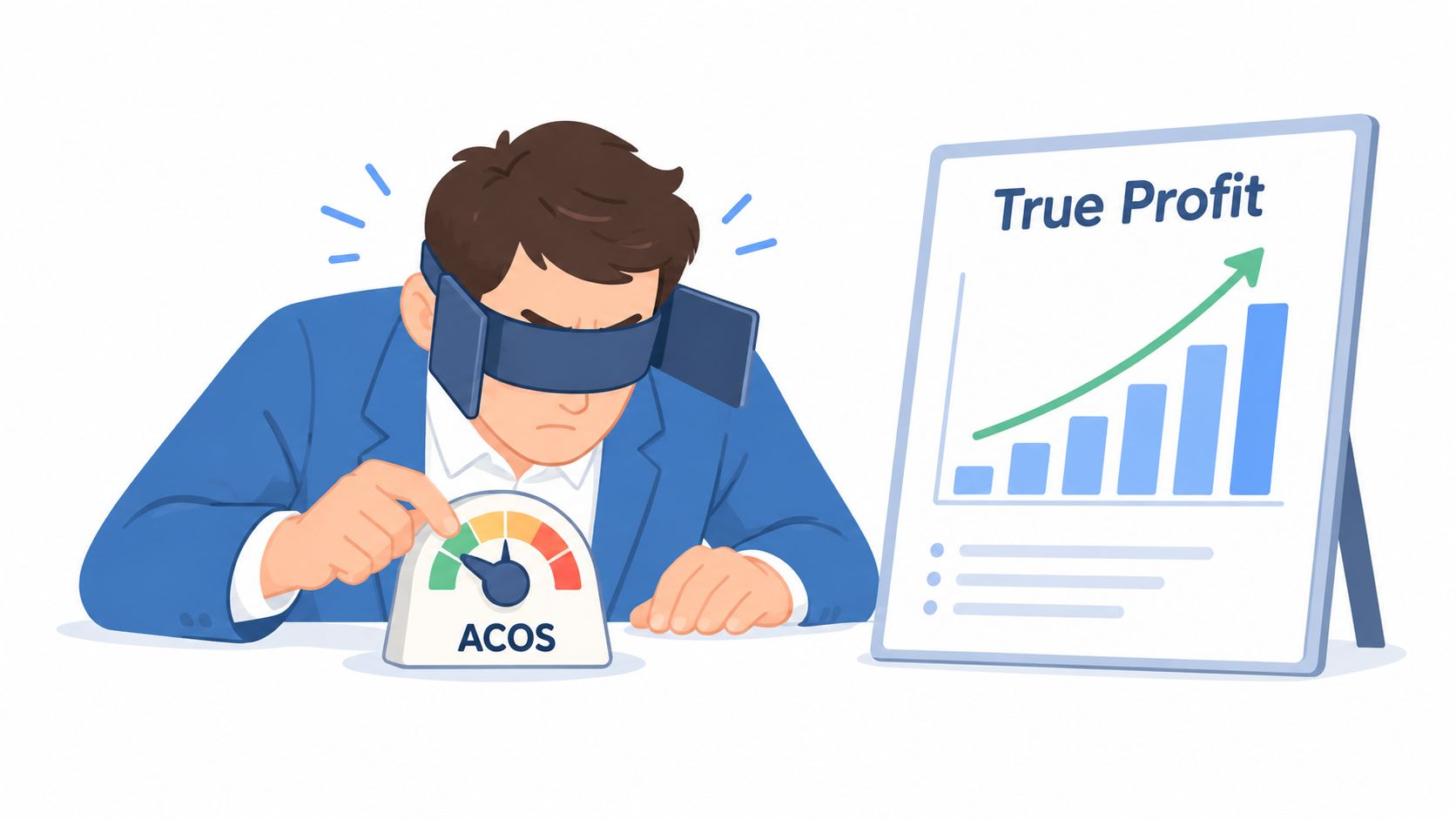
A campaign with a poor reported ACOS can still be valuable if it creates profitable organic demand, improves category visibility, introduces customers to the brand, or generates halo purchases across the catalog. The reverse is also true. A campaign with excellent ROAS can be commercially weak if it mostly captures branded shoppers who were already ready to buy.
Amazon's scale makes this distinction urgent. The company reported $68.6 billion in advertising revenue in 2025, including $21.3 billion in the fourth quarter, which increases competitive pressure on advertisers to prove genuine incremental growth rather than only efficient spending. The Amazon advertising revenue context and attribution research support a more disciplined approach.
Replace media efficiency with commercial contribution
Start with a baseline that includes:
- Attributed sales: Revenue directly credited to the campaign.
- Organic sales: Revenue generated without an ad click.
- Contribution after ad spend: Margin left after product, fulfillment, promotion, and advertising costs.
- Organic revenue share: The proportion of total sales that doesn't rely on paid traffic.
- Catalog impact: Halo sales and new-to-brand purchases created by the campaign.
Amazon's Sponsored Brands reporting separates directly promoted products from indirect brand-halo sales and can report new-to-brand purchase percentages at the individual-product level. That makes campaign evaluation broader than the advertised ASIN alone. A campaign may deserve more budget because it expands total brand value, even when its direct ACOS isn't the account's lowest.
Commercial rule: Don't cut spend because ACOS is high until you've checked whether total revenue, organic share, ranking, and contribution are improving.
This is also where channel strategy matters. Teams comparing Amazon advertising with broader retail acquisition can use a practical resource on complete ecommerce marketing Australia to think about how paid demand, owned assets, marketplace visibility, and retention fit together.
The operating model is simple. Use ACOS to control cost, ROAS to compare media efficiency, and incremental profit to decide whether to scale. PPC isn't just a checkout mechanism. It's an acquisition engine that can strengthen organic demand and raise the value of the entire catalog.
Building a Discovery-Based Campaign Architecture
Bids can't rescue a confused account structure. If broad discovery traffic, proven exact terms, brand defense, and competitor conquesting share the same budget logic, the account will spend without telling you which demand it can acquire profitably.
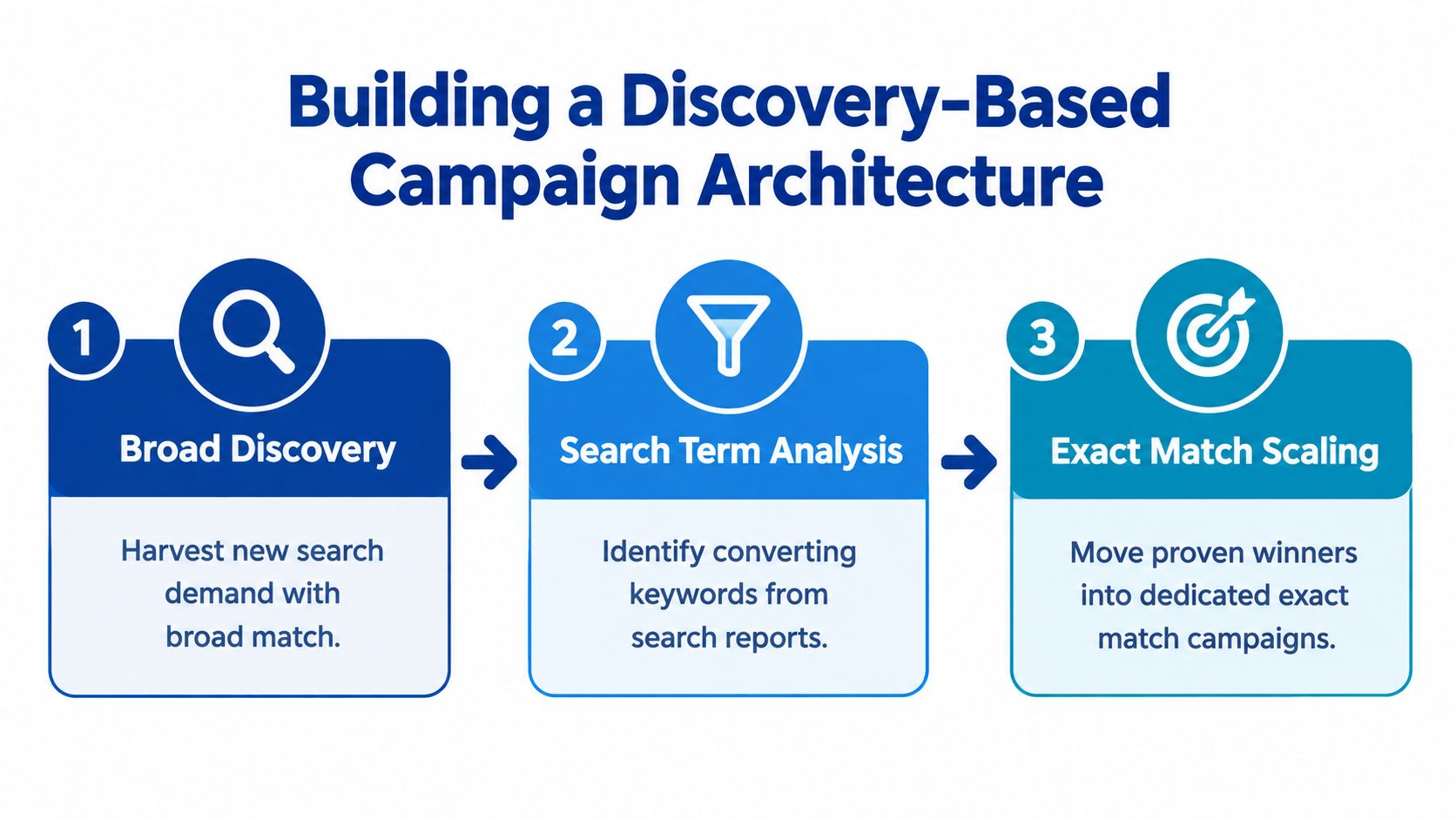
Build the architecture around discovery, harvesting, and efficiency control.
Give each match type a job
Broad and phrase match belong in discovery campaigns. Their purpose is to expose search language, adjacent needs, and new commercial themes. They aren't supposed to absorb the budget reserved for proven demand.
Exact match belongs in harvesting campaigns. When a search term generates consistent conversions and fits the product's economics, promote it into a dedicated exact-match ad group. Add the term as a negative in the discovery campaign where appropriate, so the new exact campaign can control its bids and budget.
The workflow should look like this:
- Launch broad and phrase discovery: Use relevant themes to identify actual customer queries.
- Review the Search Term Report: Separate useful demand from irrelevant traffic and expensive non-converters.
- Promote proven terms: Move converting searches into dedicated exact-match groups.
- Block waste: Add irrelevant queries and high-spend, zero-conversion searches as negatives.
- Protect budgets: Keep brand, generic, and competitor campaigns separate.
- Adjust placements later: Wait until placement-level data is sufficient before applying multipliers.
This structure prevents a common failure mode. Unproven broad terms consume money that should fund the exact terms already demonstrating purchase intent.
Segment intent before adjusting bids
Brand campaigns defend existing demand and often require a different profit interpretation from generic campaigns. Generic campaigns acquire category shoppers who may not know the brand. Competitor campaigns test whether your offer can win shoppers already considering another product.
Keep those roles distinct. A blended campaign can hide the fact that brand traffic is subsidizing expensive conquesting or that generic discovery is consuming funds needed for efficient harvesting.
Sponsored Products conversion benchmarks typically range from 5% to 10%, with conversion above 8% considered strong across many categories, according to Amazon advertising benchmark analysis. Those ranges aren't a universal target. Category, price, reviews, ASIN maturity, placement, and retail readiness all change the baseline.
The recommendation is blunt: structure the account so every campaign has a declared job. If you can't explain whether a campaign discovers demand, harvests demand, defends the brand, or tests conquesting, don't increase its budget.
Calculating True Profitability with TACOS
Low ACOS is not the objective. A campaign can look efficient in isolation while weakening the business by failing to create profitable, unpaid demand.
ACOS asks how much advertising spend produced attributed sales. TACOS asks how much advertising consumed from the entire business. TACOS equals total ad spend divided by total revenue, including organic sales. That broader denominator shows whether advertising is strengthening marketplace demand or creating permanent paid dependence. A falling TACOS alongside stable or growing total sales indicates potential organic lift. A rising TACOS points to continued reliance on paid traffic, as explained in this TACOS calculation guide.
Read the relationship between the metrics, not a headline result. ACOS may worsen after a brand expands into competitive generic terms. If total sales increase, organic revenue grows, and TACOS declines, the campaign may be acquiring customers and creating future unpaid demand. Cutting it because direct ACOS looks unattractive can remove the activity supporting that growth.
The reverse pattern demands action. Stable ACOS combined with rising TACOS, flat total sales, and declining organic share means the brand is paying more to preserve the same business. Cosmetic bid changes will not solve that problem. Diagnose demand, contribution, and the source of lost organic sales.
Use contribution margin as the guardrail
Contribution margin belongs between revenue reporting and budget decisions. Calculate what remains after variable costs on each order, then determine how much advertising the product can support while staying commercially viable.
| Signal | What it tells you | Decision |
|---|---|---|
| ACOS | Paid media cost against attributed sales | Control efficiency |
| TACOS | Advertising burden across total revenue | Assess dependence |
| Contribution after ad spend | Profit left after advertising and variable costs | Decide whether to scale |
| Organic revenue share | Reliance on paid traffic | Judge durability |
| Organic-rank movement | Potential future demand capture | Assess strategic lift |
Use the table to frame decisions, not to chase a single favorable metric. TACOS can fall because advertising declines while total sales collapse. Read it with total revenue, contribution, organic share, inventory availability, and ranking.
Recompute TACOS after budget reallocations
Portfolio-level TACOS must be recalculated after every meaningful budget shift. Moving spend toward a campaign with lower ACOS can still raise total TACOS if the change suppresses organic halo effects elsewhere or diverts funding from demand creation.
Compare the portfolio before and after the reallocation. Track total ad spend, total revenue, organic revenue share, contribution after ad spend, and organic-rank movement together. A campaign that wins its own auction metrics may still reduce portfolio profit if it captures sales that would have arrived organically or displaces a campaign creating new demand.
The operating rule is direct: use ACOS to identify expensive media, but use incremental contribution and TACOS movement to decide whether advertising is making the brand stronger.
The Placement and Match-Type Decision Matrix
High conversion doesn't automatically make a placement profitable. A top-of-search position can produce stronger intent while also carrying a higher marginal CPC. Product-detail-page traffic may convert less often but support efficient discovery or competitor comparison. The right choice depends on profit per click, not conversion rate alone.
Amazon placement reporting cites different conversion ranges across inventory: top-of-search at approximately 12% to 18%, rest-of-search at 6% to 10%, and product-detail-page placements at 3% to 6%. Placement and TACOS guidance shows why placement decisions need context.
| Placement | Typical Conversion Range | Strategic Implication |
|---|---|---|
| Top-of-search | 12% to 18% | Strong purchase intent, but test marginal CPC and contribution |
| Rest-of-search | 6% to 10% | Useful for scalable demand capture and controlled discovery |
| Product-detail-page | 3% to 6% | Supports comparison and conquesting, but requires strict cost control |
The ranges are directional, not targets. If top-of-search conversion rises while CPC rises faster, profit may deteriorate. If product-detail-page traffic converts less but introduces profitable new customers or halo purchases, eliminating it could weaken the wider brand.
Match type and placement must work together
Broad, phrase, and exact match shouldn't receive the same bid logic.
- Broad match: Use for query discovery. Keep budgets controlled and monitor search terms closely.
- Phrase match: Use to expand around validated themes while retaining more relevance than broad.
- Exact match: Use for proven demand where bids, budgets, and placement multipliers can be managed deliberately.
Don't push every high-converting term to top-of-search. First check marginal CPC, incremental orders, profit per click, and stock cover. A placement that wins the conversion-rate report can still lose the profit report.
Control the test environment
Placement changes become unreliable when several commercial variables move together. Before declaring a placement winner, check:
- Price: A price change can alter conversion without any ad change.
- Promotions: Coupons and event discounts can create temporary demand.
- Inventory: A stockout or weak stock position can interrupt ranking and sales momentum.
- Buy Box: Lost eligibility can make traffic appear inefficient.
- Seasonality: Demand shifts can resemble placement performance.
- Auction pressure: Competitor bids can raise CPC without improving intent.
Teams managing multiple ad types should also understand the role of each format through Sponsored Products versus Sponsored Brands. Treat placements as commercial levers, not automatic winners. The correct allocation is the one that produces the best incremental contribution at a sustainable level of spend.
Knowing When to Step Away from Automation
Automation is useful until it makes a decision the algorithm can't understand. A bidding system sees clicks, conversions, and modeled outcomes. It doesn't reliably understand that inventory is about to run short, a promotion changes margin, a branded term would have converted without advertising, or a competitor has launched a temporary price attack.

Recent research found that 74% of surveyed SMB marketing leaders were using or testing AI advertising tools, while 35% felt overwhelmed by the volume of available options. The same research estimated expected time savings of about 5.6 hours per week, but those are expectations rather than measured campaign outcomes. Amazon's SMB AI advertising research doesn't justify handing over commercial judgment.
Automate repetition, not accountability
Safe automation usually handles repeatable execution:
- Routine harvesting: Surface search terms that meet pre-set conversion and spend rules.
- Negative suggestions: Flag irrelevant queries for review rather than automatically blocking valuable variants.
- Bid adjustments: Change bids within defined spend, margin, and volatility limits.
- Budget pacing: Prevent campaigns from exhausting budgets too early in the day.
- Reporting: Consolidate placement, query, product, and catalog outcomes.
Human approval remains necessary when a decision affects commercial strategy. That includes defending branded terms, changing spend during a major promotion, scaling a product with limited inventory, entering a competitor's category, or altering messaging across markets.
Governance rule: Automation can execute a decision. A person must define the acceptable risk.
The right governance model uses escalation rules based on spend volatility, confidence in the data, inventory position, margin, and brand safety. Automation should pause or request review when a bid change creates unusual cost movement, a listing changes, conversion drops during a promotion, or the product approaches a stock interruption.
Here is a practical video reference for thinking about controlled automation and human oversight:
The best AI-enabled account isn't the one with the fewest human touches. It's the one where machines handle volume and people retain responsibility for profit, inventory, positioning, and customer economics.
Tactical Campaign Hygiene and Testing Protocols
Low ACOS cannot rescue a neglected account. Search terms drift, irrelevant queries consume budget, placement assumptions become stale, and dashboards react to incomplete attribution. A fixed operating rhythm protects incremental profit and shows whether paid activity is creating an organic halo.
Amazon Sponsored Products reports attribute sales to purchases within a seven-day window. Campaign reports record sales on the ad-interaction date, not necessarily the purchase date. Amazon's Sponsored Products reporting guidance explains why same-day results are a poor basis for aggressive bid changes.
Run a disciplined search-term routine
Review the Search Term Report on a fixed cadence, then classify each meaningful query by commercial evidence:
- Promote: Move a converting, relevant search term into a dedicated exact-match ad group.
- Observe: Keep a promising term active while it collects enough evidence.
- Exclude: Add an irrelevant or high-spend, zero-conversion query as a negative.
Go deeper than a simple conversion count. For a query with 20+ clicks and zero orders in 14 days, check search-query impression share before excluding it. Zero conversions combined with low impression share usually indicates a bid or reach problem, not a relevance problem. High impression share with repeated clicks and no orders points more strongly to offer, listing, or intent weakness.
Do not treat inactivity as failure. A term may need a stronger listing, better reviews, more exposure, or a different placement. Negative targeting should remove clear waste while preserving useful variants that can contribute to discovery and organic demand.
List hygiene applies to adjacent marketing work too. Teams reducing avoidable audience waste can review cut bounces with list hygiene, then apply the same discipline to search-term management.
Test changes with clean controls
Testing is the account's decision system. Record the baseline before changing a bid, placement, listing element, or budget. Define the commercial question, the expected effect on contribution or incremental TACOS, and the evidence required to act.
Track:
- Baseline: Spend, attributed sales, TACOS, conversion, contribution, organic sales, and inventory.
- Change: The exact adjustment and its business rationale.
- Evidence window: Enough time for attribution to mature.
- Decision rule: The contribution or incremental TACOS threshold that determines whether to keep, reverse, or extend the test.
For creative and listing experiments, use this A/B testing guide. Test a meaningful element and judge the result against conversion, contribution, and organic impact, not click-through rate alone.
Apply placement adjustments only after evidence
Placement multipliers require placement-level evidence. Before increasing one, confirm that added traffic produces incremental orders at acceptable profit per click. Before reducing one, check whether it supports profitable discovery, new-to-brand customers, or halo sales.
Run a weekly hygiene check for urgent waste and a monthly review for structural shifts. Neither should treat same-day attributed sales as the primary truth.
Your Roadmap to Sustainable Ad Growth
Start by separating discovery from harvesting. Use broad and phrase campaigns to learn, exact campaigns to scale proven demand, and distinct brand, generic, and competitor structures to keep commercial intent visible.
Then replace low-ACOS fixation with a profitability scorecard. Track ACOS, TACOS, organic revenue share, query conversion, contribution margin, organic-rank movement, halo sales, new-to-brand purchases, and inventory availability. Use controlled tests, mature attribution windows, and matched periods before making major reallocations.
Finally, automate execution within clear guardrails. Let systems process routine data and propose actions, but keep people accountable for margin, inventory, promotions, brand defense, and growth strategy. Headline Marketing Agency applies this type of Amazon advertising approach across campaign management, data analysis, testing, and content optimization, with attention to profitability and organic growth rather than isolated media efficiency.
The winning account isn't the one with the prettiest ACOS report. It's the one that turns paid demand into stronger organic demand, higher catalog contribution, and lower dependence on advertising over time.
Headline Marketing Agency offers Amazon PPC and DSP strategy, campaign management, search-term analysis, testing, and content optimization for brands that need sustainable growth rather than vanity efficiency. Visit Headline Marketing Agency to discuss a profitability-led PPC campaign optimization plan for your Amazon business.
Get Your Free Amazon PPC Audit
Discover untapped growth opportunities and see how our data-driven approach can improve your ROAS.
Get Free Audit →Wollen Sie Ihre Amazon PPC-Performance aufs nächste Level bringen?
Lassen Sie Ihre Amazon PPC-Kampagnen professionell analysieren und entdecken Sie neue Wachstumsmöglichkeiten.