Paid Search Management: A Profit-First Guide for 2026
Paid search management explained: core activities, the metrics that matter, and how to grow profitably with PPC in 2026, with practical benchmarks.

The most popular paid search advice is also the most incomplete: lower ACOS, raise bids on winners, and keep scaling. That can produce a tidy advertising report while your business becomes less profitable and more dependent on paid traffic.
Paid search management should create incremental profit and strengthen organic visibility. For Amazon leaders, that means treating campaign efficiency as a diagnostic, not the final verdict. The key question is whether your next advertising dollar adds profitable demand, protects valuable market position, or pays for a sale you would've won anyway.
What Paid Search Management Really Covers
Paid search management is less like buying a billboard and more like running a shop's auction-day strategy. Every bid is a decision about what you'll pay for a shopper's attention, and whether the product can earn that money back.
Say you sell skincare on Amazon. A shopper searching your brand name needs a different approach from someone comparing treatments or browsing a competitor's product. Management means controlling which queries you target, what you bid, what shoppers see, where they land, and what each order is worth.
That auction mindset is the starting point.

The operating logic dates to GoTo.com's keyword-bidding, pay-per-click model in 1998, documented in Lunio's history of PPC. Advertisers compete for measurable traffic, then optimize toward commercial outcomes rather than exposure alone.
On Amazon, the wider advertising toolkit includes:
- Sponsored Products: Keyword- and product-targeted listings in search results and product placements.
- Sponsored Brands: Brand-led ads featuring your identity and product selection.
- Sponsored Display: Audience and product targeting, including retargeting beyond search.
- Sponsored TV: Video advertising on streaming devices, rather than a search placement.
Placing these ads is execution. Managing them means reviewing outcomes weekly, removing waste, and reallocating budget according to business value.
Clicks aren't the objective. Neither are sales that would've happened without advertising.
The Metrics That Decide Profitable Growth
No single metric tells you whether paid search is working. Read every measure against its blind spot, and make sure your team knows which decision it supports.
Core paid search metrics and what each one decides
| Metric | What it measures | How to calculate | What it tells you |
|---|---|---|---|
| ACOS | Ad spend as a share of ad-attributed sales | Ad spend / ad-attributed sales | Campaign efficiency; ignores non-attributed sales |
| ROAS | Ad-attributed sales per unit of spend | Ad-attributed sales / ad spend | Inverse of ACOS, with the same attribution blind spot |
| TACoS | Total ad spend as a share of total revenue | Ad spend / total revenue | Paid-traffic dependence across the brand |
| CPC | Average cost of a click | Spend / clicks | Auction pressure; rising CPC with flat CVR warrants investigation |
| CVR | Share of clicks that become orders | Orders / clicks | Traffic relevance and listing, price, and review strength |
| Impression share | Share of eligible impressions won | Impressions / eligible impressions | Visibility you're missing within the reported scope |
| Contribution margin | Revenue left after variable costs | Price minus variable costs | The per-unit ceiling for advertising before profit disappears |
Express share-based calculations as percentages. Contribution margin in the table is a currency amount; divide it by selling price when you need a margin percentage.
Read the business outcome, not just the campaign
ACOS and ROAS use ad-attributed revenue. They can improve while total sales stall, particularly when spending concentrates on shoppers already searching for your brand.
TACoS, as explained by Saras Analytics, includes total Amazon revenue, making it useful for evaluating the relationship between advertising and the wider sales mix. It still doesn't establish causality. A healthier ratio could reflect stronger organic demand, seasonality, or changes elsewhere in the portfolio.
Pair operational metrics, too. Rising CPC with stable CVR suggests auction pressure or a more expensive traffic mix. Weak CVR with stable CPC points first toward query relevance, listing content, pricing, availability, or reviews.
Practical rule: Read TACoS against contribution margin, CPC against CVR, and impression share against profit potential. Never approve a budget increase from one metric alone.
Measuring Incremental Profit Instead of ACOS
A lower-ACOS campaign can be worth less than a higher-ACOS campaign if it mostly captures demand shoppers already had. Attributed sales are credited to advertising. Incremental sales wouldn't have happened without it.
Use that distinction before deciding which campaign deserves more budget.
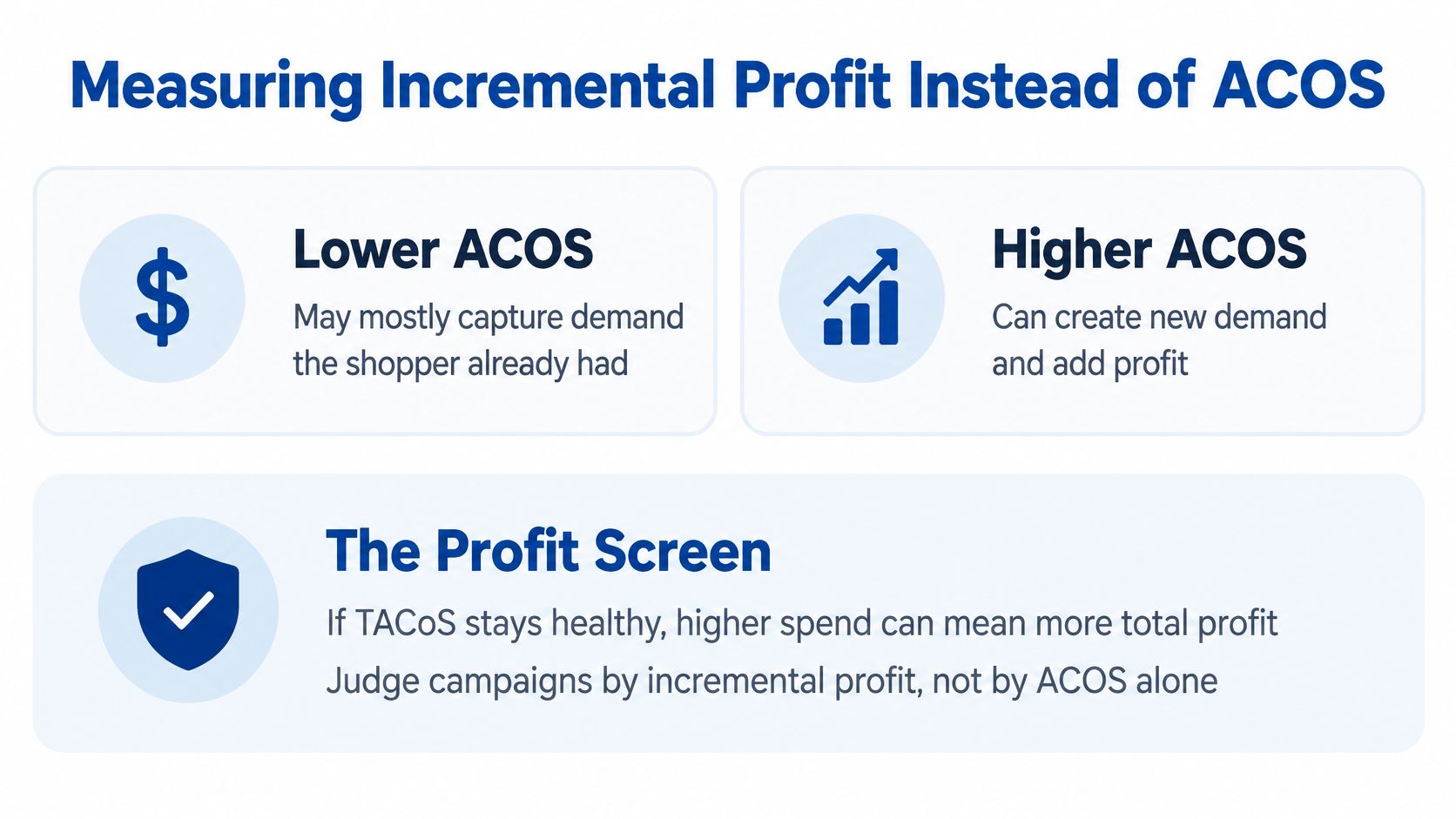
Start with the profit screen: if TACoS exceeds your contribution margin percentage before advertising, ad spend consumes more than the available contribution. That isn't economically sustainable, even when selected campaigns look efficient.
Our approach at Headline focuses on contribution margin optimization and profit-based bidding. Understanding what incremental revenue actually measures helps translate that principle into budget decisions.
Use controlled tests as the tiebreaker
A 2026 white paper, described in a Knox News-hosted press release, warns that last-click attribution may overestimate paid-search impact by as much as 190% and that major platforms can double-count conversions. Treat that as a warning to test attribution, not a universal correction factor.
Evidence can also run in the opposite direction: a peer-reviewed programmatic study summarized by Raveneye Global found an improved randomized design reduced the budget needed for statistical significance by as much as 85%, while an insurance advertiser's experiment found last-touch attribution undervalued incremental display and native conversions by 87%. Those aren't Amazon search benchmarks. They demonstrate why attribution and causal impact aren't interchangeable.
Reserve comparable treatment and control groups by audience, geography, or eligible query group where the platform permits. Compare incremental orders, revenue, ROAS, and contribution after advertising, accounting for seasonality, brand demand, interference, and the sales sacrificed during a holdout.
Profit signals and the action each one supports
| Signal | Reading | Action |
|---|---|---|
| TACoS below contribution margin, organic sales rising | Consistent with sustainable demand growth | Scale in steps and review weekly |
| TACoS above contribution margin | Advertising exceeds available contribution | Cut unprofitable non-brand spend and reset bid ceilings |
| TACoS rising while total revenue is flat | Additional spend may not create incremental demand | Run a holdout before adding budget |
| Low ACOS, branded campaigns dominate spend | Possible harvesting of existing demand | Test lower branded bids in a control-based design |
| High ACOS, new-to-brand share rising | Possible acquisition investment, not proof of future rank | Retain a bounded test budget; track customer acquisition and organic rank |
Use test results to set bid ceilings, branded coverage, and non-brand allocation. Don't preserve acquisition spend indefinitely on the promise of future growth.
For another perspective on the measurement decision, watch the video below.
How to Run the Paid Search Management Cycle
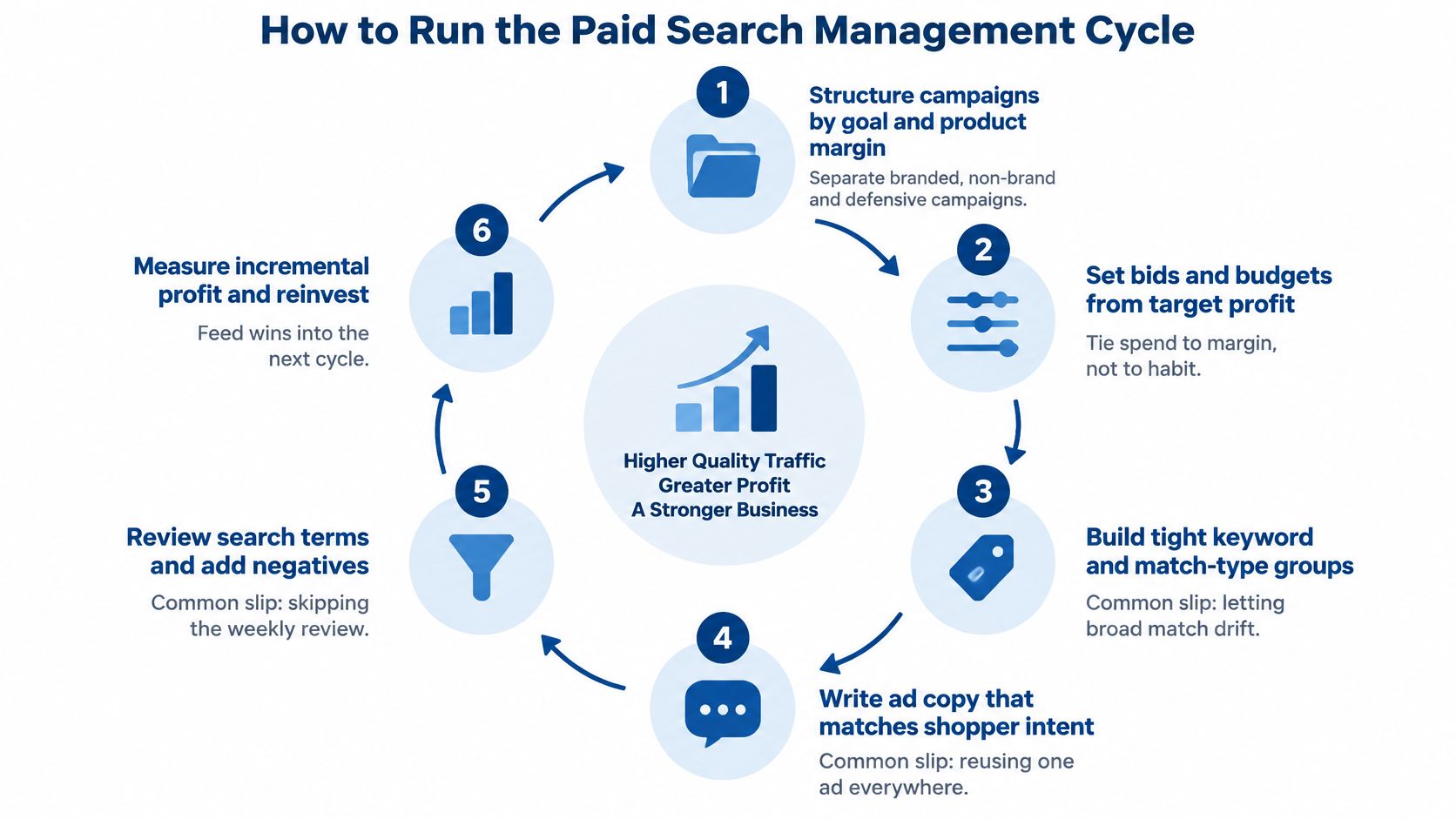
Good paid search management needs a repeatable operating rhythm, not a string of emergency bid changes. Assign an owner to each decision and record why the change was made.
Use this cycle to connect account maintenance with commercial priorities.
Turn margin targets into campaign decisions
Structure campaigns by goal and product margin. Separate branded demand capture, non-brand acquisition, and defensive placements so each has a defined budget and target. Mixing them lets efficient branded orders conceal expensive acquisition.
Mine search terms weekly. Move proven queries into exact-match campaigns where tighter control helps, and add negatives for irrelevant traffic. Don't block exploratory terms because they haven't converted before accumulating enough evidence.
Set bids from profit. In a hypothetical example, a product sells for $40 with $22 in variable costs, leaving $18 in contribution before advertising, the break-even cost-per-sale ceiling. A $12 target cost per sale leaves $6 per unit after advertising; multiply that target by the segment's expected conversion rate to establish a starting CPC ceiling.
Align the destination with the query. If a campaign attracts shoppers looking for travel-friendly packaging, make pack size and portability easy to verify on the listing. The usual mistake is paying for a relevant click, then making the shopper hunt for the promised benefit.
Plan incremental measurement before scaling. Define the comparison group, commercial outcome, and stopping conditions before changing spend. Changing targeting, pricing, and creative simultaneously makes the result harder to interpret.
Review weekly and reallocate monthly. Use weekly checks to catch waste and monthly reviews to redirect investment toward profitable acquisition or measurable organic progress. Don't let last month's allocation become a permanent entitlement.
Automate execution, retain accountability
We build custom dashboards, automate bid management, and continuously optimize campaigns. Automation handles repetitive adjustments; a person still owns the margin assumptions, test design, and budget allocation.
For a complementary execution resource, 3228 Digital UK's guidance on managing PPC campaigns that convert can help teams review campaign-management fundamentals. Apply those fundamentals within Amazon's targeting and reporting constraints rather than copying another platform's setup.
Weekly review checklist: Check margin, inspect search terms, isolate waste, verify listing readiness, review test results, and document the next budget decision.
Why Ad Quality Signals Beat Bid Increases
Raising bids isn't a strategy for fixing weak relevance. You may buy more exposure without improving the shopper's reason to click or purchase.
In Google Ads, auction eligibility and position depend on more than money. The Google Ads materials hosted by the US Department of Justice describe Ad Rank inputs including bids, expected click-through rate, ad relevance, landing-page experience, and auction context; they also distinguish the 1–10 Quality Score diagnostic from direct auction inputs.
Diagnose the weak component
Better message-to-query alignment can improve expected click-through rate and relevance. A useful, navigable landing page can improve the shopper's experience. Together, those improvements can support stronger visibility and sometimes a lower actual CPC for a comparable position, without guaranteeing either outcome.
Use a practical diagnostic sequence:
- Group by intent: Separate comparison, category, branded, and specific-feature queries.
- Match the promise: Give each meaningful query cluster relevant creative and a suitable destination.
- Inspect the weak component: Determine whether shoppers aren't clicking, aren't finding the promised information, or aren't buying.
- Measure commercial impact: Evaluate impression share, qualified clicks, CVR, marginal CPA, and contribution after advertising.
Google's Quality Score isn't an Amazon bidding input. On Amazon, apply the relevance discipline through targeting, Sponsored Brands creative, product titles, images, detail-page content, and Store destinations where available.
Don't treat a stronger click-through rate as an automatic win. An attractive but vague promise can bring more visitors who never purchase. The useful improvement is better-qualified traffic at an affordable acquisition cost.
Run a controlled relevance test
Choose a commercially important query theme and rewrite the ad and relevant landing section around that intent. Headline's guide to improving ad relevance provides a useful framework for organizing the work.
Run the comparison against a control for four weeks as an initial test window, extending it if conversion volume or reporting lag prevents a reliable decision. Keep bids and other major variables stable where possible.
The decision isn't whether the new wording sounds better. It's whether the revised experience produces more contribution from the traffic you can afford to buy.
How Paid Search Feeds Organic Rank
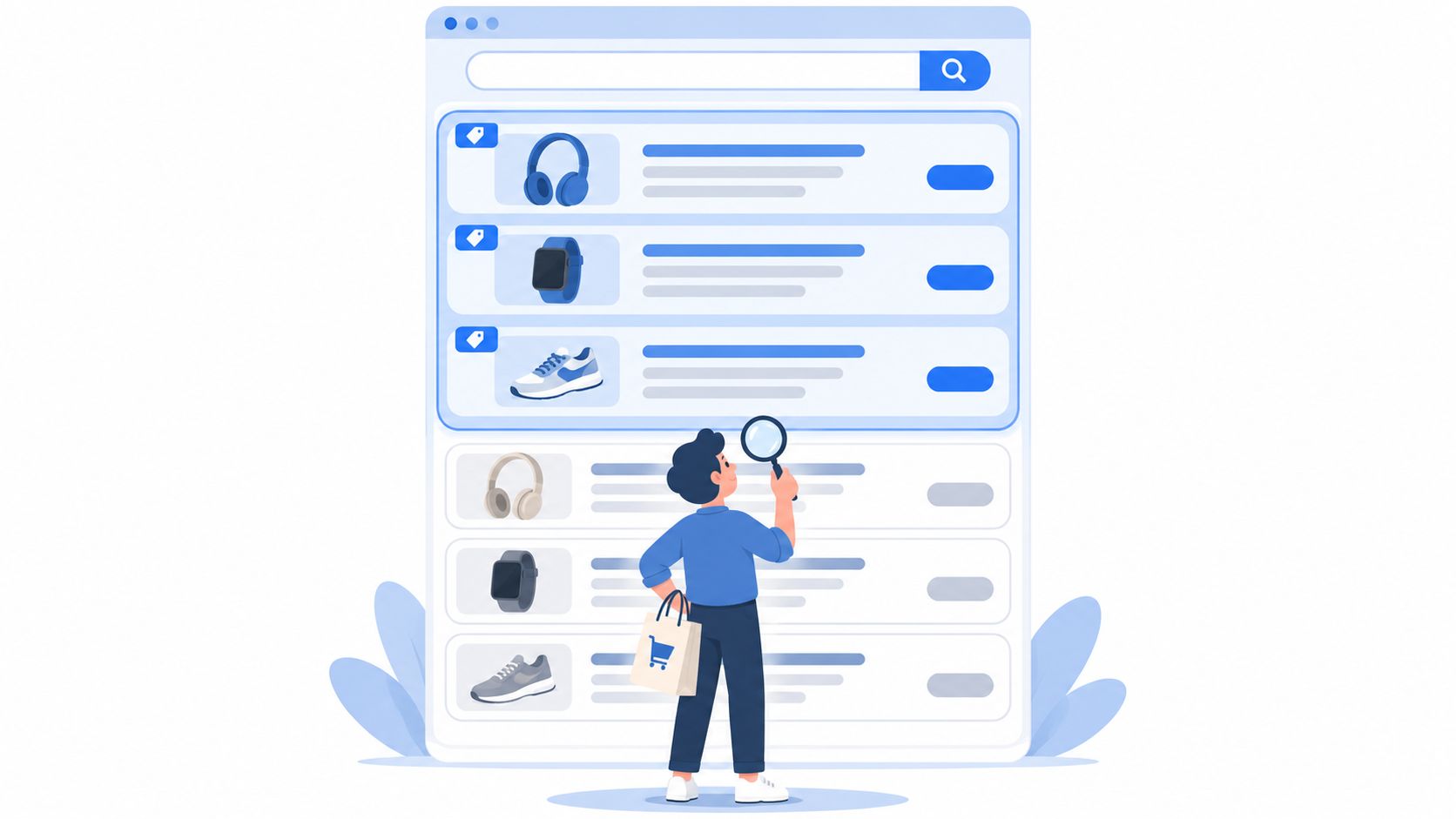
Shoppers encounter sponsored placements before they reach many organic listings. A 2024 academic analysis of Amazon search results found nearly 30% of observed results were sponsored and at least one sponsored result preceded the top organic result in 85% of first-page cases, across approximately 2 million organic results and 638,000 sponsored results.
That makes advertising a visibility decision, not just a direct-response decision.
Invest in query-level progress
The growth hypothesis is straightforward:
- Secure visibility on strategically valuable queries.
- Generate relevant clicks and orders that demonstrate shopper demand.
- Test for organic improvement, then determine whether you can defend the query with a healthier paid-to-organic mix.
Advertising doesn't purchase organic rank directly. Treat ranking improvement as an outcome to verify, not a guaranteed consequence of spending.
Amazon's Search Query Performance documentation describes impressions, clicks, cart adds, and purchases by query, with query-detail comparisons against the top 10 ASINs. Its brand view includes organic and Sponsored Products search activity, so it helps diagnose the full funnel but doesn't isolate paid causality.
If you win clicks but lose purchases, address retail readiness before buying more traffic. Track organic position separately alongside the funnel.
Evaluate growth quality
Amazon's Active Skin Repair case study reports a 60% new-to-brand purchase share against a 50% goal, 33% year-over-year Amazon sales growth in 2025 against a 28% objective, and 56% year-to-date growth in 2026. New-to-brand share indicates acquisition beyond existing buyers, although it doesn't independently prove incrementality or organic-rank lift.
In our lifestyle brand case study, we doubled market share and increased organic visibility by 156%, using PPC as an investment in organic visibility.
That's the commercial logic behind connecting paid search and SEO. Judge campaigns by incremental coverage, customer acquisition, and query-level organic movement, while retaining profitable paid defense where your organic position remains vulnerable.
Common Mistakes and Their Fixes
Senior teams often see the symptom before they see the cause. Use the following patterns to choose an investigation, not to skip one.
Paid search symptoms, causes and first fixes
| Symptom | Likely cause | First fix |
|---|---|---|
| Spend up, sales flat | Broad match capturing irrelevant queries | Move search-term winners to exact match and add negatives |
| Good ACOS, falling total sales | Only branded demand captured | Shift a bounded budget to non-brand and test incrementality |
| Clicks strong, orders weak | Listing, price, or reviews aren't ready | Fix listing content and pricing before raising bids |
| Rising CPC, flat impression share | Ad and landing quality trail rivals | Rewrite ads and landing content by query theme |
| Budget exhausted early each day | Poor pacing; bids may be too low to compete at valuable peak hours | Review timing and raise bids only on profitable segments with budget available |
Early budget exhaustion doesn't, by itself, prove bids are too low. Check when the campaign spends, which segments consume the budget, and whether peak-hour orders justify reallocating spend. Raising bids across a capped campaign can exhaust it faster.
Separate fast controls from slower improvements
Negative keywords and bid adjustments change traffic selection directly. Inspect delivery within days, but wait for the relevant conversion lag before judging profitability.
Listing and pricing changes need a longer evaluation window, often a few weeks as a working review cadence. Keep a change log and avoid rewriting the listing, changing price, and restructuring targeting together unless immediate loss control requires it.
For teams managing limited execution capacity, AI Optimization Services' PPC guide for lean marketing teams offers another resource for organizing optimization work. Keep your own margin and measurement requirements in charge of the priority list.
Fix the issue with the greatest expected effect on profit, not the setting that's easiest to change.
A large listing conversion problem can matter more than dozens of small bid edits. Give the commercial bottleneck an owner and a clear decision date.
Confirm Your Paid Search Plan Before Scaling Spend
Don't add budget until the account clears three gates: contribution margin covers advertising, a measured share of sales is incremental, and acquisition and defense have distinct controls.
- Confirm the economics. Validate variable costs and establish a cost-per-sale target that leaves the contribution your business needs.
- Confirm the evidence. Identify which campaign groups have credible incremental results and which still require a bounded test.
- Confirm the structure. Separate branded, non-brand, and defensive campaigns so budget decisions reflect their different jobs.
Turn those checks into an ordered action list. Assign the campaign-cycle changes and symptom fixes that remove the biggest constraint first, rather than expanding every campaign together.
Our free Amazon PPC audit evaluates organic visibility and ranking trends, brand share growth and competitive positioning, bleeder spend, targeting coverage and gaps, target starvation and missed opportunities, and campaign structure and bid strategy. It also includes a growth strategy session to determine where the next dollar should go.
Use the findings to distinguish immediate loss control from acquisition tests and organic-growth investment. Run PPC as a lever for profit and organic growth, not a standalone sales tap. Scale the segments that demonstrate incremental profit and organic progress, rather than assuming a strong advertising report proves both.
Headline Marketing Agency offers a free Amazon PPC audit to identify inefficient spend, targeting gaps, and opportunities to strengthen organic visibility. Visit Headline Marketing Agency to request your audit and discuss where your next advertising dollar can make the strongest contribution to profitable growth.
Get Your Free Amazon PPC Audit
Discover untapped growth opportunities and see how our data-driven approach can improve your ROAS.
Get Free Audit →Wollen Sie Ihre Amazon PPC-Performance aufs nächste Level bringen?
Lassen Sie Ihre Amazon PPC-Kampagnen professionell analysieren und entdecken Sie neue Wachstumsmöglichkeiten.