Master How to Bid on Amazon Ads and Win
Getting Amazon ad bidding right means balancing short-term ROAS with long-term organic growth. Here's how we do both.

When you bid on Amazon, you’re not just managing an advertising cost. You’re leveraging PPC as a strategic tool for driving organic growth, long-term profitability, and sustainable scale. Your real job is to invest ad dollars to build sales momentum and capture market share—a goal that transcends simply managing your Advertising Cost of Sale (ACOS).
Think Bigger Than ACOS for Your Amazon Bidding
For years, eCommerce leaders have been conditioned to chase a low ACOS as the primary KPI. While efficiency is critical, a myopic focus on ACOS throttles growth, stagnates organic rankings, and ultimately leaves revenue on the table.
The goal isn't just to sell products with ads. The goal is to use ads to sell more products organically down the line.
This requires a fundamental mindset shift. Instead of reflexively cutting bids to lower ACOS, you must invest in bids that ignite the Amazon flywheel. Every sponsored sale signals to Amazon’s A9 algorithm that your product is relevant and desirable. This improves organic placement, which drives more sales—a powerful feedback loop that begins with intelligent bidding.
Getting a Handle on Your Bidding Options
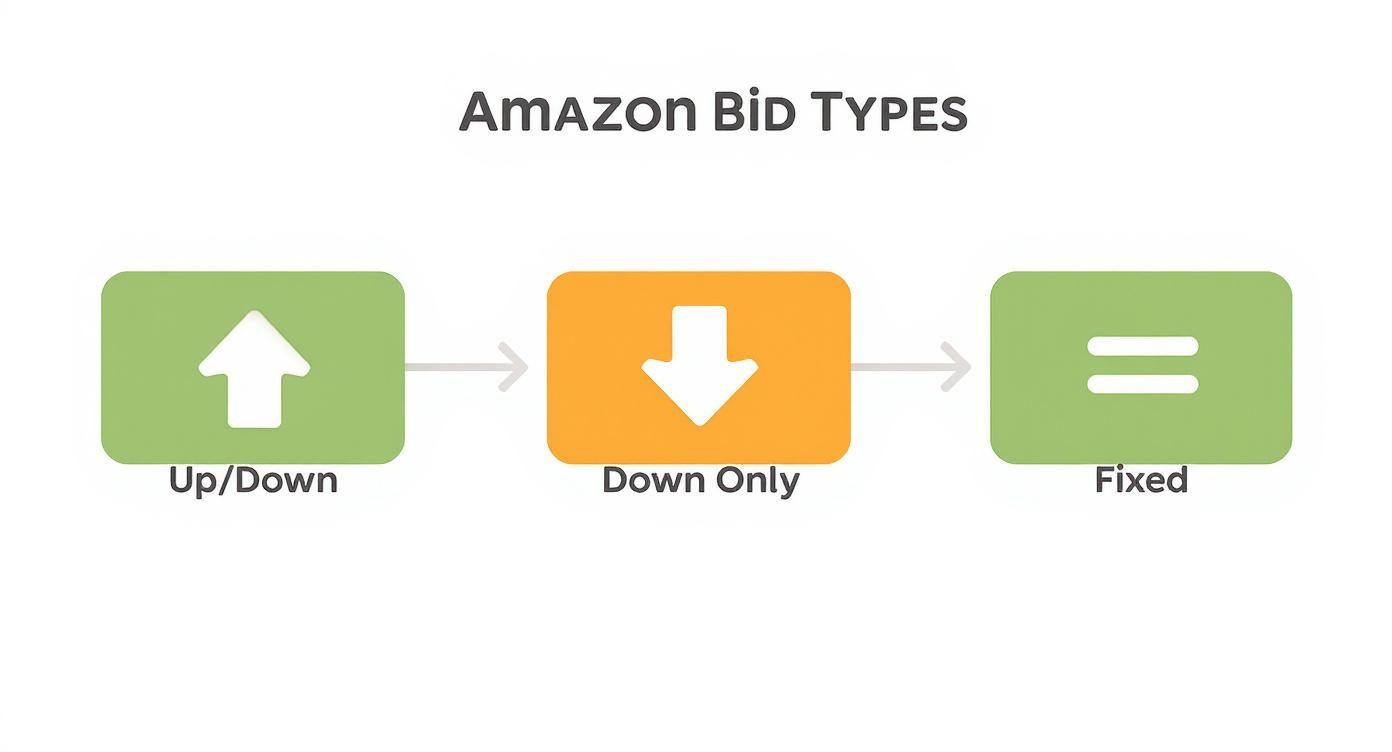
Amazon provides three core bidding strategies. The right choice depends entirely on the strategic objective of a given campaign; there is no "one-size-fits-all" solution.
- Fixed Bids: You dictate the exact bid amount. This offers maximum control, ideal for validating new keywords or defending high-value branded terms where consistent visibility is non-negotiable.
- Dynamic Bids – Down Only: This is your efficiency-focused setting. Amazon will automatically lower your bids in auctions it deems less likely to convert. It's a conservative approach designed to protect your budget and trim waste, making it perfect for mature, profitable campaigns.
- Dynamic Bids – Up and Down: This is your growth lever. Amazon can increase your bids by up to 100% for top-of-search placements (and up to 50% for others) when its algorithm predicts a high conversion probability. This is the strategy for product launches, scaling proven campaigns, or aggressively challenging competitors.
Here’s a quick way to look at them:
Amazon Bidding Strategies at a Glance
This table breaks down the core bidding strategies to help you match them to your campaign goals right from the start.
| Bidding Strategy | Best For | Control Level | Typical Use Case |
|---|---|---|---|
| Fixed Bids | Maximum predictability and control. | High | Testing new keywords, brand defense campaigns. |
| Dynamic Bids – Down Only | Protecting your budget and efficiency. | Medium | Mature, profitable campaigns. |
| Dynamic Bids – Up and Down | Aggressive growth and maximum visibility. | Low | Product launches, scaling top performers. |
Aligning your bidding strategy with your campaign’s objective is crucial. A new product launch needs the aggressive push of "Up and Down," while a long-time bestseller might do better with the steady efficiency of "Down Only."
I see this all the time: brands apply one bidding strategy to their entire account and wonder why it's not working. A launch campaign has a completely different risk profile than a brand defense campaign. You absolutely have to segment your approach if you want to scale.
A Better Way to Make Bidding Decisions
Moving beyond an ACOS-only mindset requires evaluating a broader set of metrics. Your bidding decisions should be a direct reflection of your business objectives.
Consider these common scenarios:
- Launching a New Product: The objective is visibility and sales velocity. A high ACOS is not just acceptable—it's necessary. An aggressive "Up and Down" strategy is required to rapidly collect performance data and kickstart the flywheel.
- Defending Your Turf: A top product is under assault from competitors. "Fixed Bids" or a tightly managed "Up and Down" strategy on your branded keywords can ensure you dominate the top spot and prevent rivals from poaching sales.
- Harvesting Profits: For a mature product with strong organic rank, the focus shifts to maximizing profit. "Down Only" is the optimal choice here, allowing you to capture efficient sales without overpaying and protecting your margins.
How to Calculate and Set Your Initial Bids
Setting an initial bid on a new Amazon campaign shouldn't be guesswork. Bidding too high burns your budget; bidding too low results in zero visibility. Many brands default to Amazon's "suggested bid," but this is often a fast track to overspending.
Your optimal starting point is calculated from your own product economics. By tying your bid directly to your profit margin, you ensure every ad dollar is invested in a profitable outcome.
First, Nail Down Your Break-Even ACOS
Before setting a bid, you must determine your absolute spending limit per sale. This is your break-even ACOS, and it is equal to your pre-ad profit margin.
For example, if you sell a product for $50 and, after all costs (COGS, Amazon fees, shipping), you have $15 in profit, your profit margin is 30%. Your break-even ACOS is therefore 30%.
If you spend more than 30% of your revenue on ads for that product, you are losing money on every ad-driven sale. Establishing this financial guardrail is non-negotiable.
Understanding how Amazon's dynamic bidding strategies work is also crucial. These settings will automatically adjust the bid you set based on how likely Amazon thinks a click is to convert, directly affecting how your initial bid plays out in a live auction.
The Go-To Formula for Your Starting Bid
Once your financial parameters are set, use this formula to calculate a data-driven starting bid. It connects your product’s price, its conversion rate, and your ACOS goal into a logical maximum Cost-Per-Click (CPC).
Starting Bid (Max CPC) = (Product Price x Conversion Rate) x Target ACOS
Let's walk through a quick example:
- Product Price: $50
- Average Conversion Rate (CVR): 10% (0.10)
- Target ACOS: 25% (aiming below the 30% break-even to ensure profitability)
Now, plug those numbers into the formula:
($50 x 0.10) x 0.25 = $1.25
Your maximum profitable bid is $1.25. This is a hard ceiling based on your actual business metrics. If you want to get more granular with these figures, our guide on how to calculate profit per unit is a great resource.
Fine-Tuning Bids for Match Types and Placements
A uniform bid across all keywords is a common but costly mistake. Experienced sellers tier their initial bids by keyword match type and ad placement for tighter budget control.
- Broad Match: These are discovery keywords, often with lower conversion rates. Start with a bid 30-40% lower than your calculated max CPC. The objective is data collection, not immediate sales.
- Phrase & Exact Match: These keywords signify higher purchase intent and typically convert better. Here, you can bid confidently near your calculated max CPC. For a high-performing exact match keyword, you might even bid slightly above it to secure a top-of-search placement.
Your initial bid is just that—a start. It's an educated guess designed to get you into the auction without burning your budget. The real work begins when you start analyzing the performance data and making informed adjustments.
Placement bid adjustments are also critical. "Top of Search" is premium real estate—highly visible, competitive, and requiring a higher bid. In contrast, ads on product pages may justify a more conservative bid. Use Amazon's placement modifiers to allocate your budget to the placements that deliver the highest ROI for your brand.
Winning at the Keyword Level
True mastery of Amazon bidding is achieved at the keyword level. This is where you move from broad campaign settings to surgical precision, tailoring each bid to a keyword’s specific performance, search intent, and strategic value.
Setting one flat bid for all keywords is a guaranteed way to misallocate your budget. A more sophisticated approach is to build a tiered structure that funnels ad spend toward keywords that deliver tangible results.
Creating a Tiered Bidding Structure
Not all keywords are created equal. Some are reliable revenue drivers, while others are for market intelligence. Your bidding strategy must reflect this reality.
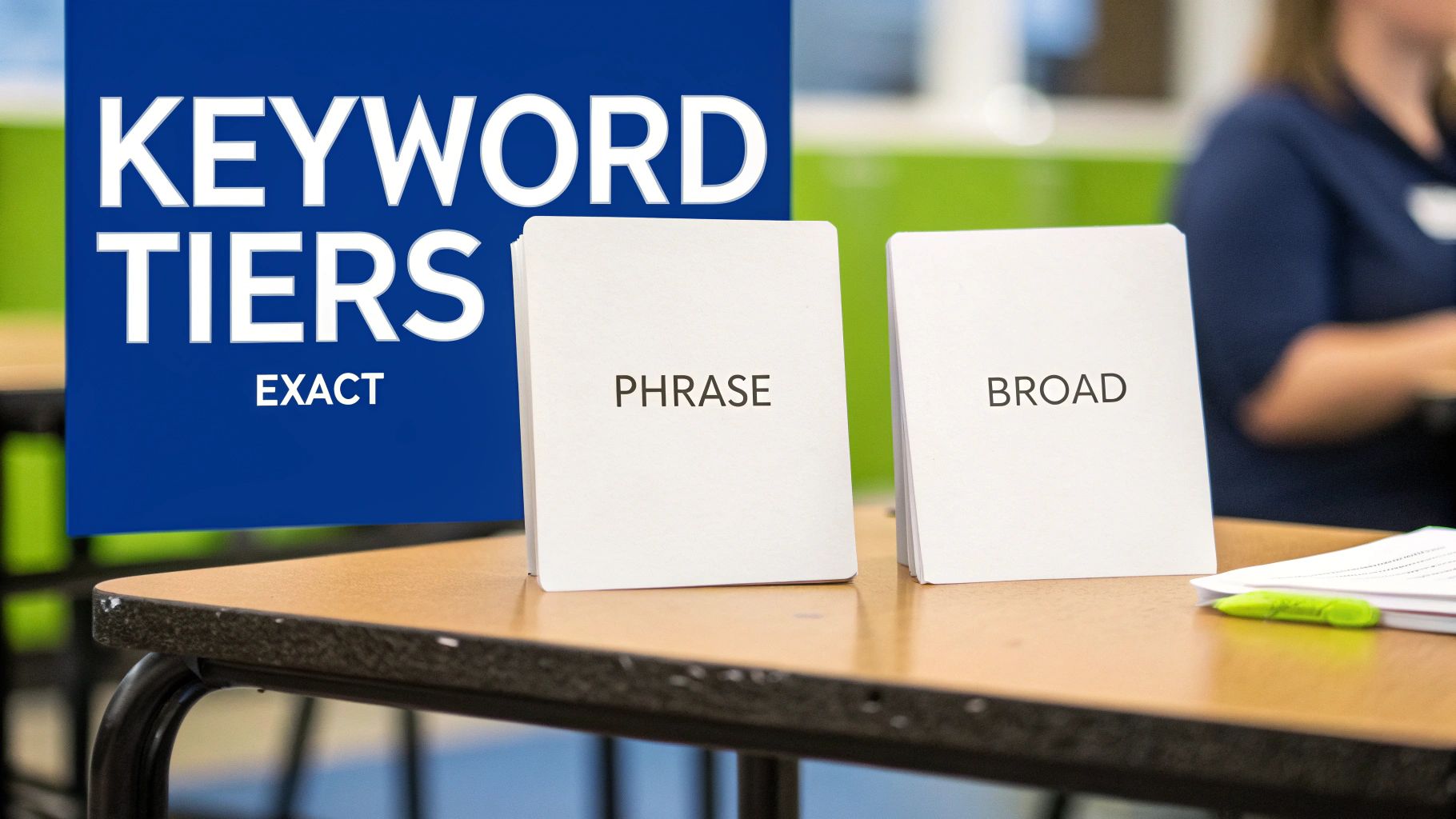
- Top Tier (Your Winners): These are high-converting, exact-match keywords with a proven track record of driving sales at or below your target ACOS. Bid aggressively to defend top placement and maximize impression share.
- Mid Tier (Your Prospects): This is your proving ground for phrase-match keywords and promising exact-match terms that have yet to demonstrate consistent profitability. Bids should be moderate—high enough to gather data but calibrated to protect profit margins.
- Discovery Tier (Your Explorers): This tier is for broad-match keywords. Their primary function is research—unearthing new long-tail search terms that real customers are using. Bids must be low; you are paying for data, not direct sales.
This tiered system concentrates your budget on proven performers while enabling controlled, low-risk exploration of new opportunities. You're no longer just bidding; you're strategically allocating capital.
Segmenting Campaigns by Keyword Performance
To implement this tiered logic effectively, your campaign structure must align. We consistently see top-performing brands segment keywords into distinct campaigns based on performance, enabling tailored budgets and bidding rules.
A common and highly effective structure:
- Winners Campaign: Home to your top-tier, exact-match keywords with a history of excellent sales and ACOS. These campaigns receive a significant budget and aggressive bids, often paired with "up and down" dynamic bidding to dominate top-of-search placements.
- Prospecting Campaign: Houses your phrase-match and less-proven exact-match keywords. The goal is to graduate keywords to the Winners campaign once they consistently meet performance targets. Bids are more conservative, with "down only" being a common choice to control costs.
- Research Campaign: This is where you run broad-match keywords to discover new search terms. With low bids and a tight budget, its sole purpose is to populate your search term reports with fresh opportunities. Getting your initial Amazon PPC keyword research right is essential for feeding these campaigns from the start.
This segmentation allows you to apply rules at the campaign level, eliminating the need to micromanage individual bids. You can confidently increase the budget for your Winners campaign, knowing every dollar is invested in a proven performer.
We often see brands lumping all their keywords—winners, losers, and maybes—into one campaign. This forces them to bid for the average, overspending on poor performers and underfunding their stars. Segmentation isn't just an organizing tactic; it's a core profitability strategy.
Using Bids to Fuel the Flywheel
This is where PPC transcends its role as a sales channel to become a strategic growth engine. Your bids directly influence sales velocity, a critical factor in Amazon's organic ranking algorithm.
Consider a keyword where your product is stuck on page two organically but converts exceptionally well through paid ads. This is a prime opportunity. By strategically increasing your bid on that specific keyword, you drive more ad-fueled sales.
This surge in sales velocity sends a powerful signal to the A9 algorithm: your product is highly relevant for that search term. In response, Amazon rewards this performance with a better organic ranking. For brands like STEADY JAPAN, this exact strategy helped them maintain their top category position while cutting ACOS by 25%.
This is the flywheel effect in action. You use paid ads to prove your product's relevance, and Amazon rewards you with free, organic visibility. Your ad spend transforms from a short-term cost into a long-term investment in organic dominance.
Automating Your Bids for Scale and Efficiency
As your brand scales, manual bid management becomes an operational bottleneck. Adjusting bids across hundreds or thousands of keywords with the required speed and precision is impossible.
This is the inflection point where you must transition from manual adjustments to intelligent automation. This isn't about relinquishing control; it's about reclaiming executive time for high-level strategy.
Amazon's native rule-based bidding is the logical starting point. These are simple "if-this-then-that" rules that automatically adjust bids based on performance triggers you define. It's a powerful method for enforcing your strategy 24/7 without manual intervention.
Setting Up Rule-Based Bidding
Amazon's rules are built around core performance metrics. You can create rules that react to changes in ACOS, conversion rates, click-through rates, or order volume over a specified period.
For example, a standard set of effective rules includes:
- The "Feed Your Winners" Rule: If a keyword’s ACOS is below a 20% target and has generated at least 10 orders in the last 14 days, then increase the bid by 15%. This automatically allocates more budget to proven performers.
- The "Stop the Bleeding" Rule: If a keyword’s ACOS exceeds 40% (well beyond break-even) with 20+ clicks and zero sales, then decrease the bid by 25%. This is your automated safety net to cut wasted spend.
Rules like these handle the fundamental, repetitive optimizations every account requires, freeing up your team to focus on strategic initiatives rather than manual tasks.
Automation isn't about setting and forgetting. It's about encoding your strategic decisions into a system that can execute them faster and more consistently than any human. The goal is to elevate your team from performing manual tasks to designing intelligent systems.
This rule-based approach is the perfect entry point into automation. It gives you full control and transparency, letting you build confidence in automated systems while tying every action directly to the performance metrics that actually matter.
Graduating to Advanced PPC Platforms
While Amazon's native rules are a great first step, they are fundamentally reactive—adjusting bids based on past performance. To gain a competitive edge, you need a predictive, holistic approach, which is where third-party PPC software excels.
These platforms utilize machine learning to analyze thousands of data points in real-time, making micro-adjustments that are impossible to replicate manually. Their purpose is to align every bid with your true profitability goals, not just a target ACOS.
It makes sense to upgrade when:
- Your SKU count has exploded. Managing bids for a catalog of 500+ products with manual rules is unsustainable.
- Competitors are consistently outbidding you. If you're losing impression share on key terms, your rivals are likely using more advanced bidding technology.
- You need to account for external factors. Advanced platforms can factor in inventory levels, seasonality, and time of day (day-parting) to make smarter decisions, such as automatically reducing bids for a product that is about to go out of stock.
These tools don’t just change bids; they optimize your entire advertising investment. They forecast performance, identify wasted ad spend, and dynamically shift budgets between campaigns based on real-time ROI. For any brand with serious growth ambitions, this level of automation is a competitive necessity.
Using Advanced Analytics to Sharpen Your Bidding
Standard ad reports tell you what happened. Advanced analytics tell you why it happened and what to do next. To gain a true competitive advantage, you must move beyond surface-level metrics and leverage the data within tools like Amazon Marketing Cloud (AMC) and the Search Query Performance dashboard.
This is where you stop reacting to ACOS and start proactively shaping the customer journey. These platforms provide a clear map of the path to purchase, unlocking insights that lead to smarter, more profitable bids across the entire marketing funnel.
Uncovering the Path to Purchase with AMC
Amazon Marketing Cloud (AMC) is a secure data "clean room" that allows you to analyze anonymized signals across all your advertising efforts—Sponsored Ads, DSP, and even organic interactions. Its primary value is revealing the complex, non-linear path customers take before purchasing.
Instead of seeing only the last ad a customer clicked, you can see every touchpoint. Did a shopper first see a Sponsored Display ad, then search a generic term and click a Sponsored Brands video, and finally purchase through a Sponsored Products ad a week later? Standard reports can't tell that story. AMC can.
This visibility completely changes how you approach bidding.
- Top-of-Funnel Validation: You can finally prove the value of awareness campaigns that don't drive immediate sales but are critical for introducing your brand to new customers who convert later.
- Smarter Attribution: It enables you to assign proper credit to each ad format, giving you the confidence to invest in upper-funnel keywords you might have previously cut based on a simplistic last-click ACOS model.
The single biggest mistake I see brands make is slashing bids on high-ACOS campaigns without understanding their role in the bigger picture. AMC often shows that these "inefficient" top-of-funnel ads are actually the engine driving your lower-funnel conversions.
Fusing Your Organic and Paid Strategy with Search Query Performance Data
The Search Query Performance dashboard is another powerful, often overlooked tool. It provides brand-level data on the top search queries driving impressions, clicks, and sales across both your organic listings and paid ads. This is the key to unlocking total profitability.
Consider this common, high-impact scenario:
You identify a high-volume search query where your product holds the #1 organic ranking and captures a dominant 70% organic click-share. Simultaneously, you are bidding aggressively to maintain the #1 sponsored placement for the exact same query. You are effectively paying to compete against yourself for a click you were likely to win organically.
By analyzing this data, you can make the strategic decision to reduce your PPC bid on that specific term. Your strong organic presence will continue to capture the sale, protecting your rank while dramatically improving your Total ACOS (TACOS) and overall profit.
While it's a bit of a tangent from ad placements, it’s interesting to note that bidding plays a unique role in Amazon's lesser-known B2B liquidation world. Here, resellers bid on entire pallets of returned goods in auctions, a market that generated over $1.5 billion globally through partners—showing a totally different side of the auction dynamic on Amazon.
Integrating these advanced analytics into your workflow transforms bidding from a simple PPC task into a core component of your business intelligence. Understanding the principles of business intelligence and reporting will strengthen your ability to make these data-backed decisions, ensuring every ad dollar is an intentional investment in profitable growth.
Common Amazon Bidding Questions Answered
Even with a robust strategy, questions will arise as you manage your Amazon bids. Here are no-nonsense answers to the challenges facing eCommerce leaders.
How Often Should I Adjust My Amazon Bids?
For a new campaign, monitor performance daily, but adjust bids only every three to five days. This provides sufficient time to gather meaningful data, preventing reactions to random daily fluctuations.
For mature campaigns, a weekly review is typically adequate. The cardinal rule is to avoid knee-jerk reactions. Base decisions on performance trends over a consistent timeframe. For continuous micro-adjustments, automation is the superior solution.
What Is a Good Starting Bid on Amazon PPC?
There is no universal "good" bid. The optimal starting bid is a function of your product's price, profit margin, and category competitiveness.
The most strategic approach is to calculate your break-even Cost-Per-Click (CPC) based on your product's financials. Use Amazon's suggested bid range as a market indicator, not a directive. A practical method is to start slightly below the suggested range for broad keywords and within the range for highly relevant, exact-match keywords. Collect data for a few days, then adjust based on performance.
Why Are My Bids High but My Impressions Are Low?
A high bid does not guarantee impressions. The most common cause of low impressions is poor keyword relevance. If Amazon's algorithm determines your product is not a good match for the search query, it will not serve your ad, regardless of your bid.
Other potential culprits include:
- Your daily budget is being exhausted too early in the day.
- A low-quality product listing (e.g., poor star rating, few reviews) can render you ineligible to win the ad auction.
- Negative keywords may be inadvertently blocking your ads from appearing on relevant searches.
Should I Use Dynamic Bids or Fixed Bids?
This choice must align directly with your campaign's strategic objective. Using the wrong bidding strategy is a fast way to either burn cash or miss opportunities.
I see this all the time: people apply a one-size-fits-all bid strategy. A product launch campaign has a totally different risk tolerance than a campaign focused on squeezing every last drop of profit from a bestseller. You have to match the strategy to the objective.
Here’s the decision framework:
- Dynamic bids – down only: Use when efficiency and budget protection are the primary goals. Ideal for stable, mature campaigns focused on profitability.
- Dynamic bids – up and down: Deploy for aggressive growth. This is for product launches, key sales events, or scaling proven campaigns where the objective is market share capture.
- Fixed bids: Provides maximum control and predictable costs. Best used for specific A/B tests or for defending your most critical branded keywords at all costs.
Ensuring your bidding strategy is sound means avoiding common pitfalls. It's wise to review the common errors e-commerce brands make with Amazon Ads to ensure you're not making simple, costly mistakes.
Ready to stop guessing and start building a profitable, data-driven advertising strategy on Amazon? The experts at Headline Marketing Agency use advanced analytics and hands-on management to turn your PPC spend into a powerful engine for organic growth and sustained profitability. Let’s talk about scaling your brand.
Get Your Free Amazon PPC Audit
Discover untapped growth opportunities and see how our data-driven approach can improve your ROAS.
Get Free Audit →Wollen Sie Ihre Amazon PPC-Performance aufs nächste Level bringen?
Lassen Sie Ihre Amazon PPC-Kampagnen professionell analysieren und entdecken Sie neue Wachstumsmöglichkeiten.