Amazon Seller Best Practices for Profitable Scale
Master amazon seller best practices with a data-driven playbook. Learn how to leverage PPC, listing optimization, and SQP data

Most Amazon seller best practices still start with the wrong question: How do we grow sales faster? The better question is, which sales improve profit, strengthen organic rank, and leave the brand more resilient than it was before? Keyword stuffing, indiscriminate PPC expansion, and revenue targets detached from inventory and contribution margin create activity, not necessarily a durable business.
Amazon has become less forgiving of weak execution. Amazon reports that independent U.S. sellers averaged more than $290,000 in annual sales in 2024, while fewer than 8,000 sellers account for roughly half of Amazon's U.S. third-party GMV. The gap between participation and meaningful scale is widening, so mid-market brands need a system that connects retail readiness, conversion, advertising, data, and operations.
The Profit-First Operating Model for Amazon Growth
Revenue is a lagging indicator. Contribution profit by search term, ASIN, and advertising objective gives a senior ecommerce team something it can manage.
Many brands still treat Amazon as a growth channel first and a business second. They increase bids, add products, accept weak margins, and call the resulting revenue momentum. That approach breaks when costs rise, compliance work expands, competitors multiply, or a product loses the Buy Box. Jungle Scout identifies rising costs as a top seller challenge in its 2025 Amazon Seller Report, while Marketplace Pulse reported that Amazon registered 165,000 new sellers in 2025 and that active sellers fell to 1.65 million by the end of 2025. Those figures describe a marketplace where entry is not the same as durable participation.
At the other end of the market, Amazon said more than 75,000 independent sellers surpassed $1 million in annual sales in the prior year, a 36% increase, as reported in the same Jungle Scout source. That contrast matters. Scaled operators aren't winning just because they spend more. They build cleaner catalogs, protect availability, understand their unit economics, and use advertising to reinforce products that can convert profitably.
Replace growth targets with operating thresholds
A practical Amazon operating model should define thresholds before campaigns launch:
- Contribution margin: Calculate profit after product cost, referral fees, fulfillment, storage, discounts, returns, and advertising. Use this profit margin calculation framework to make campaign decisions against real economics rather than top-line revenue.
- Retail readiness: Don't scale traffic toward a listing with weak images, missing attributes, suppressed content, poor reviews, or an offer that can't remain competitive.
- Inventory coverage: Fund advertising only when the supply plan can support the demand it creates. A sudden stockout can waste paid momentum and interrupt organic sales velocity.
- Compliance control: Treat claims, documentation, product safety, variation relationships, and category requirements as commercial infrastructure, not administrative cleanup.
Amazon's New Seller Guide is a foundational operating reference because sellers who use it during their first 90 days generate approximately 6x more first-year sales on average. The useful lesson isn't that every brand should copy a launch checklist blindly. It's that early account setup, catalog discipline, and operational consistency can materially influence the trajectory of the business.
Practical rule: Never approve a growth plan that doesn't show the margin, inventory, and compliance conditions required to sustain it.
The profit-first model also changes how teams judge PPC. A campaign can have acceptable ACOS and still attract low-value customers, cannibalize organic orders, or push a product toward an inventory shortage. Conversely, a campaign with a controlled short-term return can be rational if it moves a strategically important query, introduces a profitable product, or helps defend branded demand.
The decision standard is simple: fund activity that improves the economics or strategic position of the catalog. Cut activity that produces revenue without a credible path to profit, rank, retention, or brand protection.
Listing Optimization and Conversion Discipline
A product detail page is a sales system, not a keyword container. Amazon product pages typically convert in the 10% to 15% range, with 13% to 15% commonly described as excellent, according to SellerApp's Amazon conversion rate guide. That range makes conversion a direct efficiency lever. If the same qualified traffic produces more orders, the brand can often generate more revenue from the existing media investment instead of buying additional clicks.
A simple illustration shows why this matters. At a 10% conversion rate, 100 relevant detail-page visits produce 10 orders. At 15%, the same 100 visits produce 15 orders. That isn't a promise of performance, but it demonstrates the operating benefit available when a brand improves persuasion without increasing traffic. Better conversion can also make a paid click more valuable because the campaign has more opportunities to recover its cost through orders.
Diagnose the page before rewriting it
Don't begin with a keyword dump. Start by identifying the buyer's unanswered questions and the point where intent weakens.
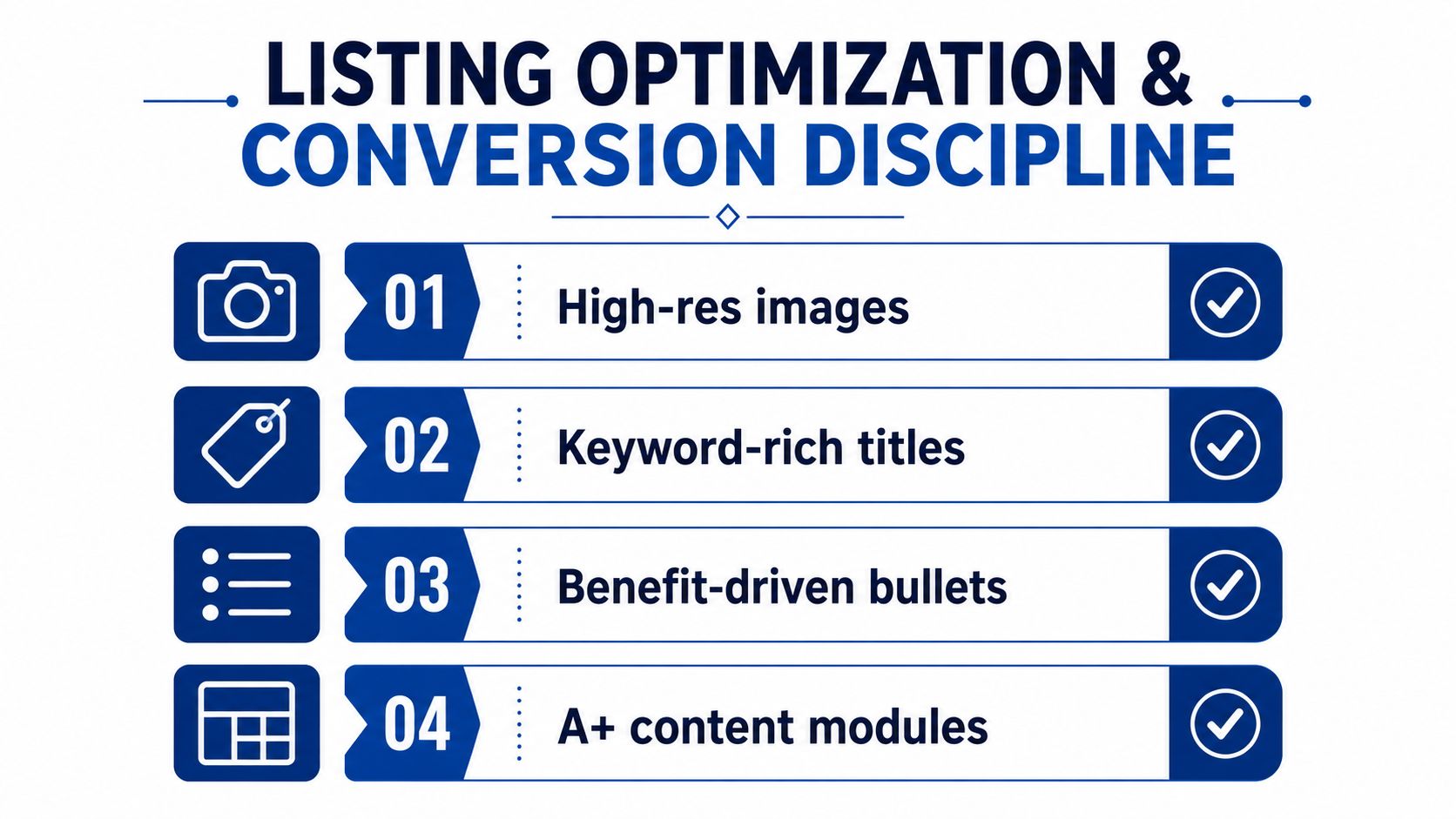
The title earns relevance and the click. Use the product type, brand, defining attributes, and meaningful use case in readable language. A title that contains search terms but obscures the product's value forces shoppers to work too hard.
The images reduce uncertainty. The main image must make the product recognizable at thumbnail size, while supporting images should clarify scale, use, compatibility, ingredients, dimensions, or included components. For brands that need a practical reference, how to build compliant image sets offers useful guidance on organizing visual information without creating policy risk.
The bullets translate features into decisions. Each bullet should answer a buying question. “Stainless steel construction” is a feature. “Resists corrosion during repeated kitchen use” explains why the feature matters. Claims still need evidence and category compliance.
A+ Content handles the deeper objection. Use comparison modules, diagrams, use-case sections, and brand context to help shoppers distinguish products and understand the portfolio. SellerApp reports that sellers using A+ Content see a 5% to 10% average increase in conversion rates, and listings with 5 or more high-quality images convert 20% better than listings with fewer images. Those figures make page enrichment worth testing, but the right module still depends on the product and the shopper's concern.
Backend search fields deserve the same discipline. Amazon's search optimization guidance emphasizes synonyms, spelling variants, abbreviations, lowercase text, and spaces instead of punctuation. It also advises sellers to avoid repeated terms, short stop words, brand names, ASINs, profanity, and subjective claims in backend search terms. Every redundant character occupies limited space that could cover another relevant shopper expression.
Use conversion evidence to prioritize edits
Separate content problems from offer problems. A strong click-through rate with weak detail-page conversion points toward price, reviews, images, bullets, A+ content, delivery expectations, or product-market fit. Weak clicks with adequate conversion among visitors points toward the main image, title, price presentation, or query alignment.
For larger catalogs, manage changes in controlled batches. Record the original title, images, bullets, backend terms, price, and advertising support. Change one meaningful variable or one coherent content group, then compare performance over a sensible observation window. The objective isn't to make the page look more polished. It's to improve the relationship between query relevance, click appeal, purchase confidence, and advertising efficiency.
For a deeper operating framework, use this guide to Amazon product listing optimization. The strategic priority remains the same: build a page that helps the right shopper decide quickly, then use paid traffic to test and amplify that page.
Full-Funnel Advertising as an Organic Growth Lever
PPC shouldn't be treated as a vending machine for immediate revenue. It's a controlled way to buy qualified exposure, collect query evidence, accelerate product discovery, and support organic rank. That only works when the brand separates objectives instead of forcing every campaign to meet the same ACOS target.
A full-funnel structure gives each ad format a job:
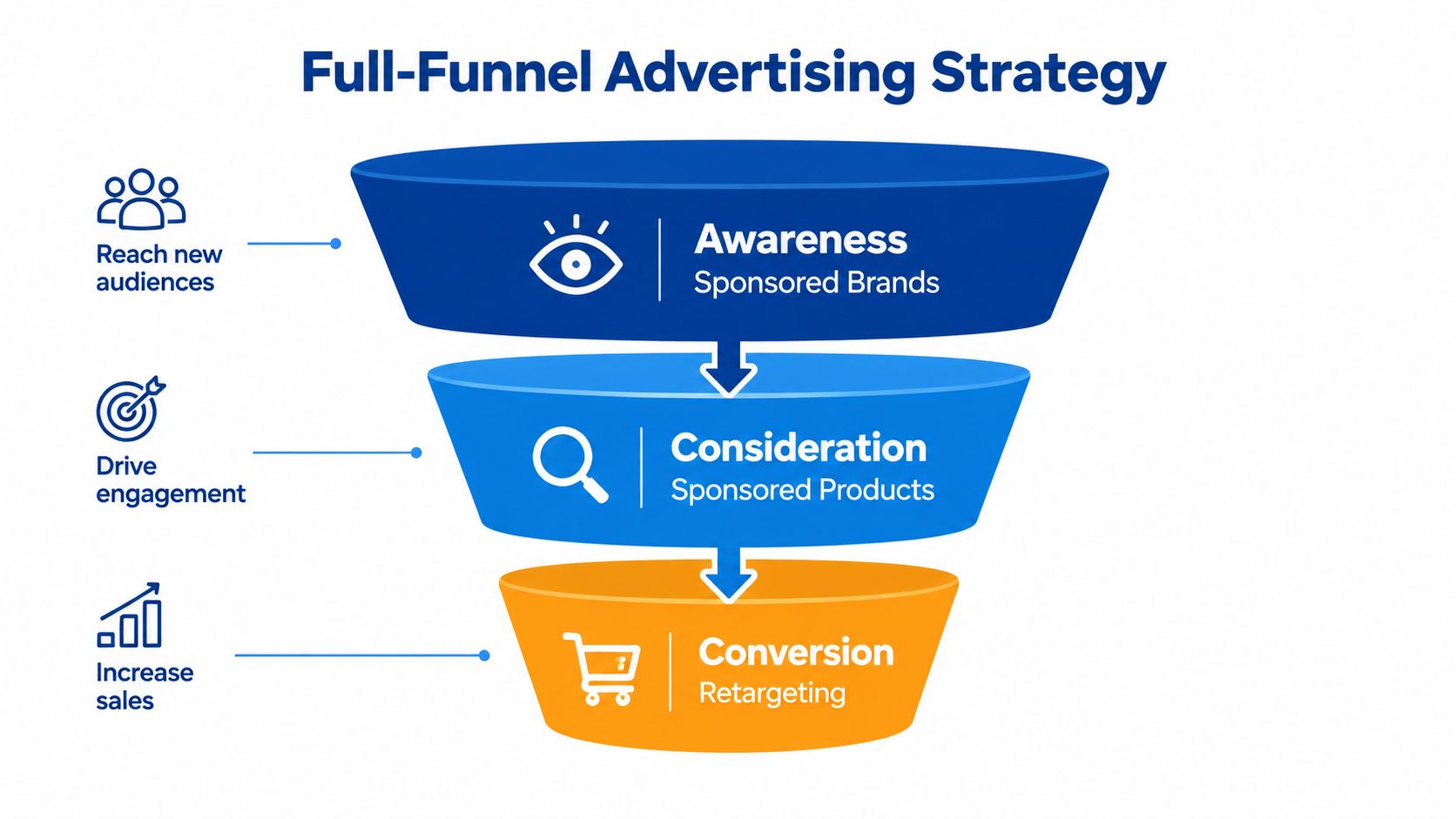
- Awareness with Sponsored Brands: Use brand creative, video where appropriate, and category or competitor audiences to introduce the portfolio. The goal is qualified attention and branded demand, not just the cheapest conversion.
- Consideration with Sponsored Products: Capture category and non-brand intent at the product level. Use search term performance to isolate queries that deserve exact-match investment, product targeting, or negative targeting.
- Conversion and re-engagement with Sponsored Display and DSP: Reconnect with shoppers who viewed products, engaged with the brand, or bought related items. Segment audiences so retargeting doesn't become an undifferentiated spend pool.
- Organic reinforcement: Identify queries where paid orders support a strategically important ASIN. Maintain relevance and conversion quality, because buying impressions alone won't create durable rank.
Build campaigns around decisions
Start with a query and product map. Mark terms as branded, generic, competitor, or use-case driven. Then assign each group a role, bid range, landing ASIN, and success condition. A generic discovery campaign should not carry the same efficiency expectation as a branded defense campaign or a retargeting audience.
Amazon advertising conversion benchmarks in 2026 cluster around 8% to 15% for many accounts, with 10% to 12% often cited as a healthy platform average and sub-8% viewed as weak in Sequence Commerce's benchmark analysis. The same source estimates Sponsored Products at 10% to 18%, Sponsored Brands at 8% to 12%, and Sponsored Display at 5% to 10%. Use these as diagnostic reference points, not universal targets. A low conversion rate can indicate weak traffic quality, an offer problem, or a detail-page failure. A high rate can still be unprofitable if CPC, price, returns, or product cost are unfavorable.
Budget principle: Give more budget to campaigns that create profitable orders and useful strategic evidence. Don't preserve spend simply because a campaign has a high conversion rate.
Video can support the upper and middle funnel when creative communicates the product quickly and links the message to a clear shopping action.
After launch, evaluate three outcomes separately:
- Immediate economics: Orders, sales, spend, CPC, conversion rate, and contribution profit.
- Query development: New converting terms, branded search growth, non-brand share, and rank movement for priority queries.
- Portfolio impact: Cross-sell, repeat demand, new-to-brand behavior, and whether advertising supports hero products without starving complementary ASINs.
Brands need a campaign architecture that reflects those outcomes. Amazon Ads campaign management can be organized around discovery, harvesting, defense, conquesting, and retargeting rather than a single blended account target. That structure makes budget reallocation more deliberate and protects the distinction between buying short-term orders and building long-term demand.
Leveraging Search Query Performance and Benchmarks
Amazon gives brands a useful first-party view of the search funnel through the Search Query Performance dashboard. The Amazon help documentation describes a report that exposes query volume, impressions, clicks, add-to-cart activity, and buys. That sequence lets a team locate the break instead of guessing from total sales.
The diagnosis should follow the funnel:
- High query volume with weak impressions: The ASIN may lack indexing, relevance, retail readiness, or paid coverage. Review titles, bullets, attributes, backend terms, and campaign targeting.
- Impressions without sufficient clicks: Inspect the main image, title, price, badge visibility, and competitive presentation. The listing is being seen but isn't earning enough attention.
- Clicks without add-to-cart activity: The page may not resolve the shopper's core objection. Check images, value communication, variation clarity, delivery, and offer strength.
- Add-to-cart activity without buys: Look at price, promotions, availability, shipping promise, review concerns, and competitor pressure.
Convert SQP into a budget workflow
The report becomes valuable when the team assigns an action to each pattern. A query with strong demand and weak visibility may justify content expansion and controlled Sponsored Products coverage. A query with impressions and clicks but poor buys may need a detail-page or offer intervention before receiving more budget. A query with efficient purchases and improving organic performance may deserve protection, but not unlimited bids.
Backend hygiene belongs inside this loop. If a query is relevant and commercially valuable, determine whether the listing's visible content, attributes, and search fields communicate that relevance. Amazon's search guidance advises against repeated terms and subjective claims, so the answer isn't to stuff the phrase into every field. Use the available space to broaden accurate coverage with synonyms, variants, and shopper language.
Amazon Marketing Cloud can add a broader path analysis by connecting advertising exposure and conversion behavior across campaign types. The brand doesn't need to treat every touchpoint as equally valuable. It needs to understand whether awareness activity assists product consideration, whether Sponsored Products closes demand, and whether retargeting creates incremental purchases or merely captures shoppers who were already ready to buy.
Use peer benchmarks without losing your own economics
Amazon's Benchmarks reporting is generally available in supported marketplaces including the US, CA, MX, BR, AU, JP, IN, DE, FR, IT, ES, UK, NL, TR, SE, SA, UAE, and EG, according to Amazon's Benchmarks announcement. The report includes metrics such as new-to-brand purchase share, new-to-brand purchase rate, cost per new-to-brand purchase, CTR, CPC, video completion rate, cost per completed view, and CPM.
| Metric Category | Specific Metrics Available |
|---|---|
| New-to-brand | Percent of purchases new to brand, purchase rate new to brand, cost per purchase new to brand |
| Traffic efficiency | CTR, CPC |
| Video engagement | Video completion rate, cost per completed view |
| Reach and media cost | CPM |
Use these comparisons to find relative weakness. If CTR trails peer performance, creative, placement, or audience selection may need attention. If CPC is high, targeting and auction strategy deserve review. If new-to-brand efficiency is weak, the campaign may be over-indexing on existing customers or reaching audiences without sufficient category intent.
Benchmarks don't replace contribution margin. They add context to it. A campaign can outperform peers on CTR and still fail commercially if the promoted ASIN has weak economics. The winning operating rhythm combines SQP for query-level diagnosis, Benchmarks for media context, and margin reporting for the final decision.
Inventory, Pricing, and Compliance Operations
Advertising creates demand. Operations determine whether the brand can collect the value of that demand. A campaign can't compensate for an unavailable ASIN, a suppressed listing, an uncompetitive offer, or an inbound plan that misses the selling window.
Inventory planning should connect media budgets to replenishment decisions. Before increasing spend on a hero ASIN, check available units, inbound status, lead times, seasonal demand, safety stock policy, and fulfillment constraints. A stockout doesn't just pause sales. It can disrupt campaign learning, force shoppers toward competitors, and weaken the commercial foundation that paid media was supporting.
Keep catalog health visible
A weekly operating review should surface:
- Suppressed and stranded listings: Fix missing information, policy issues, or catalog relationships before spending to drive traffic.
- Variation integrity: Confirm that size, color, pack, and style relationships help shoppers compare instead of creating confusion.
- Offer competitiveness: Review price, fulfillment promise, promotions, and Featured Offer conditions at the ASIN level.
- Inbound exposure: Flag products where advertising demand could exceed available sellable inventory.
- Compliance documentation: Keep claims, certifications, ingredients, safety files, and category-specific records organized before Amazon requests them.
Inventory accounting is often the missing layer between Seller Central reporting and actual profit. A resource such as Jumpstart Partners on inventory accounting can help finance and ecommerce teams align inventory valuation, landed costs, carrying exposure, and product-level profitability.
Price for contribution, not panic
Dynamic pricing can protect competitiveness, but an automatic price change without a floor can convert a sales win into a margin loss. Set a defensible floor based on product cost, marketplace fees, fulfillment, expected returns, promotional support, and target contribution. Set a ceiling that respects brand positioning and marketplace requirements.
Promotions also need a role. Use a coupon or deal when it helps a specific objective, such as reducing conversion friction, clearing appropriate inventory, or supporting a launch. Don't apply discounts across the catalog just to preserve revenue growth. The finance team should be able to see which promotions create incremental profit and which only subsidize orders that would have happened anyway.
Compliance belongs in the same operating model. A claim that improves clicks but triggers a suppression or documentation request is not a marketing win. Assign ownership for approvals, maintain change logs, and require advertising and creative teams to work from the same approved product facts. Retail readiness is a prerequisite for scale, not a post-launch repair task.
Real-World Application of the Data-Driven Playbook
Consider a mid-market home and kitchen brand launching a new product family. The launch has impressions, some paid clicks, and enough shopper interest to justify investigation, but sales aren't scaling profitably. The brand director's first instinct is to increase bids. The better move is to inspect the funnel before buying more traffic.

Start with the query evidence
The team opens Search Query Performance and finds that priority generic queries have meaningful search volume and impressions, but clicks are weaker than expected. On queries where shoppers do click, add-to-cart activity is healthier, which points away from a total product-market failure and toward a click-appeal problem.
The team reviews the main image, title, price presentation, and competitive search results. The main image doesn't communicate the product's differentiating feature quickly. The title uses relevant language but buries the use case. The brand replaces the image with a clearer product representation, moves the strongest buying attribute into the title, and revises the first bullets around practical benefits.
It also audits backend search terms. The team removes repeated words and subjective language, then adds relevant synonyms and spelling variants within Amazon's field constraints. The goal is not to repeat the priority query everywhere. It's to improve accurate query coverage while keeping the customer-facing content readable.
Reallocate only after the page is ready
The brand then separates campaigns by function. Sponsored Products captures high-intent generic terms and harvests new queries. Sponsored Brands supports portfolio discovery. DSP retargets shoppers who viewed the product but didn't purchase, while the team keeps the audience and frequency logic distinct from prospecting.
The launch manager compares the campaign's CTR, CPC, new-to-brand metrics, and video engagement with available Amazon Benchmarks. If DSP is expensive relative to peer context and isn't producing useful downstream behavior, budget moves toward the Sponsored Products terms with stronger purchase evidence. That doesn't mean DSP is permanently cut. It means the channel must earn its role through measurable contribution to the funnel.
Protect the recovery
The operations team checks inventory before scaling the winning terms. It validates the offer, confirms the listing is compliant, and sets a margin floor that prevents an aggressive promotion from erasing contribution. The brand director reviews query-level results alongside total advertising performance rather than celebrating a blended ACOS improvement that hides weak products.
This scenario doesn't depend on a miraculous tactic. It depends on sequencing. Diagnose visibility, click appeal, conversion, and economics in that order. Then make the smallest change that addresses the actual break.
The same logic applies to an established ASIN. If organic sales soften, don't immediately assume a ranking problem. SQP may reveal fewer impressions, while Benchmarks may show that CPC has risen or creative engagement has weakened. The appropriate response could involve content, bid allocation, inventory, price, or audience strategy. A senior operator gains an edge by choosing the correct intervention, not by changing everything at once.
Strategic Takeaways for Sustainable Marketplace Scale
Sustainable Amazon growth comes from integration. Content creates relevance and confidence. PPC creates controlled exposure and query evidence. Operations preserve the ability to convert that demand. Profit reporting decides whether the system deserves more investment.
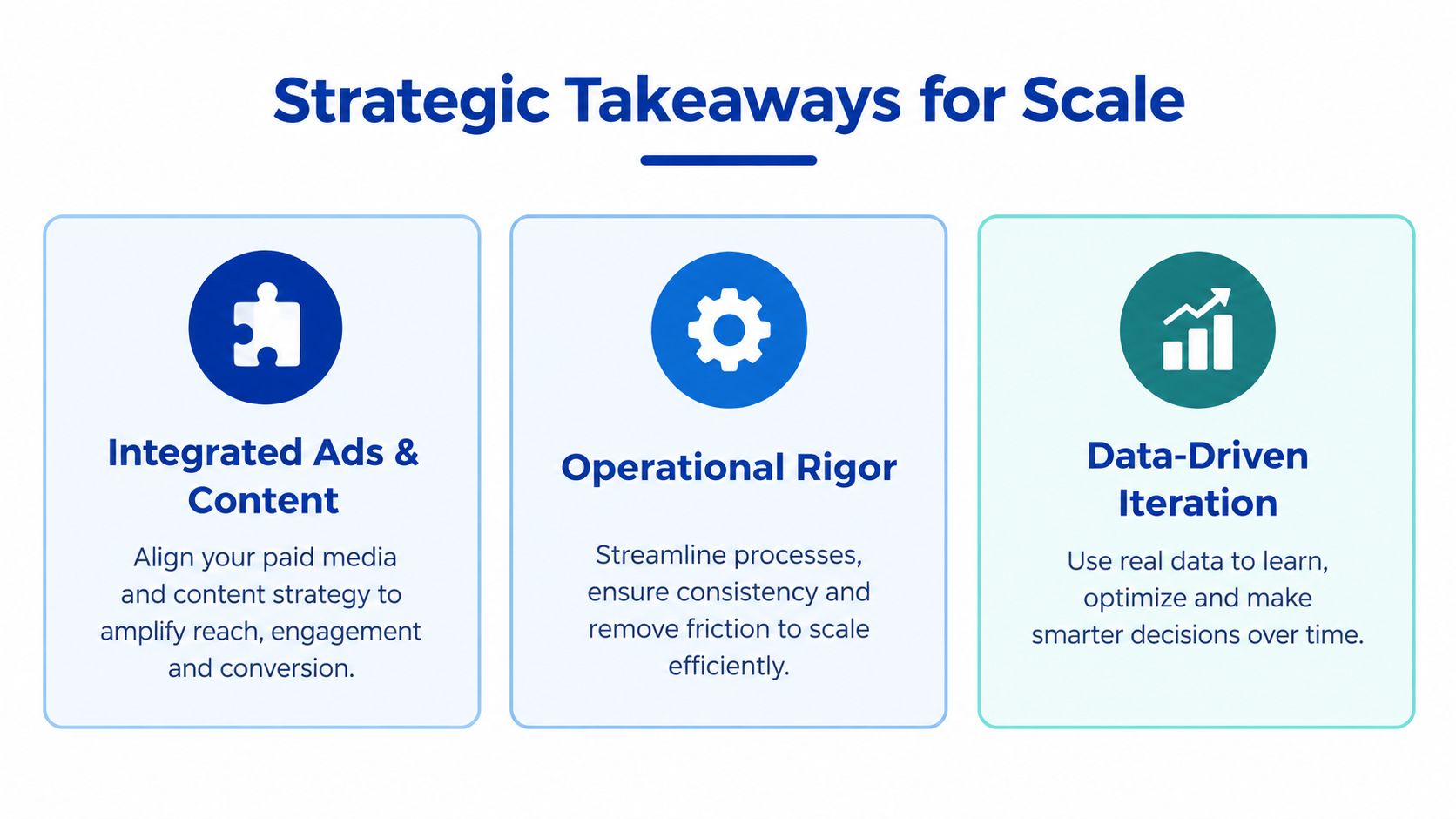
Use this checklist in every marketplace business review:
- Integrated ads and content: Confirm that priority search terms appear naturally in relevant listing content, that images answer the main objections, and that campaign landing ASINs are retail-ready. Paid traffic should expose content weaknesses, not conceal them.
- Operational rigor: Review inventory, pricing floors, fulfillment, compliance, suppressed listings, and contribution margin before increasing spend. A campaign cannot scale a product the operation can't reliably sell.
- Data-driven iteration: Use SQP to locate funnel breaks, Benchmarks to add peer context, advertising reports to evaluate channel roles, and margin data to approve or reject budget changes.
The most useful Amazon seller best practices are not isolated hacks. They form a management system with clear inputs and decisions. Search data tells you where demand exists. Listing analysis tells you whether the page can convert it. Advertising tells you how to buy and develop that demand. Finance and operations tell you whether the resulting growth is worth keeping.
Headline Marketing Agency applies this operating philosophy through Amazon PPC, DSP, listing optimization, and analytics using tools such as Search Query Performance and Amazon Marketing Cloud insights. The team can help your brand connect advertising decisions to organic ranking, profitability, and long-term marketplace position. Visit Headline Marketing Agency to evaluate where your Amazon funnel is leaking profit and build a focused plan for sustainable scale.
Get Your Free Amazon PPC Audit
Discover untapped growth opportunities and see how our data-driven approach can improve your ROAS.
Get Free Audit →Wollen Sie Ihre Amazon PPC-Performance aufs nächste Level bringen?
Lassen Sie Ihre Amazon PPC-Kampagnen professionell analysieren und entdecken Sie neue Wachstumsmöglichkeiten.