Amazon Product Targeting: A Strategic Playbook for Scale
Master Amazon product targeting to drive organic growth and profitability. Learn ASIN vs category strategies, setup, bidding, and optimization for 2026.

Clicks are often treated as proof that an Amazon campaign is working. They aren't. Amazon reports that suggested products were 321 times more likely to generate ad-attributed sales when advertised, while newly launched products were 231 times more likely to generate ad-attributed sales when advertised, according to its published Sponsored Products guidance (Amazon Sponsored Products best practices). The counterintuitive lesson is that product targeting isn't primarily about stealing a competitor's visitor. It's about placing the right ASIN in a buying journey where Amazon already recognizes strong commercial intent.
That changes the operating question. Instead of asking which product pages can generate cheap traffic, ask which targets can improve discovery, conversion efficiency, organic momentum, and category position at the same time. Amazon product targeting becomes valuable when paid visibility supports a broader retail outcome, not when a dashboard merely reports more clicks.
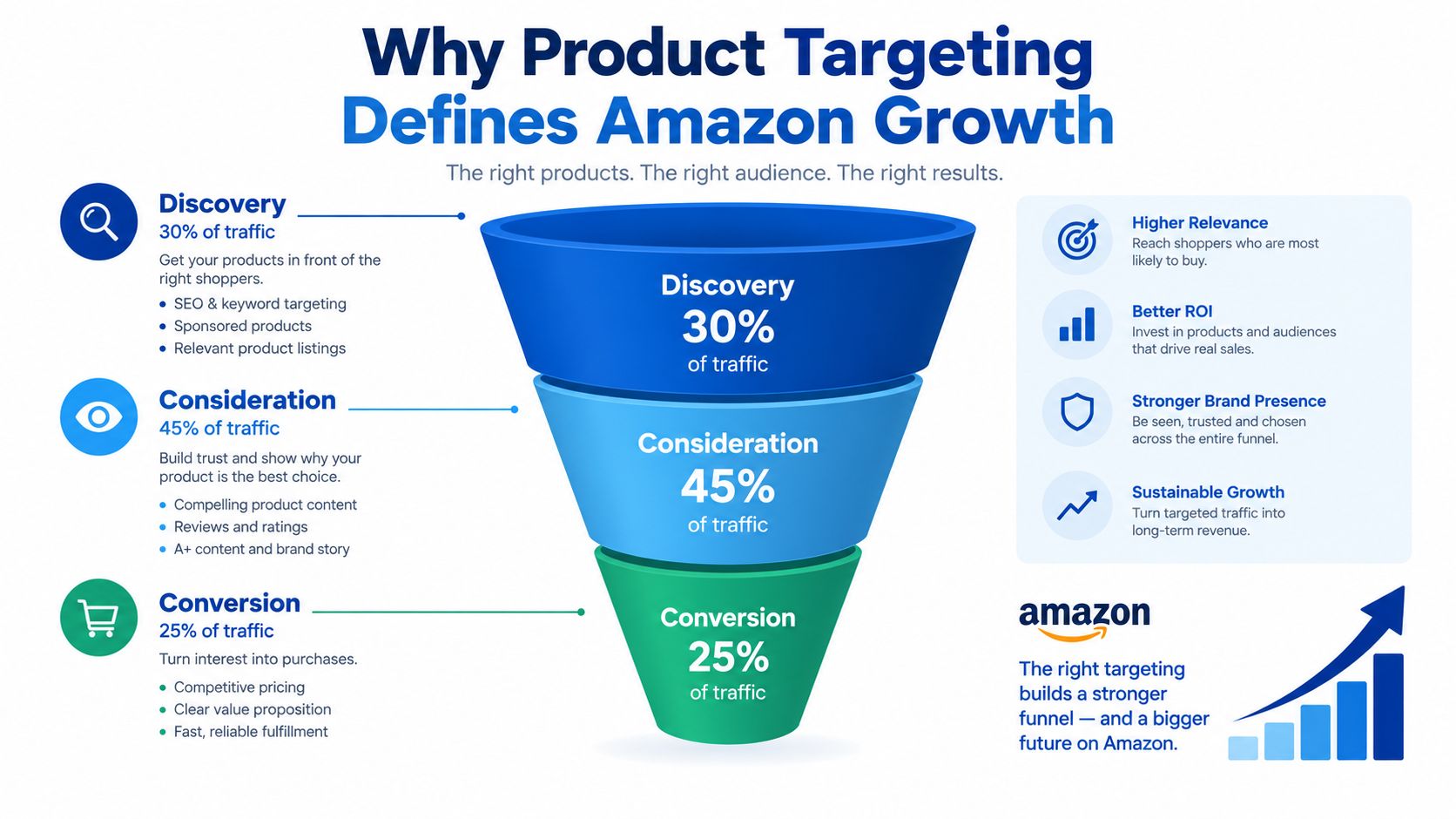
Why Product Targeting Defines Amazon Growth
Amazon's own product-strategy guidance reports that newly launched products observed 36 times more clicks when advertised than products that weren't new. It also reports that products with deals or coupons advertised with Sponsored Products saw an average 65% increase in sales and 75% increase in units sold compared with periods when those deal or coupon products weren't advertised (Amazon product strategy guidance).
Those figures point to a full-funnel mechanism. Product targeting can introduce an unfamiliar ASIN during discovery, put it beside a known alternative during consideration, and give the shopper a relevant path to conversion on a detail page or search results page. The placement matters because the shopper has already revealed context through the product they're viewing, the category they're browsing, or the relationship between items in the catalog.
Paid visibility can create organic momentum
Amazon doesn't publish a universal formula saying that an ad click automatically improves organic rank. A more defensible interpretation is that effective advertising can create the conditions that support organic growth: qualified shoppers see the product, some purchase, and the ASIN accumulates stronger commercial evidence. That only happens when the listing, price, availability, reviews, and offer can convert the attention being purchased.
This is why product targeting should be evaluated as a retail system, not as an isolated placement type. A target that produces sales at an acceptable contribution margin may also expose the brand to a relevant audience, increase consideration against a substitute, and help a new ASIN earn early demand. A target that generates clicks without purchases does none of those things efficiently.
Amazon's data also shows why lifecycle context matters. New products and suggested products can benefit disproportionately from advertising because they lack the accumulated visibility of established listings. The strategic implication is clear: launch campaigns shouldn't use the same target logic as mature-product defense campaigns. A launch needs qualified discovery and evidence gathering. A mature product may need conquesting, cross-selling, or protection of high-value detail pages.
Strategic rule: Treat every target as a hypothesis about shopper intent. The winning hypothesis isn't “this ASIN has traffic.” It's “shoppers considering this ASIN have a credible reason to choose ours.”
Choosing Between ASIN, Category, and Brand Targets
Amazon supports product-based and keyword-based contextual targeting. Within product targeting, advertisers can select specific products, categories, brands, and product features, so the right structure depends on the commercial question rather than the easiest campaign setting (Amazon Sponsored Products targeting model).
| Target type | Best strategic use | Main advantage | Main risk |
|---|---|---|---|
| ASIN targeting | Direct substitutes, complementary products, own-catalog cross-sell | Highest control over the retail context | Narrow scale and target-level volatility |
| Category targeting | Discovery, category expansion, and broader reach | More room to find relevant placements | Less control over the exact product context |
| Brand targeting | Competitive brand conquesting or portfolio visibility | Connects the campaign to a recognizable catalog | Brand context can be too broad without product or feature filters |
ASIN targeting
Use ASIN targets when you can articulate why a shopper viewing a specific product should consider yours. The rationale might be a stronger feature set, a more suitable format, a better offer, or a complementary use case. Direct substitutes are obvious targets, but complementary ASINs can be strategically important because the shopper has already demonstrated interest in the broader task or category.
Your own catalog deserves attention too. If two products solve adjacent needs, targeting one product with the other can support cross-selling while giving the shopper a more complete solution. Keep that logic separate from competitor conquesting, because the success criteria differ. A complementary target may be profitable through basket expansion, while a competitor target may be judged by conquest efficiency and new-to-brand value.
Category and brand targeting
Category targeting makes sense when the brand needs qualified reach beyond a fixed list of ASINs. It can support discovery for a launch or help a brand learn which parts of a category contain viable demand. The trade-off is control. A category target can surface products that don't match your price tier, feature set, or conversion strengths, so filters and search-term analysis matter.
Brand targeting works best when the brand itself is a useful context signal. It can help a challenger appear around a competitor's catalog or help an established brand expose related products. For a deeper treatment of how Sponsored Brands can use product-level context, see Sponsored Brands product targeting.
A practical decision framework is simple. Choose ASIN targeting for precision, category targeting for structured discovery, and brand targeting for portfolio or competitive context. Don't force all three into one campaign. Separate them so budgets, bids, and performance expectations reflect the different jobs they're performing.
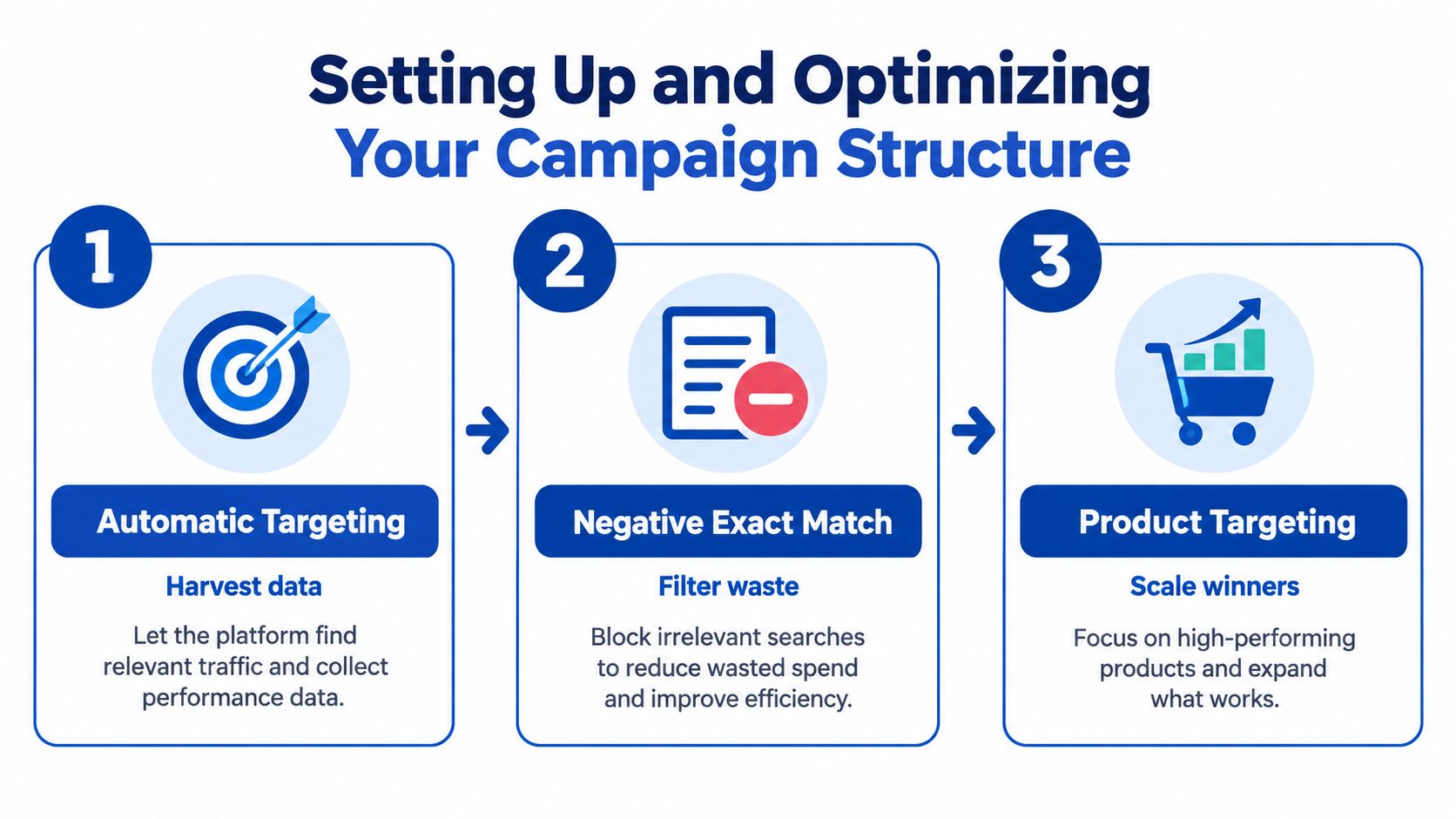
Setting Up and Optimizing Your Campaign Structure
A reliable structure starts with data collection, not with a large manual list of guesses. Amazon recommends using Automatic Targeting to harvest high-intent search queries, reviewing the search term report, moving strong queries into Manual Targeting, and adding queries with significant clicks but low or no sales as negative exact terms. Its optimization guidance also centers measurement on clicks, spend, sales, and ACoS, with reports schedulable daily, weekly, or monthly (Amazon Sponsored Products optimization guide).
Build the foundation first
Before creating targets, confirm retail readiness. Sponsored Products advertisers need an active account in good standing, a valid payment method, the ability to ship to the advertised country, and eligible listings. Amazon requires products to be eligible for the Featured Offer in an available category. Suppressed listings, virtual bundles, adult products, used and refurbished products, and products in closed categories aren't eligible, while restricted examples include alcohol-related items, knives, over-the-counter pharmaceuticals, supplements, medical devices, sexual wellness products, and religious products (Sponsored Products eligibility requirements).
A compliant listing still needs a persuasive offer. If the detail page has weak imagery, unclear benefits, poor availability, or an uncompetitive price, product targeting only buys a shopper the opportunity to reject the product.
Use a controlled migration loop
Start with Automatic Targeting. Let Amazon identify search queries and product contexts that match the advertised ASIN. Keep the purpose clear: this campaign is a discovery and harvesting layer, not the final structure.
Read the search term report. Separate queries and product targets that generate sales from those that consume spend without commercial evidence. A click is a signal to investigate, not a reason to scale.
Create Manual Targeting campaigns. Promote relevant winners into tightly defined campaigns. Separate direct substitutes, complementary products, own-ASIN targets, and category targets so you can adjust bids and budgets without obscuring the data.
Add negative exact terms. Remove waste when a query receives meaningful engagement but fails to produce sales. Negative targeting protects the harvesting campaign from repeatedly paying for the same weak match.
Review the listing after every material change. If conversion falls, don't assume the bid is the problem. Check price, Featured Offer status, inventory, content, ratings, and the relevance of the target itself.
Campaign structure should answer an optimization question. If one campaign mixes a premium competitor, a complementary accessory, and a broad category, you won't know whether the budget is funding conquest, cross-sell, or discovery. For operational context beyond Amazon advertising, Peak Transport compares delivery models, which is useful when fulfillment economics influence the profitability of promoted products.
For display-led product audiences, keep the measurement logic distinct from Sponsored Products. The Sponsored Display product targeting guide can help teams compare that layer with search-driven placements.
Use the following video as a practical visual reference for campaign structure, but validate every recommendation against current account data and Amazon's documentation.
Leveraging Advanced Insights for Deeper Optimization
ACoS tells you how attributed ad spend compares with attributed sales. It doesn't tell you whether the campaign expanded category share, influenced a later purchase, intercepted a competitor's consideration, or captured demand that would have converted anyway.
That gap is where Search Query Performance and Amazon Marketing Cloud become useful. Amazon describes Search Query Performance as a source of brand-level and ASIN-level visibility into impressions, clicks, cart adds, and purchases across weekly, monthly, and quarterly views. It also describes product targeting as a combination of products, categories, brands, and product features, which allows teams to connect a target context with the shopper behavior that follows (Amazon Search Query Performance and product targeting documentation).
Connect the target to the journey
Start with a target-level question: where does the brand lose shoppers between visibility and purchase? Search Query Performance can help identify queries where the brand receives exposure but captures limited click, cart, or purchase share. That insight can change the target list. If shoppers frequently move from a category query to a competitor detail page, a relevant ASIN target may be more useful than adding another broad keyword.
The same logic applies to your own catalog. If one ASIN attracts shoppers who later purchase another product, own-product targeting can support the journey rather than compete with it. If a target receives impressions but no meaningful downstream action, reduce its role even if its click-through rate looks attractive.
Use AMC to test incrementality
AMC can add a journey-level view across eligible advertising and retail signals. Analysts can use it to examine paths such as exposure followed by detail-page engagement, repeat interaction, or purchase. The purpose isn't to replace ACoS. It's to prevent ACoS from becoming the only definition of success.
Useful AMC questions include:
- Exposure overlap: Are the same shoppers receiving repeated impressions across Sponsored Products, Sponsored Brands, Display, and Video?
- Path efficiency: Do product-targeted shoppers purchase after one interaction, or do they require multiple ad contacts?
- New-to-brand behavior: Does a target introduce shoppers to the brand, or mostly convert existing customers?
- Assisted value: Do shoppers exposed to a target later purchase through an organic or branded route?
- Portfolio movement: Does promoting one ASIN increase demand for related products, or merely shift sales within the catalog?
For teams that need a controlled environment for this analysis, Amazon Marketing Cloud clean room capabilities provide a relevant framework for working with privacy-conscious advertising and retail datasets.
Measurement principle: A target is stronger when it creates profitable demand that would otherwise be missed, not merely when it wins the last attributed click.
Bidding should follow the answer to those questions. A target with modest last-click efficiency but strong incremental reach may deserve protection. A target with excellent attributed sales but heavy overlap with existing demand may not deserve additional budget. That distinction keeps optimization tied to business growth rather than dashboard theater.
Driving Profitability and Long-Term Brand Equity
ACoS becomes a poor business objective when it is separated from demand quality and contribution margin. A low ratio may indicate efficiency, yet it may also reflect limited reach, avoidance of competitive auctions, or dependence on shoppers who already intended to buy. A higher ratio can be rational during launch, direct conquest, or promotion of a product whose downstream value extends beyond the advertised order.
The analyst's task is to distinguish efficient growth from inexpensive demand capture.
Replace single-metric control with economic judgment
Product targeting belongs inside a contribution-margin model. Account for cost of goods, fulfillment, marketplace fees, promotional discounts, returns, and the advertised ASIN's role in the wider portfolio. Then assess two outcomes: the profit generated now and the commercial momentum created afterward.
Each campaign needs a defined job and an appropriate tolerance for investment:
| Campaign job | Primary question | Profitability lens |
|---|---|---|
| Launch discovery | Is the product reaching relevant shoppers and generating evidence? | Controlled investment with strict retail-readiness checks |
| Direct conquest | Can the product win consideration against a substitute? | Contribution margin and target-level conversion |
| Complementary targeting | Does the placement expand the basket or introduce a related need? | Incremental portfolio value |
| Brand defense | Is the brand protecting valuable detail-page and category demand? | Cost of losing the shopper to an alternative |
| Mature-product scale | Can the ASIN grow without eroding economics? | Marginal profit from additional exposure |
Amazon reports that advertising products during weeks when the product type historically had high engagement generated 32% more sales on average, while advertising during high-demand weeks generated 22% more sales on average (Amazon Sponsored Products best practices). These figures support a planning discipline rather than indiscriminate seasonal spending. Match target selection, inventory, offer strength, and budget to periods when shoppers are more receptive.

Organic growth needs operational discipline
Paid traffic can support organic visibility when the product converts and remains available. Sending shoppers to an out-of-stock ASIN, a weak detail page, or an offer that loses the Featured Offer wastes media spend and contaminates campaign analysis. The resulting data reflects retail friction as much as targeting quality.
Brand equity grows through consistent customer experiences. Shoppers evaluate whether the product fulfills its promise, whether the detail page resolves objections, and whether related products form a coherent portfolio. Product targeting can place the brand in relevant consideration sets, while the catalog and customer experience determine whether that exposure becomes durable demand.
Search Query Performance insights can connect advertising activity with changes in query-level visibility, consideration, and purchase share. AMC can then help evaluate whether exposure contributes to broader customer journeys across Amazon advertising formats and organic routes. Used together, these signals move decision-making beyond ACoS and toward incremental demand, branded search strength, and portfolio effects.
Profitability rule: A target earns scale when you can explain its current margin, its funnel role, and the evidence that additional exposure creates new demand rather than reallocating existing demand.
Sustainable scale comes from controlled expansion. Promote winning contexts, remove weak ones, refresh targets as competitors change, and connect paid results with organic and portfolio outcomes. A less aggressive bid strategy may produce a quieter short-term dashboard, but it gives leaders a clearer basis for allocating capital. The strongest target is therefore one that remains economically defensible as reach expands.
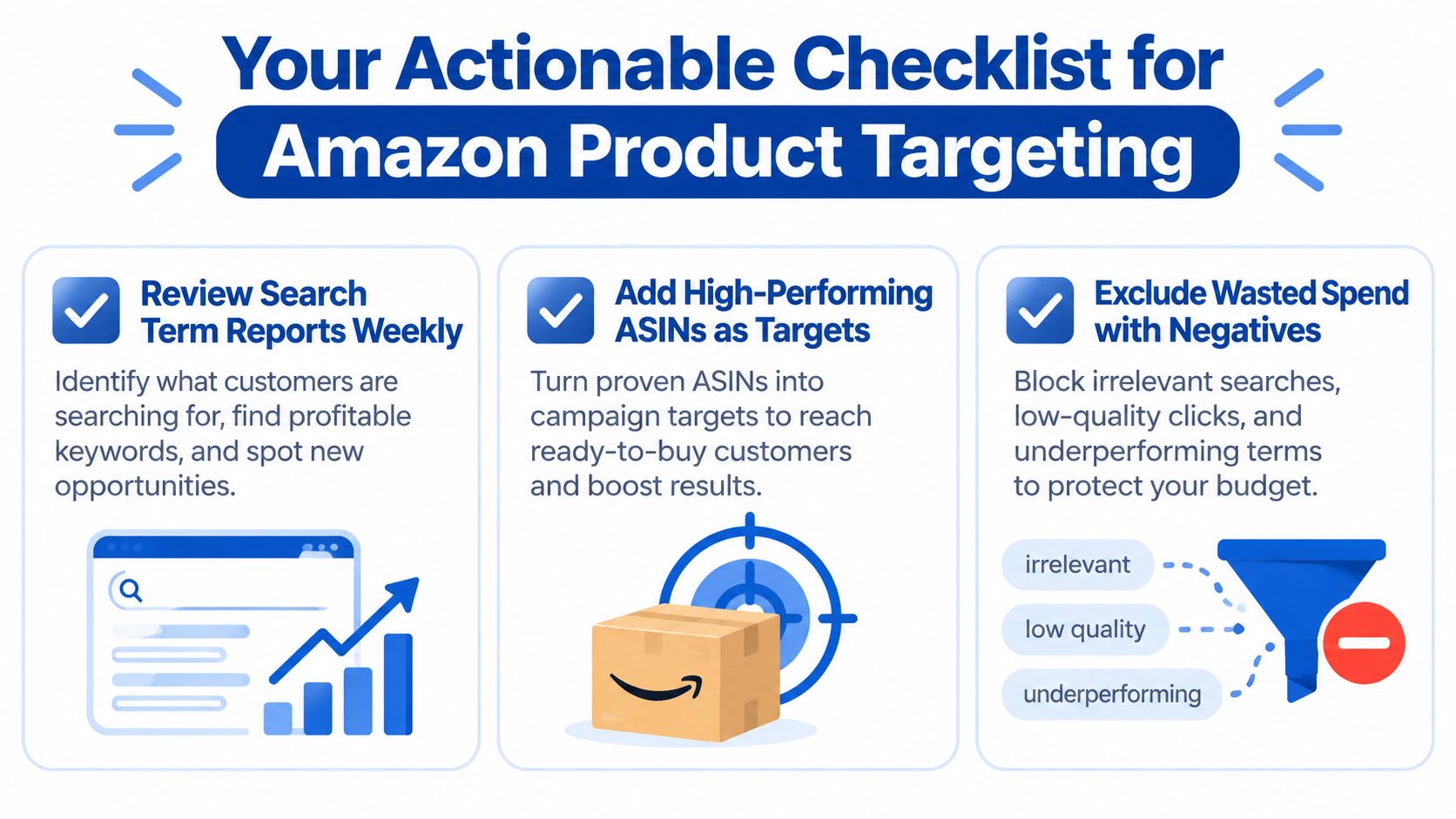
Your Actionable Checklist for Amazon Product Targeting
Use this checklist before launching a new structure or expanding an existing one. The sequence matters because measurement can't rescue a product that isn't retail-ready, and targeting can't fix an offer that fails at the detail-page stage.
Before launch
- Confirm eligibility: Check account standing, payment method, shipping availability, Featured Offer eligibility, category status, inventory, and listing suppression.
- Define the campaign job: Decide whether the campaign is for launch discovery, direct conquest, complementary sales, brand defense, or mature-product scale.
- Audit the offer: Review images, title, bullets, A+ content, price, availability, reviews, and variation logic before buying detail-page traffic.
- Separate the target logic: Keep direct substitutes, complementary ASINs, own products, categories, and brands in structures that can be evaluated independently.
During data collection
- Start with automatic discovery: Use Automatic Targeting to find relevant queries and product contexts rather than guessing the entire target list.
- Review search term reports weekly: Amazon specifically recommends using search-term data to identify strong queries and terms with significant clicks but low or no sales (Amazon targeting with Sponsored Products).
- Promote qualified winners: Move relevant, commercially productive queries and ASINs into Manual Targeting campaigns with clear segmentation.
- Exclude wasted spend: Add weak queries as negative exact terms and remove product targets that repeatedly fail to justify their spend.
- Watch the offer, not just the bid: Investigate conversion changes through price, inventory, Featured Offer status, listing quality, and competitor changes.
During optimization
- Compare target types fairly: Don't judge a narrow ASIN campaign by the same expectation as a broad category campaign. Each has a different reach and intent role.
- Use Search Query Performance: Look beyond clicks to cart adds, purchases, and the brand or ASIN's share of shopper activity.
- Use AMC for journey analysis: Examine repeated exposure, cross-channel paths, new-to-brand behavior, and assisted outcomes where the data is available.
- Protect contribution margin: Evaluate spend against the full economics of the order and the broader value of the customer or portfolio.
- Scale by evidence: Increase investment where the target produces profitable, incremental demand. Don't scale because impressions or clicks are rising.
A strong operating cadence turns product targeting into a repeatable growth system. Review the report, update the target set, test the commercial hypothesis, and connect the result to organic visibility and profit. If the team can't explain what a campaign is supposed to change in the customer journey, the structure isn't ready to scale.
Headline Marketing Agency manages Amazon PPC and DSP with a focus on product targeting, organic ranking, profitability, and long-term brand equity. Visit Headline Marketing Agency to connect your Sponsored Products, Sponsored Brands, Display, Video, Search Query Performance, and Amazon Marketing Cloud insights into a more disciplined growth strategy.
Get Your Free Amazon PPC Audit
Discover untapped growth opportunities and see how our data-driven approach can improve your ROAS.
Get Free Audit →Wollen Sie Ihre Amazon PPC-Performance aufs nächste Level bringen?
Lassen Sie Ihre Amazon PPC-Kampagnen professionell analysieren und entdecken Sie neue Wachstumsmöglichkeiten.