Amazon Product Launch Checklist for Profitable Growth
Use this amazon product launch checklist to align inventory, listings, PPC, reviews, KPIs, and profitability from launch through sustainable scale.

Aggressive bidding is the most popular Amazon launch advice, and it's also the least complete. A large budget can buy impressions, but it can't fix an unavailable offer, a weak detail page, missing trust signals, or fulfillment delays. If the listing doesn't convert, PPC turns expensive traffic into evidence that the product isn't relevant.
An Amazon product launch checklist should therefore work as a coordinated business system. Inventory needs to support demand. The listing needs to convert paid clicks. Reviews need to reduce buyer hesitation. Search-term data needs to improve targeting, creative, and organic visibility. Amazon's own launch guidance follows this logic, moving from product testing and feedback through branding, inventory, and fulfillment, then measuring impressions, clicks, cart-adds, purchases, and sales in Amazon launch guidance.
The checklist below follows that sequence, from operational readiness to post-launch scale-back. The central recommendation is simple: judge the launch through ranking progress, organic share, blended economics, and sustainable scale, not launch ACOS in isolation. PPC should accelerate organic growth and provide actionable market data, while unit economics determine when the acceleration should slow.
For adjacent marketplace merchandising ideas, review these Merch by Amazon tips from Trendlytic.
1. Pre-Launch Inventory and Fulfillment Strategy Alignment
A launch can't generate sustainable ranking signals if the product can't remain available. Before activating advertising, confirm that inventory, fulfillment, pricing, and replenishment decisions can support the demand your campaigns may create. Amazon's launch framework explicitly places sufficient inventory and efficient packaging and shipping before demand measurement, which makes operational readiness a conversion requirement, not an administrative detail.
FBA and FBM create different trade-offs. FBA can support Prime eligibility and simplify fulfillment execution, while FBM may give a brand more control over handling and cost structure. Neither option is automatically superior. The right choice depends on the product's delivery requirements, margin, operational capacity, and ability to maintain reliable customer service.
A useful planning horizon is the commonly cited 60 to 90 day launch plan, which sequences research and unit economics earlier, then shifts toward inventory, listing assets, A+ Content, and draft PPC campaigns as launch approaches. This staged Amazon launch checklist reflects an important operational conclusion: content, supply chain, and advertising should be ready together, rather than completed one at a time.
Build controls before traffic starts
Use a launch readiness review to confirm:
- Inbound status: Verify that inventory is received and eligible for the intended fulfillment promise before Sponsored Products goes live.
- Replenishment ownership: Assign responsibility for monitoring sell-through, inbound delays, and reorder timing.
- Demand limits: Set advertising budgets with available stock and contribution margin in mind. A campaign that spends faster than inventory can be replenished creates a preventable interruption.
- Fulfillment fallback: Decide in advance whether FBM can protect availability if FBA inventory becomes constrained.
Practical rule: Don't scale traffic until the team can explain how the next replenishment will arrive, what margin remains after fulfillment, and which signal will trigger a budget reduction.
For a broader operational view, connect the launch plan to this guide on supply chain in Amazon. Inventory is not merely a cost line. It determines whether your PPC investment can keep producing sales signals long enough to support organic growth.
2. Listing Optimization With Keyword Hierarchy and A/B Testing
A listing determines whether paid exposure becomes an economically useful order. PPC can introduce a new ASIN to relevant shoppers, while the title, images, bullets, video, A+ Content, price, and reviews influence clicks, cart-adds, purchases, and later organic ranking. For branded products, the Search Query Performance dashboard in inside Seller Central connects these stages by showing activity from impressions through purchases.
Build the message around a keyword hierarchy. Separate high-intent purchase language from supporting use cases, attributes, and long-tail variations. Put the strongest commercial terms where shoppers decide quickly, then use bullets, backend terms, images, video, and A+ modules to resolve objections. This structure improves relevance without forcing every keyword into visible copy.
The creative also needs to make product differences easy to verify. A Braun Series 3 listing, for example, should communicate more than “electric shaver.” It should clarify the use case, handling experience, included features, and reason to choose that model over alternatives. The same test applies to a kitchen appliance, supplement, fitness product, or premium home good.
Change one meaningful message at a time. Testing several elements together may produce a sales change, but it leaves the cause uncertain and makes future decisions less reliable.
Use the listing as a set of controlled hypotheses:
- Message priority: Test a main image, title treatment, bullet order, or A+ module separately.
- Funnel diagnosis: Compare impressions, clicks, add-to-carts, and purchases by query to distinguish weak discoverability, poor relevance, and conversion friction.
- Benefit-led proof: Show size, use, compatibility, certifications, warranty, or other differentiators that support purchase confidence.
- Experiment record: Log the hypothesis, change, launch date, traffic conditions, and business outcome.
Apply Amazon split testing to give each experiment a clear control and decision rule. For drafting or pressure-testing copy, consult Ruit's listing generator guide, then verify every claim against the product and its compliance requirements.
Recommendation: approve a listing change only when it improves the relevant funnel stage without weakening contribution margin. A higher conversion rate can reduce the paid traffic required per order, supporting both direct-response efficiency and organic growth.
3. Launch Campaign Structure With Automatic Discovery and Manual Seed Campaigns
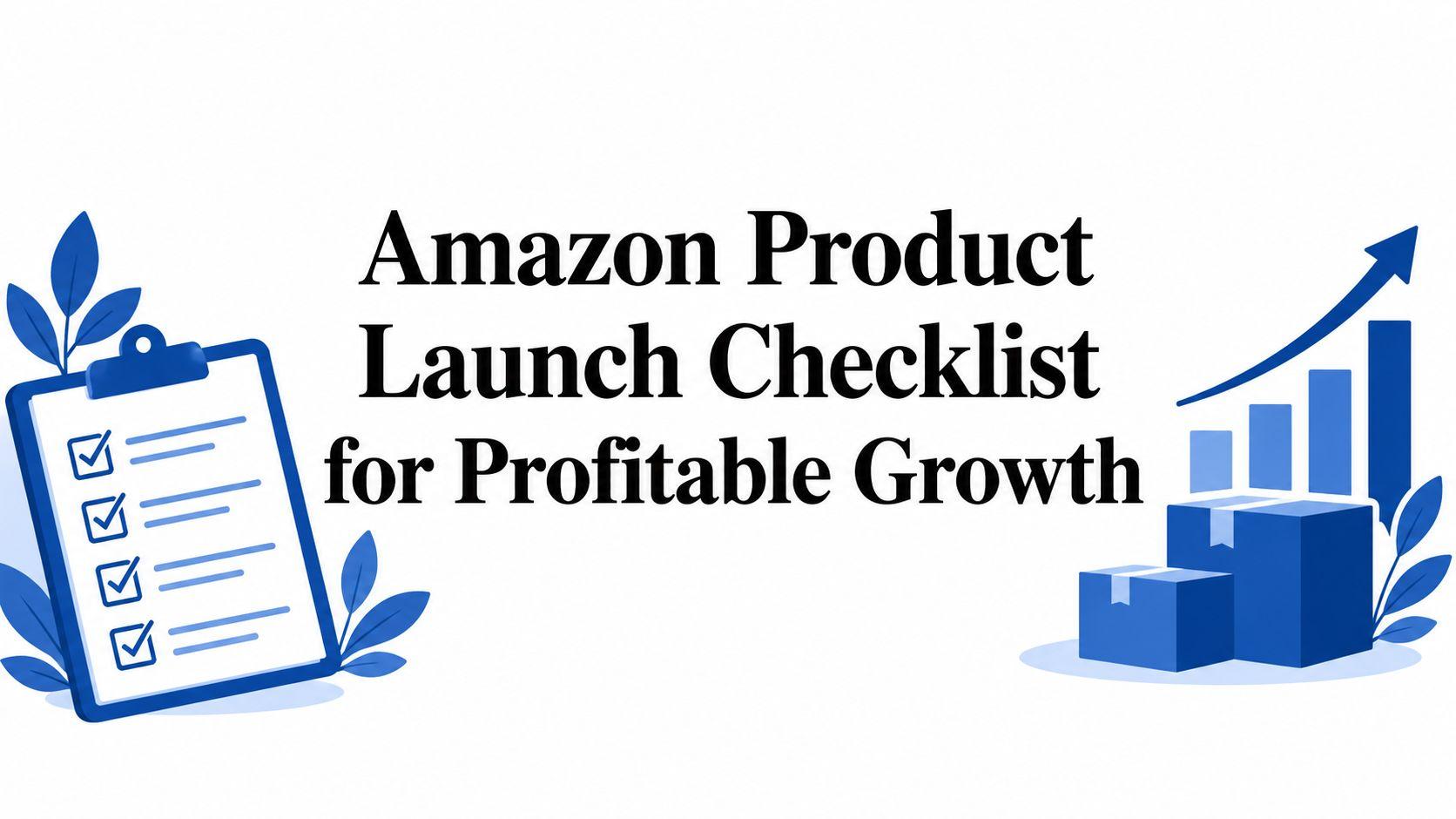
A launch campaign should separate learning from control. Automatic Sponsored Products campaigns can surface customer language and product targets that pre-launch research missed. Manual campaigns then apply deliberate bids to high-intent terms and relevant targets. Using only automatic targeting limits precision, while relying only on manual research can leave profitable demand undiscovered.
Use automatic targeting to collect evidence before promoting winners. In parallel, build manual exact, phrase, and broad campaigns around a clear commercial thesis. Keep discovery and control in separate campaign structures so search-term performance, budgets, and bid decisions remain interpretable.
Amazon's Search Query Performance reporting adds a brand-level view of the funnel. The Amazon's Brand Analytics explanation describes comparisons across impressions, clicks, cart-adds, and purchases against category demand. A listing may attract clicks but capture little purchase share, or convert strongly for a narrow group of queries while receiving limited exposure elsewhere. Those outcomes call for different actions, so campaign decisions should not rely on ACOS alone.
Build the campaign feedback loop
Start with a small operating system that turns paid traffic into better decisions:
- Automatic discovery: Review search terms and product targets for the language shoppers use to describe the problem the product solves.
- Manual seeding: Assign selected high-intent terms to exact, phrase, or broad campaigns, with budgets that preserve the distinction between testing and controlled demand capture.
- Query promotion: Move validated terms into dedicated manual campaigns when conversion quality supports a stronger bid or a separate budget.
- Listing alignment: Compare converting queries with the title, bullets, and backend terms. A profitable query missing from the listing may indicate a relevance and organic-ranking opportunity, provided the wording remains accurate and compliant.
- Negative control: Exclude irrelevant traffic after reviewing the complete query context. A broad-looking term may still identify a profitable use case, so premature negatives can reduce both paid learning and future organic coverage.
Use the Amazon advertising campaigns guide when configuring the account. Recommendation: judge PPC by the quality of information and customers it produces, then reinvest in terms that improve conversion, relevance, and sustainable acquisition economics.
4. Day-One to Day-14 Velocity Strategy With Dynamic Budget Allocation
The first two weeks require a different operating posture from mature-account management. A new ASIN has limited conversion history, little review depth, and no dependable organic position. Early PPC should therefore prioritize learning and qualified visibility, but it still needs guardrails. “Spend more” is not a strategy if the listing, inventory, or contribution margin can't support the resulting demand.
Bid-to-rank can make sense as an investment decision. The brand accepts that some early traffic may be less efficient on a direct ACOS view because the campaign is testing visibility, conversion, and keyword relevance. The trade-off is justified only if the team measures whether organic share and ranking improve afterward.
Amazon's Search Query Performance report provides three useful query-level share metrics, impression share, click share, and purchase share, as explained in this Search Query Performance deep dive. Use them to distinguish three different problems. Low impression share suggests discoverability weakness. Low click share points toward message or creative relevance. Low purchase share indicates conversion friction after the click.
Manage velocity with explicit conditions
- Protect inventory: Set a maximum daily sales pace that your available and inbound units can support without creating a stock interruption.
- Prioritize learning: Allow early campaigns to collect query and placement data, but cap exposure to irrelevant targets.
- Review daily: During the opening period, watch spend, clicks, cart-adds, purchases, and query-level share rather than waiting for a monthly report.
- Define the handoff: Establish a day-15 decision point. Continue acceleration only when conversion, inventory, and organic indicators support it.
- Reserve flexibility: Keep part of the launch budget available for campaigns or queries that demonstrate stronger demand than the original forecast.
The launch window should have an exit condition. If paid visibility rises but purchase share and organic position don't improve, more bidding may amplify waste instead of momentum.
The correct question isn't whether launch ACOS looks attractive. It's whether the incremental spend is improving the product's ability to win unpaid demand at an acceptable blended cost.
5. Review Acceleration and Social Proof Strategy Integrated With PPC Visibility
Review acquisition should be scheduled alongside advertising because social proof affects the efficiency of each paid visit. A campaign can generate impressions and clicks while the listing still leaves buyers uncertain. In that case, PPC exposes a conversion constraint rather than solving it.
Amazon's launch guidance supports collecting feedback from a select audience before expanding promotion. Current launch guidance also places Vine early in the sequence, together with external traffic and inventory planning. Reviews, traffic, and stock therefore require coordinated timing. This review and inventory sequencing analysis explains why visibility should increase according to the listing's ability to convert, not the calendar alone.
The operating rule is simple: collect compliant feedback, monitor its effect on conversion, and adjust paid reach as trust improves.
- Secure Brand Registry: Amazon permits enrollment with a pending or registered trademark serial number and verifies trademark status during approval, according to this Brand Registry launch checklist. Treat approval as a prerequisite for brand tools that support content and review workflows.
- Prepare Vine: Enroll as soon as the product and Brand Registry status permit. The objective is an early feedback loop, not a manufactured rating.
- Use permitted requests: Send Amazon's allowed post-purchase request and avoid incentives or any attempt to influence review content.
- Apply the feedback: Repeated customer questions or objections should inform A+ Content, images, FAQs, and listing bullets.
- Adjust PPC exposure: Increase reach when the listing shows clearer evidence that shoppers understand and trust the offer. Hold back when paid traffic is rising without corresponding conversion improvement.
Track review velocity beside CTR, CVR, purchase share, and inventory cover. Review volume is a longer-term trust input, while CTR and CVR show immediate response. The useful decision is whether stronger social proof is lowering the blended cost of acquiring demand, not whether a single campaign's ACOS looks favorable.
Recommendation: establish the review workflow before broad promotion, then scale paid visibility only when feedback and conversion signals support the additional spend.
6. Keyword Expansion and Negative Keyword Strategy From Seed to Scale
From week three through week eight, search-term management should become a repeatable promotion and exclusion process. Automatic campaigns continue generating discovery data, while manual campaigns test whether validated queries can acquire sales at controlled bids. Review the earlier funnel framework rather than rebuilding it here. The focus now is deciding which terms deserve more exposure, which require isolation, and which should leave the account.
Use a weekly decision log that records the query, match source, campaign, placement, spend, attributed sales, conversion trend, and relevance to the product. Then apply four actions:
- Promote validated demand: Move queries with repeat purchases or improving conversion into manual Sponsored Products campaigns. Give high-value terms separate budgets so broad discovery cannot consume their spend.
- Test intent separately: Keep category terms, problem-based searches, competitor references, and specific use cases in distinct groups. A smaller query with stronger commercial intent may support better contribution than a larger term with weak conversion.
- Add negatives with evidence: Exclude incompatible products, irrelevant brands, and mismatched use cases when the query is clearly outside the offer or repeatedly fails the defined efficiency threshold. Check close variants before applying a permanent negative.
- Extend the listing selectively: A converting query that reflects a genuine customer need can inform bullets, images, A+ Content, or video. Content expansion should follow observed demand, not a keyword list alone.
The query-performance guide can support query-level interpretation, but the operating decision should combine PPC results with organic purchase share, listing relevance, and inventory availability. A term that converts through ads but creates weak repeatable demand may deserve a smaller test. A term that improves both paid efficiency and organic visibility can justify broader coverage even before its direct-response ACOS is attractive.
Negative keywords protect learning quality as well as spend. Irrelevant traffic can distort judgments about the listing, product-market fit, and acceptable bids. The trade-off is lost reach, so exclusions should be reversible during review and tied to a documented reason.
Recommendation: during weeks three through eight, promote repeatable queries into controlled campaigns, isolate uncertain intent, and add negatives only when relevance or efficiency evidence is strong enough to justify giving up future discovery.
7. Profitability-First Scaling From Launch ACOS to Sustainable Unit Economics
A launch can tolerate temporary margin pressure only when the business defines what that pressure is buying. ACOS measures advertising cost against attributed sales, but it excludes COGS, fulfillment, Amazon fees, returns, promotions, overhead, and the mix between paid and organic revenue.
Set a break-even model before launch and revise it as actual results accumulate. Include product cost, inbound and outbound logistics, fulfillment, marketplace fees, discounts, and operating overhead. Then compare sponsored revenue with total revenue. This separates incremental demand from sales advertising may have captured without materially changing customer intent.
Use three decision tests rather than one ACOS threshold:
- Contribution test: Does revenue remain positive after major variable costs and advertising?
- Organic replacement test: Is organic revenue or query-level purchase share improving enough to reduce dependence on paid reach?
- Allocation test: Does added spend produce useful visibility, conversion evidence, or future acquisition efficiency at an acceptable cost?
A high-ACOS campaign can support organic growth if it improves purchase share and lowers later acquisition costs. A low-ACOS campaign can still be weak when it mainly captures branded demand without expanding total sales. These effects should appear separately in the dashboard, because direct-response efficiency and longer-term ranking gains mature on different timelines.
Amazon's five-step launch guidance connects impressions, clicks, cart-adds, purchases, and sales. Use that sequence alongside contribution and total-revenue reporting, rather than treating ACOS as the final decision rule.
Scale back in stages. Reduce budgets gradually once contribution is acceptable and organic volume continues to strengthen. Keep campaigns that generate profitable demand or useful discovery, consolidate proven coverage, and move uncertain activity into smaller tests. Protect inventory while reallocating spend toward products, placements, and queries that support both unit economics and durable visibility.
Recommendation: review profitability and organic contribution together, then reduce paid support only where organic demand can replace it without weakening sales or learning.
8. Sponsored Brands and Display Advertising for Upper-Funnel Growth
Sponsored Products capture existing demand. Sponsored Brands, Sponsored Display, Video, and DSP influence discovery before shoppers select a specific listing. Their role becomes clearer after the product has a credible offer, sufficient inventory, and conversion evidence. Broad reach without those conditions can increase exposure while weakening unit economics.
Upper-funnel campaigns require a different measurement frame. Sponsored Products can be judged primarily through direct-response results, while broader activity may affect brand search, repeat consideration, category visibility, and assisted conversions. Compare these effects with store demand and purchase-share signals rather than using traffic alone as the benchmark. Amazon's Brand Analytics resource can support that comparison.
Measure awareness without treating it as direct response
- Sponsored Brands: Use category and competitor contexts to state the brand's position, then direct shoppers to the most relevant product or Store destination.
- Video: Show the product's use, distinction, and outcome quickly. Address a buyer question instead of repeating the title.
- Sponsored Display: Reach shoppers who viewed relevant products or browsed the category, while checking overlap with Sponsored Products.
- DSP: Add audience and remarketing tactics when the team can assess longer consideration paths and fund a broader full-funnel plan.
- Blended reporting: Track brand-search demand, organic ranking, purchase share, new-to-brand behavior where available, and assisted sales beside direct ACOS.
The launch phase determines whether these formats create useful demand or merely add cost. A listing that converts poorly may turn upper-funnel impressions into inefficient clicks. A differentiated offer with reliable fulfillment can use broader exposure to increase qualified branded demand and strengthen category presence, although those effects may appear later than direct sales.
Use separate reporting for immediate response and delayed organic effects. Hold back expansion when awareness rises without stronger downstream conversion, purchase share, or repeat consideration. Add Sponsored Brands, Display, Video, or DSP only after defining the indirect outcome, its evaluation window, and the budget limit for learning.
Recommendation: introduce upper-funnel formats in controlled tests, then retain them only when their assisted or branded-demand contribution justifies the incremental spend.
8-Point Amazon Launch Checklist Comparison
| Strategy | Implementation complexity | Resource requirements | Expected outcomes | Ideal use cases | Key advantages |
|---|---|---|---|---|---|
| Pre-Launch Inventory and Fulfillment Strategy Alignment | Medium–High, requires cross‑functional planning and FBA/FBM decisioning | Inventory capital, FBA fees vs. FBM ops, forecasting tools, reorder automation | Minimize stockouts, enable sustained PPC scaling, protect early organic ranking | New product launches with planned high PPC spend or long replenishment lead times | Prime eligibility (FBA), consistent availability for bidding, reduced OOS ranking loss |
| Comprehensive Listing Optimization with Keyword Hierarchy and A/B Testing | Medium, content creation, taxonomy and test design | Keyword research tools, copywriting/A+ assets, A/B test budget, analytics | Higher CVR (25–40% uplift), lower required bids, improved organic visibility | Products needing conversion lift and long‑term organic growth (pre‑launch to week 2) | Better conversion quality, lower CPC/ACoS, capture broader search intent |
| Launch Campaign Structure: Automatic + Manual Seed Campaigns | Medium, campaign setup and daily monitoring | PPC budget split, daily search query review, reporting workflows | Rapid keyword discovery, better early bid allocation, 5–15% lower launch ACOS | Early launch keyword discovery and balanced volume capture (week 1–4) | Automatic discovery + manual control, efficient feedback loop for listing and bids |
| Aggressive Day‑1 to Day‑14 Velocity Strategy (Bid‑to‑Rank) | High, real‑time bidding, inventory and budget coordination | Large short‑term PPC budget, inventory buffer, intensive monitoring team | Fast organic rank acceleration, rapid conversion volume (target 50+/day) | Brands prioritizing rapid market share and rank gains in first 2 weeks | Significant early ranking lift, faster review accrual, long‑term organic payoff |
| Review Acceleration and Social Proof Integrated with PPC | Medium, program enrollment and compliant email workflows | Vine or paid review budget, post‑purchase email system, review monitoring | Rapid review accumulation, 20–35% CVR lift when pre‑scaled, stronger trust signals | Products needing social proof before scaling paid spend (pre‑launch to wk3) | Early credibility, improved conversion, enables more efficient PPC scaling |
| Keyword Expansion & Negative Keyword Strategy (Weeks 3–8) | Medium–High, weekly analysis and negative list management | Reporting tools, weekly analyst time, automated rules for negatives | Reduce wasted spend, ACOS improvement (15–25%), capture long‑tail volume | Post‑launch optimization and scale (weeks 3–8) | Systematic query promotion, improved ROI, reduced budget leakage |
| Profitability‑First Scaling (Weeks 6–12) | High, margin modeling, disciplined spend reduction | Unit economics calculator, revenue attribution, campaign controls | Transition to sustainable ACOS (25–35%), higher net margins, organic‑led volume | Scaling phase where launch momentum must convert to profitability (wk6–12) | Long‑term sustainability, prevents perpetual high ACOS, frees cash for reinvestment |
| Sponsored Brands and Display Advertising (Upper‑Funnel) | Medium–High, creative development and audience targeting | Creative production (video/carousel), DSP budget, audience data scale | Increased brand searches, faster organic trajectory, broader awareness | Brand building and awareness to support organic growth (weeks 3–12) | Brand search lift, complements Sponsored Products, drives external traffic and authority |
Turn the Checklist Into a Measurable Growth Loop
A profitable Amazon launch is a sequence of decisions, not a burst of advertising. Start by verifying inventory, fulfillment, Brand Registry dependencies, creative, and listing quality. Amazon's launch guidance places readiness before promotion for a reason. Traffic arriving at an unavailable or unconvincing offer creates cost without giving the business a fair conversion test.
Use automatic and manual Sponsored Products campaigns together. Automatic targeting discovers customer language and product relationships. Manual campaigns protect the strongest commercial opportunities. Search Query Performance then shows whether the product is gaining impressions, clicks, cart-adds, and purchases, while share metrics help distinguish visibility from actual demand capture.
Reviews belong inside that same operating rhythm. Seed feedback through compliant channels, then time broader visibility around the listing's ability to convert. If purchase share remains weak despite strong impression and click share, improve the detail page before increasing bids. If impressions remain weak while conversion is healthy, expand relevant targeting and evaluate upper-funnel support.
Sponsored Brands, Display, Video, and DSP should enter when the product can support awareness investment. Their role isn't identical to Sponsored Products, so their success shouldn't be judged through direct-response ACOS alone. Measure whether they contribute to brand search demand, organic ranking, query purchase share, and blended customer acquisition economics.
Use one weekly dashboard
A senior team should review:
- Media efficiency: Spend, attributed sales, CTR, CVR, ACOS, and placement performance.
- Business economics: Blended profitability, contribution margin, promotions, fulfillment costs, and total customer acquisition cost.
- Organic progress: Organic share, keyword ranking, branded search demand, and query-level purchase share.
- Retail readiness: Review velocity, rating trend, inventory cover, inbound status, and Buy Box or offer availability.
- Decision signals: Which campaigns deserve more budget, which queries need content support, and which activities should scale back.
The most important management question is not, “What was launch ACOS?” It's, “Did paid investment make the business less dependent on paid traffic while preserving profitable availability?” That question aligns PPC with organic ranking, unit economics, and sustainable marketplace growth.
Headline Marketing Agency is relevant for brands that need Amazon PPC and DSP management connected to listing experimentation, Search Query Performance analysis, organic ranking, and profitability. The operating model should remain transparent, with clear hypotheses, measurable checkpoints, and a defined path from launch acceleration to margin-led scale.
If your Amazon launch needs a coordinated plan across Sponsored Products, Sponsored Brands, Display, Video, DSP, listing experiments, and profitability reporting, Headline Marketing Agency can connect those workstreams to organic growth and sustainable marketplace performance. Visit the agency to discuss your launch readiness, campaign structure, and scale-back strategy.
Get Your Free Amazon PPC Audit
Discover untapped growth opportunities and see how our data-driven approach can improve your ROAS.
Get Free Audit →Wollen Sie Ihre Amazon PPC-Performance aufs nächste Level bringen?
Lassen Sie Ihre Amazon PPC-Kampagnen professionell analysieren und entdecken Sie neue Wachstumsmöglichkeiten.