Amazon PPC Product Targeting: A Profit-First Playbook
Master Amazon PPC product targeting with this data-backed playbook on ASIN, category, and brand targets, bid strategy, and measurement for real profitability.

Most Amazon PPC advice tells you to treat product targeting as a defensive ACOS lever. Bid on competitor detail pages, accept weaker efficiency, and hope the sales justify the spend. That approach turns a high-intent placement into a budget sink.
Amazon PPC product targeting should be managed as an incrementality and organic-growth lever. The question isn't whether an ASIN produced an attributed order. The useful questions are whether the exposure brought in a customer who wouldn't otherwise have converted, strengthened demand for your brand, and improved the conversion performance of the product you want to rank.
Amazon gives advertisers three Sponsored Products targeting options, automatic, manual, and negative targeting. Within manual targeting, product targeting can focus on individual products, categories, or brands, with category targets refined by attributes such as brand, price range, ratings, and Prime shipping eligibility. Ads can appear on product detail pages and search results pages where the targeted product appears among the top results, as described in Amazon's Sponsored Products targeting guide.
Why Product Targeting Is the Most Misunderstood Lever in Amazon PPC
The common mistake is measuring product targeting as if every attributed order were incremental. A competitor-detail-page ad may win a shopper who was already searching for your brand, or it may intercept a buyer who would have found your listing through an organic result. Raw ACOS can't tell you which happened.
That doesn't make ACOS useless. It makes ACOS incomplete. Product targeting deserves a separate decision framework built around the target layer, bid strategy, measurement, and funnel integration. Those four controls determine whether the channel creates new demand, captures adjacent demand, or merely shifts credit between campaigns.
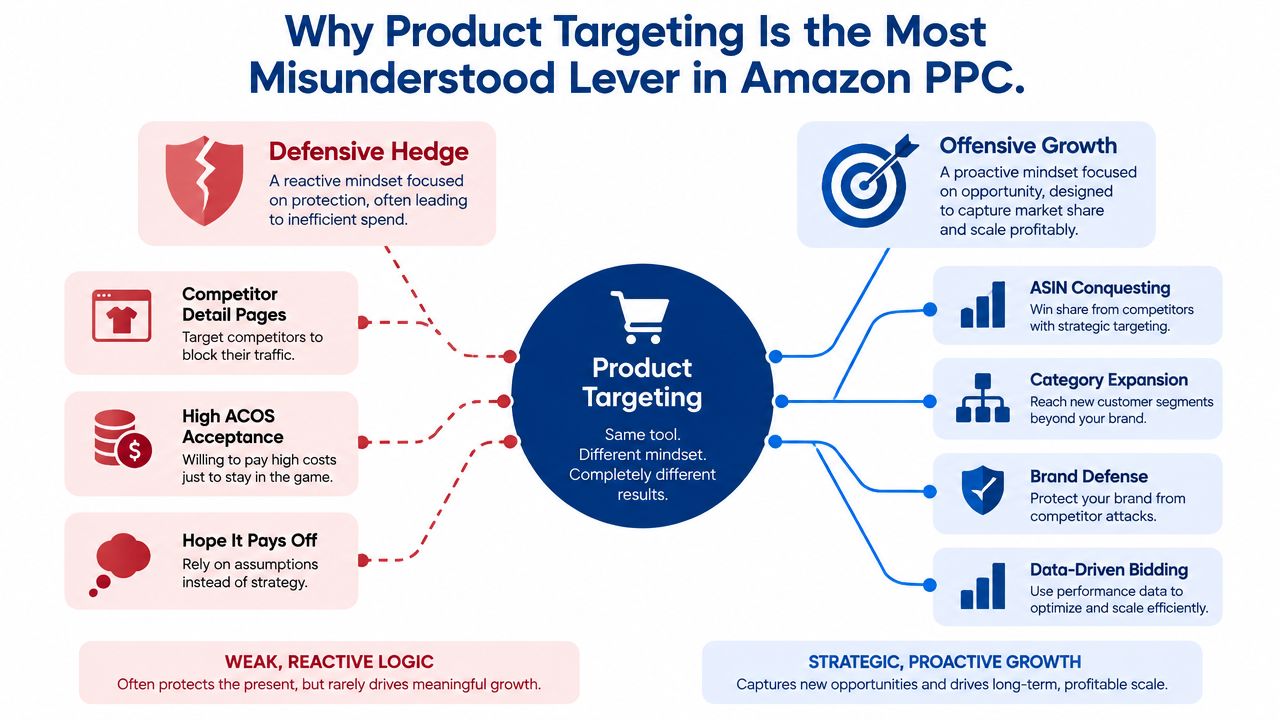
Defensive impressions aren't the same as growth
A brand may spend heavily to appear on competitor detail pages and call the activity “defense.” But if the targets don't convert profitably, the campaign is buying visibility rather than share. The same problem appears when a brand measures a competitor ASIN against a branded keyword without filtering shared search behavior.
The better lens is incremental conversion rate, post-click branded demand, and sales across related products. Amazon's product-targeting placements reach shoppers browsing similar or complementary products, with placements available on detail pages, within categories, and in shopping results. That makes the tactic useful for both conquesting and cross-sell, but only when the brand separates those jobs.
Practical rule: Don't raise a product-targeting bid because an ASIN has impressions. Raise it when the target produces acceptable economics after overlap and conversion quality are accounted for.
Product targeting can support organic growth because it puts an offer in front of shoppers already evaluating products. More qualified visits and purchases can strengthen the commercial signals surrounding a listing, but you shouldn't claim that every ad click directly improves rank. Treat organic lift as an outcome to test, not an assumption to bake into your forecast.
For a broader foundation on Sponsored Products structure and optimization, Reddog Consulting Group's PPC guide is a useful reference. Your operating model should go further than defensive placement. Build isolated campaigns, control bids by target type, measure overlap, and reinvest only where product targeting contributes profitable, incremental growth.
The Four Layers of Product Targeting and How Each Actually Works
Amazon product targeting gives you several ways to define the product context around an ad. Don't put them in one undifferentiated campaign. Each layer has a different job, a different level of control, and a different risk of wasted reach.
Individual ASIN targets
ASIN targeting is the most precise layer. You choose specific products, including direct substitutes, complementary items, and your own catalog. Use it for competitor conquesting when your listing has a visible advantage, or for cross-selling when the shopper is already browsing a product that pairs naturally with yours.
Keep the first test narrow. A practical starting structure is five manual ASIN targets per ad group, with closely related products grouped together. Separate direct competitors from complementary products, because the intent and conversion path aren't the same.
Category targets
Category targeting buys breadth. Amazon can match your ad against products within a category, and you can refine the audience by attributes such as brand, price, ratings, and Prime eligibility. This makes category targeting useful for discovery and launches, but broad category nodes often include listings where your offer has no meaningful advantage.
Cap the initial category structure at the second refinement level. If performance is diluted, narrow the cluster by brand, price, rating, or fulfillment eligibility before increasing bids. Category targets should discover opportunities, not become a permanent substitute for precise ASIN control.
Brand targets
Brand targeting lets you select a brand and reach products associated with that brand. Use it to find a wider competitive set, then migrate productive targets into individual ASIN campaigns where you can control bids and read performance more clearly.
Put brand targets in a separate ad group. This prevents brand-level reach from competing with precise ASIN logic and gives you a clean budget boundary.
Audience signals
Audience signals can add lifestyle, in-market, and lookalike context to product-targeting strategies through Amazon's broader advertising capabilities. They shouldn't replace product relevance. Use them to expand a proven product context, then validate whether the added audience produces incremental sales rather than cheap impressions.
| Layer | How It Matches | Best Use Case | Minimum Setup |
|---|---|---|---|
| Individual ASIN | Matches selected products | Competitor conquesting, cross-sell, own-catalog defense | Five ASIN targets per ad group |
| Category | Matches products within a category, with refinements | Launch discovery and market expansion | Separate campaign with refined attributes |
| Brand | Matches products associated with a selected brand | Competitive discovery and brand-level reach | Separate ad group and budget |
| Audience | Adds shopper or behavioral signals to product contexts | Expanding validated targets | Layer after product relevance is proven |
Amazon also allows advertisers to choose automatic or manual targeting, set one default bid or different bids by targeting group, and configure negative keywords or negative products. Its expanded product-targeting option can extend targeting through the advertising console and API, but expansion should follow evidence, not replace campaign structure. Details are available in Amazon's product-targeting setup documentation.
Category vs ASIN vs Brand Targets, Which Mix Fits Your Goal
There isn't a universal winner. The right mix depends on whether you need precision, discovery, or competitive reach.
Independent benchmark clusters show why generic averages are dangerous. One benchmark set reported category targets at 91.7% / 6.1% / 2.1%, ASIN targets at 84.9% / 7.7% / 7.4%, and brand targets at 91.6% / 3.8% / 4.6%, with the figures presented in the source as performance clusters by target type. The same source reported auto and manual campaign clusters at 88% / 11.5% / 0.5% and 84.7% / 15% / 0.3%, respectively. Read those clusters as directional evidence that target type changes click and conversion behavior, not as a universal forecast for every catalog. See the underlying product-targeting benchmark discussion.
| Target Type | Avg ACOS vs Baseline | Conversion Rate | Scale | Best Goal |
|---|---|---|---|---|
| ASIN | Often more efficient when the target is tightly selected | Typically stronger than broad category traffic | More limited | Conquesting priority competitors and supporting hero-SKU growth |
| Category | Can dilute conversion quality when too broad | More variable | Broadest | Launch discovery and market coverage |
| Brand | Mid-range reach and control | Depends heavily on the selected brand set | Moderate | Finding competitive demand before refining to ASINs |
Choose by business objective
Use ASIN targets for precision. Select competitor products where your price, rating, reviews, features, or listing quality give shoppers a credible reason to switch. This is the layer to prioritize when you need share of voice around a hero SKU.
Use category targets for breadth. A new product may need exposure beyond a short competitor list. Start with a refined category and watch which product contexts convert. Don't let the category absorb budget just because it supplies volume.
Use brand targets for discovery. Brand targeting can identify useful competitive pockets, but it should not remain vague forever. Move winning brand-level opportunities into individual ASIN campaigns so you can manage them at the product level.
A clean operating rule is to lead with five competitor ASINs, add one refined category node, and introduce brand targets only after the first two layers have produced profitable evidence for fourteen consecutive days. That sequence keeps discovery from overwhelming control.
Bidding, Budgets, and Negative Targeting Without Burning Cash
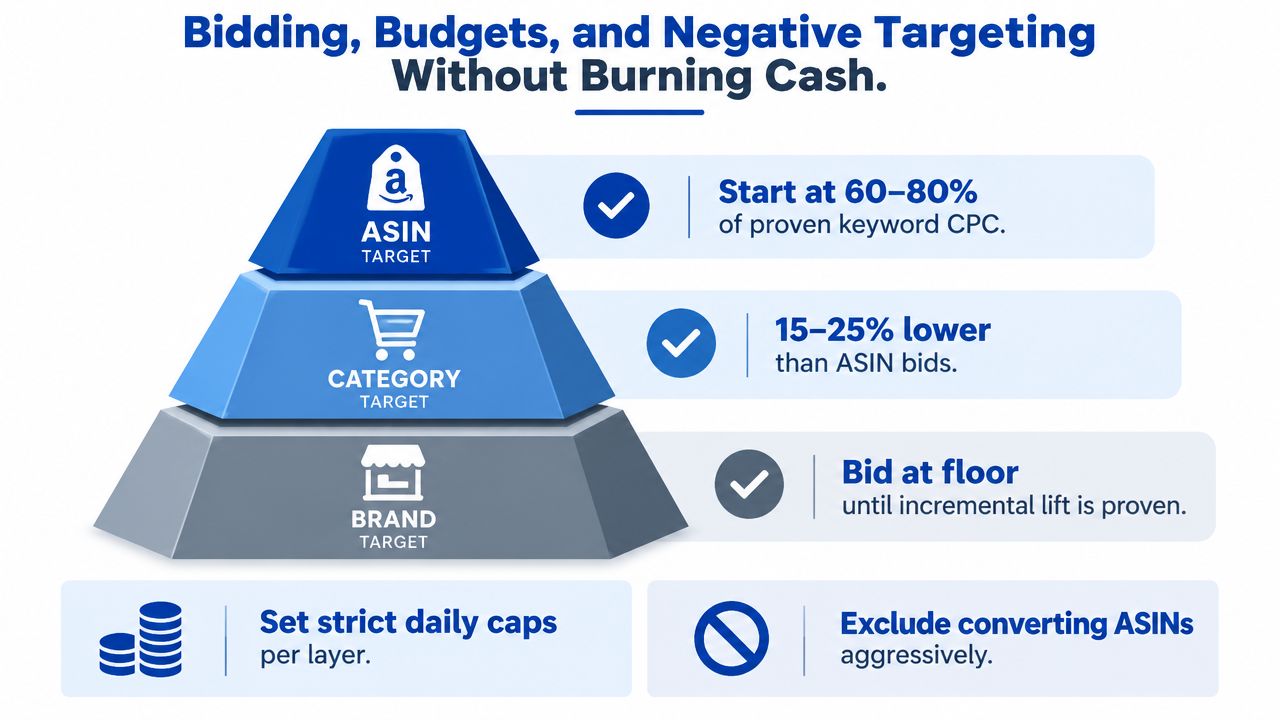
Product-targeting bids should reflect the quality of the placement, not copy whatever you use for keywords. A useful starting stack is 60% to 80% of your proven keyword CPC for ASIN targets, 15% to 25% lower than ASIN bids for category targets, and brand bids at the floor until you prove incremental lift. These starting ranges come from the planned operating framework, while current benchmark guidance separately places Sponsored Products CTR at 0.3% to 0.5% and average CPC at $1.00 to $3.50 or higher in one 2026 planning set. Broader Amazon benchmarks report average CTR around 0.58% and CPC around $1.22, so use category context rather than a platform-wide average when setting expectations. The benchmark ranges and optimization guidance are detailed in this Amazon PPC strategy benchmark.
Don't allow a broad target to inherit the bid of a precise one. Category traffic can generate impressions without giving you a comparable conversion path, and high-impression ASINs can also consume spend while producing weak sales.
Build negatives in passes
Negative targeting isn't cleanup. It's how you protect the campaign's purpose.
- Remove bad ASIN contexts. After a 14-day click window, add exact ASIN negatives for direct competitors that spend without producing acceptable results. Keep a record of why each target was excluded.
- Protect your catalog. Use brand and product negatives to prevent halo SKUs, sibling listings, and your own high-converting products from drawing spend that should support another objective.
- Harvest search terms. Amazon's Sponsored Products Search Term report supports summary and daily views with a 65-day lookback window. Use it to identify strong searches and create negative keyword or product targets for queries that fail campaign goals, as explained in Amazon's Search Term report documentation.
For settings, start with dynamic bids down only. Keep up-and-down disabled until TACoS is stable and the campaign has enough conversion evidence to justify auction volatility. A single negative-keyword workflow can centralize waste review, while target-level negatives should stay attached to the campaigns that created the problem. Headline's guide to Amazon negative keyword management covers the operational detail behind that separation.
Review the account on a 7-day, 21-day, and 65-day cadence. The first view catches obvious waste, the second reveals a more reliable conversion pattern, and the longest window supports search-term re-harvesting. Don't make permanent bid decisions from one noisy day.
Reading Search Query Performance and AMC for Real Incrementality
Product targeting becomes strategically valuable when you stop treating its attributed sales as final truth. Search Query Performance and Amazon Marketing Cloud can show whether the campaign created a new path to purchase, intercepted an existing path, or assisted a wider brand relationship.
Start with Search Query Performance to identify the search terms associated with the product context. Then use AMC to examine overlap between shoppers exposed to product-targeting ads and shoppers who later purchased through organic or keyword-led paths. The point isn't to discredit last-click reporting. It's to identify where last-click reporting overstates the value of the product target.
Separate substitutes from complements
A substitute target competes directly with your product. A complementary target can introduce your product to someone already shopping within the same use case. Those paths shouldn't share one incrementality benchmark.
In AMC, build cohorts for exposed shoppers and compare them with a holdout ASIN set or an equivalent control structure. Where available, use geographic lift logic to compare markets with different exposure levels. The analysis should answer whether product targeting increased total purchasing activity, not just whether Amazon assigned the sale to the ad.
Three signals deserve priority:
- Incremental conversion rate: Compare exposed and control behavior after accounting for campaign overlap.
- Branded search lift: Use Search Query Performance to identify whether product exposure is followed by stronger branded query activity.
- Sibling-ASIN halo: Monitor sales on related products after exposure, while keeping the observation window and product relationship consistent.
| Metric | Source | What It Tells You | Decision Trigger |
|---|---|---|---|
| Incremental conversion rate | AMC with holdout or control design | Whether exposure changed purchase probability | Scale only when lift survives overlap review |
| Shared search-term behavior | Search Query Performance | Whether product targeting overlaps keyword demand | Add negatives, split campaigns, or reduce bids |
| Branded query movement | Search Query Performance | Whether exposure creates branded consideration | Preserve spend when downstream demand improves |
| Sibling-ASIN sales | AMC or retail reporting | Whether the target creates a catalog halo | Fund the layer according to total contribution |
| Impression share lost and gained | Search Query Performance | Whether budget changes shift visibility rather than demand | Reallocate only when sales quality improves |
Sort Search Query Performance by shared search terms and compare impression share lost with impression share gained. If product targeting takes credit for shoppers already captured by branded keywords, reduce overlap before scaling. The Search Query Performance analysis framework provides a useful operating reference for this work.
External market observation can help identify candidate products and changing competitive contexts, but it shouldn't replace first-party performance analysis. A marketplace scraping benchmark can support target discovery, while AMC and SQP should decide whether those targets deserve budget.
Your weekly report should include spend, attributed sales, incremental sales evidence, branded-query movement, sibling-ASIN halo, and overlap with keyword campaigns. That changes the budget conversation from “What was ACOS?” to “What revenue did this layer create that we wouldn't have captured otherwise?”
Wiring Product Targeting Into Sponsored Brands, Display, and DSP
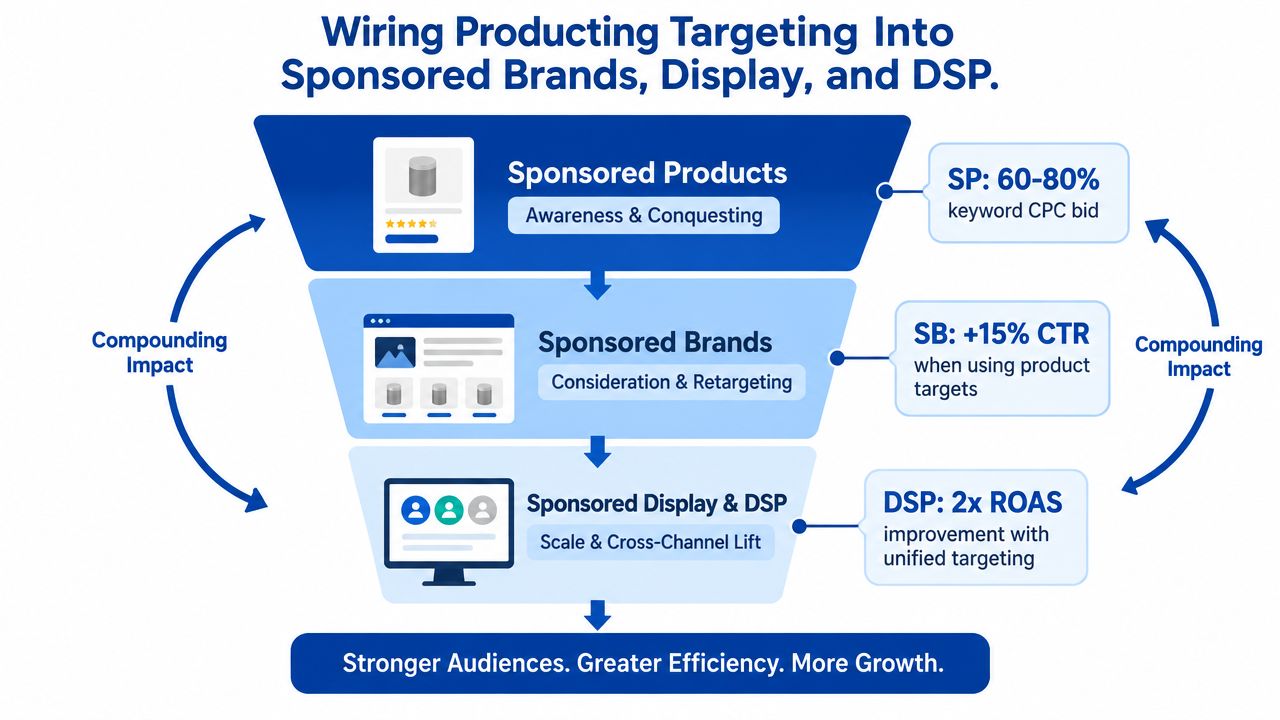
Product targeting works better as a handoff system than as an isolated Sponsored Products tactic. Each ad type should serve a different stage of the decision, and each stage should pass a clearly defined audience into the next.
Start at the bottom of the funnel with Sponsored Products product targeting on carefully selected competitor ASINs. These placements reach shoppers already evaluating a product. Use the winning ASIN set to inform Sponsored Brands video, especially when the brand has a relevant cross-sell story or a product range that can solve more of the shopper's need.
Give each layer one handoff
Sponsored Display can retarget shoppers who viewed a product-targeting ad but didn't convert. Amazon states that product targeting is available in both Sponsored Products and Sponsored Display, and can reach customers browsing individual items or categories, including detail pages, categories, and shopping results, as described in Amazon's product-targeting audience guidance.
Use a defined retargeting window rather than letting every viewer remain eligible indefinitely. The supplied operating framework uses 30 days for Sponsored Display retargeting. That gives the brand a practical recapture window while limiting stale audiences.
DSP belongs later in the sequence. Once Sponsored Products and retargeting generate a validated converter audience, DSP can extend reach and build lookalike strategies across the broader funnel. Do not add DSP merely because the account has budget. Add it when the audience signal is strong enough to support an incrementality test.
Control the overlap: Sponsored Display product targeting and Sponsored Products ASIN targeting shouldn't run against the same ASIN set without frequency governance.
Use AMC overlap reports to find shoppers receiving multiple ad types, then reallocate where stacking adds cost without adding sales. A single-screen view should show the handoff: Sponsored Products creates the product-context visit, Sponsored Brands develops consideration, Sponsored Display recaptures the non-converter, and DSP expands the validated audience. Headline's explanation of Sponsored Display product targeting offers further detail on how that retargeting layer fits into the system.
Your 90-Day Product Targeting Rollout and the Metrics That Matter
A profitable rollout doesn't begin by scaling every available target. It begins with controlled discovery, moves into precise ASIN management, and adds full-funnel media only after the brand can separate incremental demand from campaign overlap.
Phase one covers discovery
During weeks 1 to 2, create separate category, brand, and ASIN structures. Use category and audience signals to find relevant product contexts, then shortlist individual ASINs where your offer has a clear advantage. Record the baseline for ACOS, conversion rate, organic sales, branded search behavior, and contribution margin.
Don't judge discovery by immediate efficiency alone. Judge it by whether the campaign produces targets worth isolating.
Phase two locks in control
During weeks 3 to 6, launch dedicated conquesting and defense layers around the strongest ASIN opportunities. Keep direct competitors, complementary products, categories, and own-catalog targets separated. Apply the bid hierarchy, introduce negatives, and compare performance over stable review windows.
At this point, stop rewarding impressions. Reward profitable target-level behavior and evidence that the campaign reaches customers outside your existing keyword capture.
Phase three validates the funnel
During weeks 7 to 12, add Sponsored Display retargeting to product-targeting viewers. Sponsored Brands and DSP should follow only after incrementality analysis shows that the product-targeting layer creates value beyond last-click attribution.
The core metrics are:
- Incremental sales rate, measured against a suitable control or holdout.
- Organic lift on targeted ASINs, tracked as a trend rather than assumed from ad exposure.
- Branded search trend, using Search Query Performance to monitor downstream demand.
- Contribution margin after ad-attributed refunds, so reported revenue doesn't hide poor economics.
- Overlap-adjusted revenue, which removes the false comfort of duplicated campaign credit.
Retire blended ACOS as the primary growth KPI. It can remain a diagnostic, but it shouldn't decide whether an incremental campaign receives funding. Re-harvest the Search Term report after its 65-day lookback and apply a stop-loss rule: pause a product-targeting campaign when its incremental sales rate falls below the category baseline for two consecutive 14-day windows.
Headline Marketing Agency manages Amazon PPC and DSP with product-targeting optimization across ASIN, category, Sponsored Display, Sponsored Brands, and measurement layers such as Search Query Performance and AMC. If your campaigns need a clearer separation between profitable conquesting, organic growth, and cannibalized spend, visit Headline Marketing Agency to discuss a measurement-led product-targeting program.
Get Your Free Amazon PPC Audit
Discover untapped growth opportunities and see how our data-driven approach can improve your ROAS.
Get Free Audit →Wollen Sie Ihre Amazon PPC-Performance aufs nächste Level bringen?
Lassen Sie Ihre Amazon PPC-Kampagnen professionell analysieren und entdecken Sie neue Wachstumsmöglichkeiten.