7 Amazon Listing Novel Project Examples That Moved Revenue
Explore 7 Amazon Listing Novel Project Examples with the tactics, test designs, and reported results behind each case, plus PPC-led growth takeaways.

A premium skincare brand lifted conversion from 8.2% to 12.1% across 68 ASINs, according to Kwontified's A+ Content and CRO case study, while a manufacturer projected $6.66 million in annual excess revenue from reordering existing content in Vizit's CPG manufacturer case study. Those are substantial outcomes, but a conversion improvement and an annualized revenue projection aren't equivalent evidence.
These seven Amazon listing novel project examples show where listing work produced measurable results, and where the claims need closer scrutiny before you copy them. They also compare different approaches: search-led optimization, catalog restructuring, controlled creative testing, image scoring, and Amazon-native experimentation.
For a brand investing in PPC, the useful question isn't only whether sales increased. It's whether better content converted comparable traffic more efficiently, supported organic demand, and left more contribution profit after advertising costs. Read each case for the change, the comparison group, and the economics. Copy the testing method before copying the creative.
1. The Rag Company, Amazon SEO Case Study
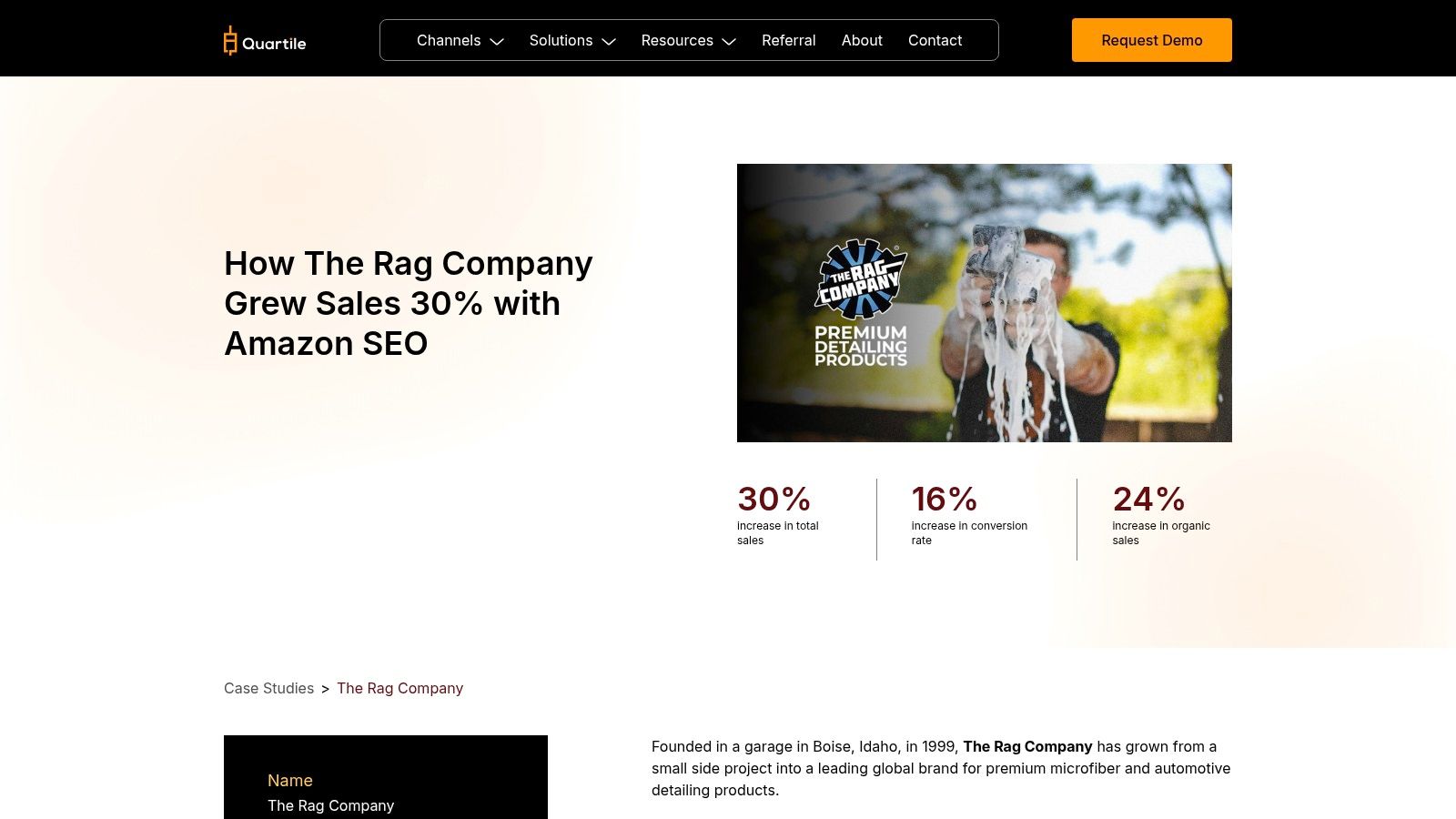
Best fit: brands with useful advertising search data but weak alignment between ads and listing copy. Quartile worked on The Rag Company's best-selling car-drying towel, using paid and organic search behavior to revise its title, bullet order, backend keywords, and product-page messaging.
Quartile's case study reports sales increasing 30%, conversion rate 16%, organic sales 24%, and orders 24%, while ACOS improved 5% and TACOS remained effectively stable. That combination is more informative than a sales headline alone: advertising efficiency improved, but advertising's share of total revenue didn't materially decline.
What the comparison actually supports
The pilot and its April-to-July comparison don't establish the same causal confidence as a randomized listing experiment. Seasonality, changing query demand, and the advertising mix remain plausible influences, and the reported ACOS improvement shouldn't be interpreted as a percentage-point change without clarification.
- Strength: Paid-search language informed organic-facing content rather than remaining isolated inside campaigns.
- Limitation: A priority-product pilot doesn't establish an expected return across an entire catalog.
- Commercial gap: Service pricing isn't published, so implementation cost must remain outside any claimed payback calculation.
Copy the workflow, not the forecast. Select an ASIN with meaningful search-term history, map converting queries to shopper questions, and revise the content that answers those questions. Measure total sales, organic sales, conversion, ACOS, and TACOS together before expanding the project.
2. Safariland, Catalog and Variation Redesign
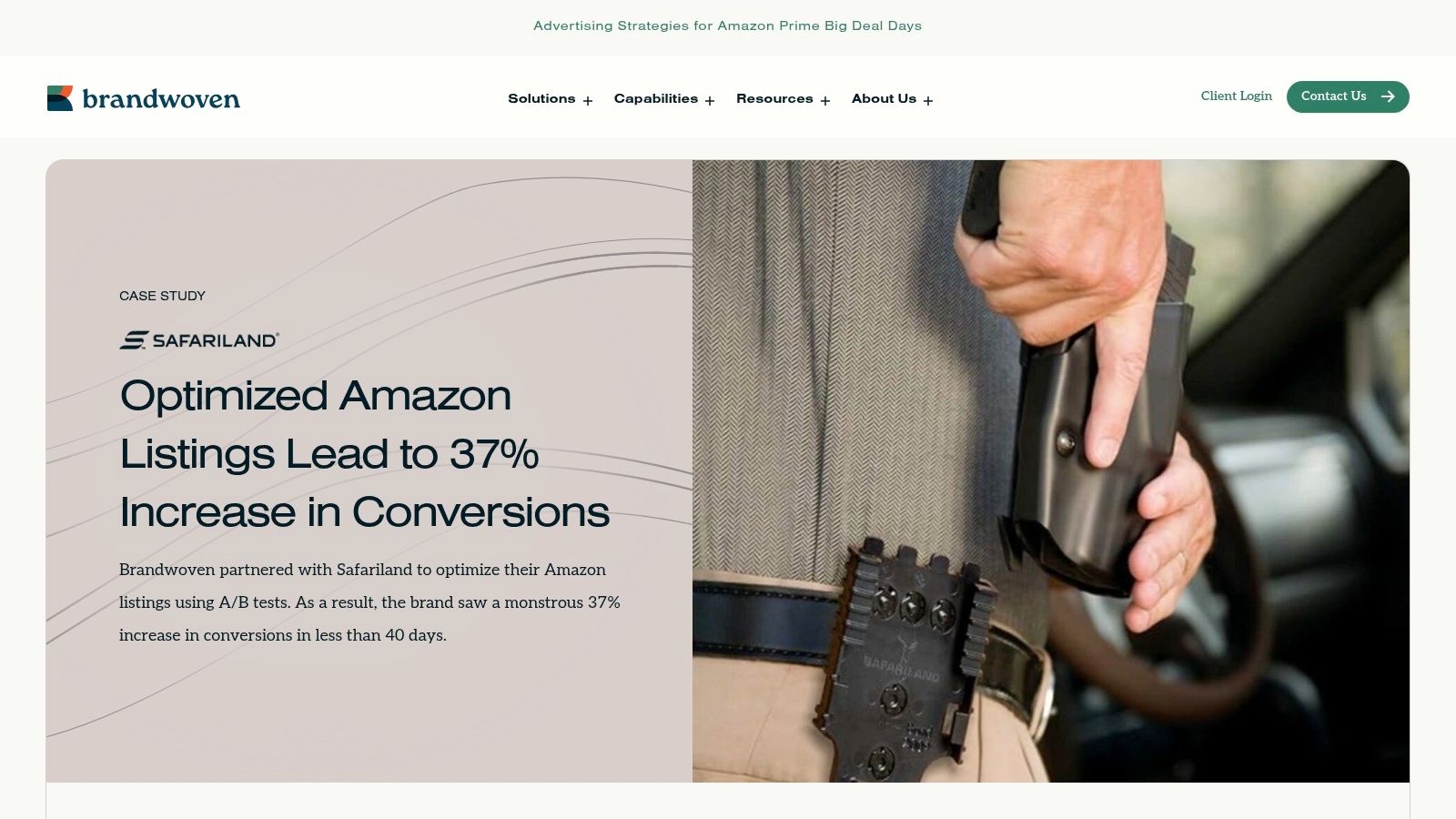
A shopper choosing a holster must identify the correct firearm compatibility, configuration, and color. Persuasive copy won't resolve a confusing variation structure if the shopper still can't confidently select the right product.
Brandwoven's Safariland case study describes a catalog exceeding 9,000 SKUs and reports a 37% month-over-month increase in conversions within 40 days of listing updates. The work combined variation restructuring, rewritten titles and descriptions, refreshed images, and Storefront improvements.
Practical rule: Fix product selection before spending more to bring shoppers into a confusing catalog.
Architecture versus copy
The reported metric is conversions, not necessarily conversion rate. Without the underlying sessions, order definition, and comparison logic, leaders shouldn't translate that result into a claim about improved traffic efficiency.
Advertising and other initiatives were also part of the broader engagement. There's no isolated copy-only control in the available account, and neither ACOS nor TACOS outcomes establish the profitability of the redesign.
The advantage is scope: Brandwoven addressed navigation and catalog maintenance rather than treating each detail page as a disconnected copywriting assignment. The trade-off is attribution, because simultaneous merchandising changes make it harder to identify which intervention mattered most; project pricing also isn't listed.
For a smaller catalog, copy the compatibility audit rather than the enterprise-scale rebuild. Identify where shoppers hesitate between variants, correct legitimate product relationships within Amazon's rules, and make selection criteria explicit in images and copy. Then compare conversion and returns against unchanged, reasonably similar products.
3. Kwontified, Premium Skincare A+ Content and CRO Case Study
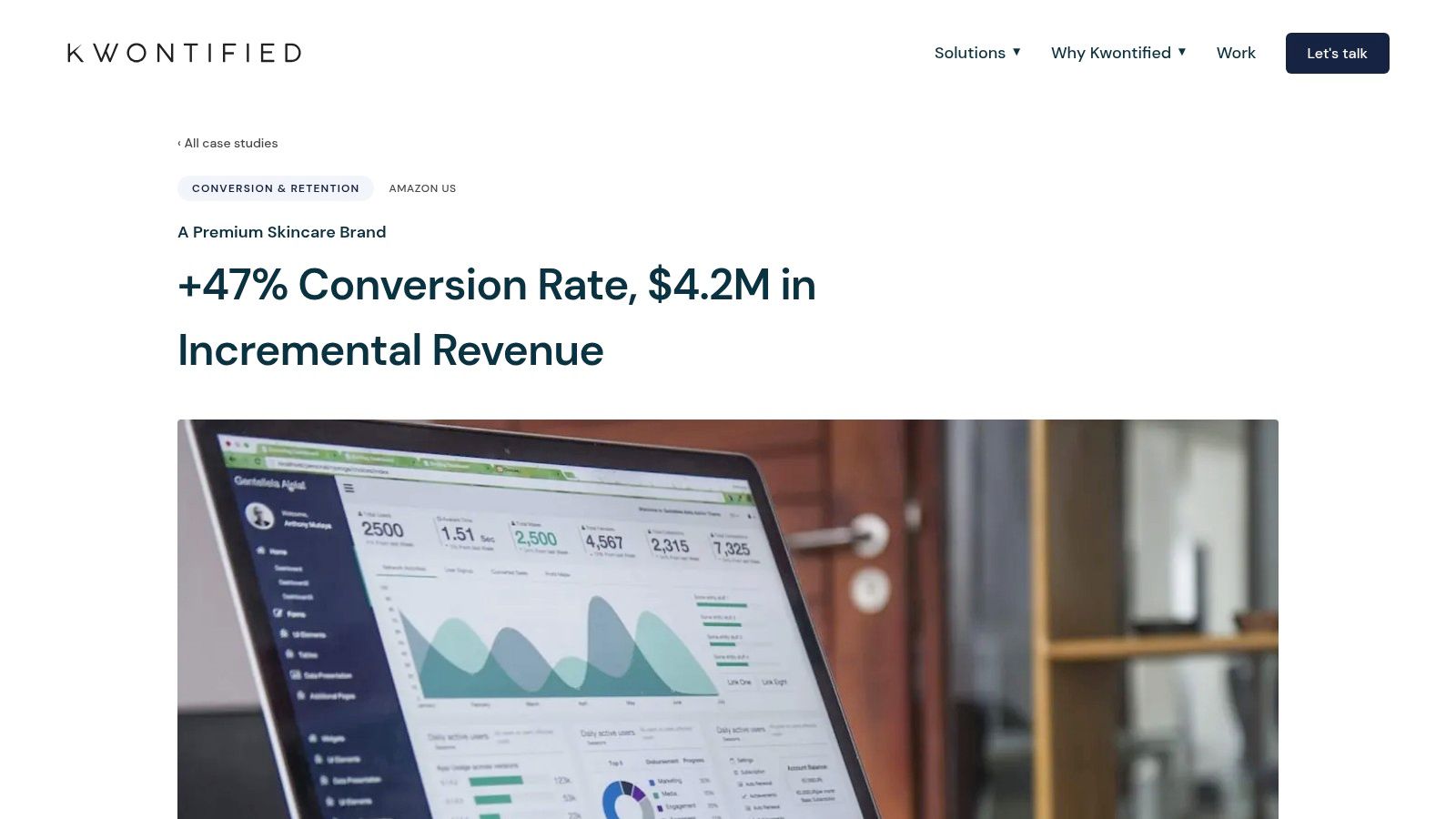
Prioritization is the most transferable feature of Kwontified's skincare project. The team selected products with meaningful revenue and a conversion gap, rather than refreshing every listing equally.
The vendor account cited above describes staged testing of main images, A+ Content, titles, and bullets, with the advertising budget held constant year over year. That's a useful spending constraint, but it isn't a traffic control: unchanged budget doesn't guarantee unchanged CPCs, query mix, placement, or shopper intent.
A disciplined rollout, with economic questions remaining
Testing before rollout is stronger than assuming a redesigned page will outperform because it looks more polished. Still, leaders should distinguish the experimental result for a specific content change from the broader engagement's revenue estimate.
- Strength: Revenue-opportunity prioritization directs production effort toward commercially meaningful ASINs.
- Testing advantage: Staged changes make diagnosis more useful than replacing every content element simultaneously.
- Limitation: The longer engagement and broader rollout may not translate to a short project or a smaller brand.
- Commercial gap: Pricing isn't published, and reported revenue isn't a substitute for contribution profit.
For skincare, useful content questions include suitability, usage sequence, texture, ingredients, and package contents, where product documentation supports the answers. A module should resolve a purchase decision, not merely repeat brand positioning.
Use this Amazon A+ Content guide to assess module roles before commissioning assets. Then connect each proposed change to a hypothesis, such as whether clearer usage instructions improve qualified conversion without increasing returns.
The profitability test remains straightforward: does the incremental contribution from additional orders exceed production and testing costs? Neither a stable ad budget nor stronger conversion answers that question alone.
4. Animal, Consumer-Tested Creative Refresh
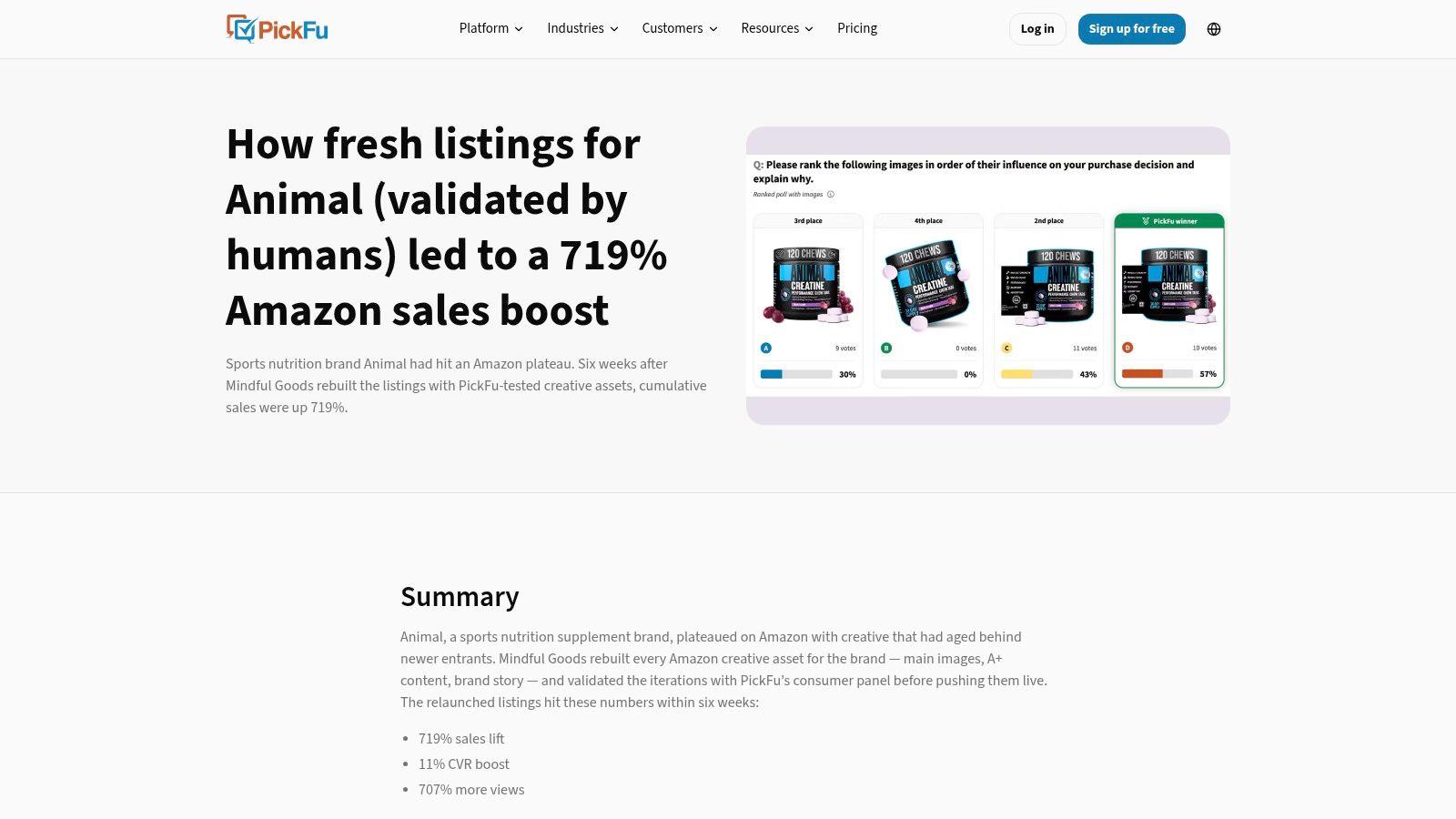
Animal's project separated creative preference testing from live marketplace performance. Mindful Goods used shopper panels to compare image concepts, refined the creative using shopper comments, and then checked performance after relaunch.
PickFu's Animal case study reports 719% higher cumulative sales, 707% more sessions, and an 11.2% increase in overall conversion within six weeks, while stating that PPC and pricing were unchanged. The work included main images, supporting image stacks, A+ Content, and Brand Story.
The session increase is the critical qualification. This wasn't a case of converting the same volume of visitors more efficiently, and unchanged PPC doesn't explain why traffic expanded.
A shopper panel can help choose what to test. It can't establish what Amazon shoppers will buy.
Where the workflow earns its place
The strength is the combination of qualitative feedback and live validation. Panel comments can expose unreadable packaging, unclear benefits, or imagery that attracts attention without explaining the product.
The limitation is that cumulative results across relaunched listings aren't per-ASIN guarantees. The unusually large lift depends on the starting point, measurement period, and changing traffic; ACOS, TACOS, and contribution-margin outcomes aren't established in the summary, and agency and testing prices aren't listed.
Copy the inexpensive decision sequence first: compare concepts, diagnose objections, refine the strongest candidate, and validate it with actual shoppers. Don't commission video or animation services unless motion answers a product question that static content can't communicate clearly.
5. Vizit, Top CPG Manufacturer Listing Content Test
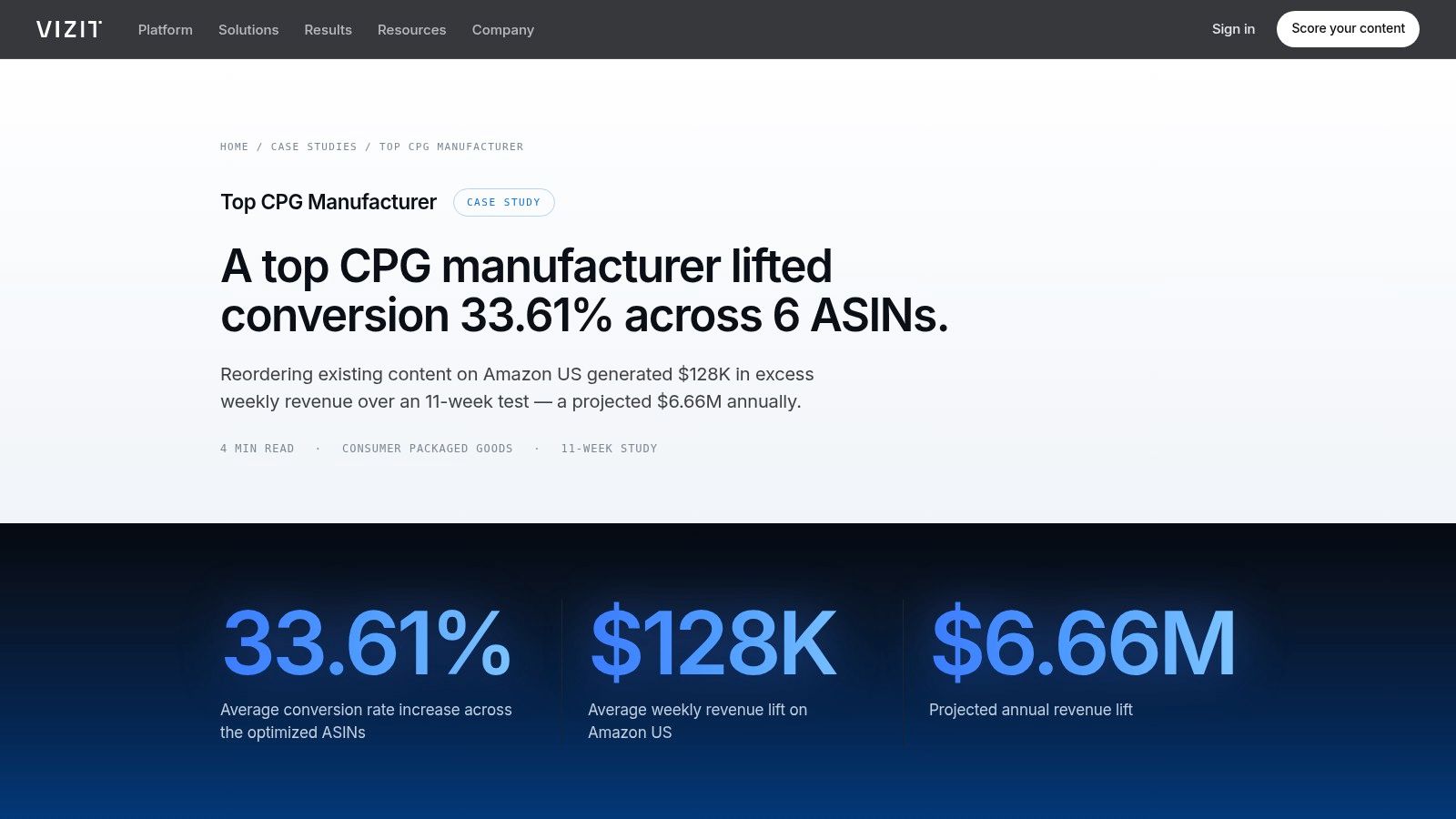
Before producing new assets, test whether the existing assets appear in the right order. That's the practical appeal of Vizit's manufacturer project: the intervention reorganized product-page content rather than requiring a new creative production program.
The vendor account cited in the opening describes optimized ASINs compared with matched controls selected for similar glance views, conversion rates, and sales. That comparison is more useful than a simple before-and-after result because the team attempted to account for differences between products.
A stronger control, not a profit guarantee
Matching isn't randomization. Optimized and control products can still differ in availability, promotions, competitive pressure, review changes, and underlying demand.
The annual revenue figure is also a projection, not a completed year of realized incremental sales. It depends on the observed advantage persisting, with sufficient stock and demand to support it.
- Strength: Existing-content sequencing offers a lower-production starting point.
- Control advantage: Comparable untreated products provide context for interpreting the optimized group.
- Limitation: A narrow test doesn't establish how the approach will perform across unrelated categories.
- Commercial gap: Platform pricing and contribution-margin outcomes aren't supplied on the case page.
Use an A/B testing framework to define the primary metric and document concurrent changes before launch. For image sequencing, specify what the shopper should understand at each stage: product identity, fit, benefits, evidence, and package contents.
The budget-independent lesson is sequencing discipline, not necessarily purchasing a scoring platform. Keep advertising conditions reasonably comparable, track stock and offers, and distinguish observed incremental revenue from any longer-term financial projection.
6. EZ2C, Advance Amazon Listing Optimization Case Study
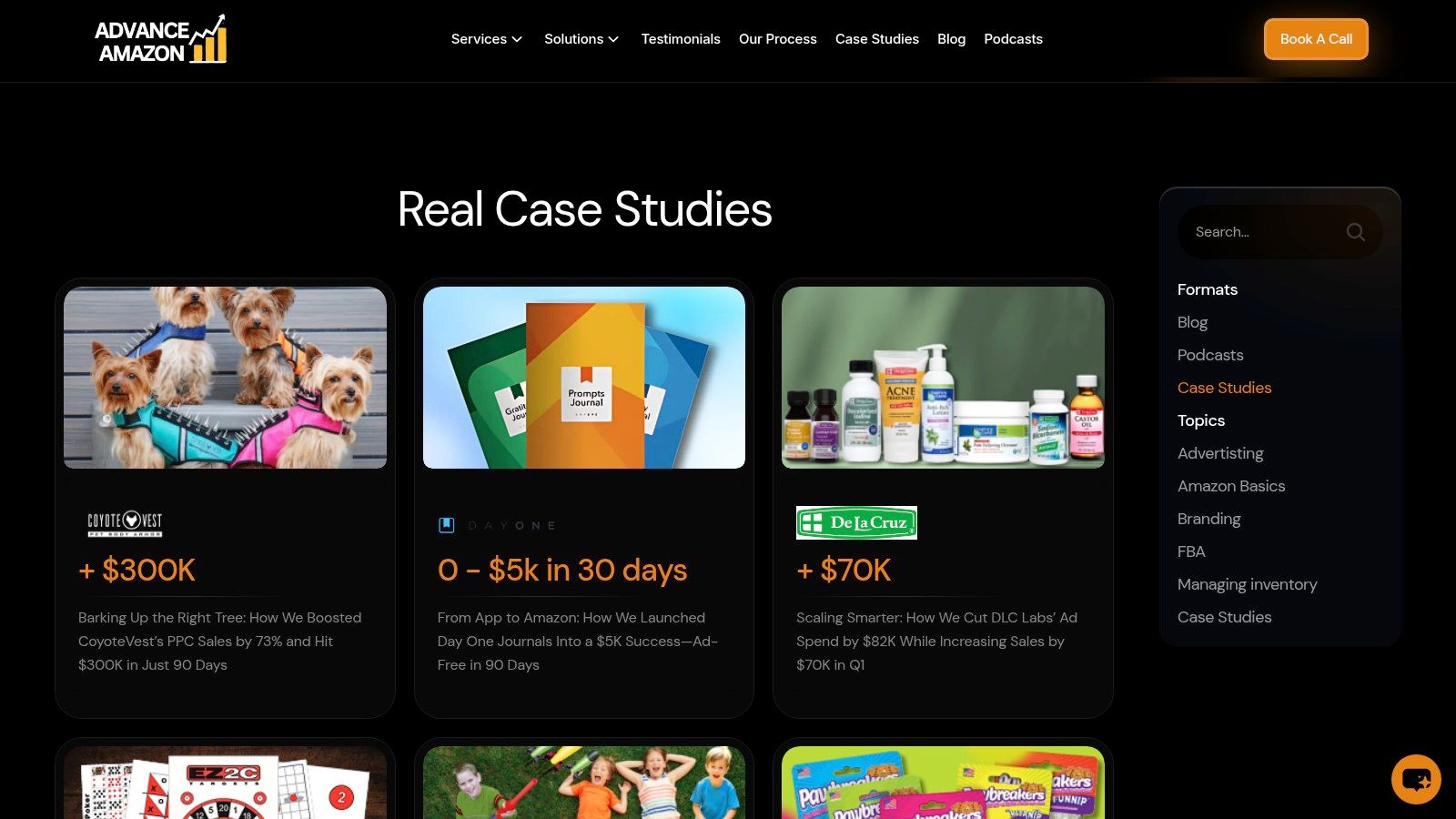
Advance Amazon's case-study portfolio headlines a 70% conversion-rate increase for EZ2C. It also includes listing-related examples such as GeoSpace and Pawbreaker alongside PPC and broader account-growth projects.
That makes the portfolio useful for discovery, but the headline alone isn't sufficient evidence for a financial forecast. The available information doesn't establish the baseline conversion rate, measurement window, exact listing changes, or control design.
Treat the result as a diligence starting point
Without a baseline, a relative lift says little about the resulting conversion level. Without sessions and advertising context, it also doesn't establish whether the listing attracted more qualified visitors or converted comparable visitors more effectively.
The benefit is relevance: EZ2C explicitly connects listing optimization with conversion, and the surrounding portfolio lets leaders compare content work with advertising engagements. The drawback is limited reproducibility from the information available, with no published service pricing or stated ACOS and TACOS outcomes.
Investment filter: Don't turn a vendor's conversion headline into your budget forecast until the baseline, denominator, and comparison period are clear.
A practical Amazon listing optimization process should record what changed, why it changed, and which metric will determine whether it stays. That documentation matters more than the size of an isolated headline.
For an image-led hypothesis, Picjam's listing image scoring tool is an additional option to evaluate, not independent proof that an image will convert. Treat any score as a diagnostic input and let live purchasing behavior determine rollout.
7. Amazon Seller Case Studies
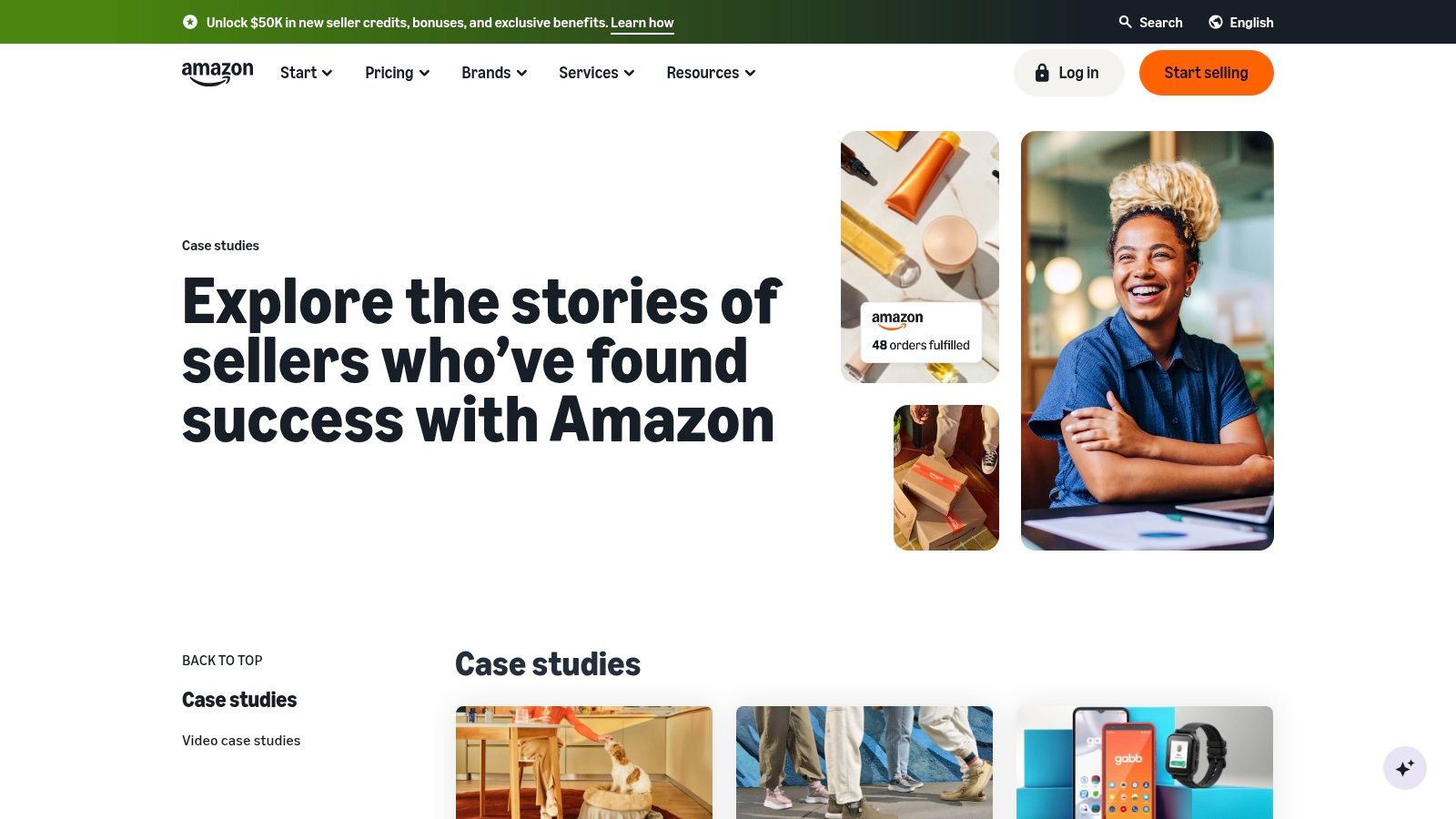
Best fit: teams deciding which Amazon-native capability to test before selecting an agency or platform. The free Amazon seller case-study library includes Sony's Premium A+ Content story, Onkata's experimentation example, and cases involving brands such as Spigen and Lumineux.
The library isn't a single optimization tool. It's a collection of examples spanning product-page education, brand analytics, experimentation, and marketplace programs, with varying levels of detail.
The most actionable experiment
In Amazon's Onkata case study, AccuTec tested American Line razor-blade imagery and title language through Manage Your Experiments, with the title wording change increasing conversion rate by 8%. Testing image and title hypotheses separately makes the method more transferable than a broad redesign with no component-level comparison.
The mechanism is specific: show the actual product more clearly and use wording that better matches customer intent. Don't copy an unusual keyword merely because it worked for another product; establish relevance through your own search-query evidence.
- Strength: Official examples connect practical projects with Amazon-native capabilities.
- Cost advantage: The case-study library is free to access.
- Limitation: Some stories describe overall brand growth rather than isolated listing effects, and program eligibility varies.
For query-led work, Amazon's TheFitGuy case study reports units sold rising 43% in the fourth quarter of 2022 versus the same quarter in 2021 after the brand optimized around high-value search terms identified through Brand Analytics. That supports using query reports as an input, but it doesn't isolate listing edits from other commercial changes or establish a profit outcome.
How the seven listing projects compare on reported outcomes, tactics, and testing method
The outcomes below are vendor-reported figures, so treat them as directional. The tactic and method columns are where the repeatable lessons sit.
| Item | Reported Outcome | Core Tactic | Testing Method | Best Fit |
|---|---|---|---|---|
| The Rag Company, Amazon SEO Case Study | Sales +30%; 16% conversion rate; organic sales and orders +24%; ACOS improved 5%; TACOS stable | Use paid and organic search data to refine listing copy and keywords | Pilot changes on priority products; compare April–July results | Brands connecting advertising insights with organic listing optimization |
| Safariland, Catalog and Variation Redesign | Conversions +37% month over month within 40 days | Restructure variations, rewrite listings, refresh images, and improve Storefront | Testing and Storefront updates; broader work also included advertising | Brands with large, complex catalogs and shopper-navigation challenges |
| Kwontified, Premium Skincare A+ Content and CRO Case Study | Conversion rose from 8.2% to 12.1% | Prioritize ASINs by revenue opportunity and test listing content | Listing content tests prioritized by ASIN revenue opportunity | Brands seeking revenue-prioritized optimization across many ASINs |
| Animal, Consumer-Tested Creative Refresh | Cumulative sales +719%; sessions +707%; overall conversion +11.2% within six weeks | Refresh images, A+ Content, and Brand Story using shopper feedback | Shopper-panel testing followed by live-traffic checks | Brands refreshing dated creative and able to validate concepts with shoppers |
| Vizit, Top CPG Manufacturer Listing Content Test | Higher conversion reported for pages with reordered content | Reorder existing product-page content without creating new assets | Optimized product pages measured against a control group | Brands seeking lower-production content tests with a control group |
| EZ2C, Advance Amazon Listing Optimization Case Study | Conversion rate +70% reported | Listing optimization focused on conversion | Testing design and measurement window not specified | Brands seeking listing-focused conversion improvements and related case examples |
| Amazon Seller Case Studies | Results differ by case, spanning content, analytics, and experimentation projects | Explore Amazon-native content and marketplace programs | Methods differ by case, including Manage Your Experiments | Sellers seeking free official examples across categories and programs |
The Rag Company project is the only one that pairs sales growth with efficiency metrics, which makes its +30% the most interpretable figure in the group. Vizit has the only stated control group, while EZ2C's +70% arrives without a published method or measurement window, placing it at the thin end of the evidence. The most copyable tactics are also the cheapest: rewriting copy from search data, reordering existing content, and fixing variation structure require no new assets.
What Profitable Listing Work Looks Like in Practice
The strongest evaluation method combines a credible control, revenue-based ASIN prioritization, and profitability measurement alongside conversion. Not every case above meets that standard, which is precisely why vendor-reported percentages should guide hypotheses rather than determine forecasts.
Start with a product that has sufficient traffic, dependable inventory, and an identifiable purchase obstacle. Use PPC search terms and Search Query Performance to establish what shoppers want, then decide whether the missing answer belongs in a title, bullet, compatibility image, or A+ module.
PPC can support organic growth, but it isn't proof of it. Better query targeting can bring relevant shoppers to the page, while clearer content can help those shoppers purchase; organic sales and query-level visibility still need separate measurement before you claim a durable organic gain.
Measure the economics, not just the lift
- Conversion rate: Use a consistent denominator and distinguish conversion improvement from additional traffic.
- ACOS: Compare ad spend with attributed advertising sales to assess paid efficiency.
- TACOS: Compare ad spend with total sales, while checking whether organic demand increased.
- Contribution profit: Account for product costs, marketplace fees, advertising, returns, and content investment before scaling.
Stable TACOS isn't automatically a failure, and falling ACOS isn't automatically a win. A brand can profitably maintain its advertising share while expanding total contribution, or improve attributed efficiency while losing valuable discovery traffic.
At Headline, we approach listing and advertising decisions as one system, using contribution margin optimization and profit-based bidding to determine where additional budget is justified. The practical recommendation is to pilot a clearly defined change, retain a credible comparison, and expand only when the economic outcome supports it.
Keep external acquisition experiments, including getting started with Amazon and Pinterest, separate from the initial listing test so you don't confuse new traffic with better conversion. Sustainable scale comes from knowing which intervention earned the next investment.
Headline Marketing Agency offers a free audit of your Amazon PPC campaigns to identify wasted spend and search-data opportunities that can inform organic listing improvements. Visit Headline Marketing Agency to connect your next listing experiment with contribution margin, profit-based bidding, and a measurable scaling decision.
Get Your Free Amazon PPC Audit
Discover untapped growth opportunities and see how our data-driven approach can improve your ROAS.
Get Free Audit →Wollen Sie Ihre Amazon PPC-Performance aufs nächste Level bringen?
Lassen Sie Ihre Amazon PPC-Kampagnen professionell analysieren und entdecken Sie neue Wachstumsmöglichkeiten.