Amazon Keyword Finder: How to Pick Keywords That Convert
Amazon Keyword Finder playbook: validate terms with native data, funnel metrics and profit rules, then turn them into PPC and listing wins.

Most Amazon keyword finder advice still starts with the biggest search volume and works downward. That habit is expensive. Volume only shows that shoppers typed a phrase. It does not show that they bought, that your margin survived the click, or that you can take the term from whoever already owns the results.
Treat every term as a profit decision with one action attached. Fix the listing, bid exact match, run a discovery test, add a negative, or do nothing. The evidence should come from Amazon's own reports, not a third-party volume estimate. I would rather fund a smaller phrase that converts at a healthy margin than defend a category term that only looks important on a keyword list.
The Keyword Finder Workflow at a Glance
The top-volume term on most keyword lists is often the weakest buy. Demand is not purchase intent, and a popular query can still be a poor place to spend.
Run discovery as six stages, and write the pass rules before you export a single report. A blank rule lets the sheet talk you into a favourite term.
What moves a term forward
| Stage | Primary input | Source or tool | Output | Pass rule |
|---|---|---|---|---|
| 1. Build candidates | Customer language from reviews, Q&A and competitor listings | Amazon autocomplete, Brand Analytics, review mining | Raw phrase list | Keep only phrases that describe the product's real use |
| 2. Pull observed demand | Candidate phrases | Search Terms Report, Search Query Performance | Query-level impressions, clicks and purchases | Term shows purchases in the chosen period |
| 3. Validate the funnel | Query-level data | Spreadsheet formulas for CTR, cart rate and CVR | Funnel rates per term | Brand under-indexes on query share but has enough purchases to test |
| 4. Score on profit | Validated terms | Contribution margin, return rate, impression share | Priority score | Positive contribution after ad cost |
| 5. Assign one action | Scored terms | Decision rules in the profit section | Listing, exact PPC, discovery, negative or no action | One action per term, no exceptions |
| 6. Review after window | Campaign results | Search term report exports | Keep, scale or cut | Judged only after the fixed attribution window closes |
Stage one is shopper language only. Pull autocomplete in the marketplace where you sell, then mine reviews, Q&A threads, and competitor titles for the words buyers already use. Drop any phrase that does not describe how the product is used. A "best" modifier with no product fit is clutter, not a candidate.
Stage two asks whether Amazon has recorded purchases for that phrase in the period you chose. No purchases means the term stays a hypothesis. Stage three turns the survivors into funnel rates so impressions cannot hide a weak click or a weak cart. Stage four asks whether the order still pays after ad cost and returns. Stage five allows exactly one action, which stops teams from indexing a term, bidding on it, and negating a close variant in the same week. Stage six waits. Daily bid edits before the attribution window closes mix noise with judgement.
Practical rule: Lock every pass rule in the sheet before the first export, then let the rule move the term.
That is the finder. Everything after this is how each stage uses Amazon's data without pretending volume is a business case.
Free Native Amazon Data to Pull First
Most keyword research goes wrong at the source, not in the spreadsheet. Native Amazon datasets reflect marketplace behaviour, and each one has a hard boundary you should plan around before you build a model on top of it.
Advertising search-term reports are the easiest to over-read. The Amazon Ads API reporting guide states that Sponsored Products and Sponsored Brands search-term reports include customer searches that generated at least one advertising click, not every impression and not every query. The same guide lists a 65-day lookback for Sponsored Products, a maximum API date range of 31 days, and 60-day retention for Sponsored Brands. A finder built only on those files is biased toward queries that already earned a click. It understates low-click and emerging terms, and it cannot show a multi-year trend by itself.
What each free dataset can prove
| Dataset | What it shows | Limit to plan around | Best use |
|---|---|---|---|
| Search autocomplete | Phrases shoppers type in each marketplace | No volume figures | Building the raw candidate list |
| Search Terms Report (Brand Analytics) | Top terms with search-frequency rank and top three clicked products | Relative rank, not absolute volume | Checking demand and competitor control |
| Search Query Performance | Impressions, clicks, cart adds, purchases, median price, brand share | Covers organic and Sponsored Products search traffic only | Funnel validation of each candidate |
| Sponsored Products search term report | Queries that produced at least one ad click | 65-day lookback; API date range capped at 31 days | Finding converting queries already paid for |
| Sponsored Brands search term report | Queries that produced at least one ad click on branded formats | 60-day data retention | Mining branded and category terms |
| Search Term Impression Share report | Share of impressions per term | Needs about two weeks of campaign history | Spotting visibility gaps on proven terms |
Autocomplete is the cheapest raw list. Type the seed in the right marketplace and department, then add a letter or a modifier such as "for" or "with". You get real phrasing and zero volume, which is fine at stage one.
The Search Terms Report is the next check on demand and control. Amazon's Brand Analytics help defines search-frequency rank as a term's popularity relative to other terms in that period, and it shows the top three products clicked, with click share and conversion share. A high rank with conversion share parked on two rivals is a crowded term, not an open one. You can look up a term to see who gets the click, or look up a product to see which terms send clicks to it.
Search Query Performance is where candidates earn a test. It is not a census of every ad impression, so pair it with saved search-term exports. If you also use Product Opportunity Explorer to spot category gaps, treat those gaps as seeds, then confirm them in these reports before you write a bid.
Say you sell travel-size personal care and you are choosing travel body wash suppliers for a new pack size. Autocomplete in that marketplace will surface "TSA", "3 oz", or a local language equivalent long before a volume tool will. Those phrases belong on the candidate list. They do not belong in a budget until the reports show purchases.
Export the advertising reports on a monthly calendar. The window closes faster than many teams expect, and a missed export is data you cannot rebuild from the standard retention period.
How to Validate Candidates in Search Query Performance
A term can look strong on one metric and fail on the next. Treat validation as funnel analysis, not list cleaning.
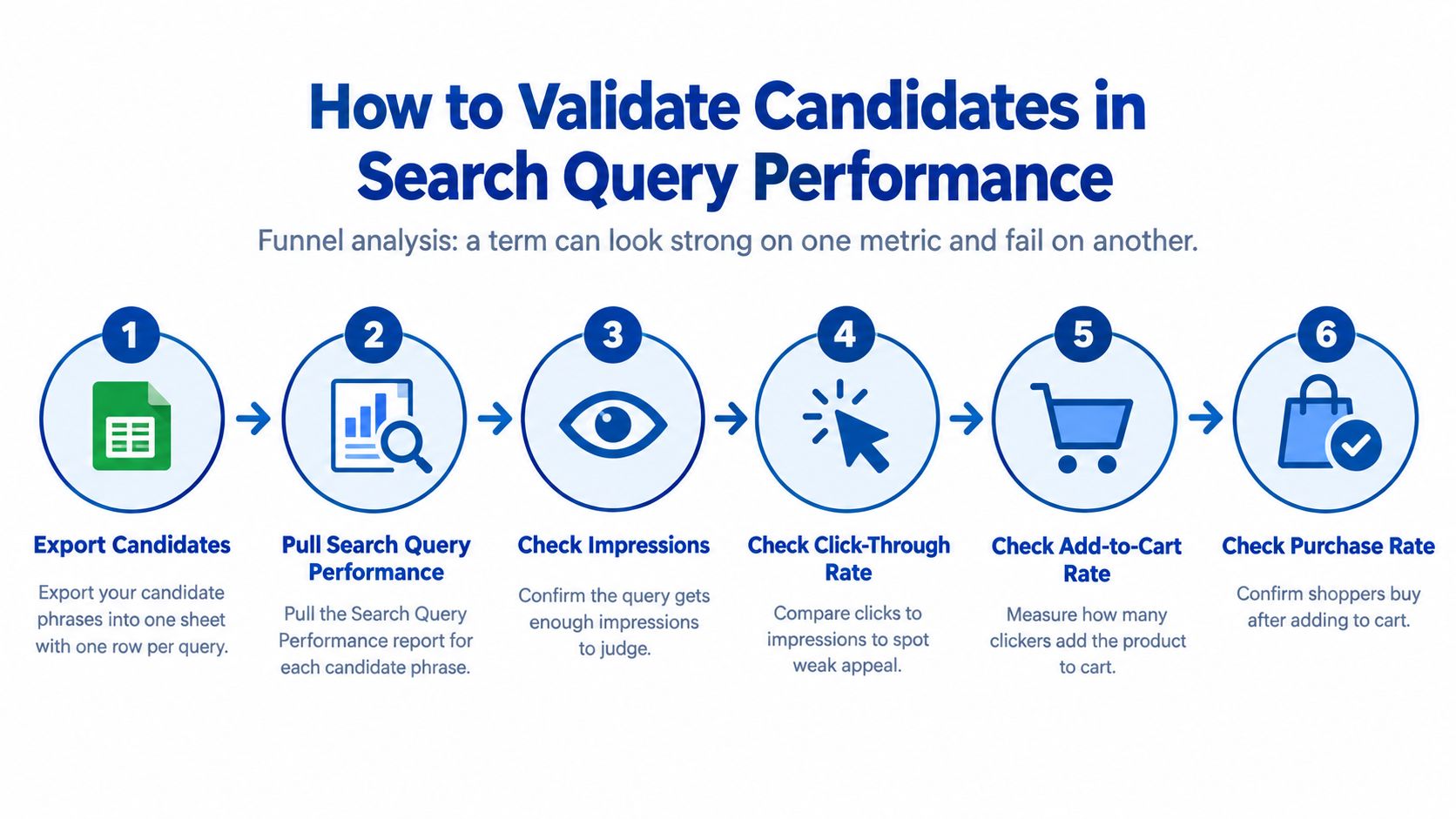
Amazon Seller Central's Search Query Performance reference states that SQP covers organic and Sponsored Products traffic from search results, and that it ranks query and ASIN pairs with a score built from impressions, clicks, cart additions, and purchases. Record query volume, impressions, clicks, add-to-cart events, purchases, conversion rate, median price, and your brand's share. Then do the maths yourself.
Seven steps and the reason for each
- Export candidates into one sheet with one row per query. A single row stops the same phrase from living in three decks with three different spellings.
- Pull Search Query Performance for each query and add impressions, clicks, cart adds, purchases, median price, and brand share. You need the whole path, because a median price far from yours can explain a click that never becomes an order.
- Calculate CTR as clicks divided by impressions, cart rate as carts divided by clicks, and purchase CVR as purchases divided by clicks. Rates make a small query comparable with a large one.
- Segment each term as discovery, high-intent long-tail, branded, or defensive. Each segment gets a different budget rule, so a brand term and a category term should not share one bid logic.
- Flag terms where your brand share trails the query leader but purchase volume is high enough to test. Pick that minimum purchase count before you open the file. Deciding it afterward is how teams keep the terms they already like.
- Drop terms with high impressions and weak clicks or purchases. Visibility that does not move the cart is a cost, not an asset.
- Send survivors to listing indexing, Sponsored Products targeting, or an exact-match test with bids held steady until the attribution window closes. Changing bids daily makes the test unreadable.
A phrase such as "12 inch cast iron skillet lid" can pass with modest impressions, a healthy cart rate, and enough purchases to clear your preset floor. A phrase such as "kitchen gadgets" can fail with huge impressions, a thin CTR, and almost no purchases on your ASIN. The second term looked like the prize on a volume sort.
Where a paid tool still helps
Use a paid third-party tool only to fill a gap Amazon's fields leave, such as a phrase that has no SQP rows yet or a competitor ASIN you have not mined. When SQP and the search-term report disagree, treat the tool's volume as a tiebreaker, not as observed demand. Log the tool name and the export date beside every figure so a later review can audit it. A deeper walk-through of the report fields sits in this Search Query Performance guide.
The short version of the same funnel is easier to brief to a team that will not read the sheet:
Reassess after a fixed attribution window. If you edit bids every morning, you never learn which term earned the order.
A Profit-First Rule for Every Keyword
Tool accuracy matters less than the rule you apply after discovery. A keyword list is not the output. A decision is.
Take a kitchen brand and two made-up results, labelled that way so nobody treats them as a case study. The broad phrase "kitchen tools" shows high volume, a 1.2 percent purchase rate, and a thin margin. The longer phrase "silicone spatula set heat resistant" shows a 9 percent purchase rate and a healthy margin. The specific phrase wins the budget. After ad cost and returns, the broad term does not pay for the clicks its volume attracts.
RT7 Digital's 2025 keyword research note makes the same point from the tool side. Keyword tools aggregate data without revealing intent, and sellers should read conversion and return patterns from their own campaigns instead of chasing high-volume terms. Score each query on four dimensions: relevance, conversion rate, contribution margin after ad cost and returns, and incremental organic value.
The bid ceiling before the test
Write the break-even click cost before launch. Maximum cost per click equals purchase rate multiplied by contribution margin per unit after returns. On the made-up kitchen numbers, a 9 percent purchase rate and a $12 contribution margin support about $1.08 per click. The 1.2 percent broad phrase supports about $0.14. If your planned bid sits above that ceiling, the term is not a scale candidate, whatever the volume tool says.
Impression share and impression rank belong in the same score. Amazon's impression share guidance defines impression share as the percentage of impressions you receive for a term relative to all impressions that term generates, and 0 percent means you received none. Impression rank is your position against other advertisers' shares. A converting term with low share is room to grow. A high-spend term with weak conversion is not a term you should defend just to stay visible.
If you need a clean way to separate price architecture from ad maths, it helps to compare retail and wholesale pricing before you lock contribution margin. A wholesale cost you have not updated will make every "profitable" keyword look better than it is. The same margin logic is the core of a margin-first Amazon ads workflow.
Six patterns, one action each
| Signal pattern | Action | Why it works |
|---|---|---|
| Relevant, profitable purchases, low impression share | Build an exact-match campaign and raise bids in small steps | Proven demand you are under-serving |
| Relevant, strong clicks, weak purchases | Fix the listing, price or images before adding budget | The problem is conversion, not reach |
| High spend, purchases below contribution break-even | Add a negative phrase or negative exact on the waste | Stops the loss without touching winners |
| Irrelevant or wrong-intent query | Add a negative exact | Keeps low-intent clicks out of the account |
| High volume, brand already wins most purchases | Defend with brand campaigns at capped bids | Visibility without much incremental value |
| Low volume, high purchase rate, no listing index | Index the term in title or backend fields, then test exact match | Cheap, high-intent demand that is easy to win |
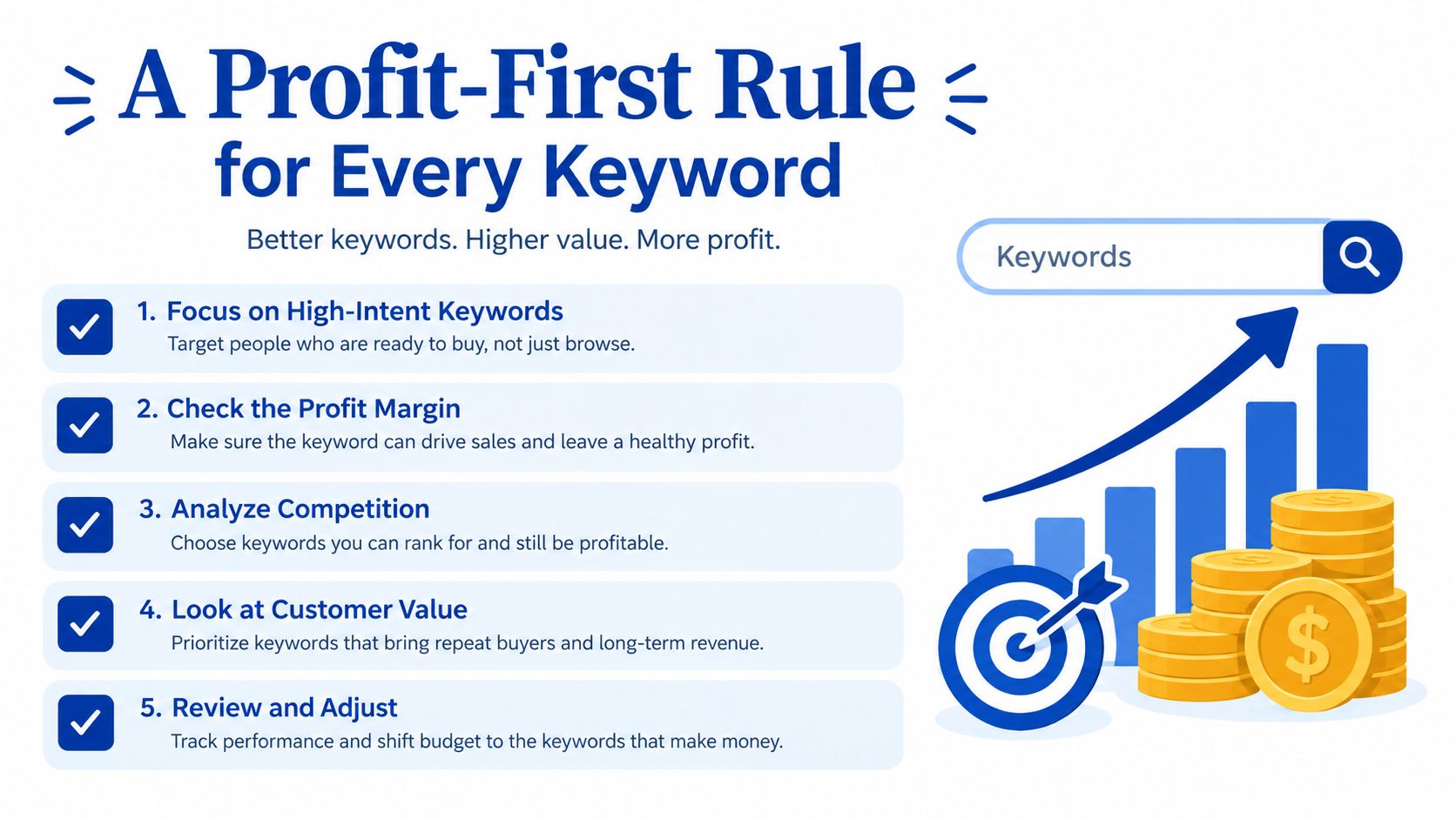
Your break-even and your minimum purchase count belong to your margin, not to a benchmark borrowed from another category. Write both numbers down before the first test starts. ACOS alone will not do this job, because a low ACOS on a term you already own can still add little incremental profit.
Turning Validated Keywords Into PPC and Listing Moves
The listing and the ads have to work as one system. NielsenIQ reported in 2024 that about 80% of products placed in shoppers' baskets appeared within the top 10 keyword-generated Amazon search results. A paid click on a term your listing cannot rank for is rented traffic. A listing that ranks, with ads that defend the same phrase, is how paid spend turns into durable visibility.
Match types after you already know the query
Amazon's manual keyword guidance sets three reaches. Broad match can fire when terms appear in any order and may include related terms. Phrase match needs the phrase or its sequence. Exact match is the most restrictive and usually the closest to the shopper query. All three account for plurals, misspellings, and translations, so a sloppy negative can block more than you meant. Use broad only for controlled discovery, mine the search terms it produces, and move proven queries into phrase or exact, where the bid is easier to defend. Once a campaign has run for about two weeks and has enough traffic and click history, open the Search Term Impression Share report to judge whether your bid is winning visibility on the term or just spending.
Keep each cluster in its own ad group. Attribute, size, audience, and use-case modifiers should not share one budget line, or you cannot read CTR, CVR, and spend. An independent look at ranking breadth points the same way. Ripen's analysis of 746,500 Amazon search results found 344,936 unique products, about 2.2 searches per product, while products in the top 1% of sales rank appeared for an average of 8.7 queries versus 1.2 for the bottom 1%. The strongest link they observed was between search position and title keyword matching. That argues for a precise primary phrase plus a few real modifiers, not for stuffing every discovered term into the title.
Negatives have a length cap
Amazon's negative keyword rules allow negative phrase and negative exact only. Negative phrase blocks queries that contain the complete phrase or a close variation. Negative exact blocks the exact phrase or a close variation. Negative phrase is capped at four words and 80 characters. Negative exact is capped at 10 words and 80 characters. Use the narrowest negative that stops the waste. A wide exclusion will suppress a high-converting variant you meant to scale.
| Match type | Reach | Best use after discovery | Negative keyword limit |
|---|---|---|---|
| Broad | Terms in any order, including related terms | Controlled discovery and mining search terms | Not applicable as a negative type |
| Phrase | The phrase or its sequence | Scaling proven queries with managed bids | Negative phrase: up to 4 words and 80 characters |
| Exact | The most restrictive, closest to the shopper query | Profit-critical terms with the tightest control | Negative exact: up to 10 words and 80 characters |
Build the loop on purpose. Discovery finds the query, exact match tests profit, the listing indexes the winners, and organic rank is the check on whether the spend created visibility you still hold when bids ease off. A one-time keyword list does not do that.
Sparse Data and Multilingual Markets
A bigger keyword tool does not fix a thin market. If the marketplace has little behavioural history, the tool is estimating from a weak base, and a smoother interface will not add shoppers who were never observed.
Smaller marketplaces and languages with limited traffic give Amazon less training data, so query understanding and expansion quality drops. An arXiv paper on query reformulation reports that Amazon search modeling has historically used more than one billion query-query pairs from roughly 30 million unique queries, and that expanding the dataset lifted coverage of low-request queries from about 166,000 to more than 3 million. Even at that scale, low-traffic and linguistically complex markets stayed hard to model. Your brand will not close that gap with a translation pass.

Test local language as separate variants
Build the candidate list in the language shoppers type:
- Native autocomplete: Run it on that marketplace domain, in the right department, logged out so your own history does not steer the suggestions.
- Search-term reports: Keep only queries that earned a click in that locale, and do not backfill gaps with an English export.
- Local competitor copy: Read titles, bullets, and reviews written for that country. A phrase that locals repeat is better evidence than a glossary.
- Query clustering: Group close spellings, then test the cluster members apart. Conversion, not a similarity score, picks the winner.
Do not treat a translated synonym as the same keyword. A machine-translated phrase can read cleanly and still miss the words people search. Put each variant in its own exact-match test, and give it one job before spend starts: prove it can produce purchases, or stay out of the listing.
New-market launches usually need local keyword targets before the locale has enough search history to rank them with confidence. Supply the seed list from autocomplete, competitor copy, and clicked search terms, then let exact-match campaigns separate real demand from plausible wording. Keep the action rule identical in every market: listing fix after local conversion, exact-match PPC while evidence is thin, negative when spend is wasted, and no action when the term is only a hunch.
How much evidence is enough
With few purchases, one good week can look like a winner. Set a minimum purchase count and a minimum test window before launch, and treat anything under that line as a hypothesis. If you need 15 purchases and you have 4, you do not have a scale decision. You have a reason to keep the test running.
Thin data calls for more patience and a clearer test, not a more expensive tool.
Judge success on purchases and contribution in that locale. A rank estimate with no orders behind it is not a finding. I would rather leave a term unassigned for another cycle than promote a translated phrase because a tool gave it a smooth volume line.
Run One Validated Keyword Test Before You Scale
Shrink the method to one test you can launch next week. Pick five validated terms: two relevant high-intent terms, one discovery term, one branded term, and one defensive term. Give each its own exact-match ad group. Set bids you can defend against the contribution-margin ceiling you already wrote down. Write the minimum purchase count and the review date in the same row, before the campaigns go live.
Save the search-term exports on a calendar that beats the reporting window, including the 60-day and 65-day lookbacks, so a late download does not erase the test. When the attribution window closes, sort every term into keep, scale, or cut with the same single-action rules. Do not add a sixth term mid-flight because a new export looks exciting.
PPC earns its budget when it is a lever for organic growth. A paid win that also lifts organic rank and on-page conversion is the signal worth scaling. A paid win that vanishes the week you cut the bid was rented traffic, and it should stay capped or get cut.
If the team cannot run this loop against profit, a single five-term test is still the right first commitment. Headline Marketing Agency runs that process across Sponsored Products, Sponsored Brands, and DSP, using Search Query Performance and Amazon Marketing Cloud, and can start with one test before any larger scope.
I would start there. Five terms, one action each, and a review date nobody is allowed to move.
Headline Marketing Agency builds Amazon PPC and DSP programs around profitability, organic rank, and the same first-party keyword evidence this workflow uses. If you want that loop run against your catalog instead of a volume export, visit Headline Marketing Agency and start with one validated keyword test.
Get Your Free Amazon PPC Audit
Discover untapped growth opportunities and see how our data-driven approach can improve your ROAS.
Get Free Audit →Wollen Sie Ihre Amazon PPC-Performance aufs nächste Level bringen?
Lassen Sie Ihre Amazon PPC-Kampagnen professionell analysieren und entdecken Sie neue Wachstumsmöglichkeiten.