Is Amazon FBA Worth It? A Performance-Based Guide to Profitability
Amazon fulfillment fees keep changing. Our Amazon FBA profitability guide breaks down the current costs and money-saving tactics.

So, is Amazon FBA worth it? The short answer for any brand leader is: it depends on your unit economics and your operational discipline.
For brands that can make the numbers work, FBA is a powerful growth lever. It unlocks Prime eligibility, feeds Amazon’s A9 algorithm positive signals, and provides the operational backbone to scale. But its value isn't automatic. It's determined by your ability to manage costs, inventory, and advertising in a fully integrated strategy.
Is Amazon FBA Really Worth It for Your Brand?
At first glance, Fulfillment by Amazon (FBA) is a logistics solution. You send inventory to Amazon's warehouses; they handle storage, picking, packing, shipping, and customer service. But for e-commerce and retail leaders, convenience isn't the core question—performance and profitability are.
The strategic power of FBA lies beyond fulfillment. It’s your entry point into the Amazon Prime ecosystem, a key driver for the A9 search algorithm, and a direct amplifier for your PPC campaigns. The Prime badge alone can significantly lift conversion rates, which in turn improves ad performance and lowers your Advertising Cost of Sale (ACoS). Before diving into our analysis, it's worth reviewing an honest look at whether Amazon FBA is truly worth it in the current market.
The Strategic Advantages of FBA
Opting for FBA is a major strategic decision that impacts every facet of your Amazon channel. The program is engineered to deliver a superior customer experience through fast, reliable shipping—a factor Amazon’s algorithm heavily rewards. By using FBA, you are integrating your brand directly into Amazon's customer-centric machine.
This alignment provides several performance-critical advantages:
- Prime Eligibility: Your products gain the Prime badge, qualifying for free, two-day shipping. This is a non-negotiable for reaching Amazon’s most valuable and loyal customers.
- Increased Buy Box Ownership: FBA is a dominant factor in winning the Buy Box, which is critical since over 80% of Amazon sales are processed through it.
- Algorithmic Boost: Higher conversion rates and faster shipping provide strong positive signals to the A9 algorithm, accelerating your organic search ranking over time.
- Operational Scalability: FBA enables growth without the corresponding capital expenditure in warehouse space or fulfillment personnel, allowing you to scale volume on demand.
The Reality for Private-Label Brands
The data is clear. A staggering 92% of private-label brands leverage FBA, signaling its critical role in building and scaling a brand on the platform. For these sellers, FBA provides direct access to millions of Prime members and a competitive search advantage that is nearly impossible to replicate with a self-fulfilled model.
This guide moves beyond generic advice to provide a performance-focused breakdown of the true costs, operational demands, and strategic trade-offs of using FBA.
FBA at a Glance Is It the Right Move for You?
To make a sound decision, you must weigh the pros and cons against your specific business model. This framework outlines the key decision points for senior leaders.
| Key Business Factor | FBA Is Likely Worth It If... | Consider Alternatives If... |
|---|---|---|
| Product Margins | You have healthy unit economics (40%+ gross margin) capable of absorbing FBA fees while maintaining target profitability. | Your margins are razor-thin, and FBA fees would eliminate your contribution margin per unit. |
| Sales Velocity | Your products have a high sell-through rate (turnover within 60-90 days), minimizing exposure to long-term storage fees. | Your products are slow-moving, have unpredictable demand, or are highly seasonal, risking aged inventory surcharges. |
| Product Size & Weight | Your items are small and lightweight, placing them in lower-cost fulfillment tiers. | You sell large, heavy, or oversized items where FBA fees become prohibitively expensive. |
| Operational Capacity | You lack the internal infrastructure, staff, or systems to manage fulfillment efficiently at scale. | You operate a sophisticated in-house fulfillment center or have a high-performing 3PL partner relationship. |
| Target Customer | Your core audience consists of Prime members who prioritize fast, free shipping over other value propositions. | You sell bespoke or high-consideration items where customers accept longer, specialized shipping timelines. |
Ultimately, FBA is a tool. For some businesses, it's the perfect-fit, multi-purpose wrench that solves a dozen problems at once. For others, it's the wrong tool for the job. The key is to run your numbers, understand your operational realities, and choose the path that best supports your long-term growth.
Understanding the Real Cost of Amazon FBA
To determine if Amazon FBA is a profitable channel for your brand, you must master its fee structure. It’s easy to be sold on the promise of outsourced logistics, but the true cost can be a minefield for the unprepared. Reviewing the basic fulfillment and storage rates on Amazon’s website is insufficient; you'll miss the variable costs that ultimately dictate profitability.
These costs extend far beyond shipping a package. Every decision—from product dimensions to inventory turn rate—directly impacts your P&L. For any brand leader focused on protecting margins and scaling profitably on Amazon, a granular understanding of these variables is non-negotiable.
As Amazon itself states, the service is designed to handle logistics. But make no mistake, every component of that service carries a price that must be modeled into your unit economics.
The Two Pillars of FBA Costs
At a high level, FBA fees fall into two primary categories. Understanding this distinction is the first step toward building an accurate financial forecast.
Fulfillment Fees: This is the primary cost to pick, pack, and ship an order. It is calculated based on item size and weight. Amazon uses precise size tiers (e.g., small standard, large standard), and a marginal difference of a few ounces or inches can push a product into a more expensive category, fundamentally altering its per-unit profit.
Inventory Storage Fees: This is the "rent" for storing your products in Amazon's fulfillment centers. It’s calculated monthly based on the average daily volume your inventory occupies, measured in cubic feet. These fees are not static; they increase significantly during the Q4 peak holiday season.
A large portion of FBA expenses is embedded in complex logistics. Understanding the underlying Amazon shipping integration can provide a clearer view of how these costs are incurred and how efficiently your products move from shelf to customer.
Uncovering the Hidden Costs That Wreck Your Margins
While fulfillment and storage fees are well-documented, a range of other charges frequently blindside sellers. These "hidden" costs are where inexperienced brands bleed cash, turning a seemingly profitable product into a financial liability.
Key Takeaway: True FBA profitability isn't just about covering the main fees. It requires obsessive accounting for every potential charge—from returns to removals—to build a financial model that safeguards your bottom line.
Here are the other critical costs you must factor into your analysis:
- Long-Term Storage Fees: If your inventory remains unsold for over 181 days, Amazon imposes significant aged inventory surcharges. This is a direct penalty for poor inventory forecasting and slow-moving products.
- Removal and Disposal Order Fees: Extracting unsold inventory from a fulfillment center incurs a per-item fee. Having Amazon dispose of it also comes at a cost.
- Returns Processing Fees: FBA manages returns, but you will be charged a processing fee for items in certain categories. If a returned item is unsellable, you lose the product cost and pay the return fee—a double financial hit.
- Inbound Preparation Service Fees: If products arrive at a fulfillment center without correct labeling or packaging, Amazon will perform the necessary prep work and bill you for it. These unplanned service fees can accumulate rapidly.
Failing to account for these variables will give you a dangerously inaccurate view of your business’s financial health. You need to know your numbers cold, which is why it’s imperative to learn how to calculate profit per unit with every potential FBA cost included. This isn't just an accounting exercise; it's a strategic requirement for survival and growth on the platform.
How to Calculate Your FBA Profitability
So, is Amazon FBA actually worth it for your business? The answer isn't a simple yes or no—it’s a number you have to find. The only way to know for sure is to get brutally honest about your unit economics. Forget generic advice. You need to map out the profitability of every single unit you plan to sell. This isn't just about subtracting a few fees; it's about building a realistic financial forecast that covers everything from manufacturing to marketing.
It all starts with your Landed Cost. This is the total, all-in cost to get one unit of your product sitting in an Amazon warehouse, ready to ship. It’s more than just what you paid the factory; it includes freight, customs duties, and any prep costs. If you get this number wrong, your entire profit projection will be off.
Breaking Down Your Unit Economics
Once you know your Landed Cost, it's time to trace where every penny of your retail price goes. Think of it as a financial teardown for a single sale. This process is how you find your Contribution Margin—the profit you make on each unit sold before you factor in fixed business costs like salaries or software. A strong contribution margin is what fuels a scalable FBA business.
Your calculation needs to include these key expenses:
- Retail Price: What the customer sees and pays on Amazon.
- Amazon Referral Fee: Amazon’s commission for the sale, which is usually 15%.
- FBA Fulfillment Fee: The cost for Amazon's team to pick, pack, and ship your product.
- Monthly Storage Fees: Your product's share of the rent for sitting in the warehouse.
- Estimated PPC Cost Per Unit: This is a big one that many sellers forget.
Expert Insight: Never calculate FBA profitability without incorporating marketing spend. Your Amazon PPC budget is not an "extra"—it's a fundamental cost of customer acquisition. Building an estimated advertising cost into each unit provides a true picture of your net margin.
A Practical Example: Putting It All Together
Let's see what this looks like with a real-world example. We'll map out the costs for a hypothetical product to see exactly how the numbers shake out.
Here’s a line-by-line breakdown to illustrate how quickly costs can add up and eat into your retail price.
| Example FBA Unit Economics Calculation | ||
|---|---|---|
| Line Item | Example Cost/Value | Description |
| Retail Price | $40.00 | The price a customer pays on the Amazon listing. |
| Landed Cost | -$10.00 | All-in cost: manufacturing, freight, duties, prep. |
| Amazon Referral Fee (15%) | -$6.00 | Amazon's commission on the $40.00 sale. |
| FBA Fulfillment Fee | -$5.50 | Cost to pick, pack, and ship the item to the customer. |
| Monthly Storage Fee | -$0.25 | Estimated cost to store one unit for one month. |
| Estimated PPC Ad Cost | -$4.00 | Your target advertising cost per sale (e.g., 10% ACoS). |
| Net Profit Per Unit | $14.25 | The final profit in your pocket from a single sale. |
As you can see, the final profit is what's left after every single variable cost has been paid. This simple math moves your FBA decision from a gut feeling to a data-backed choice.
You can get a more detailed look at this process in our guide on how to calculate profit per unit. For now, the core formula looks like this:
Net Profit per Unit = Retail Price - (Landed Cost + Amazon Referral Fee + FBA Fulfillment Fee + Monthly Storage Fee + PPC Ad Cost per Unit)
Taking the time to do this math really pays off. Research shows that about 64% of Amazon sellers turn a profit in their first year. For FBA sellers, that number is even better—an impressive 86% are profitable, with 68% earning over $1,000 per month. You can dig into more of these seller stats over on TrueProfit's blog.
The takeaway here is simple: FBA can be a massive growth engine, but only if your product's finances are built for it. By meticulously calculating your per-unit profitability and including all the costs—especially advertising—you give your brand the clarity it needs to make a smart decision, protect your margins, and set yourself up for long-term success.
How FBA Supercharges Your PPC and Organic Growth
Viewing Fulfillment by Amazon (FBA) as merely a logistics service is a strategic error. For performance-driven brands, FBA is a marketing amplifier—a direct lever for improving ad efficiency and strengthening organic rank. When asking "is Amazon FBA worth it?", the answer is often found in the growth flywheel it ignites, a mechanism that extends far beyond just shipping boxes.
This dynamic is rooted in Amazon's obsession with the customer experience. The A9 search algorithm is designed to reward sellers who deliver on the Prime promise of fast, reliable shipping. Enrolling a product in FBA grants it the Prime badge, arguably the single most powerful conversion driver and trust signal on the platform.
The FBA and PPC Flywheel Effect
The connection between FBA and Amazon PPC performance is direct and measurable. The Prime badge increases your click-through rate and, more importantly, your conversion rate. A higher conversion rate signals to Amazon's ad algorithm that your product is highly relevant to customer searches.
This triggers a positive feedback loop that directly benefits your campaigns:
- Improved Ad Rank: Because your listing converts well, Amazon grants it better ad placements without requiring higher bids, increasing visibility at a lower cost.
- Lower ACoS: As your conversion rate increases, your Advertising Cost of Sale (ACoS) naturally declines. You generate more revenue from the same ad spend.
- Higher ROAS: Consequently, your Return on Ad Spend (ROAS) improves, making every dollar in your media budget work harder to drive profitable growth.
This is a self-reinforcing cycle. Stronger ad performance drives more sales, boosting your sales velocity. Increased sales velocity is a primary input for Amazon's organic ranking algorithm. Therefore, your PPC investment directly contributes to higher organic placement, creating a sustainable growth engine.
Winning the Buy Box and Owning the Search Page
The Buy Box is where the transaction happens. Over 82% of all Amazon sales are processed through it, particularly on mobile. Inconsistent Buy Box ownership is a direct barrier to scale. While price and seller feedback are factors, fulfillment method is the heavyweight champion in the Buy Box algorithm.
Expert Takeaway: FBA is the single most effective lever for dominating the Buy Box. Amazon's system is inherently biased toward its own fulfillment network because it can guarantee the Prime delivery promise. Consistent Buy Box ownership neutralizes competitors and maximizes the ROI of every ad dollar spent.
Consider the alternative. You could run a perfectly optimized Sponsored Products campaign, but if a competitor using Fulfillment by Merchant (FBM) undercuts your price and captures the Buy Box, you are paying to send traffic to their offer. FBA ensures that when you pay for the click, you capture the sale.
This is a massive strategic advantage. A higher Buy Box win rate means every dollar invested in PPC has a greater probability of converting to a sale, reinforcing the flywheel effect: more sales, stronger sales history, and a sustained climb in organic rankings.
The bottom line is that FBA is much more than an operational choice; it's a foundational piece of your marketing strategy. It has a direct, positive impact on your conversion rates, making your PPC campaigns more profitable. That paid velocity then juices your organic rank, creating a compounding growth loop that FBM sellers will find nearly impossible to match. For any brand trying to win on Amazon, this integrated benefit is what makes FBA not just "worth it," but essential.
Getting Real About FBA Operations
FBA presents a compelling model for scalability, but its power is contingent upon rigorous operational discipline. Ignoring the back-end execution is a direct path to margin erosion and logistical chaos. A winning FBA strategy means confronting the real-world operational hurdles head-on.
The single greatest challenge is inventory management. This is not merely about stocking product; it's about maintaining the optimal amount of product at the optimal time. Failure here is costly.
A stockout isn't just a series of lost sales—it's a direct hit to your sales velocity, the primary fuel for your organic rank on Amazon. The A9 algorithm penalizes products that cannot meet demand, and you can lose search positions that took months of investment to secure.
The Hidden Costs of Getting It Wrong
The inverse problem—overstocking—is equally damaging. Pushing excess inventory into Amazon's fulfillment centers creates its own set of financial drains. Once inventory sits for more than 181 days, Amazon begins applying punitive long-term storage fees that can completely erase your product margins.
This is a major reason why long-term success on the platform is so challenging. Some industry data suggests that only about 10% of Amazon sellers achieve significant, sustained profitability, often because they are overwhelmed by escalating FBA fees and operational missteps. You can find more Amazon seller statistics at AMZ Prep that illustrate this reality.
The Takeaway: Mastery of inventory forecasting is non-negotiable. It is a tightrope walk between sustaining sales momentum and avoiding crippling storage costs. Success requires a data-driven approach, analyzing historical sales data and seasonal trends to ensure FBA makes financial sense for your product catalog.
Nailing Your Inbound Shipments
Beyond managing inventory levels, you must master Amazon’s notoriously strict requirements for inbound shipping and preparation. Amazon's logistics network is a finely tuned machine; your shipments must integrate into that system flawlessly.
Failure to adhere to these protocols can result in painful consequences:
- Rejected Shipments: Incorrect labeling, packaging, or palletization can lead to Amazon refusing an entire inbound shipment at the warehouse door.
- Unplanned Prep Fees: In some cases, Amazon will accept a non-compliant shipment but will perform the required prep work (e.g., poly-bagging, bubble-wrapping) and charge you significant, unbudgeted fees for the service.
- Receiving Delays: Shipments that fail to meet requirements face significant check-in delays. This means your product is sitting in a receiving dock instead of being available for sale, increasing the risk of a stockout.
These inbound processes are especially critical when sourcing from overseas. Your manufacturing partners must understand and comply with Amazon’s standards before inventory leaves the factory. For a detailed breakdown of this process, review our guide on how to ship from China to Amazon FBA.
Ultimately, FBA is not a "set it and forget it" solution. It demands constant, sophisticated operational management. The brands that win are those that treat inventory and inbound logistics as core strategic functions, not administrative afterthoughts. This is the true cost of admission for unlocking the immense benefits FBA offers.
Making the Final Call on FBA
Deciding if Amazon FBA is right for you isn't about jumping on a bandwagon. It's a hard-nosed business decision that hinges entirely on your brand's specific situation. To get to the real answer, you have to look past the shiny benefits and take an honest look at your products, your operational capacity, and where you want to go in the long run.
This is where the rubber meets the road. You need to weigh your reality against what the FBA model demands. Can your current setup handle the pace and precision FBA requires, or are you ready to build one that can? It’s a question that gets answered on your P&L statement.
A Framework for Your FBA Decision
Assemble your leadership team and address these critical questions. The answers will determine whether FBA is a growth engine or a potential cash burn for your brand.
- Do the Unit Economics Work? Analyze your product margins. Are they robust enough to absorb all FBA fees and still deliver target profitability? Are your products small and lightweight, minimizing fulfillment costs, or are they large and heavy, making FBA fees a potential dealbreaker?
- Are You Operationally Ready? Be honest about your team's capabilities. Do you have the discipline and systems for precise inventory forecasting? Can you manage the complexity of Amazon's strict inbound requirements without incurring penalties and delays?
- Is It Aligned with Your Growth Strategy? How critical is the Prime badge to your customer acquisition and retention goals? More importantly, are you committed to funding an aggressive Amazon PPC strategy to ignite the FBA flywheel and drive essential early sales velocity?
This decision process boils down to a few core challenges: your inventory, your prep process, and the fees. Nail these, and FBA can be a goldmine.
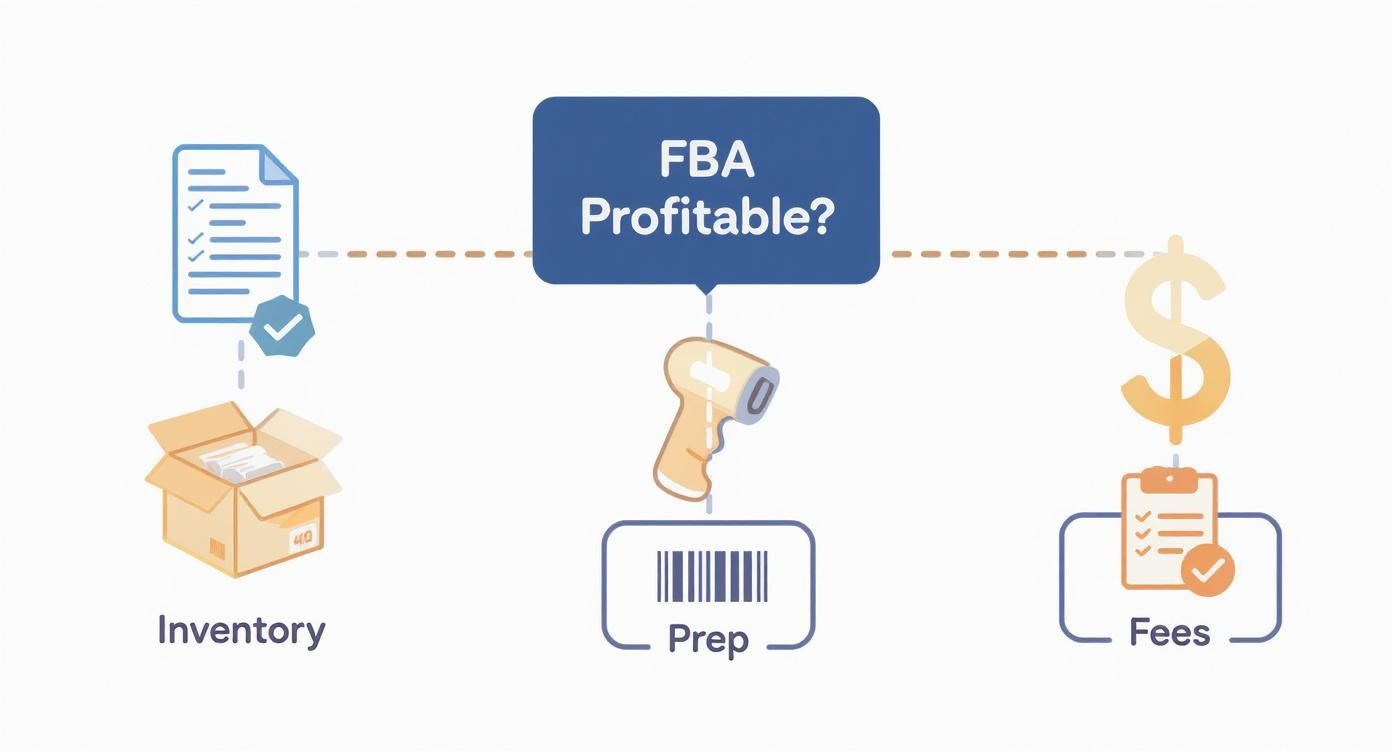
As the diagram shows, profitability isn't a single event. It’s the end result of managing these three moving parts really, really well.
The Bottom Line: It's an Integrated Play
FBA is a powerful tool, no doubt about it. But it's not a "set it and forget it" solution. The brands that truly crush it on FBA are the ones that pair operational discipline with a smart, aggressive advertising strategy. Just signing up for FBA and waiting for the sales to roll in is a surefire way to lose money.
The Big Takeaway: Stop viewing FBA as just a fulfillment service. It is a marketing catalyst. Sustainable success on Amazon is achieved through a holistic strategy where operations and advertising are fully integrated. This is the blueprint for building a profitable, scalable brand on the platform.
For brands ready to execute at that level, FBA is more than worth it—it's a launchpad. For those who aren't, the costs will eat you alive. The final call comes down to an honest assessment of which camp you're in.
Your Top FBA Questions, Answered
We’ve dug deep into the numbers and strategy behind FBA. Now, let’s tackle the most common questions that pop up when brands are on the fence about whether FBA is really worth it.
What's a Realistic Startup Budget for FBA?
There’s no magic number, but a pragmatic starting investment for a new product launch is typically between $3,500 and $10,000. This budget should cover your initial inventory order, the first cycle of Amazon fees, and a properly funded advertising launch.
While starting with less is technically possible, it is a high-risk approach. An undercapitalized launch creates a high probability of a stockout immediately following initial sales traction. This halts sales momentum and signals to Amazon's algorithm that your product is unreliable, which can permanently damage your ranking potential.
Can I Use FBA for Orders from My Own Website?
Yes, through a service called Multi-Channel Fulfillment (MCF). This allows you to centralize your inventory in Amazon’s warehouses, and they will fulfill orders originating from your Shopify store or other sales channels.
However, there are critical trade-offs. MCF fees are structured differently—and are often higher—than standard FBA fees. It is essential to benchmark their rates against other 3PL providers. More importantly for brand-conscious leaders, your products will arrive in an Amazon-branded box, which can dilute the direct-to-consumer brand experience you have worked to cultivate.
Expert Insight: Before committing to MCF for its convenience, conduct a thorough cost-benefit analysis against a dedicated 3PL. The brand control and potential cost savings offered by a non-Amazon partner for your off-Amazon fulfillment often represent the superior long-term strategic choice.
What Are the Biggest Mistakes New FBA Sellers Make?
Time and again, we see new sellers stumble and wrongly conclude that FBA doesn't work. It almost always comes down to one of these three classic blunders:
- Poor Product Selection (Low Margin): This is the number one profitability killer. If product margins are too thin from the outset, FBA fees will consume any potential profit, leaving no capital for reinvestment in advertising or to absorb unforeseen costs.
- Mismanaging Inventory Levels: This is a two-sided failure. Over-ordering leads to punitive long-term storage fees that crush profitability. Under-ordering leads to stockouts, which kills sales velocity and severely damages organic search ranking.
- Neglecting Amazon PPC: Many sellers mistakenly believe FBA is a sales-generation tool. It is not. FBA is a fulfillment and conversion tool. You are still responsible for driving traffic. On Amazon, this means executing a smart, sustained PPC strategy to generate initial sales, gather data, and fuel the growth flywheel.
At Headline Marketing Agency, we don't treat FBA as a logistics line item—we leverage it as a core component of a holistic growth strategy. Our data-driven approach to Amazon advertising transforms your PPC spend into a powerful engine that maximizes the benefits of FBA, creating a flywheel of profitability and dominant organic rankings. Partner with us to build a dominant Amazon presence.
Get Your Free Amazon PPC Audit
Discover untapped growth opportunities and see how our data-driven approach can improve your ROAS.
Get Free Audit →Wollen Sie Ihre Amazon PPC-Performance aufs nächste Level bringen?
Lassen Sie Ihre Amazon PPC-Kampagnen professionell analysieren und entdecken Sie neue Wachstumsmöglichkeiten.