A Guide to Winning with Amazon Display Advertising
Amazon display ads reach shoppers beyond search results. Our with Amazon Display Advertising guide shows when display works and when it's waste.

Amazon display advertising is your key to reaching shoppers with high-impact visual ads, both on and off Amazon. Unlike search ads that wait for a customer's query, display campaigns actively find and engage audiences throughout their entire journey. For mid-to-senior eCommerce leaders, mastering display isn't just about another ad type; it's about building a sustainable, profitable brand.
How Amazon Display Advertising Drives Growth Beyond PPC
When most leaders think "Amazon ads," they default to Sponsored Products—the pay-per-click (PPC) ads that capture bottom-funnel demand. It's a critical, high-intent tactic. But relying solely on PPC is like only harvesting a crop without ever planting new seeds. You're competing for a finite pool of existing demand, which inevitably gets more expensive.
Amazon display advertising is the strategic lever for creating new demand. It's how you move from capturing existing market share to expanding the market for your brand. This proactive approach builds a more defensible and profitable business by filling the top of your funnel and influencing consideration long before a customer searches for a specific keyword.
Building a Foundation for Sustainable Scale
A performance-first display strategy isn't about chasing a low ACOS (Advertising Cost of Sale). It’s about building a flywheel that drives holistic growth. By reaching shoppers at different stages, you fuel a cycle where paid advertising directly boosts organic performance.
Here's the performance breakdown:
- Create New Demand: Introduce your brand to high-potential audiences who are browsing your category but have never encountered your products.
- Nudge Shoppers to Buy: Retarget users who viewed your product but didn't convert. A strategic visual reminder can recover that sale. For example, a home goods brand saw a 32% increase in ROAS by retargeting users who had viewed but not purchased products in the last 30 days.
- Climb the Organic Ranks: Increased traffic and sales velocity from display campaigns are powerful positive signals for Amazon’s A9 algorithm, directly improving organic search ranking over time.
- Defend Your Brand Equity: Place display ads on your own product detail pages. This is a non-negotiable defensive tactic to prevent competitors from siphoning off your hard-earned traffic at the point of conversion.
The Headline POV: Viewing Amazon display advertising as just another direct-response tool is a strategic misstep. Its true value lies in building brand awareness, filling the top of your funnel, and creating a ripple effect that lifts your entire Amazon presence—making your PPC campaigns more efficient and your organic rank more resilient.
This guide will break down the two primary platforms for execution: Sponsored Display and the Amazon DSP (Demand-Side Platform). Understanding the strategic application of each is the first step toward building a full-funnel strategy that drives profitable, long-term market share.
Choosing Your Platform: Sponsored Display vs. Amazon DSP
When launching Amazon display advertising, you face a critical choice: Sponsored Display or Amazon DSP. They both serve visual ads, but their strategic applications, reach, and required investment are fundamentally different.
Think of it like this: Sponsored Display is a precision tool, like a scalpel. It’s perfect for targeted, high-impact actions within the Amazon ecosystem. Amazon DSP, in contrast, is the heavy machinery. It requires a significant investment and expertise but can reshape the entire landscape by building brand awareness across the web.
The key isn't which is "better," but which is the right tool for the job. Aligning your business objective with the right platform is the difference between a profitable investment and a wasted budget.
Sponsored Display: Your On-Ramp for On-Amazon Dominance
For most brands, Sponsored Display is the logical entry point. It's integrated directly into the Advertising Console, offering a familiar interface with no complex setup. This accessibility makes it ideal for executing critical on-Amazon tactics.
Core strategic applications include:
- Brand Defense: A non-negotiable strategy. Place ads on your own product detail pages to block competitors from poaching customers at the finish line.
- Targeted Remarketing: Re-engage shoppers who viewed your product but didn't buy. A visual ad following them on Amazon can be the final push needed for conversion.
- Conquesting: Go on the offensive. Target ads to appear on competitor product pages, capturing consideration at the most critical decision-making moment.
Sponsored Display is about precision and protection on Amazon. It’s your go-to for defending brand equity and converting high-intent shoppers already in the ecosystem.
This flowchart helps simplify when to use broader display ads versus more targeted Sponsored Products.
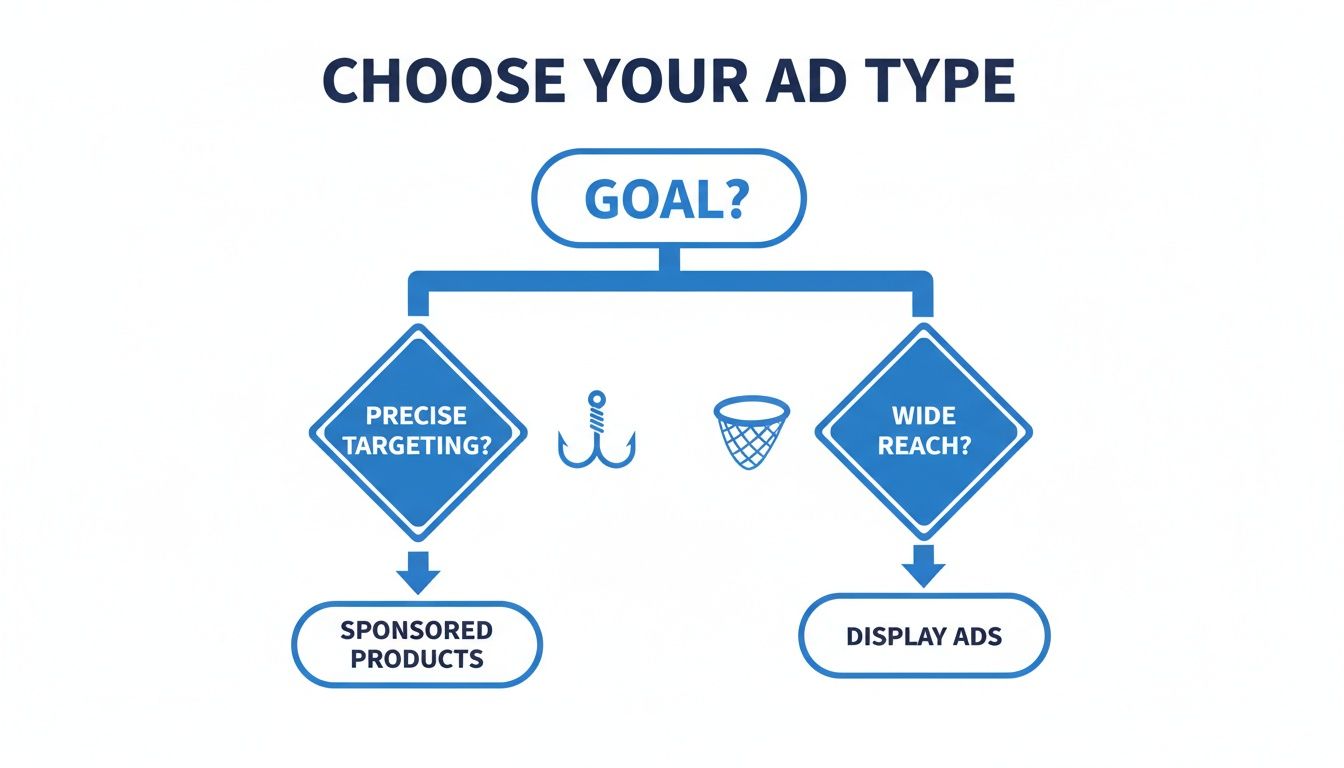
As the visual shows, when your main goal is casting a wide net to build awareness, display advertising is the clear choice.
Amazon DSP: The Engine for Full-Funnel Scale
Once you've maximized on-Amazon tactics and are focused on true brand building, it’s time for the Amazon DSP (Demand-Side Platform). This is where display advertising becomes a tool for market expansion, offering reach and targeting capabilities far beyond Sponsored Display.
The DSP is a separate, more complex platform enabling programmatic ad buying not just on Amazon but across a vast network of websites, apps, and streaming services like Prime Video and Twitch.
With Amazon DSP, you’re no longer just talking to shoppers on Amazon. You’re building a brand presence across the entire web, using Amazon’s invaluable first-party data to find the most relevant audiences wherever they consume content.
The strategic advantage of DSP lies in its audience creation tools. You can build custom audiences based on lifestyle ("eco-conscious shoppers"), purchase intent ("in-market for a new TV"), or create lookalike audiences that mirror your best customers. This is how you execute top-of-funnel campaigns to introduce your brand to entirely new segments. For a deeper look, our guide on how Amazon DSP ads work details its advanced features.
Sponsored Display vs. Amazon DSP At a Glance
The decision comes down to your strategic objective. This table outlines the core differences to align your goals with the right platform.
| Feature | Sponsored Display | Amazon DSP (Demand-Side Platform) |
|---|---|---|
| Accessibility | Self-service, right in Seller Central & the Ad Console. | Requires a managed service from Amazon or an agency partner. |
| Audience Reach | Stays on Amazon's website and app. | Reaches audiences on and off Amazon, including third-party sites and streaming services. |
| Targeting Options | Product/category targeting, remarketing to people who viewed your products. | Advanced audiences (lifestyle, in-market, lookalike), device targeting, and much more. |
| Creative Formats | Standard, mostly auto-generated ads with some customization. | Fully custom image and video creative, responsive ads, and rich media formats. |
| Minimum Spend | No minimums. You can start with a small daily budget. | High minimums, typically starting at $50,000 or more for meaningful data. |
| Primary Goal | Brand defense, lower-funnel sales, and conquesting on Amazon. | Full-funnel brand building, reaching new customers, and driving market expansion. |
The directive is clear: Start with Sponsored Display to protect your brand and convert existing on-Amazon demand. When you are ready to invest in creating new demand and scaling your brand across the web, graduate to Amazon DSP.
Building a Full-Funnel Amazon Targeting Strategy
Having the right tools is one thing; deploying them within a coherent, full-funnel framework is what separates market leaders from the pack. An effective Amazon display strategy isn’t a series of disconnected campaigns. It’s an integrated growth engine that guides shoppers from initial awareness to loyal advocacy.
When structured correctly, advertising ceases to be a cost center and becomes a strategic asset. Each funnel stage works in concert to create a flywheel: paid traffic drives sales, sales velocity improves organic rank, and higher rank generates more visibility, reducing dependency on paid media over time. This is the path to sustainable scale.
Top of Funnel: Driving Awareness
The top of the funnel (ToFu) is about introducing your brand to new, high-potential audiences. These are consumers who fit your ideal customer profile but may not know you exist. This stage is almost exclusively the domain of Amazon DSP, which allows you to cast a wide, intelligent net far beyond Amazon.com.
The goal isn't an immediate sale; it's to manufacture brand recall and fill your pipeline with future buyers.
Key tactics include:
- Lifestyle Audiences: Target shoppers based on aggregated browsing and buying behaviors. A brand selling premium kitchenware can target audiences Amazon identifies as "Gourmet Cooks."
- In-Market Segments: Reach people actively showing purchase intent in your category. Think "shoppers in-market for air fryers."
- Lookalike Audiences: Upload a list of your best customers, and Amazon will build a new audience of users who share similar online behaviors—a powerful tool for scalable prospecting.
Mid Funnel: Nurturing Consideration
Once a shopper is aware of your brand, the mid-funnel (MoFu) objective is to stay top-of-mind and guide them toward a purchase. This is where you differentiate your product. Both Sponsored Display and Amazon DSP are critical here.
The primary goal is to re-engage interested prospects and intercept them during their comparison phase. One CPG brand, for instance, saw a 46.8% new-to-brand conversion rate after implementing a robust mid-funnel retargeting strategy.
- Contextual Targeting (Sponsored Display): A direct and highly effective tactic. Place your ads on competitor product detail pages or pages for complementary items. Selling protein powder? Advertise on detail pages for popular shaker bottles.
- Product View Remarketing: Retarget shoppers who viewed your product but didn't add it to their cart. A timely visual reminder of the exact product can drive them back to complete the purchase.
The Headline POV: The mid-funnel is where you convert passive awareness into active consideration. By strategically placing your brand during the research phase, you prevent competitor capture and reinforce your unique value proposition.
Bottom of Funnel: Sealing the Deal
The bottom of the funnel (BoFu) is about closing the sale. These shoppers are on the verge of purchase, and your task is to provide the final catalyst. Targeting must be laser-focused on immediate conversion.
This is where you capitalize on the awareness and consideration you've built.
- Cart Abandoner Remarketing: This is the highest-intent audience available. Target shoppers who added your product to their cart but failed to check out.
- Cross-Selling and Upselling: Use display ads to reach your existing customer base. Someone who just bought a camera is the perfect audience for an ad showcasing compatible lenses. This tactic drives repeat purchases and increases customer lifetime value (LTV).
By layering these strategies, you create a deliberate customer journey. For a deeper dive, our guide on building a full-funnel marketing strategy provides a complete framework.
Designing Display Ad Creative That Actually Converts
World-class targeting is useless if your creative fails to connect. In the fast-scrolling environment of Amazon display advertising, your ad has less than a second to capture attention. Weak creative doesn't just get ignored; it actively wastes your ad spend.
This isn't about aesthetics; it's about performance. Every element—from the image to the call-to-action—must work in concert to drive a specific action.
The Anatomy of a High-Performing Display Ad
Think of your display ad as a micro-landing page. There is no room for ambiguity. Each component must contribute to a single, clear message.
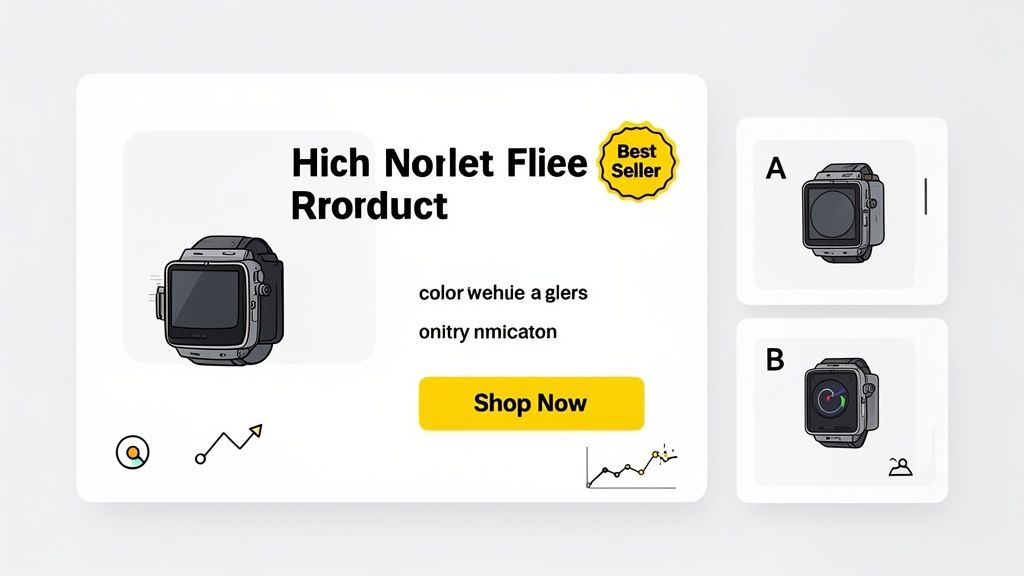
A winning ad requires four key elements:
- High-Quality Imagery: The product is the hero. Use crisp lifestyle photos or product-in-use shots that instantly communicate value. Ensure visuals comply with all platform rules; consult the official image requirements for Amazon to prevent ad rejection.
- A Compelling Headline: Go beyond the product name. Use this space to highlight a key benefit, announce a promotion, or solve a customer pain point.
- A Clear Value Proposition: In a crowded market, why should a customer choose you? A "Best Seller" badge, a unique feature ("Plant-Based"), or a high star rating must be immediately obvious.
- A Strong Call-to-Action (CTA): Tell the user exactly what to do next. "Shop Now," "Learn More," or "Save 20%" are direct commands that eliminate friction.
Streamlining Creative with Responsive eCommerce Ads
Manually creating dozens of ad sizes is inefficient. Amazon's Responsive eCommerce Creative (REC) for Sponsored Display solves this.
You provide the core assets—logo, headline, and product image—and Amazon automatically assembles them into ads that fit any placement.
This provides two key advantages. First, your ads are always optimized for the device and placement. Second, it facilitates rapid A/B testing. You can easily swap headlines or images to identify top performers without a complete creative overhaul.
The Headline POV: Creative is not a "set it and forget it" task. Use REC to launch quickly, then begin a disciplined testing process. Isolate variables—headline, image, CTA—and iterate based on performance data. Small, data-driven optimizations are what unlock significant improvements in click-through and conversion rates.
Ultimately, you are seeking the ideal combination of visuals and copy that resonates with your target audience. For brands looking to innovate further, creating AI video ads that convert can unlock new levels of engagement. When creative is treated as a performance lever, not a design task, it becomes a primary driver of growth.
Measuring What Matters: Key Metrics and Attribution Models
Launching an Amazon display campaign is the start. Proving its business value is the real challenge. To do this, leaders must look beyond simplistic metrics like ACOS and focus on KPIs that demonstrate true business growth—especially for top-of-funnel campaigns designed for awareness, not immediate conversion.
Without proper measurement, display advertising can look like a cost center. With a sophisticated approach, you can prove it's a powerful engine for long-term, profitable growth.
Beyond ACOS: The KPIs That Really Count
A low ACOS is satisfying but is the wrong metric for measuring an awareness campaign. When the strategic goal is different, the measurement must adapt.
These KPIs provide a more accurate picture of display ad performance:
- New-to-Brand (NTB) Customers: This is the gold standard for measuring market expansion. It quantifies the percentage of ad-attributed sales from shoppers who have never purchased from your brand on Amazon before. A high NTB rate is direct proof that your campaigns are growing your customer base.
- Detail Page View Rate (DPVR): This metric measures how many users clicked through to your product page after seeing an ad. It's a key indicator of creative effectiveness and audience relevance—did the ad spark enough interest to earn the click?
- Total Advertising Cost of Sale (TACOS): TACOS provides a holistic view by comparing total ad spend to total sales (paid and organic). This KPI demonstrates how advertising is lifting your organic sales baseline, the foundation of a profitable Amazon business.
When you shift focus to metrics like NTB and TACOS, the question changes from, "What was my ROAS on this campaign?" to "How is my total ad investment impacting overall business growth?" This is the strategic mindset that drives market leadership.
Understanding How Amazon Gives Credit
To measure accurately, you must understand Amazon's attribution models. Unlike search ads tied primarily to clicks, display ads generate significant value even when not clicked.
Amazon uses two primary models:
- Click-Through Attribution: A shopper clicks your ad and buys the product within a 14-day window. The sale is credited to the click.
- View-Through Attribution: This model is critical for display. A shopper sees your ad, doesn't click, but later returns and buys your product within 14 days. The sale is attributed to the impression.
Ignoring the view-through conversion means under-valuing your display campaigns. It captures the "brand halo" effect—the awareness your ad created that resulted in a future sale.
The scale of this is immense. Amazon's platform now serves an average of 61,017 impressions per user every day across its properties. This offers countless opportunities to influence future purchases. To dive deeper, review these Amazon advertising statistics.
Unlocking Deeper Insights with Amazon Marketing Cloud
For brands demanding next-level analysis, the Amazon Marketing Cloud (AMC) is the definitive solution. If standard ad reports are a snapshot, AMC is the full-length documentary of the customer journey.
AMC is a secure, privacy-safe data environment where you can analyze Amazon's ad signals alongside your own datasets. It answers the complex questions that standard reporting cannot:
- How many display ad impressions does a customer typically see before converting on a Sponsored Products ad?
- Which ad sequence (e.g., video followed by static display) generates the highest customer lifetime value?
- How are my top-of-funnel DSP campaigns influencing branded search volume over time?
AMC allows you to build a complete, data-backed model of how your media investments work together, proving the true value of upper-funnel campaigns and optimizing your entire media mix for maximum business impact.
How to Integrate Display Ads into Your Total Amazon Strategy

The most sophisticated brands on Amazon don't run ad campaigns in silos; they build an interconnected system where each component amplifies the others. In this system, Amazon display advertising is the catalyst that ignites the entire growth flywheel, powering both paid and organic sales.
Top-of-funnel display ads, managed through Amazon DSP, serve as the primary entry point for new, qualified audiences. These campaigns introduce your brand, filling the top of your funnel with a fresh pool of consumers who are now aware of your solution.
Creating a Synergistic Growth Loop
Once these new shoppers are in your ecosystem, your other ad types execute their roles. Mid-funnel Sponsored Brands and lower-funnel Sponsored Products campaigns are now positioned to convert this pre-warmed audience. This creates powerful synergy: awareness campaigns make conversion campaigns more efficient, and conversion campaigns validate the targeting of your awareness efforts.
This integrated approach is mission-critical for key business moments:
- New Product Launches: Display ads are essential for generating the initial wave of traffic and sales velocity. This early momentum builds sales history and secures the first reviews, signaling to Amazon's A9 algorithm that the product is a winner from day one.
- Brand Defense: Use Sponsored Display to create a defensive "moat" around your own product detail pages, preventing competitors from poaching the high-intent traffic your upper-funnel campaigns worked hard to attract.
The core principle is simple but powerful: top-funnel display advertising feeds performance-focused PPC. A shopper who has been exposed to your brand via a display ad is significantly more likely to recognize and click your Sponsored Product ad later in their journey.
Driving Profitability and Organic Rank
This interconnected strategy creates a powerful flywheel. The incremental traffic and sales generated by this holistic approach directly boost your sales velocity—a primary factor in Amazon's organic ranking algorithm. As sales velocity increases, your organic search ranking improves.
Better organic rank leads to more high-converting, free traffic, which in turn allows you to strategically reduce paid ad dependency. This is the mechanism for lowering your Total Advertising Cost of Sale (TACOS) and increasing overall profitability. Each component—Display, Sponsored Products, Sales Velocity, and Organic Rank—drives the others forward in a cycle of sustainable, profitable growth.
The Headline Takeaway: Stop viewing display and PPC as separate line items. An elite Amazon strategy weaves them into a single growth engine. By using Amazon display advertising to build awareness and feed your conversion funnel, you create a powerful flywheel that improves sales velocity, boosts organic rank, and builds a more profitable, defensible brand on the marketplace.
Burning Questions About Amazon Display Ads
Still have questions? Let's tackle some of the most common queries from eCommerce leaders navigating Amazon's display advertising landscape. Here are no-nonsense answers to guide your decision-making.
What’s a Realistic Starting Budget for Amazon DSP?
Let's be transparent: while Sponsored Display has no minimum, Amazon DSP is a significant investment. Brands should be prepared to commit a minimum of $50,000 for an initial campaign to gather statistically significant data.
This budget is necessary to test multiple audiences and creatives effectively. Spreading a smaller budget too thin yields inconclusive data and wastes the investment. DSP is for brands that are serious about funding top-of-funnel growth and are prepared to measure its long-term impact.
How Long Until I Actually See Results?
This depends entirely on the objective. For bottom-funnel Sponsored Display campaigns (e.g., remarketing, brand defense), you can expect to see a clear performance signal within 14 to 30 days.
However, for broad awareness campaigns on DSP, patience is required. The goal is building brand equity, not immediate sales. A minimum 90-day flight is necessary to accurately measure the impact on metrics like new-to-brand customer acquisition and the lift in your organic sales baseline.
The Headline POV: Judging a DSP awareness campaign on its first-week ACOS is like pulling up a seedling to check its roots. You destroy the potential for growth. Trust the process and measure against the right long-term KPIs.
When Should I Move from Sponsored Display to DSP?
Graduating from Sponsored Display to DSP is a strategic decision, not just a budgetary one. You are ready to make the leap when:
- You've Saturated On-Amazon Channels: You have maximized performance from on-Amazon remarketing and conquesting, and your reach has hit a ceiling.
- Your Focus Shifts to Creating Demand: You are ready to move from simply capturing existing demand to proactively creating new demand by finding audiences who have not yet heard of you.
- You Need a Holistic View: You're asking bigger questions about the complete customer journey that require the advanced analytics of tools like Amazon Marketing Cloud (AMC).
Ultimately, you move to DSP when your strategic priority shifts from harvesting existing demand to planting the seeds for future, sustainable growth.
Ready to build a holistic Amazon advertising strategy that drives profitability and sustainable growth? The team at Headline Marketing Agency uses data-driven insights from Amazon Marketing Cloud and Search Query Performance to create display and PPC campaigns that deliver real business results. Let's talk about scaling your brand.
Get Your Free Amazon PPC Audit
Discover untapped growth opportunities and see how our data-driven approach can improve your ROAS.
Get Free Audit →Wollen Sie Ihre Amazon PPC-Performance aufs nächste Level bringen?
Lassen Sie Ihre Amazon PPC-Kampagnen professionell analysieren und entdecken Sie neue Wachstumsmöglichkeiten.