How to Build Amazon Advertising Campaigns That Drive Real Growth
Advertising on Amazon gets more competitive every year. Here's how we stay ahead with Amazon ad campaigns across 12 marketplaces.

Your Amazon advertising campaigns are more than just a sales channel; they're the primary lever you can pull to fuel organic growth, drive profitability, and build a sustainable brand on the world's biggest marketplace. To win, you must move past outdated metrics and treat every ad dollar as a strategic investment in your brand’s future. This is the performance-first approach that separates market leaders from the pack.
Moving Beyond ACOS to True Profitability
For years, eCommerce leaders were conditioned to obsess over one metric: Advertising Cost of Sale (ACOS). While it has its place, treating a low ACOS as the ultimate goal is a surefire way to stunt growth. Today, that singular focus is a vanity metric that masks operational weaknesses and leaves market share on the table for more aggressive competitors.
Winning on Amazon in 2024 and beyond demands a shift in thinking. The most successful brands view their Amazon advertising campaigns as the engine for the "flywheel effect"—using paid placements to generate sales velocity, which in turn boosts organic keyword ranking, leading to a virtuous cycle of visibility and sales that you don’t have to pay for. The ad-driven sale isn't the end goal; it's the catalyst.
The Problem with ACOS-Only Thinking
Relying solely on ACOS to measure success is like trying to drive a car by only looking at the tachometer. You see how hard the engine is working, but you have no idea if you're heading in the right direction or about to hit a wall.
An artificially low ACOS often indicates:
- Insufficient Aggression: Bidding too conservatively to protect ACOS means you are forfeiting crucial top-of-search placements to competitors who understand the value of acquiring market share.
- Negligible Organic Impact: Your "profitable" campaign isn't generating the sales velocity needed to improve organic rank for key terms, minimizing its true contribution to business growth.
- Strategic Misalignment: A high ACOS during a product launch is a necessary investment to gain traction and reviews. Judging it by the same standard as a mature product is a critical strategic error.
A performance-first mindset recognizes that a temporarily high ACOS can be a strategic investment. The critical question isn't "What is my ACOS?" but rather, "Is my total ad spend driving profitable, long-term growth across my entire business?"
Adopting a Profit-Driven Framework
Aligning campaigns with business goals requires a broader view of success. It means connecting advertising data to your brand's overall financial health, moving beyond campaign-level efficiency to measure total business impact.
Metrics that actually drive decision-making for senior leaders:
- Total Advertising Cost of Sale (TACOS): This is your total ad spend divided by your total revenue (ad-driven + organic). A downward-trending TACOS is the clearest indicator that your ad spend is successfully lifting organic sales—the foundation of a scalable Amazon business. A recent study showed that a 10% increase in ad spend can lead to a 1-3% increase in total sales, highlighting this direct link.
- Organic Rank Velocity: Actively track how ad spend impacts organic ranking for your top 10-20 commercial keywords. Aggressive, targeted bidding should produce a measurable climb in organic placement. If it doesn't, your targeting or conversion rate is flawed.
- New-to-Brand (NTB) Customer Metrics: Use Sponsored Brands and Sponsored Display to measure the percentage of sales from new customers. Acquiring customers who make repeat purchases dramatically increases Customer Lifetime Value (CLV) and justifies a higher initial acquisition cost.
Shifting focus from ACOS to these more holistic indicators transforms advertising from a reactive cost center into a proactive engine for brand growth.
Building a Campaign Structure That Actually Works
Jumping into Amazon ads without a clear, scalable structure is a recipe for wasted spend and operational chaos. A deliberate, layered campaign architecture provides the granular control needed to make intelligent decisions about bids, budgets, and strategy. This isn't just theory; it's the blueprint for building advertising systems that scale efficiently.
The core principle is functional separation. Campaigns must be organized by their specific mission, creating a hierarchy that allows you to push investment where it's most effective and pull back where it's not.
The Three Pillars of a Scalable Structure
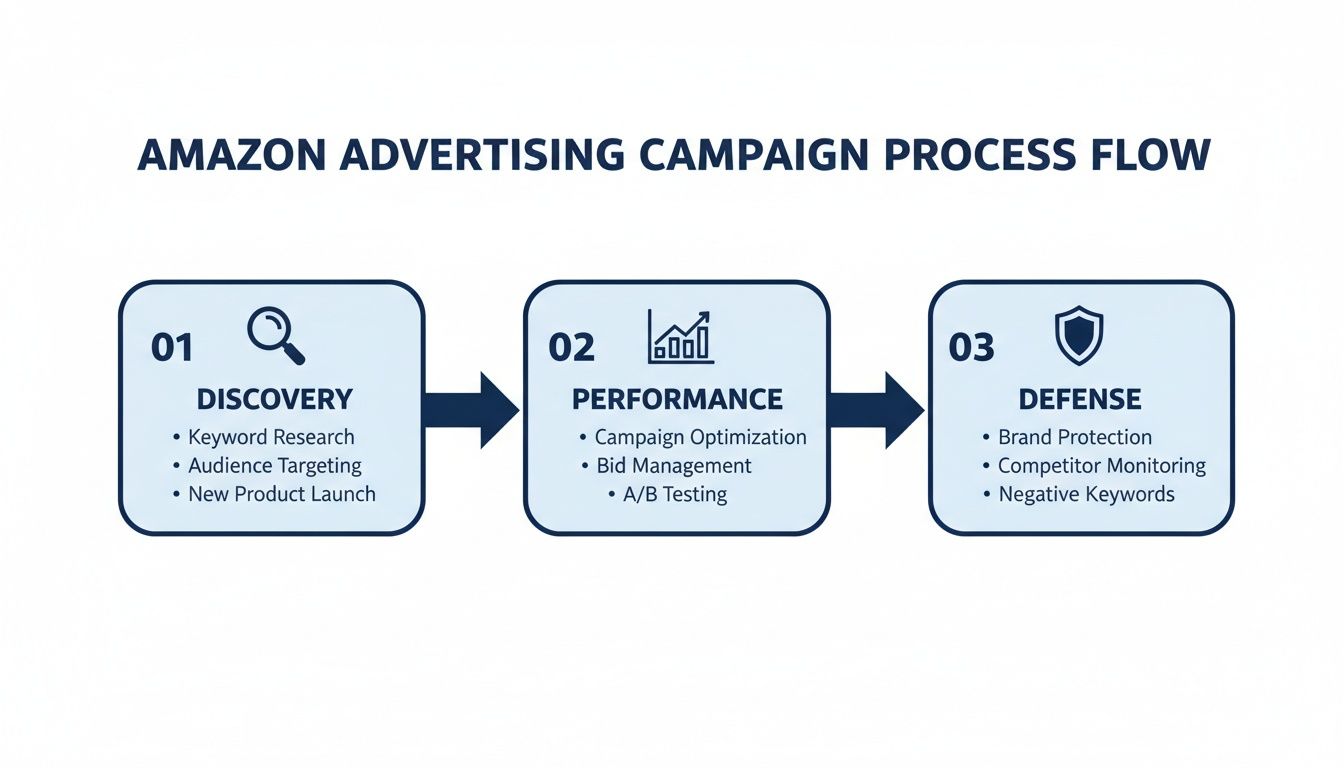
We build every ad account around three strategic pillars. This methodology ensures every dollar has a purpose, eliminating the wasteful "spray and pray" approach that plagues so many brands.
Discovery Campaigns: These are your market intelligence operations. Use automatic targeting and broad match campaigns to harvest new, high-converting customer search terms and profitable ASINs. Tolerate a higher ACOS here; the value is in the data you collect.
Performance Campaigns: This is your primary growth engine. These campaigns use manual targeting (Phrase and Exact match) for keywords and product targets that have already proven their ability to drive profitable sales. This is where the bulk of your budget should be allocated to drive efficient sales and boost organic rank.
Defensive Campaigns: This is your brand protection unit. Bid on your own branded keywords and target your own product detail pages (Product Targeting). The mission is simple: prevent competitors from siphoning off high-intent customers who are already looking for you.
The real power is unleashed when data flows between these pillars. Profitable search terms "graduate" from Discovery to Performance campaigns, while irrelevant terms are negated. This creates a self-optimizing system that gets more efficient over time.
Structuring by Match Type and Product Stage
Within the "Performance" pillar, granularity is key. A common mistake is lumping Broad, Phrase, and Exact match keywords into a single ad group. This makes it impossible to control bids effectively and allocate budget to your highest-performing exact match terms.
Create separate campaigns for each match type. A basic structure for one product family might look like:
- SP | Red Kettle | Auto
- SP | Red Kettle | Manual - Broad
- SP | Red Kettle | Manual - Phrase
- SP | Red Kettle | Manual - Exact
This separation allows you to strategically channel budget toward high-ROI exact match campaigns. This is non-negotiable. With Sponsored Products making up nearly 70% of total Amazon ad spend, owning the top spots for your most important exact match keywords is fundamental to winning.
Your strategy must also adapt to the product lifecycle. A new product requires an aggressive "Launch" portfolio, where Auto and Broad campaigns are funded with a higher ACOS target to build sales velocity. A mature product, conversely, belongs in a "Profitability" portfolio, where the focus shifts to efficiency and maintaining a low ACOS on proven exact match terms.
Naming Conventions and Budgeting
A logical naming convention is the unsung hero of a well-managed account. It provides at-a-glance clarity and streamlines reporting. A simple format like [Ad Type] | [Product Line] | [Targeting] | [Strategy] can bring immediate order to chaos.
As you build this structure, remember that traffic is only half the equation. The anatomy of a perfect product listing is the foundation. A brilliant campaign sending shoppers to a poorly optimized detail page is an expensive way to learn about conversion rate problems.
Finally, leverage Portfolios. Group campaigns by product, strategic goal (Launch, Profit, Defend), or business unit. This not only organizes your account but also allows you to set top-level budget caps and analyze performance by strategic initiative, turning a tangled web of campaigns into a goal-focused, manageable machine.
Getting Your Keyword and Targeting Strategy Right
Your keyword and targeting strategy is the engine of your entire Amazon advertising operation. To gain a competitive edge, you must look beyond third-party tools and leverage the rich, proprietary data Amazon provides.
The most valuable and underutilized data source is Amazon's Search Query Performance dashboard. This reveals the exact search terms shoppers use to find your products organically, including impressions, clicks, and conversion data for terms you may not even be targeting with ads. These are high-intent keywords your competitors are likely missing.
The Keyword Graduation System
The most effective keyword management approach is not a static list but a dynamic system. We call it the "keyword graduation system"—a process for discovering, testing, and promoting winning search terms into high-performance campaigns, ensuring your ad spend is guided by real-time customer behavior.
This process moves your targeting from broad discovery to surgical precision.
Here’s the practical workflow:
Discovery (Auto & Broad Match Campaigns): Run Automatic and Broad match campaigns with one objective: to harvest raw customer search queries and ASINs. Tolerate a higher ACOS; you are paying for mission-critical data.
Testing (Phrase Match): When a search term from your Discovery campaigns generates a sale, "graduate" it to a manual Phrase match campaign. This allows you to test the term with more control and budget to validate its potential.
Performance (Exact Match): Once a keyword consistently converts at your target ACOS in testing, promote it to a dedicated Exact match campaign. Here, you can bid aggressively to own top-of-search placements and maximize sales velocity.
Throughout this process, be relentless with negative keywords. An irrelevant search term in your Auto campaign should be added as a negative exact match there and a negative phrase match in your manual campaigns. This continuous refinement is what drives efficiency. For a deeper look, see our guide to building a powerful Amazon keywords list.
A Smarter Way to Think About Campaign Types
To avoid getting lost in tactical weeds, align each campaign type with a clear strategic goal. This framework helps you match your budget, bids, and KPIs to your actual business objectives.
| Campaign Type | Primary Objective | Key Performance Indicator (KPI) | Best Used For |
|---|---|---|---|
| Sponsored Products (Auto) | Discovery & Research | Clicks, Search Term Report Data | Finding new, high-converting customer search terms and relevant ASIN targets. |
| Sponsored Products (Manual) | Performance & Scale | ACOS, ROAS, Orders, TACOS | Driving efficient sales on proven keywords and product targets. |
| Sponsored Brands | Brand Awareness & Defense | Impressions, New-to-Brand Orders | Protecting branded search terms and dominating the top of search results. |
| Sponsored Display | Retargeting & Conquesting | Detail Page Views (DPV), Conversions | Re-engaging past shoppers and appearing on competitor product detail pages. |
| Sponsored Brands Video | Consideration & Engagement | Video Completion Rate, CTR | Telling your product's story and standing out in a crowded search results page. |
This isn't just a list; it's a strategic framework. By defining the why behind each campaign, you can make smarter decisions about capital allocation and measure success far beyond a simple ACOS.
Advanced Product and ASIN Targeting
Keywords are critical, but Product Targeting (PAT) campaigns—where you target specific ASINs—are your secret weapon for both offense and defense.
The goal isn't just to appear on a search results page; it's to be present on your competitors' product detail pages, intercepting customers at the final moment of decision. This is how you win market share, not just sales.
Defensive ASIN Targeting
This is non-negotiable. You must run a Product Targeting campaign that targets your own ASINs. The "Products related to this item" carousel on your detail page is prime real estate. If you don't occupy it with your own products, your competitors will.
- Your Goal: Create a "brand block" by showing ads for your other relevant products (e.g., different sizes, colors, or complementary items) on your own listings.
- Why It Works: It keeps shoppers within your brand ecosystem, increasing average order value and preventing them from clicking away to a competitor. It is a low-cost, high-impact tactic to protect your sales.
Offensive ASIN Targeting
Now, go on the attack. Identify top competitors—especially those with higher prices, weaker reviews, or poor content—and target their ASINs directly.
- Your Goal: Position your product, with its superior value proposition, directly on their product page.
- How to Do It: Create specific ad groups targeting competitor ASINs. Focus on newly launched products gaining traction but lacking social proof (reviews). Exploit their weaknesses and position your product as the obvious alternative.
Combining a dynamic keyword graduation system with surgical ASIN targeting creates a comprehensive advertising strategy. It transforms your campaigns from a simple sales tool into a machine that actively finds new customers, converts them efficiently, and defends your market share.
Fine-Tuning Bids and Budgets for Real Growth
Strategy is nothing without execution. Effective bid and budget management is where you translate data into results. This isn't about hitting a target ACOS; it's about deploying capital to drive organic rank and build sustainable profit. You must know when to bid aggressively to capture market share and when to focus on bottom-line efficiency.
Static bidding is a death sentence in a dynamic marketplace like Amazon. Your bidding strategy must be fluid and mirror your campaign's objective. A product launch requires aggressive bids to secure initial sales velocity. A mature, profit-focused campaign demands a more measured, data-driven approach.
The Art of Bidding for Placement
Not all ad placements are created equal. The Top of Search (ToS) placement is the most valuable real estate on Amazon. It commands the most visibility, the highest click-through rates, and has a disproportionate impact on organic ranking. Securing this spot is a deliberate strategic investment.
Analyze your Placement reports. If a high-performing campaign has a low impression share at Top of Search, it's a clear opportunity. Use Amazon’s "Adjust bids by placement" feature to increase your ToS bid modifier, often by 50-100% or more. This signals to Amazon that you are prioritizing this high-visibility placement. It's a direct investment in the sales velocity flywheel that lifts organic rank.
Your goal isn't just to win an auction; it's to win the right auction. Prioritizing Top of Search for your highest-intent, exact-match keywords is a direct investment in your product's long-term organic visibility.
Dealing with Rising CPCs and Smart Bidding
Effective bid management requires market awareness. Costs are constantly in flux. The average Cost-per-Click (CPC) on Amazon recently climbed to $1.33, a significant increase reflecting intensifying competition. This market pressure makes intelligent bid management critical for maintaining profitability.
When CPCs spike for a core keyword, diagnose the cause. Is a new competitor bidding aggressively, or is it a permanent market shift? If your objective is market share, you may need to absorb the higher cost. If your focus is profitability, it may be time to shift spend to less competitive, long-tail keywords.
Leverage Amazon’s dynamic bidding strategies to automate and optimize:
- Dynamic bids - down only: The most conservative option. Amazon will lower bids on clicks less likely to convert. Ideal for campaigns where strict profitability is the primary goal.
- Dynamic bids - up and down: Amazon can increase bids (up to 100% for ToS) for clicks it deems likely to convert. Best for performance-focused campaigns where you are balancing growth and efficiency.
- Fixed bids: Provides maximum control but requires constant monitoring. Reserve this for defensive campaigns where securing a specific ad placement is mission-critical.
Beyond CPC, understanding metrics like what is a good CPM can provide valuable benchmarks for brand awareness campaigns and help you allocate budget more effectively across different ad types.
A Smarter Way to Allocate Your Budget
Your budget should follow opportunity. Move away from rigid daily budgets and adopt a more fluid, rules-based system using the Portfolios feature. Group campaigns by strategic initiative (e.g., "Product Launch - Red Kettle," "Profitability - Blue Widget") and set a single budget cap for the entire portfolio.
Then, implement performance-based rules to automate budget management. For example: If the "Performance - Exact Match" portfolio maintains a TACOS below 15% for seven consecutive days, increase its budget by 20%. Conversely, you can create rules to cap spend on a "Discovery - Auto" campaign if its ACOS exceeds 60%, preventing inefficient spend.
This data-driven approach removes emotion from budgeting, ensuring capital flows toward what is working and allowing you to scale your amazon advertising campaigns profitably without constant manual intervention.
Think Bigger: Using Ad Data to Fuel Your Entire Business
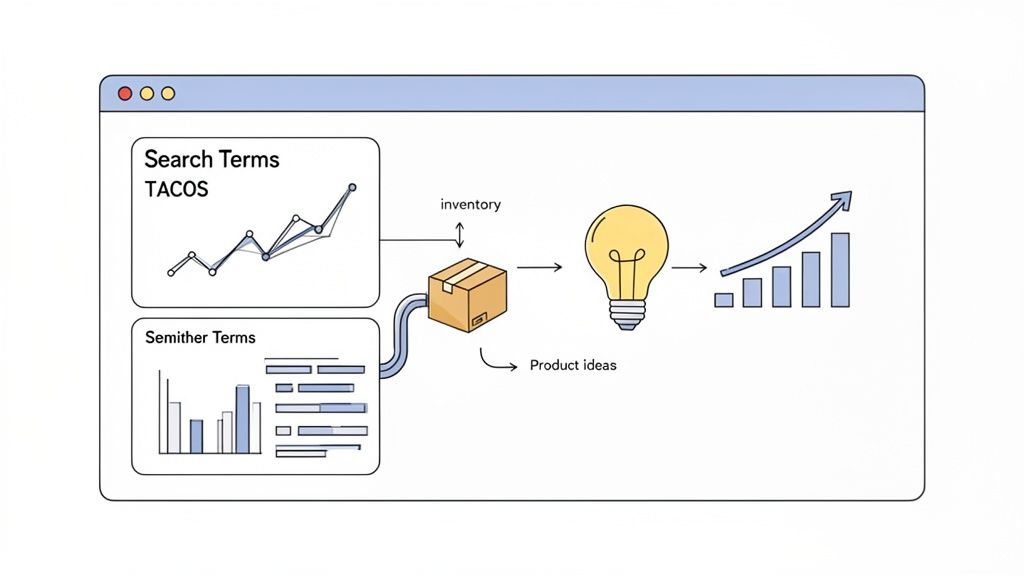
The most sophisticated brands on Amazon understand a critical truth: advertising data is business intelligence. Your amazon advertising campaigns generate a real-time feed of customer behavior and market demand. Using this data solely for ACOS optimization means you're leaving immense value on the table.
This data is your key to creating a powerful feedback loop where ad insights inform critical business decisions—from inventory forecasting and product development to high-level marketing strategy. It’s time to elevate PPC from an isolated marketing function to your company's de facto R&D department.
Uncovering Hidden Gems in Your Search Term Reports
The Search Term Report is the most valuable dataset Amazon provides. While most sellers use it to find new keywords and negatives—which is table stakes—its true power is unlocked through strategic analysis.
These search terms are the unfiltered voice of the customer. They reveal problems, feature preferences, and unanswered questions. Analyzing these reports for patterns uncovers massive business opportunities:
- Spotting New Product Opportunities: Are you seeing repeat searches for a product variation you don't offer? If you sell a blue widget and see consistent, converting searches for "large blue widget," that isn’t just a keyword. It’s a data-backed product development roadmap.
- Refining Your Product Messaging: Do shoppers consistently use specific adjectives? If they search for "durable dog toy for aggressive chewers" instead of just "dog toy," that's a clear signal. "Durable" and "for aggressive chewers" must be central to your product titles, bullets, and A+ Content.
- Identifying Gaps in the Market: Look for long-tail search terms with high click-through rates but low conversion. This often indicates strong demand for a specific solution that no one is providing effectively. If you can develop a product that serves that niche need, you've found a profitable gap in the market.
Think of every search term as a customer survey response. You are collecting thousands of these data points daily, revealing exactly what the market wants. Ignoring this is like commissioning expensive market research and then shredding the results.
How TACOS Informs Your Strategic Planning
As discussed, Total Advertising Cost of Sale (TACOS) is your north star for measuring ad spend health. But its utility extends far beyond campaign optimization. When blended with operational data, TACOS becomes a powerful tool for forecasting and strategic planning.
A consistently falling TACOS proves that your advertising is successfully lifting organic sales. This provides the confidence to make bolder strategic moves. You can more accurately forecast future revenue, enabling smarter inventory planning. A strong organic sales foundation, validated by your TACOS trend, de-risks larger purchase orders and helps you avoid costly stockouts.
It’s no surprise that advertiser confidence on the platform is growing. Amazon’s ad revenue growth consistently outpaces the rest of the digital ad market, with a 26% year-over-year jump recently reported. This is fueled by the fact that the majority of product searches begin on Amazon, leading to higher conversion rates. Your ability to translate ad data into business intelligence is a massive competitive advantage in this environment.
Building an Integrated Data Workflow
To operationalize these insights, you must break down the silos between your advertising, product, marketing, and operations teams. PPC insights must be systematically shared and integrated into cross-functional decision-making.
Establish a recurring process to analyze key PPC reports for business-wide intelligence, not just ad performance metrics. This simple discipline transforms advertising from a sales expense into the core of your business intelligence engine.
This integrated approach aligns your entire organization with real-time market demand. You will launch more successful products, write more resonant marketing copy, and manage inventory with greater precision—all because you learned to listen to the data your amazon advertising campaigns were already providing.
Frequently Asked Questions About Amazon Ads
Even with a robust strategy, navigating the complexities of Amazon ads always surfaces tough questions. Here are no-nonsense answers to the most common challenges faced by eCommerce leaders.
What’s a Good ACOS for My Campaigns?
There is no universal "good" ACOS. The right ACOS target depends entirely on your product's profit margin and your strategic objective for that specific campaign. The common 20-30% benchmark is generic advice that can lead to poor decision-making.
Obsessing over a low ACOS is a tactical error that inhibits strategic growth. Instead, think in terms of goals:
- Product Launch: A high ACOS (often 100% or higher) is a strategic investment. You are buying data, initial reviews, and the sales velocity needed to achieve organic ranking, not immediate profit.
- Mature Product: For an established product with strong organic rank, your ACOS should be at or below your break-even point. The objective has shifted to maximizing profitability and efficiency.
Key Takeaway: Shift your focus to Total ACOS (TACOS). It measures ad spend against total sales (ad-driven + organic). If your TACOS is decreasing, your advertising is successfully building your brand's organic foundation. That is the ultimate sign of a healthy, scalable business.
How Long Before My Campaigns Are Actually Profitable?
Patience is a strategic advantage. Expect an initial investment period of 4-8 weeks. During this "discovery phase," your campaigns are gathering critical search term data and allowing Amazon's algorithm to learn. You will likely operate at a loss during this period; you are paying for the market intelligence required for future profitability.
After this initial phase, you can begin aggressive optimization—graduating converting search terms to exact match campaigns and implementing a robust negative keyword strategy. Most well-structured amazon advertising campaigns can achieve profitability within 90 days, but sustained success requires continuous, hands-on management. This is not a "set it and forget it" channel.
Should I Run Automatic or Manual Campaigns?
This is not an either/or question. The correct answer is: you need both, working in concert. Relying on only one campaign type is a common mistake that severely limits your ability to scale effectively. They serve two distinct but equally vital functions.
- Automatic Campaigns: Your R&D department. Their primary purpose is to discover the actual search terms and competitor ASINs customers use. They will uncover high-value keywords you would never brainstorm on your own.
- Manual Campaigns: Your performance and control center. This is where you leverage the proven keywords from your auto campaigns, bidding with precision to maximize return on ad spend.
The optimal strategy is a continuous feedback loop: Auto campaigns discover, you analyze the data, and then you graduate the winners to manual campaigns (Broad -> Phrase -> Exact) for controlled scaling and profitability.
How Much Should I Spend on Amazon Ads?
Your budget should be dictated by your strategic goals, not an arbitrary percentage. While a common starting point is 10% of your total Amazon revenue, a performance-first approach is far more fluid.
For a product launch, you may need to invest 20-30% of projected revenue to gain initial traction. For established products, let your target TACOS be your guide. If your TACOS is healthy and trending downward, it's a green light to increase ad spend to accelerate growth. Let performance data, not a fixed number, drive your budget decisions.
At Headline Marketing Agency, we transform advertising data into a strategic growth engine. We design and manage comprehensive Amazon PPC and DSP strategies that look beyond surface-level metrics to drive true profitability and long-term brand dominance. Partner with us to unlock your brand's full potential on Amazon. Learn more at https://headlinema.com.
Get Your Free Amazon PPC Audit
Discover untapped growth opportunities and see how our data-driven approach can improve your ROAS.
Get Free Audit →Wollen Sie Ihre Amazon PPC-Performance aufs nächste Level bringen?
Lassen Sie Ihre Amazon PPC-Kampagnen professionell analysieren und entdecken Sie neue Wachstumsmöglichkeiten.