Your Amazon Ads Strategy is a Growth Lever, Not Just an Expense
Great campaigns don't happen by accident. Our systematic Amazon ad strategy planning approach has driven 4.2x average ROAS for clients.

A winning Amazon ads strategy isn't about babysitting ad spend or chasing a low ACOS. It’s a primary lever for driving organic sales, improving search rankings, and achieving profitable, sustainable scale. For senior eCommerce leaders, the objective isn't just to sell more products today; it's to build a defensible market position for tomorrow.
This guide reframes PPC from a tactical expense into a strategic investment. We'll outline a performance-first framework for using paid advertising to spin Amazon’s flywheel in your favor, building tangible brand equity and a dominant market presence.
Thinking Beyond ACOS: A Performance-First Philosophy for Amazon Ads
For too long, the Amazon advertising conversation has been dominated by a single metric: Advertising Cost of Sale (ACOS). While important, a myopic focus on ACOS leads to timid, short-sighted decisions that actively stifle growth.
A sophisticated Amazon ads strategy recognizes that paid advertising is the most potent tool for fueling organic growth. This performance-first approach understands that every ad-driven conversion is a signal to Amazon's A9 algorithm. This sales velocity directly impacts Best Sellers Rank (BSR) and keyword ranking, which in turn drives more organic visibility and sales, creating a powerful, self-sustaining growth loop.
From Tactical Metrics to Strategic Outcomes
The critical shift is from managing ad campaigns to building a business on Amazon. Instead of asking, "What's my ACOS?" the strategic question becomes, "How can my ad investment capture more total market share and drive enterprise value?" This requires aligning ad strategy with core business objectives, whether that's launching a new product, defending against a competitor, or dominating a new category.
This philosophy demands a new scorecard. Key performance indicators must evolve beyond campaign-level stats to measure the holistic business impact.
We're moving from a narrow, tactical view to a broad, strategic one. The old way keeps you in the weeds; the new approach provides a clear path to long-term market leadership.
Here’s a direct comparison of that mindset shift:
| Shifting from Tactical Metrics to Strategic Goals | |
|---|---|
| Traditional Focus (Tactical) | Strategic Focus (Growth-Oriented) |
| Obsessing over campaign-level ACOS | Measuring Total ACOS (TACOS) for overall efficiency |
| Chasing cheap clicks and impressions | Focusing on Organic Ranking Improvement for key terms |
| Valuing all sales equally | Prioritizing New-to-Brand Customer Acquisition |
| Reacting to daily performance swings | Building a defensible market share "moat" |
| Viewing ads as an isolated cost | Seeing ads as an investment in the sales flywheel |
This new scorecard focuses on what truly moves the needle for brand growth on Amazon.
We start measuring metrics that matter to the P&L:
- Total ACOS (TACOS): Total ad spend divided by total revenue (paid and organic). This provides a clear view of advertising's true contribution to overall sales, not just the sales it gets direct credit for. A healthy, mature brand often operates in the 8-15% TACOS range.
- Organic Ranking Improvement: Are ad-driven sales for "blue widget" measurably improving your organic rank for that keyword over time? This is the flywheel in action.
- New-to-Brand Customer Acquisition: Are your campaigns attracting new shoppers or just converting existing ones? For long-term growth, acquiring new customers is paramount.
The Takeaway: The ultimate goal is to reach a state where organic sales consistently and significantly outpace ad-driven sales, all while maintaining profitability. Advertising becomes the catalyst, not the crutch.
When you adopt this mindset, your ad spend transforms from a line-item expense into a powerful strategic asset. Every dollar becomes a calculated investment in your brand's visibility, credibility, and long-term moat on the world's largest product search engine.
How to Architect Your Ad Account for Profit and Scale
An Amazon Ads account without a deliberate structure is an engine for burning cash. It leads to chaotic data, wasted spend, and zero strategic clarity. A profitable, scalable Amazon ads strategy is built on a foundation of clean, granular architecture.
Forget the outdated approach of lumping keywords into a few massive campaigns. A high-performance account mirrors your business objectives. This means creating dedicated campaigns for each strategic goal, preventing budget bleed and ensuring every dollar has a specific job. Your account structure becomes a well-oiled machine for harvesting data and driving measurable growth.
The Foundational Campaign Structure
Think of your account structure as a strategic portfolio. Each campaign is a specific investment vehicle designed to achieve a clear objective, making it easy to allocate capital and measure ROI. This segmented approach is the backbone of any effective Amazon advertising strategy.
A high-performance structure will almost always have dedicated campaigns for these four pillars:
- Brand Defense: Campaigns targeting your own brand and product names. The objective is non-negotiable: own the top of search for your brand terms to block competitors trying to siphon off high-intent customers. Data shows that brands not running defensive ads can lose up to 30% of branded search sales to competitors who are.
- Competitor Conquesting: Proactively targeting competitor brand names and specific ASINs. The goal is to intercept competitor traffic and sales, placing your product in front of shoppers at the exact moment of consideration.
- Category & Non-Brand Keywords: This is your primary engine for scalable growth. These campaigns target generic, problem-solving search terms (e.g., "waterproof running headphones"). This is how you acquire new-to-brand customers and expand your market share.
- Product Launches: New products require an aggressive, ring-fenced strategy to generate sales velocity and crucial early reviews. A dedicated launch campaign with a protected budget sends the right signals to Amazon's A9 algorithm to accelerate ranking.
This flowchart illustrates how a performance-first ad strategy directly fuels organic rank, creating a self-sustaining growth loop.
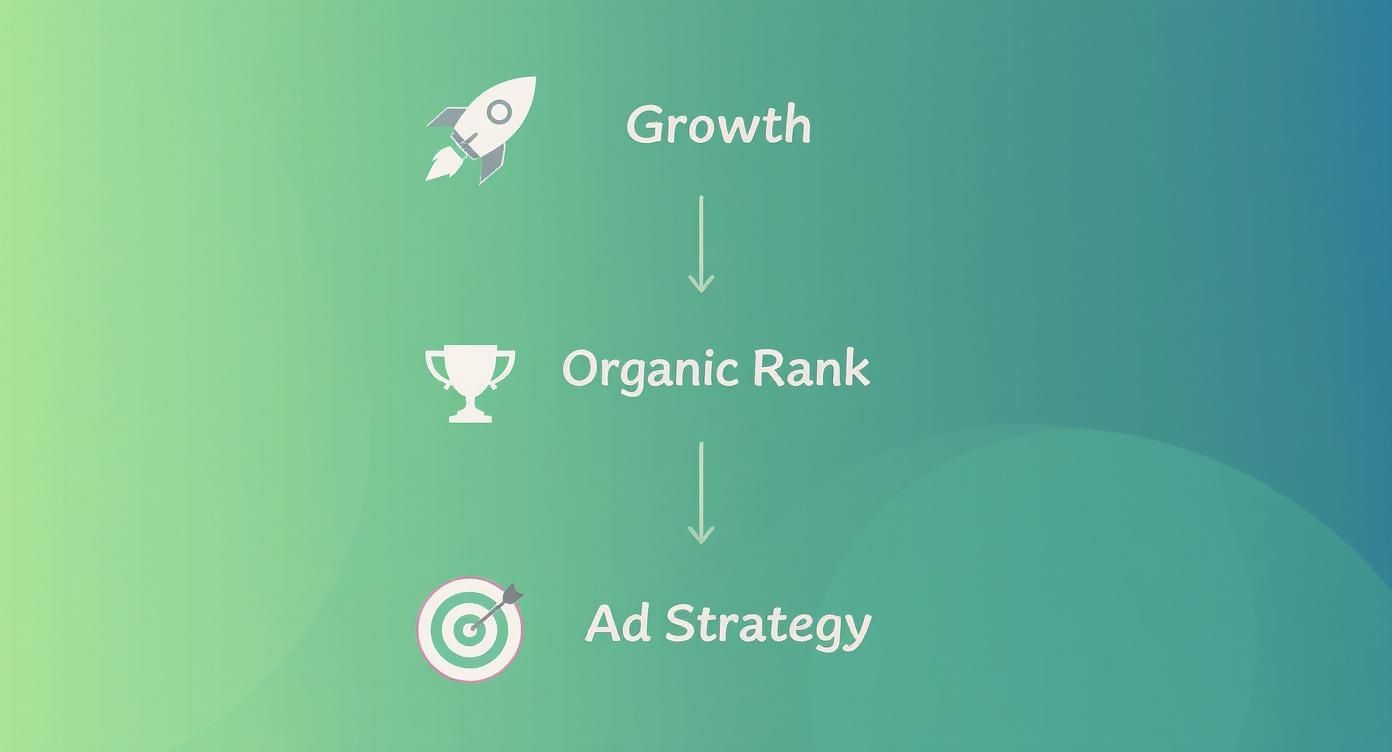
The key insight is that a well-architected ad strategy directly powers the flywheel. Paid ads generate the sales velocity required to climb organic rankings, which in turn reduces your long-term dependency on paid media.
Granularity and the Match Type Waterfall
Within these strategic campaigns, we implement a "match type waterfall"—a system for systematically discovering new keywords and optimizing proven performers. It works by creating separate campaigns for the same keyword sets, segmented by match type to control spend and data flow.
- Auto & Broad Match Campaigns (The Discovery Engine): These are your research and development campaigns. They cast a wide net to let Amazon's algorithm find new, relevant customer search terms. Their sole job is to mine for high-converting queries at a low cost.
- Phrase Match Campaigns (The Testing Ground): When a search term shows promise in discovery campaigns, it's "graduated" to a Phrase Match campaign. This provides more control while still allowing for some variation.
- Exact Match Campaigns (The Profit Drivers): This is the destination for your proven, highest-converting keywords. Here, you can bid aggressively and allocate significant budget because you have data-backed confidence in their ability to drive profitable sales.
The Takeaway: This tiered structure creates a perpetual motion machine, constantly feeding your high-performance exact match campaigns with new, data-validated keywords. The critical step: when you graduate a keyword, add it as a negative exact match in the discovery campaigns to prevent bid cannibalization and ensure clean data.
For a deeper dive, our complete guide to https://www.headlinema.com/blog/amazon-ppc-campaign-structure offers detailed implementation playbooks. This methodical approach transforms your ad account from a chaotic expense into a predictable, scalable growth machine.
Mastering Advanced Keyword and Audience Targeting
A solid account structure is the foundation, but a winning Amazon ads strategy is executed by reaching the right customer at the right moment. This requires moving from broad assumptions to data-driven precision, ensuring every ad dollar is aimed at high-intent buyers.
This isn't a minor tweak; it's a fundamental shift in targeting philosophy. Your Search Query Reports (SQRs) must become more than a source for negative keywords—they are a direct line to your customer's vocabulary. Simultaneously, you must look beyond the search results page to engage shoppers throughout their entire journey using Amazon's powerful audience tools.
Uncovering High-Intent Keywords Competitors Miss
Effective keyword research is about uncovering the specific, long-tail phrases that signal purchase intent. These are often the lower-competition terms your rivals have overlooked.
Your own data is the most valuable starting point. The Search Query Performance dashboard in Brand Analytics is a goldmine, revealing the exact terms shoppers use to find you, along with impression, click, and conversion data for each.
To gain a competitive edge, deploy these advanced techniques:
- Reverse ASIN Lookups: Analyze which keywords your top competitors are ranking for, both organically and via paid ads. This espionage tactic consistently reveals profitable opportunities.
- "Mispelling" & "Synonym" Mining: Intentionally targeting common misspellings or alternative product names can be highly profitable. Search volume is lower, but competition and CPCs are often negligible.
- Problem/Solution-Based Queries: Think about the problem your product solves. A customer with a sore neck doesn't search for an "ergonomic memory foam pillow"; they search for "neck pain relief while sleeping."
Turning Search Query Reports into a Growth Engine
Most sellers use their Search Query Reports defensively to find irrelevant terms to negate. That’s table stakes. The real power is using the SQR offensively to identify new growth opportunities.
Establish a regular cadence for analyzing SQR data from your automatic and broad match campaigns. You are hunting for customer search terms that are converting profitably but are not yet in your exact match campaigns. This is the core of the "keyword graduation" process—finding what works in a low-cost discovery environment and scaling it in a high-performance campaign.
The Takeaway: View your SQR not as a report card, but as a roadmap. It's Amazon providing a direct, unfiltered look into the language of your customers. Ignoring these insights is willingly leaving money on the table.
With CPCs having risen over 50% in the last two years in some categories, finding these unique, high-intent keywords from your own data is one of the most effective ways to sidestep bidding wars and maintain profitability. You can learn more about the rising costs of Amazon advertising from Luzern.co.
Expanding Beyond Keywords with Audience Targeting
While Sponsored Products ads are keyword-driven, a complete Amazon ads strategy must include audience-based targeting via Sponsored Display and the Amazon DSP. This is how you transition from capturing existing demand to actively creating it.
Leverage Amazon's first-party data to build these powerful audience segments:
- Remarketing: Target shoppers who viewed your product detail page but did not purchase. This is a high-ROI tactic for re-engaging interested buyers.
- In-Market Audiences: Reach shoppers whose recent browsing and purchase history indicate they are actively researching products in your category.
- Lifestyle Audiences: Connect with users based on their broader interests and hobbies, such as "fitness enthusiasts" or "eco-friendly shoppers," to build brand affinity.
- Lookalike Audiences: Provide Amazon with your existing customer data, and it will build an audience of new shoppers with similar behavioral traits—a game-changer for scalable customer acquisition.
By combining precise keyword targeting with sophisticated audience targeting, you build a true full-funnel strategy that connects with customers at every stage of their journey, driving both immediate sales and long-term brand equity.
A Data-Driven Framework for Bids and Budgets
If account structure is the chassis, your bidding and budget strategy is the engine. This is where your Amazon ads strategy becomes operational. The common mistake is an obsession with maintaining a low ACOS, which often starves top-performing campaigns and suffocates the organic sales lift they could generate.
A performance-first approach ties every bid and budget decision to a specific business objective. The goal isn’t to spend less; it's to invest every dollar with purpose and a clear expectation of return. This requires moving beyond default settings and taking explicit control over capital allocation.
Choosing the Right Bidding Strategy for the Job
Amazon's bidding strategies are tools, and using the right one for the job is critical. Applying a one-size-fits-all approach will either waste budget on low-converting clicks or miss out on profitable sales. The choice must align with the campaign's strategic objective.
A practical guide to bidding strategy selection:
Dynamic Bids (Down Only): The safest default. Amazon will lower your bid if a click is less likely to convert. Use this for evergreen brand defense and established category campaigns where the goal is steady, efficient performance.
Dynamic Bids (Up and Down): Signals to Amazon that it can increase your bid (by up to 100%) for placements with a higher likelihood of conversion. This is the go-to for aggressive initiatives like a product launch or a Prime Day offensive where maximum visibility is paramount.
Fixed Bids: You retain full control; Amazon will not adjust your bid. This is a surgical tool for specific scenarios, such as targeting a top competitor’s primary ASIN where you must ensure your ad appears consistently.
The Takeaway: Your bidding strategy is not static. A product launch might start with an aggressive "Up and Down" strategy to maximize initial velocity and then shift to a more conservative "Down Only" approach to focus on profitability once organic rank is established.
Implementing a Profit-Focused Budgeting Model
With bidding strategies aligned to goals, you need a disciplined budget allocation model. Instead of spreading budget thinly across all campaigns, a profit-first mindset demands funding proven winners first. This "waterfall" method is ruthlessly effective.
Think of it as filling a series of buckets in order of importance:
Fund Your Brand Defense First: Your highest-converting, lowest-ACOS campaigns are almost always those targeting your own brand terms. Fully fund these campaigns to run 24/7. This is non-negotiable territory protection.
Allocate to Exact Match "Profit Drivers": Next, direct budget to your top-performing, exact-match non-brand campaigns. These are the workhorses that consistently drive profitable new customer acquisition.
Invest in Phrase & Broad "Discovery": The remaining budget is allocated to broader match and automatic campaigns. The objective here is not immediate profit but data mining—finding new search terms to graduate into your profit-driver campaigns.
This waterfall model ensures your most profitable campaigns are never budget-constrained, maximizing your overall return on ad spend (ROAS). For more detail, our guide on how to bid on Amazon breaks down advanced frameworks.
Going Beyond Search: How to Use Amazon DSP and AMC for Real Growth
When you're ready to scale beyond the search bar, Amazon's enterprise-level tools—Amazon DSP (Demand-Side Platform) and Amazon Marketing Cloud (AMC)—are the next frontier. While Sponsored Ads are crucial for capturing existing demand, DSP and AMC are how you create new demand and gain a holistic understanding of your marketing's total impact.
Think of it this way: Sponsored Products is like fishing in a well-stocked pond. The DSP allows you to fish in every ocean, targeting audiences across Amazon-owned properties like Prime Video and Twitch, as well as thousands of third-party websites and apps. This is the shift from targeting keywords to targeting people.
Reaching the Entire Funnel with Amazon DSP
The DSP unlocks the ability to engage shoppers at every stage of the journey. You can build hyper-specific audiences using Amazon's vast first-party purchase and browsing data, allowing your Amazon ads strategy to become far more sophisticated.
You can now execute initiatives like:
- Build Brand Awareness: Run video ads on Fire TV to introduce your brand to new audiences before they even begin their search.
- Drive Consideration: Retarget shoppers who viewed your product but didn't buy, reminding them of your value proposition as they browse other sites.
- Foster Loyalty: Re-engage past purchasers with new product launches or complementary offers to increase lifetime value.
At this level, creating compelling ecommerce video ads becomes a critical skill for telling your brand story and connecting with shoppers emotionally, long before a transactional search occurs.
Finally Measuring What Matters with Amazon Marketing Cloud
If DSP provides the reach, Amazon Marketing Cloud (AMC) delivers the clarity. AMC is a secure, privacy-safe data "clean room" where you can analyze performance across all your channels—DSP, Sponsored Ads, and even your own first-party data—in one unified environment. It finally allows you to answer the complex attribution questions that standard reports can't.
The Takeaway: With AMC, you can finally connect the dots and measure path-to-purchase. You can see how a shopper viewing your display ad on a third-party site, then seeing a video ad on Prime Video, ultimately leads them to search for and buy your product a week later. It moves you from simplistic last-click attribution to a true understanding of the customer journey.
This is where your strategy becomes genuinely data-driven. AMC allows you to measure the "halo effect"—how your brand-building DSP ads lift your search-driven sales. It provides the proof needed to justify upper-funnel investments by showing their direct impact on the bottom line. Our guide on leveraging Amazon DSP provides a deeper operational look.
This combination of massive reach and deep measurement is why Amazon's ad business is projected to exceed $50 billion in 2024, according to Amazon's growing ad revenue at eMarketer. For enterprise brands, leveraging DSP and AMC is no longer optional; it's essential for building sustainable, long-term dominance.
Building a Full-Funnel Optimization Loop
An elite Amazon ad strategy is not a static plan; it’s a dynamic system. The best strategies operate in a perpetual cycle of measurement, analysis, and optimization, ensuring you stay ahead of the competition and market shifts. This is where all the components we've discussed converge into a powerful engine for profitable growth.
First, performance measurement must mature beyond ACOS. To understand the true business impact of your ad spend, you must be guided by Total ACOS (TACOS). This metric reveals how advertising lifts your entire business—both paid and organic sales—providing a clear, honest view of your investment's efficiency in driving total growth.
Driving Gains Through Constant Experimentation
Data-driven experimentation is the core of a high-performance optimization loop. You should constantly be running disciplined A/B tests to achieve incremental gains across every touchpoint. This process removes guesswork and forces decisions based on customer behavior, not assumptions.
Build a testing roadmap that isolates one variable at a time for clean, interpretable results. High-impact areas to test include:
- Main Images: Does a lifestyle shot outperform a product-on-white image in click-through rate (CTR)? Test different angles, infographics, or videos.
- Product Titles: Does moving a key benefit or high-volume keyword to the front of the title improve visibility and clicks?
- A+ Content: Experiment with different layouts and modules to identify the combination that most effectively tells your brand story and increases conversion rate (CVR).
The Takeaway: Patience is key. A test must run long enough to gather statistically significant data. One strong sales day is an anomaly, not a winner. Let the numbers—specifically your unit session percentage rate—guide your creative and listing optimization decisions.
Establishing a Rhythm for Performance Reviews
To make this optimization loop effective, it requires a consistent cadence. This isn't about daily micromanagement; it's about a structured schedule for reviewing performance, identifying trends, and making strategic adjustments to stay agile.
With retail media ad revenue projected to approach $70 billion by 2026, the volume of data flowing through Amazon's ecosystem is immense. This creates a rich environment for advertisers to test, learn, and iterate with confidence. You can read more about Amazon's growing ad revenue at eMarketer.
Your review framework should be a recurring cycle:
- Measure: On a weekly basis, pull performance data, focusing on core KPIs like TACOS, organic rank changes, and new-to-brand customer growth.
- Analyze: Benchmark current performance against goals and historical data. Dig into the "why." Did a competitor's price change impact your CVR? Did a new main image cause a dip in CTR?
- Optimize: Take decisive action based on your analysis. Adjust bids, reallocate budgets from underperformers to winners, and pause ineffective strategies.
- Repeat: This cycle is perpetual. Every optimization generates new data, which fuels the next round of analysis and keeps the flywheel of improvement spinning.
This relentless commitment to optimization separates market leaders from the pack. It transforms your Amazon advertising from a reactive tactic into a proactive, data-driven system for building a profitable and defensible brand.
Your Burning Questions About Amazon Ads Strategy, Answered
Even the most sophisticated eCommerce leaders have pressing questions about their Amazon ads strategy. The platform is in constant flux, and yesterday's winning playbook may be obsolete today. Let's tackle the most common questions we hear from senior brand leaders.
How Much Should I Spend on Amazon Ads?
There is no magic percentage. While a mature brand often targets a Total ACOS (TACOS) between 8% and 15%, a top-down budget is the wrong approach. The right question is, "What is the business objective?"
For a new product launch, you must be prepared to accept a high ACOS—potentially operating at a loss on ad spend for the first 90 days—to generate the sales velocity required to secure organic ranking. Conversely, for a mature cash-cow product, the goal is maximum profitability, demanding a much lower ACOS. Your budget must be a direct reflection of the strategic goal for that specific product or category.
When Should I Use Sponsored Display or DSP Instead of Sponsored Products?
Sponsored Products are your primary tool for capturing existing, bottom-of-funnel demand. You use them to appear when a customer is actively searching for a product like yours. You layer in Sponsored Display and the Amazon DSP when your objective expands from capturing demand to creating it.
It's time to deploy these tools when you need to:
- Re-engage lost sales: Retarget shoppers who viewed your product but did not purchase.
- Build brand equity: Reach new, relevant audiences across the web before they even begin their Amazon search.
- Increase customer lifetime value: Cross-sell and upsell complementary products to your existing customer base.
How Long Does It Take to See Results From a New Ad Strategy?
Initial performance data will appear within days, but a new Amazon ads strategy requires at least 30-60 days to validate. The A9 algorithm needs time to learn, and you need sufficient data to make statistically significant optimization decisions.
The most critical outcome—improved organic ranking—is a lagging indicator. While ad-driven sales may increase in the first month, the ultimate prize of a sustainable lift in organic sales can take a full quarter to materialize as your product builds authority. Patience is a strategic advantage.
The Takeaway: Your advertising performance is a direct input into Amazon's organic ranking algorithm. Every ad-driven sale validates your product's relevance for a given keyword, which is the mechanism for building long-term organic visibility and reducing your reliance on paid traffic.
Ready to build an Amazon ads strategy that drives profitability and sustainable growth? The experts at Headline Marketing Agency use data-driven frameworks to help brands dominate their categories. Book a consultation with us today.
Get Your Free Amazon PPC Audit
Discover untapped growth opportunities and see how our data-driven approach can improve your ROAS.
Get Free Audit →Wollen Sie Ihre Amazon PPC-Performance aufs nächste Level bringen?
Lassen Sie Ihre Amazon PPC-Kampagnen professionell analysieren und entdecken Sie neue Wachstumsmöglichkeiten.