How to Control Your Amazon Advertising Cost & Drive Profit
Amazon ad cost control are rising — but so are the opportunities. Here's how we help brands spend smarter, not just less.

Let's get one thing straight: your Amazon advertising cost isn't a bill you pay. It's a strategic lever you pull to drive organic growth, profitability, and sustainable scale.
While the average cost-per-click (CPC) on Amazon hovers around $0.97, getting hung up on industry averages is a rookie mistake. The real question isn’t "What's a cheap click?" but "Which clicks generate the most profitable growth?"
Reframe Your Cost From an Expense to an Investment
Viewing ad spend as a line-item expense is the fastest way to stifle your brand's potential. Every dollar should be a calculated investment toward a specific business outcome—whether that's launching a new product, defending market share, or boosting organic rank.
A performance-first mindset means you’d rather pay a $2.50 CPC that generates a $100 sale than a $0.50 CPC that leads nowhere. Your ad budget isn't a necessary evil; it's your primary tool for manufacturing growth on the world's largest marketplace.
The True Purpose of Amazon Ads: Fueling the Flywheel
Smart Amazon advertising isn't just about direct-response sales. It’s the catalyst for the entire Amazon flywheel. A successful ad campaign doesn't just generate ad revenue; it drives sales velocity, which in turn boosts your organic ranking. Higher organic rank leads to more organic sales, creating a self-sustaining growth loop.
A strategic ad spend becomes an engine that:
- Boosts Organic Ranking: Increased sales velocity signals to Amazon's A9 algorithm that your product is a winner. This directly improves your organic search placement, generating "free" sales long after the initial click.
- Builds Defensible Brand Equity: Sponsored Brands and Amazon DSP campaigns build brand recognition and audience loyalty, creating a moat around your business that competitors can't easily cross.
- Defends Your Market Share: In a crowded niche, a consistent ad presence is non-negotiable. It's your defense against competitors bidding on your brand terms and poaching high-intent customers.
Your true advertising cost is tied to what it takes to acquire a new customer. A Customer Acquisition Cost calculator can provide clarity, but the real goal is to turn that cost into a profitable, long-term asset.
Key Takeaway: Stop asking, "How much does Amazon advertising cost?" and start asking, "How can I invest my ad budget to achieve the best possible Total Return on Ad Spend?" This shift is the foundation of a sophisticated Amazon strategy.
Benchmarking Your Initial Spend
So, where do you start? While industry averages are a guide, not a rule, they provide a baseline. A $2.00 CPC that lands a $50 sale is a massive win compared to a $0.50 CPC that never converts. This is precisely why your Return on Ad Spend (ROAS) and, more importantly, your Total Advertising Cost of Sales (TACoS) are the metrics that truly matter.
Here's a strategic breakdown of how ad spend and focus should evolve.
Quick Guide to Amazon Ad Spend by Seller Size
This table provides a snapshot of typical monthly advertising budgets and the primary focus for sellers at different stages of growth, shifting from basic visibility to strategic market dominance.
| Seller Stage | Typical Monthly Budget | Primary Goal |
|---|---|---|
| New Seller | $500 - $1,500 | Data acquisition and proving conversion |
| Growth Stage | $1,500 - $10,000 | Scaling profitable keywords and boosting organic rank |
| Established Brand | $10,000 - $20,000+ | Market dominance, brand defense, and audience building |
This table is a starting point. A brand with high-margin products in a competitive niche might invest far more. Your budget must be tied to your specific goals and unit economics.
This guide will walk you through the key factors that shape your real Amazon advertising cost, helping you build a profit-driven strategy that scales.
Understanding Amazon's Ad Types and Pricing Models
Mastering your Amazon advertising cost requires knowing which tool to use for which job. Amazon’s ad types have different pricing models and strategic purposes. Using them interchangeably is a surefire way to burn cash. Success comes from aligning the ad type with a clear business objective.
Are you driving an immediate sale for a specific product? Or are you building a long-term audience? The answer dictates your strategy.
This infographic breaks down how the real cost of your ads is a balancing act between what you pay for clicks, the sales those clicks bring in, and the profit you actually pocket.
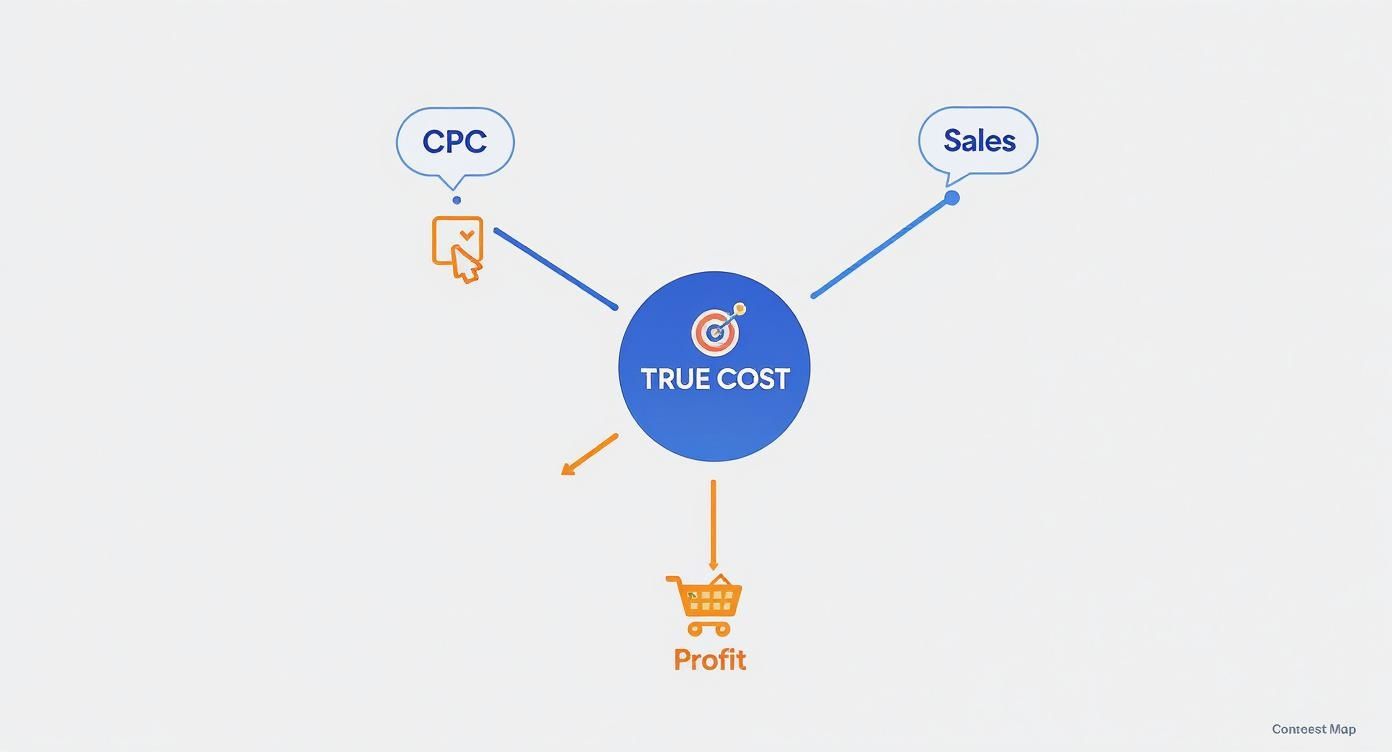
Fixating on CPC alone is a mistake. The true cost is the dynamic relationship between spend, revenue, and profit.
Sponsored Products: The Workhorse of Sales
Sponsored Products are the ads you see within search results and on product detail pages. Their pricing model is pure performance: Cost-Per-Click (CPC). You only pay when a shopper clicks.
A CPC ad is a direct investment in a high-intent shopper. They've already told you what they want by typing it into the search bar. Your job is to close the deal. This direct link to purchase intent makes Sponsored Products your go-to tool for driving immediate sales and powering the Amazon flywheel.
Use them for:
- Driving immediate sales velocity for core products.
- Launching new products to gain initial traction and reviews.
- Defending your brand by bidding on your own branded keywords to box out competitors.
Because these ads are tied so directly to sales, optimizing your CPC bids and keyword targeting is the single biggest lever for managing your day-to-day Amazon ad costs.
Sponsored Brands: Building Your Brand Story
Sponsored Brands also operate on a CPC model but serve a broader strategic purpose. These are the banner ads at the top of search results, featuring your logo, a headline, and multiple products.
While they drive sales, their primary function is to build brand awareness and increase your share of voice on the digital shelf. A Sponsored Brand ad isn't just selling a product; it’s selling your brand's solution. For example, a shopper searching for "organic baby lotion" might see a banner from The Honest Company featuring three related products, instantly establishing brand authority and cross-selling the regimen.
Key Insight: Use Sponsored Brands to move beyond single-product transactions. They empower you to shape brand perception, introduce shoppers to your broader catalog, and build the recall that turns one-time buyers into loyal customers.
This makes them essential for growing brands aiming to establish a foothold against larger incumbents.
Amazon DSP: Reaching Beyond the Search Bar
Amazon DSP (Demand-Side Platform) is a different league. It allows you to programmatically buy display and video ad placements on and off Amazon. The primary pricing model is Cost-Per-Mille (CPM), meaning you pay a flat rate per 1,000 ad impressions.
Think of CPM as renting a digital billboard on a high-traffic internet highway. The goal is upper-funnel awareness and audience engagement, not immediate clicks.
Amazon DSP’s power is its sophisticated audience targeting. You can reach shoppers based on their past purchase behavior, browsing history, and lifestyle interests, even when they're on other websites or apps. This is incredibly effective for:
- Retargeting shoppers who viewed your product but didn't purchase.
- Prospecting for new customers by targeting audiences who have viewed competitor products.
- Building loyalty by serving ads to your existing customer base to drive repeat purchases.
While DSP's impact on immediate sales is less direct, it’s the engine for long-term, sustainable growth. It fills the top of your funnel, ensuring a steady stream of new customers discovers your brand. A balanced strategy uses all three ad types in concert to guide shoppers from awareness to consideration to purchase.
The Levers You Can Pull to Control Your Ad Spend
Your Amazon advertising cost isn't a fixed number; it's the output of your daily strategic decisions. Proactive brands don't just react to high spend—they pull the right levers to control costs, protect margins, and fund growth.
In an ecosystem where Amazon’s global ad revenue exceeds $47 billion, and you’re competing with over 300,000 sellers earning $100,000+ annually, passivity is not an option. You must master the mechanics of bidding and targeting.
Master Your Bidding Strategies
Your bid is the most direct lever for controlling CPC. Amazon’s dynamic bidding options automatically adjust your bids based on conversion likelihood. Your choice should align directly with your campaign's objective.
You have three main options:
Fixed Bids: You set the bid, and Amazon won't change it. This offers maximum control but requires constant manual oversight to remain competitive. Best for highly stable, predictable campaigns where you have extensive performance data.
Dynamic Bids (Down Only): This is your budget-protection strategy. Amazon will lower your bid if a conversion is unlikely but will never exceed your maximum. Ideal for mature campaigns where the primary goal is maximizing profitability and eliminating wasted spend.
Dynamic Bids (Up and Down): This is the aggressive growth strategy. Amazon can increase your bid (by up to 100% for top-of-search) based on high conversion probability. Use this for new product launches or when targeting high-value competitor keywords where visibility is paramount.
The Takeaway: Bidding strategies are not "set and forget." Make a deliberate choice. Use 'Down Only' to protect profitability on core products and strategically deploy 'Up and Down' to invest aggressively in launches or market-share grabs.
How to Outsmart the Competition
Your competition is the biggest external factor driving up your costs. More bidders on the same keywords mean higher CPCs for everyone. Simply outspending the competition on broad keywords is a race to the bottom that will destroy your margins.
Instead of brute force, use strategic finesse:
Target Long-Tail Keywords: Instead of a high-cost term like "running shoes," target "men's trail running shoes for wide feet." These longer phrases have lower search volume but are used by shoppers with extremely high purchase intent, leading to lower CPCs and higher conversion rates.
Make Your Product Page a Conversion Machine: Your ad only earns the click; your product detail page earns the sale. A listing with high-quality images, compelling A+ Content, and strong social proof (reviews) will have a higher conversion rate. A higher conversion rate means you can afford to bid more aggressively and still remain profitable.
Use Product and Category Targeting: Move beyond keywords. Sponsored Products and Sponsored Display ads allow you to target specific competitor ASINs or entire product categories. This lets you place your ad directly on a competitor’s listing or in front of shoppers browsing complementary items, often at a lower cost than crowded keyword auctions.
By managing bids strategically and using intelligent targeting, your ad spend transforms from a reactive cost into a proactive tool for profitable growth.
Measuring Success Beyond ACoS
In Amazon advertising, it’s easy to get tunnel vision on one metric: ACoS (Advertising Cost of Sales). It measures how much you spend on ads to generate a dollar in ad-attributed sales.
But here’s the unvarnished truth: chasing a low ACoS can kill your growth. It often means you're playing defense, bidding only on your own brand terms—harvesting sales that were likely coming anyway instead of acquiring new customers and building your brand.
To truly scale, you need a metric that measures the impact of your ads on your entire business. That metric is TACoS (Total Advertising Cost of Sales).
The Power of Total Advertising Cost of Sales
TACoS is your strategic north star. It measures your ad spend against your total sales (ad-generated + organic). This reveals the powerful "flywheel effect"—how your ad investment is lifting your organic sales, improving your overall profitability, and reducing your dependency on paid traffic.
The formulas are simple, but the insight is profound:
- ACoS Formula: (Ad Spend / Ad Sales) x 100
- TACoS Formula: (Ad Spend / Total Sales) x 100
A declining TACoS over time is the ultimate indicator that your advertising is a successful growth investment, not just an expense.
Why a Rising ACoS Can Be a Great Sign
This is counterintuitive for many brand leaders, but a rising ACoS can be a sign of a healthy, aggressive growth strategy. When managed intentionally, it indicates you are investing in new customer acquisition, not just harvesting low-hanging fruit.
Consider this product launch scenario:
- Month 1 (Launch): You invest $5,000 in ads, generating $15,000 in ad sales (33% ACoS). Your total sales reach $20,000, for a TACoS of 25%.
- Month 3 (Scale): The initial push worked. Your sales velocity has improved your organic rank. You double down, increasing ad spend to $8,000 to capture more market share. This drives $20,000 in ad sales, and your ACoS rises to 40%.
- The Critical Insight: But thanks to your improved organic visibility, your total sales have jumped to $40,000. Your TACoS has actually decreased to 20% ($8,000 / $40,000).
You strategically accepted a higher short-term ACoS to build a more profitable and less ad-dependent business in the long term. That is the power of TACoS-driven thinking.
Benchmarking Your ACoS Performance
While TACoS is the strategic metric, ACoS remains a vital tactical indicator of campaign efficiency. On average, ACoS on Amazon hovers between 25% and 36%. That spend is effective, as Amazon’s platform-wide conversion rate is nearly 10%, dwarfing the typical eCommerce average of 1.33%.
Ultimately, a "good" ACoS is entirely dependent on your profit margins. If you have a 40% margin before ad spend, a 25% ACoS is healthy. If your margin is 20%, that same ACoS means you're losing money on every ad-driven sale.
When you shift your focus from ACoS to TACoS, your Amazon advertising cost becomes what it should be: a powerful lever for building a profitable, enduring brand. For a deeper dive, read our guide on how to calculate and use TACoS for your brand.
Actionable Strategies to Optimize Your Ad Spend

Theory without execution is useless. Optimizing your Amazon advertising cost comes down to disciplined, granular campaign management. Real profit is found in the details—cutting waste, doubling down on what works, and aligning your tactics with your overarching business goals.
Structure Campaigns for Granular Control
A disorganized campaign structure is the fastest way to lose money. Lumping all your keywords into a single ad group gives you zero control and zero insight. A proven, sophisticated approach is to segment campaigns by objective and targeting type.
Structure your campaigns with purpose:
- Branded Campaigns: Target your own brand name. This is brand defense. The goal is to own your search results and prevent competitors from siphoning off customers already looking for you.
- Generic Campaigns: Target non-branded, category-defining keywords (e.g., "bamboo cutting board"). This is your primary engine for new customer acquisition.
- Competitor Campaigns: Target the brand names and specific ASINs of your direct competitors. This is an offensive strategy to capture market share from shoppers who are actively comparison shopping.
This segmentation allows for precise budget and bid control. You can allocate a larger portion of your budget to acquisition (Generic/Competitor) while running a highly efficient, low-cost defense on your Branded terms.
Eliminate Wasted Spend with Negative Keywords
Paying for irrelevant clicks is a silent profit killer. Every time your ad shows for a search term that will never convert, you waste money and pollute your performance data. Negative keywords are your most powerful tool to prevent this.
By adding a term as a negative keyword, you instruct Amazon not to show your ad for that search query. For example, a seller of premium leather wallets should add "cheap," "fabric," and "vegan" as negative keywords to filter out unqualified shoppers.
Pro Tip: Make reviewing your Search Term Report a non-negotiable weekly task. Identify irrelevant, money-wasting search queries and add them to your negative keyword lists. This single discipline can dramatically improve your ACoS and overall profitability.
Mastering using Amazon negative keywords is not optional for any serious seller.
Align Ad Strategy with Your Product Lifecycle
Your ad strategy for a new product launch should be fundamentally different from that of a mature, best-selling product. Each stage of the product lifecycle requires a different approach, budget, and goal.
A simple lifecycle framework:
- Launch Phase: The goal is sales velocity and data acquisition, not immediate profitability. Use aggressive "up and down" bidding on a broad set of relevant keywords. A higher ACoS is expected and is an investment in building initial rank and reviews.
- Growth Phase: With initial data and sales history, shift focus to optimization and efficiency. Prune underperforming keywords, refine bids, and use placement modifiers to dominate top-of-search. ACoS should begin to decline as organic rank improves.
- Maturity Phase: The focus now is profitability and defense. Shift to more conservative "down only" bidding to protect margins. Reinvest profits into Sponsored Display and DSP to build audiences and drive repeat purchases.
This lifecycle-aware approach ensures you invest aggressively when needed and harvest profits when the time is right, turning your ad spend into a precision tool for sustainable growth.
Your Framework for Profitable Ad Budgeting
The most critical mental shift is to stop treating your Amazon advertising cost as an expense and start managing it as a growth investment. A profitable budget isn't a random number; it's a strategic figure derived by working backward from your profit margins and business objectives.
Your target ACoS, for example, must be rooted in your product's profitability and its stage in the lifecycle. To see how this fits into your broader marketing efforts, you can explore smart digital marketing budget allocation strategies.
The Headline Takeaway: Don’t ask what your ad budget should be. Determine what your advertising needs to achieve. Calculate your profit per unit, set a clear growth objective, and then fund that objective accordingly.
Executing this on a platform as complex as Amazon requires deep expertise. To better understand the key performance indicators that matter, learn how to calculate your return on ad spend.
Your Top Questions About Amazon Ad Costs, Answered
Let's tackle the most common questions from e-commerce leaders trying to master their Amazon advertising cost.
How Much Should a New Seller Actually Spend on Ads?
Forget arbitrary numbers. A smart starting point is to budget 10% of your target revenue for advertising. If your goal is $5,000 in monthly sales, your initial ad budget should be $500.
Use this initial budget exclusively for Sponsored Products campaigns targeting your most relevant, high-intent keywords. The goal for the first 1-3 months is not profit; it is data acquisition. You are paying to learn your true CPCs, discover which keywords convert, and feed the Amazon algorithm its first taste of your sales velocity. This data is the foundation of your future profitability.
Is a High ACoS Always a Bad Thing?
Absolutely not. A high ACoS is only a problem when it's unintentional and unprofitable. Strategically, a high ACoS is a powerful weapon.
During a product launch, you might intentionally run at a high ACoS to rapidly generate sales and reviews. This initial velocity is a direct investment in your future organic rank. You accept a short-term loss for a long-term, profitable gain.
The ultimate arbiter is Total ACoS (TACoS). If your high-ACoS campaigns are successfully lifting your total sales and your TACoS is stable or declining, your strategy is working. Context is everything.
Similarly, entering a highly competitive category may require accepting a higher ACoS as the cost of entry to gain a foothold.
How Long Until I See Real Results from My Ads?
You will see impression and click data within hours. But meaningful, profitable results require patience and a phased approach.
- Phase 1: Data Collection (Weeks 1-4): Launch campaigns and gather performance data. The goal is learning, not earning. Do not make drastic changes.
- Phase 2: Optimization (Months 2-3): Act on the data. Cut non-converting keywords, adjust bids based on performance, and shift budget to proven winners.
- Phase 3: Scaling (Month 3+): With an optimized foundation, you can now confidently increase budgets on profitable campaigns to scale your growth.
For actively managed campaigns, you should expect to see consistent, profitable returns within 90 days. Anything less is an anomaly, not a strategy.
Making sense of Amazon advertising is about more than just setting a budget; it’s about building a data-driven strategy. At Headline Marketing Agency, we help brands turn their ad spend into a reliable engine for growth. Discover how our expert team can help you scale on Amazon.
Get Your Free Amazon PPC Audit
Discover untapped growth opportunities and see how our data-driven approach can improve your ROAS.
Get Free Audit →Wollen Sie Ihre Amazon PPC-Performance aufs nächste Level bringen?
Lassen Sie Ihre Amazon PPC-Kampagnen professionell analysieren und entdecken Sie neue Wachstumsmöglichkeiten.