How to Build Amazon Ads Campaigns That Fuel Organic Growth and Profitability
A profitable Amazon build Amazon Ads Campaigns That starts with smart structure. Our blueprint has been refined across 5,000+ ASIN optimizations.

Winning Amazon ads campaigns aren't born from guesswork or a "set it and forget it" mindset. They're built on a performance-first strategy that connects every dollar spent to tangible business outcomes.
This requires a fundamental shift in thinking: view PPC not just as a sales channel, but as a strategic lever to drive organic growth, protect profitability, and build sustainable scale in a hyper-competitive marketplace. The real work begins long before you launch a single campaign.
Laying the Groundwork for High-Growth Campaigns
Too many brands jump straight into keyword selection and bid management. This is a critical error. The campaigns that generate exponential growth are built on two pillars: total retail readiness and clear, phased business objectives. Skipping this foundational work is like pouring capital into a leaky bucket—you'll get clicks, but you won't see the profitable, long-term scale you need.
Conduct an Honest Retail Readiness Audit
Before investing a single dollar in traffic, your product detail pages must be optimized for maximum conversion. Driving traffic to a subpar listing is the fastest way to burn through your budget and signal to Amazon's A9 algorithm that your product isn't relevant. It's time for a no-nonsense audit.
Analyze these critical conversion factors:
- High-Quality Imagery and Video: Your main image must command attention in crowded search results. Support it with a full suite of lifestyle shots, benefit-driven infographics, and a product video. The goal is to visually answer every potential customer question.
- Optimized Copy: Your title, bullets, and description must be keyword-rich for discoverability but also written to sell. Don't list features; articulate the benefits and solve the customer's problem.
- A+ Content: For Brand Registered sellers, A+ Content is non-negotiable. It's your opportunity to tell a brand story, overcome objections, and, according to Amazon, can boost conversion rates by up to 10%.
- Reviews and Ratings: A critical mass of positive social proof is essential before scaling ad spend. A product with fewer than 15 reviews or a rating below 4 stars will struggle to convert paid traffic, crippling your ROI from the start.
Define Your Tiered Business Objectives
Your advertising goals are not static; they must evolve with your product's lifecycle. A singular focus on "lowering ACOS" is a recipe for stagnation. Instead, structure your objectives in distinct phases.
Launch Phase Objectives:
- Goal: Generate initial sales velocity and market awareness.
- Metrics: Clicks, impressions, conversion rate, and initial customer reviews.
- Mindset: ACOS will be high. This is a calculated investment in data acquisition and "priming the pump" for the Amazon flywheel. Profitability is not the primary objective.
Growth Phase Objectives:
- Goal: Aggressively scale sales volume and improve organic search rank for high-value keywords.
- Metrics: Ad-driven sales, organic rank progression, and Total ACOS (TACOS).
- Mindset: Balance aggressive growth with improving efficiency. Use ad spend as a strategic tool to capture market share and prove relevance to the algorithm. Our complete Amazon ads strategy guide provides advanced frameworks for this crucial phase.
Profitability Phase Objectives:
- Goal: Defend market position and maximize net profit.
- Metrics: ACOS, TACOS, and return on ad spend (ROAS).
- Mindset: The focus shifts to ruthless efficiency. Optimize top-performing campaigns and systematically eliminate wasted spend.
The Performance-First Takeaway: View your launch-phase ad spend as an investment in the entire Amazon ecosystem. A high ACOS isn't a failure; it's the cost of acquiring invaluable performance data, securing initial visibility, and fueling the future organic sales that will drive long-term profitability.
As you build this foundation, it's crucial to understand how paid and organic channels influence each other. A deep understanding the key differences between PPC and organic search is non-negotiable. When this synergy is achieved, ad spend transcends short-term sales, building lasting brand equity and organic dominance.
How to Structure Campaigns for Maximum Profitability
A disorganized ad account is a direct path to wasted budget and missed opportunities. Your campaign structure is more than an organizational tool; it's the strategic framework for controlling bids, harvesting data, and scaling your Amazon ads campaigns for profit. A messy setup guarantees overlapping targets, corrupted performance data, and an inability to make informed decisions.
The architecture we implement for clients is engineered for clarity, control, and performance. It’s a systematic machine designed to identify winning strategies and then allocate budget with precision. This isn't just about tidiness; it’s about turning ad spend into a predictable engine for both immediate sales and long-term organic rank improvement.
Before diving into tactics, internalize the foundational principles that govern effective campaign architecture.
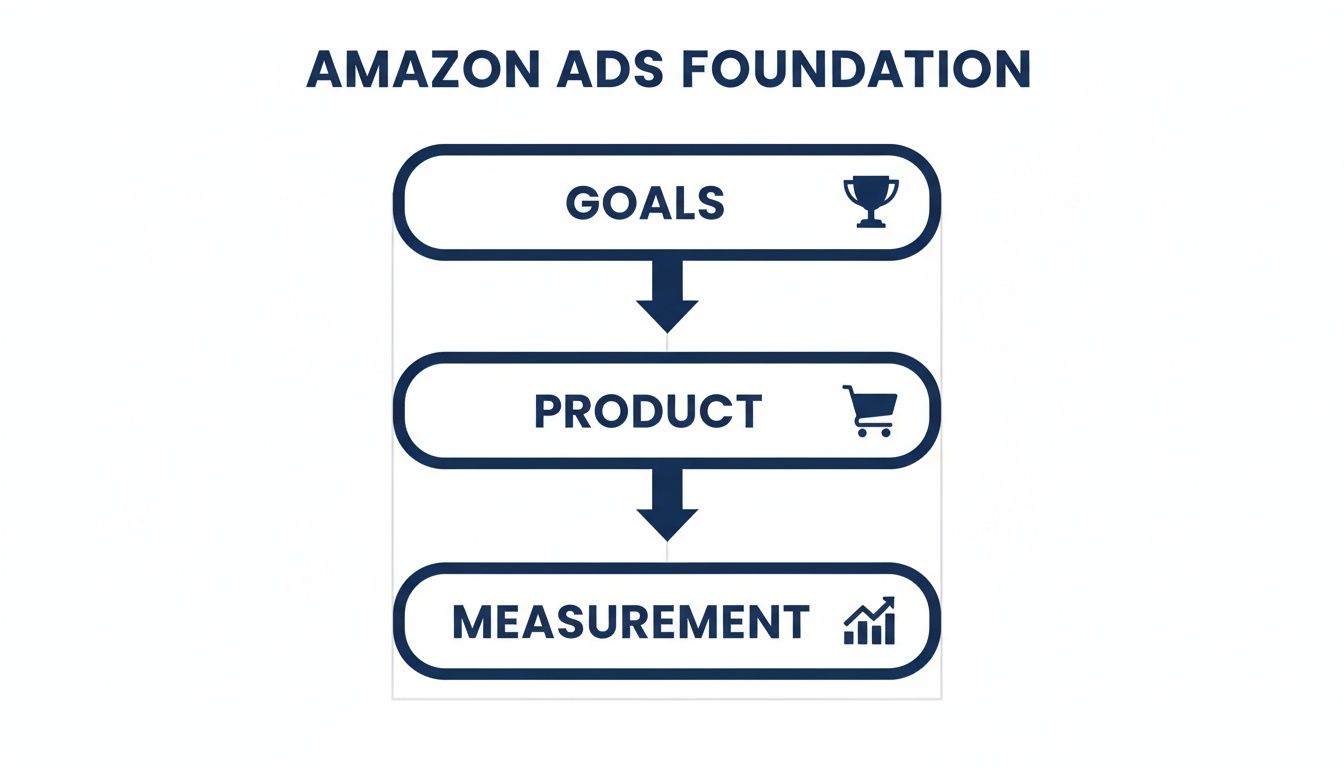
As this illustrates, everything flows from clear goals, a retail-ready product, and robust measurement. Without this foundation, any structure will eventually fail.
The Keyword Harvesting Method
The core of a profitable Sponsored Products strategy is the "keyword harvesting" or "match type segmentation" method. The concept is powerful: isolate campaigns by match type—Auto, Broad, Phrase, and Exact—to create a controlled flow of data and budget.
Think of it as a performance funnel. Wider match types act as a low-cost discovery engine for new, converting customer search terms. Proven terms are then "harvested" and moved into more controlled, higher-bid campaigns.
- Auto Campaigns: Your R&D lab. Let Amazon's algorithm explore and identify relevant search terms. Maintain a modest budget and low bids. The primary goal is data collection, not immediate ROI.
- Broad/Phrase Match Campaigns: Your validation stage. Once a converting search term is identified in Auto campaign reports, move it here. This step validates performance with more focused targeting before committing a significant budget.
- Exact Match Campaigns: Your profit drivers. Only the highest-performing, most relevant keywords from your Phrase campaigns are promoted to Exact Match. Allocate your largest budget share here and bid aggressively to dominate placements for search terms you know convert.
The Performance-First Takeaway: This tiered structure provides surgical control. You can bid aggressively on proven, high-ROI exact match keywords while simultaneously discovering new opportunities in lower-risk auto campaigns. It ensures every dollar is deployed for maximum strategic impact.
Get Granular with Ad Groups and Campaigns
Beyond match type segmentation, profitability demands granularity. A cardinal sin of Amazon advertising is lumping dissimilar products into a single ad group. An ad group should only contain tightly-themed product variations (e.g., different colors of the same T-shirt). This ensures the keywords you bid on are hyper-relevant to every product shown, directly improving click-through rates and your Quality Score.
For distinct product lines, create entirely separate campaign sets (Auto, Broad, Phrase, and Exact for each). This prevents a single bestseller from cannibalizing the budget and provides clean, product-level data for smarter optimization.
This level of control is no longer optional. The average Cost-Per-Click (CPC) on Amazon has reached $1.12, with competitive categories like health climbing to $1.41. Since Sponsored Products comprise 68% of ad revenue, precise budget allocation is critical for survival. To understand the market better, explore the latest Amazon advertising statistics.
Aligning Ad Types with the Customer Journey
Finally, apply this structured approach across all ad formats. Don't operate Sponsored Brands and Sponsored Display in silos. Align each ad type to a specific stage of the marketing funnel to create a cohesive customer experience that drives conversions.
Here’s a blueprint for full-funnel campaign architecture:
Campaign Structure Blueprint by Funnel Stage
| Funnel Stage | Primary Goal | Recommended Ad Types | Targeting Strategy Example |
|---|---|---|---|
| Awareness | Drive discovery & brand recognition | Sponsored Brands, Sponsored Display | Target broad, non-branded category keywords (e.g., "running shoes for women"). |
| Consideration | Engage shoppers actively researching | Sponsored Products, Sponsored Brands | Target specific competitor ASINs or long-tail keywords (e.g., "lightweight trail running shoes"). |
| Purchase | Convert interested shoppers into buyers | Sponsored Products, Sponsored Display | Target your own branded keywords and retarget shoppers who viewed your product but didn't buy. |
| Loyalty | Encourage repeat purchases | Sponsored Display | Retarget past purchasers with ads for complementary products or new arrivals. |
This full-funnel methodology ensures your campaigns work in concert, guiding a shopper from initial discovery to purchase and repeat business.
Getting Your Keyword and Product Targeting Right
Superior targeting separates profitable Amazon ad campaigns from budget-draining ones. It’s not about bidding on the most obvious, high-volume keywords. True performance comes from identifying the precise search terms and product placements that connect you with high-intent shoppers your competitors are overlooking.
Your objective isn't a static keyword list; it's a dynamic targeting ecosystem. This system uses broad, discovery-focused campaigns to continuously feed new, profitable search terms into tightly controlled manual campaigns. It's a self-optimizing flywheel where your ad spend becomes more intelligent over time, fueling both paid and organic growth.
Let Amazon's Data Show You the Way
Many sellers overlook the goldmine of targeting data available directly within Seller Central. Before turning to third-party tools, extract insights from Amazon’s own reports, specifically the Search Query Performance (SQP) report and Brand Analytics.
- Search Query Performance (SQP): This provides an unparalleled view of your brand's performance across all of Amazon search, not just ads. It reveals your impression share, click share, and conversion share for specific queries. Identify high-volume keywords where you have a low ad impression share but a high organic click-through rate. These are prime opportunities to use ads to dominate the entire search results page.
- Brand Analytics: The "Search Terms" report here shows the top keywords driving clicks and conversions market-wide. It's invaluable for spotting emerging trends and "shoulder" keywords—related terms you hadn't considered. A term with high click share but low conversion share across the category often signals an unmet customer need your product can solve.
My Takeaway: Shift from merely looking for keywords to identifying data-driven opportunities. A keyword where your brand ranks high organically but has minimal ad visibility is a clear signal to increase PPC spend, capture existing demand, and build a defensive moat around your organic position.
Going Beyond Keywords with Product Attribute Targeting (PAT)
While keyword targeting is foundational, don't neglect Product Attribute Targeting (PAT). Available in Sponsored Products and Sponsored Display, PAT allows you to place ads with surgical precision on specific product detail pages—competitors', complementary items, or even your own.
Playing Offense and Defense with PAT
Structure your PAT strategy into two distinct categories: offensive and defensive.
1. Playing Offense
This is about aggressive market share capture and intelligent cross-selling.
- Target Competitor ASINs: Place your ads on the detail pages of direct competitors, focusing on those with weaker reviews, higher prices, or stock issues. Your ad appears as a superior alternative at the critical moment of decision.
- Target Complementary Products: Selling a coffee grinder? Target the detail pages of top-selling espresso machines. This captures customers who have a demonstrated need for your product, even if they aren't actively searching for it.
2. Playing Defense
This is about protecting your brand equity and increasing customer lifetime value.
- Target Your Own ASINs: Use ad placements on your own product pages to cross-promote other items in your catalog. This creates a "brand wall" that pushes competitor ads further down the page and keeps shoppers within your ecosystem, boosting average order value.
By blending deep keyword intelligence with strategic product targeting, you build a comprehensive strategy. Your ads aren't just visible; they're positioned to intercept customers at every critical point in their buying journey.
To execute this flawlessly, you must master the fundamentals. Our guide on Amazon PPC keyword research provides the frameworks to build that essential foundation.
Advanced Bidding and Budget Optimization
Your bidding and budget strategy is the engine of your Amazon ads campaigns. A flawed approach means you're either leaving revenue on the table or burning cash. A "set it and forget it" strategy with static bids is a direct path to underperformance. Top-tier brands treat ad spend as a dynamic lever for growth, not a static expense.
This requires moving beyond a reactive obsession with ACOS. Smart optimization is about driving total profitability and using ads to accelerate the entire Amazon flywheel. Let's examine the practical techniques that separate market leaders from the rest.

Choosing the Right Dynamic Bidding Strategy
Amazon offers three core bidding strategies. There is no single "best" option; the optimal choice depends on your campaign's specific goal and maturity.
Dynamic bids - down only: This is the safest setting and our default for new or budget-sensitive campaigns. Amazon will only lower your bid if a click is deemed unlikely to convert, protecting profitability and ensuring strict budget control.
Dynamic bids - up and down: For aggressive growth phases. Amazon can increase your bid by up to 100% for top-of-search placements if a conversion is likely. Use this for product launches or to dominate high-value keywords where visibility is paramount. Be prepared for a corresponding increase in ACOS.
Fixed bids: For maximum manual control. Amazon will not adjust your bids, giving you predictable performance. This is best for experienced advertisers who trust their own optimization cadence and want to eliminate algorithmic variables.
Using Placement Modifiers to Dominate Top-of-Search
Not all ad placements are created equal. An ad at the top of page one search results is exponentially more valuable than one at the bottom. Placement modifiers are your tool to secure this prime real estate.
Within manual campaigns, you can set a percentage bid increase—up to 900%—for two key placements: Top of search and Product pages. For your most critical, high-converting keywords, an aggressive top-of-search modifier is essential for maximizing visibility, sales, and market share.
Pro Tip: Analyze your campaign's placement report. If top-of-search placements show a high conversion rate but a low impression share, it's a clear signal to implement or increase your bid modifier. Don't be timid—a significant boost is often required to see a material impact.
Moving Beyond Basic Budgeting with Dayparting
Does a customer browsing at 2 AM have the same purchase intent as one shopping during their lunch break? Unlikely. Dayparting—scheduling ads to run only during peak conversion hours—is an advanced tactic to eliminate wasted spend on low-intent traffic.
While Amazon's native console lacks hourly scheduling, numerous third-party tools can automate this process. Analyze your hourly sales data in Seller Central to identify your brand's "golden hours." By pausing campaigns during low-conversion periods (e.g., overnight), you conserve budget to bid more aggressively when it counts. This single optimization can significantly improve ROAS.
The goal is to align ad spend with peak shopper intent. Amazon ads already see high conversion rates, averaging 9-11%, because users are on the platform to buy. Smart management capitalizes on this inherent advantage.
Making Smarter Decisions with Amazon Marketing Cloud
For scaled brands, the Amazon Marketing Cloud (AMC) is a transformative analytics tool. It’s a secure data "clean room" that allows you to analyze ad exposure and conversion paths across all Amazon channels, from Sponsored Ads to DSP.
AMC enables you to answer complex attribution questions:
- What is the average number of Sponsored Display ad views before a customer searches our brand term and converts via a Sponsored Products ad?
- Which sequence of ad interactions generates the highest customer lifetime value?
These insights allow you to build attribution models far beyond last-click ACOS, allocating budget based on how different ad types truly work together to drive a sale. This is how you transition advertising from a cost center to a scientifically managed growth engine. To maximize these insights, leveraging advanced A/B and multivariate testing strategies is essential for continuous creative and campaign improvement.
Measuring Success Beyond ACOS
An obsessive focus on Advertising Cost of Sale (ACOS) will stifle your growth on Amazon. Brands that treat ACOS as the ultimate measure of success inevitably make short-sighted decisions that sacrifice long-term market share for temporary efficiency gains. True marketplace dominance requires viewing amazon ads campaigns as a strategic investment that powers the entire flywheel.
Fixating on ACOS is like driving a car while only looking at the speedometer. You know your current speed, but you have no idea if you're heading in the right direction. A holistic performance dashboard must connect ad spend to the overall financial health of your business on the platform.
Shifting Focus to Total ACOS (TACOS)
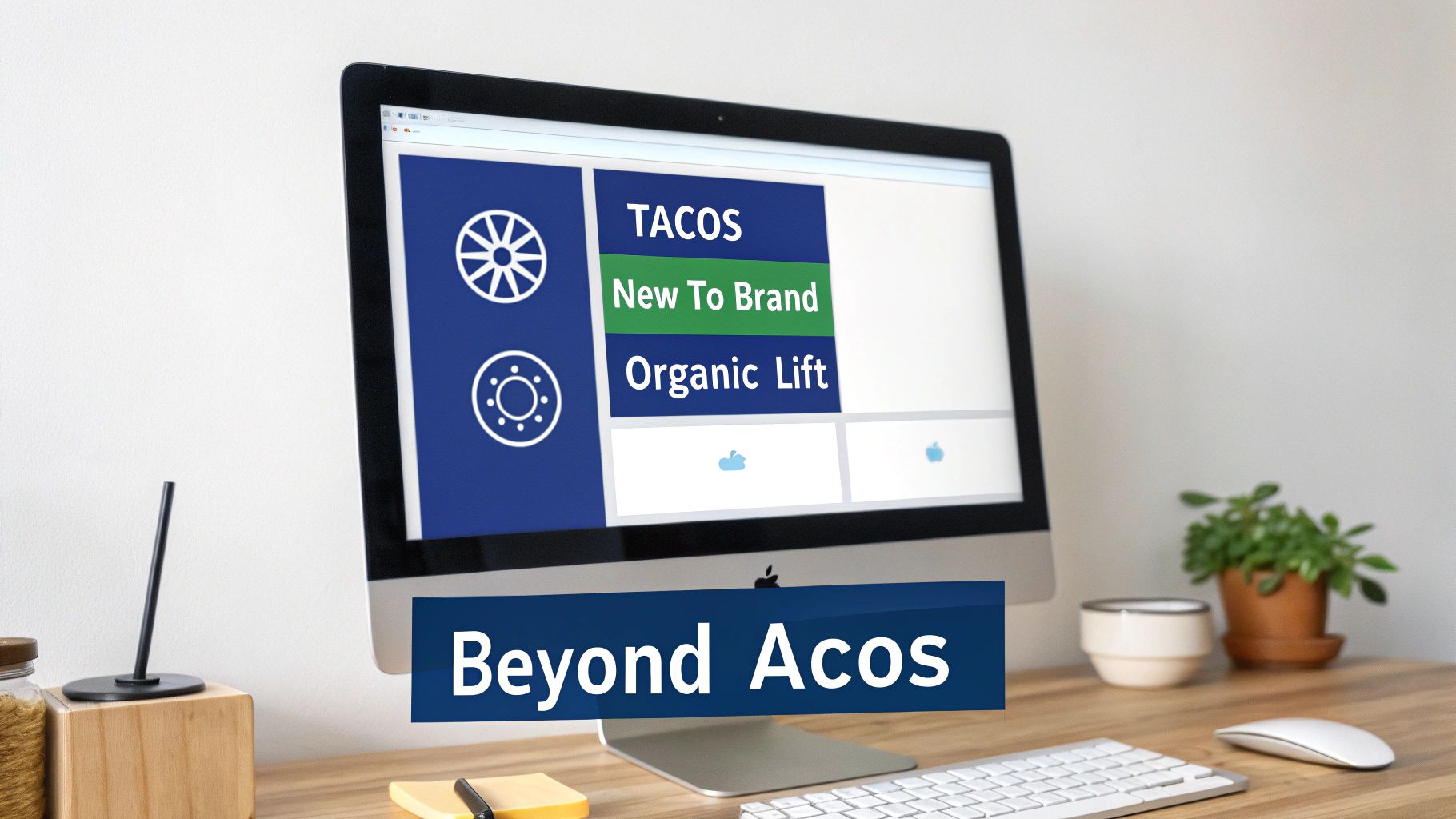
If you track only one North Star metric, make it Total Advertising Cost of Sale (TACOS). This KPI measures your total ad spend against your total sales—both paid and organic.
It answers the most critical strategic question: "Is my advertising investment driving profitable, incremental growth for the entire business?"
The formula:
TACOS = (Total Ad Spend / Total Revenue) x 100
A decreasing TACOS over time is the ultimate indicator of a successful strategy, even if ACOS remains flat or temporarily increases. It is empirical proof that your ad spend is creating a halo effect, lifting organic sales and improving keyword rank. This creates a virtuous cycle where your brand becomes progressively less reliant on paid clicks to generate revenue.
Quantifying Growth with New-to-Brand Metrics
Are your campaigns simply retargeting existing customers, or are they acquiring new ones? Amazon’s New-to-Brand (NTB) metrics provide the answer by tracking orders from customers who have not purchased from your brand in the past 12 months.
A high NTB rate is evidence that your campaigns are successfully driving discovery and expanding your customer base—critical for product launches and market share growth. A campaign might run a high ACOS but be a strategic success if 80% of its sales are from first-time buyers who can be converted into loyal, repeat customers.
Amazon's ad platform revenue recently hit $56.22 billion, a 20% YoY increase, with Sponsored Products accounting for 68% of that total. To effectively leverage this massive audience, you must focus on acquisition, and NTB is your primary measure of success.
Tracking the Impact on Organic Rank
A powerful—and often overlooked—benefit of well-executed ad campaigns is the direct impact on organic search ranking. Every ad-driven sale signals to Amazon's A9 algorithm that your product is relevant for a given keyword. This "sales velocity" is a primary factor in climbing the organic ranks.
Consider a brand that accepts a 40% ACOS for one month on a new product. On a simple P&L, it looks unprofitable. But if that investment vaults the product from page five to a top-three organic position for a primary keyword, the long-term value of that organic real estate will far outweigh the initial ad cost.
This is a measurable effect. Track your organic rank for key terms before, during, and after an aggressive ad campaign. Use tools within Seller Central or third-party software to correlate changes in your Best Seller Rank (BSR) and keyword positions with your ad spend. This provides tangible proof that your advertising is spinning the flywheel. For a deeper analysis, our guide on how to measure advertising effectiveness offers a holistic framework.
The Headline Takeaway: Stop managing campaigns to an ACOS target; start managing them to a growth target. A temporary ACOS spike is often a necessary investment to capture market share, boost organic rank, and acquire new customers. Build a custom dashboard that prioritizes TACOS, New-to-Brand sales, and organic rank changes to see the complete, profitable picture of your advertising performance.
Your Top Amazon Ads Questions, Answered
We’ve covered the strategic frameworks for building and measuring high-performance Amazon campaigns. Now, let’s address the most common tactical questions we hear from brands. Here are the no-nonsense answers you need to make smarter, data-driven decisions.
How Long Until My Amazon Ads Actually Make Money?
The honest answer: for a new product, plan for your ads to be unprofitable on a simple ACOS basis for the first 30 to 90 days.
This is often a difficult reality for brands to accept, but this initial launch phase is not about immediate profit. It is a calculated investment in data acquisition and market momentum.
During this period, your ad spend is purchasing:
- Real-world customer search term data from your automatic campaigns.
- The initial sales velocity required to influence organic ranking.
- The first wave of product reviews, which are critical for social proof and conversion rates.
Only after establishing this foundation of proven keywords and social proof can you pivot your focus to profitability. At that point, you begin optimizing bids and budgets to achieve your target ACOS. A mature, optimized campaign will deliver a strong return, but the initial investment period is non-negotiable for long-term success.
My ACOS Is Through the Roof. What's Going On?
A high ACOS is a symptom, not the root cause. The common reactive mistake is to slash all bids, which can kill your momentum. Instead, act as a diagnostician to identify the underlying issue.
The most common culprits include:
- A Low-Converting Product Page: You can drive infinite traffic, but if your listing isn't retail-ready, you're wasting money. Are your images poor? Is your copy unconvincing? Do you lack reviews? Fix the conversion issues on the detail page before investing more in traffic.
- Overly Broad Targeting: Are your broad match or auto campaigns running without disciplined keyword harvesting? These campaign types are for discovery, not efficiency. You must constantly graduate high-converting search terms to exact match campaigns and add non-converting terms as negative keywords.
- Overly Aggressive Bidding: Winning the top-of-search placement is valuable, but it's also expensive. If you're paying a premium for clicks that don't convert at a profitable rate, your ACOS will inflate. Ensure your bids are justified by performance data.
The fastest way to stop the bleeding is to analyze your Search Term Report. Identify every search query with significant spend and zero sales, then add it as a negative exact match keyword. This simple hygiene task can have an immediate and dramatic impact.
I'm Ranking Well Organically. Can I Turn Off My Ads Now?
No. This is one of the most common and costly mistakes a brand can make on Amazon. Deactivating ads once you achieve a top organic position is like taking your foot off the gas just as you're about to win the race.
The moment you vacate your ad placements, competitors will immediately occupy them. They will begin siphoning sales that would have been yours, sending a negative signal to Amazon's algorithm about your product's relevance and sales velocity.
The Performance-First Takeaway: Think of your ads as a defensive shield for your organic rank. Ad-driven sales continuously fuel the sales velocity that maintains your top organic position. It's a flywheel you cannot afford to stop.
Instead of turning ads off, evolve your strategy. You can reduce bids on keywords where you hold the #1 organic spot (a "brand defense" strategy). Then, reallocate that budget to more offensive tactics, like targeting competitor ASINs or expanding into new keyword sets. The goal is not to stop advertising; it is to shift your strategy from pure offense to a sophisticated mix of offense and defense.
At Headline Marketing Agency, we transform these complex challenges into clear, actionable growth strategies. We manage Amazon ad campaigns by looking beyond surface-level metrics to build sustainable, long-term profitability. If you're ready to move from guesswork to a performance-driven approach, let’s talk.
Get Your Free Amazon PPC Audit
Discover untapped growth opportunities and see how our data-driven approach can improve your ROAS.
Get Free Audit →Wollen Sie Ihre Amazon PPC-Performance aufs nächste Level bringen?
Lassen Sie Ihre Amazon PPC-Kampagnen professionell analysieren und entdecken Sie neue Wachstumsmöglichkeiten.