How to Increase Amazon Sales: A Performance-First Playbook
We've spent years in the Amazon trenches with real brands. Our scaling Amazon revenue guide distills what works from what's noise.

Stop chasing fleeting sales spikes. Sustainable growth on Amazon demands a strategy where paid advertising (PPC) is the engine for long-term organic growth. This performance-first mindset moves beyond tweaking daily budgets to building a profitable, scalable sales machine.
Your Blueprint for Amazon Sales Growth
Real growth on Amazon isn't about secret hacks; it's about a disciplined framework. For experienced eCommerce leaders, this requires a shift from tactical campaign tweaks to designing a full-funnel strategy that dominates a category, not just competes in it.
This guide is your blueprint, built on one core principle: using PPC as a strategic lever to drive organic rank and lasting profitability. We’ll move past the industry's obsession with Advertising Cost of Sale (ACoS) and focus on how intelligent ad spend can elevate your entire brand’s P&L.
A Full-Funnel Mindset
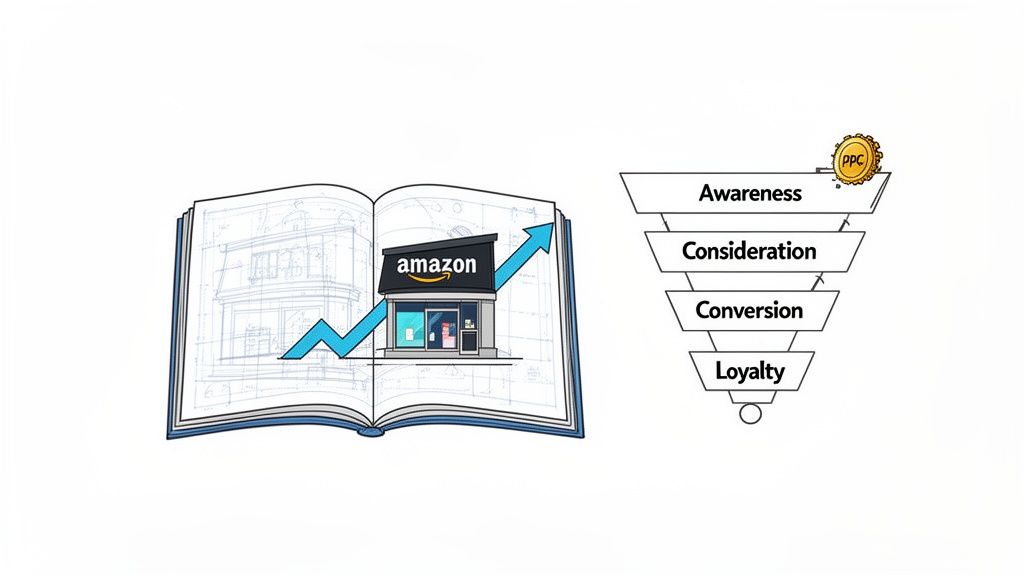
A winning strategy covers the entire customer journey, integrating paid and organic tactics across four stages:
- Awareness: Introducing your brand to new audiences before they even know they have a problem you can solve.
- Consideration: Engaging shoppers as they actively compare you against competitors and evaluate their options.
- Conversion: Capturing high-intent buyers at the exact moment they’re ready to purchase.
- Loyalty: Driving repeat purchases and turning one-time buyers into brand advocates.
Viewing your Amazon presence through this funnel reveals how advertising, product listings, and operations must work in concert. This creates a powerful flywheel effect, critical for capturing and holding market share. As you scale, optimizing your backend with modern inventory systems for e-commerce growth becomes a critical component of this integrated strategy.
Key Takeaway: Top-tier brands don’t treat paid and organic as separate channels. They use PPC data to inform SEO, drive the initial sales velocity needed for organic ranking, and build a brand that compounds in value. This guide provides the performance-first framework to execute these strategies effectively.
Make Sure Your Product Pages Are Primed to Convert
Pouring ad spend onto a product page that isn’t optimized for conversion is a classic way to burn cash. Before scaling any campaign, your product detail pages must be "retail ready." This isn't just Amazon jargon; it's the non-negotiable foundation of a profitable ad strategy. Get this right, and ad dollars generate profit. Get it wrong, and they become expensive clicks.
Many brands treat listings as a one-and-done task. High-growth sellers, however, view them as dynamic sales tools that require constant data-driven refinement. A truly optimized listing anticipates customer questions, overcomes objections, and builds a compelling case for your product, directly improving your conversion rate (CVR) and ad profitability.
Nail Your Title and Bullet Points
Your product title is your most critical on-page SEO asset. It must perform two jobs flawlessly: satisfy the A9 algorithm and compel a human to click. For the algorithm, this means front-loading your highest-volume, most relevant keywords. For the shopper, it means delivering instant clarity and relevance.
Structure it with a clear hierarchy: Brand Name – Core Product Name – Key Feature/Benefit (e.g., Size, Quantity) – Secondary Keywords. Avoid keyword stuffing at all costs; a title that reads like a machine wrote it will destroy your click-through rate (CTR).
Your bullet points are your sales pitch. Translate every feature into a tangible customer benefit.
- Lead with the Benefit: Start each bullet with a capitalized, benefit-driven header. "ALL-DAY BATTERY LIFE" is more compelling than "Includes 5000mAh battery."
- Solve Their Problems: Analyze your customer reviews—and your competitors'—to identify common questions and pain points. Address them directly in your bullets.
- Weave in Keywords Naturally: This is the ideal place to integrate secondary and long-tail keywords that support your broader SEO strategy without sacrificing readability.
Executed correctly, your bullet points build trust, answer unspoken questions, and move the customer closer to purchase.
Use A+ Content to Tell Your Brand's Story
If your bullets are the sales pitch, your A+ Content is the immersive brand experience. It’s your opportunity to use rich media and compelling copy to differentiate your product, tell your brand story, and significantly lift your conversion rate. Don't treat it as an afterthought; it's one of your most potent conversion tools.
Effective A+ Content does more than display extra photos. It guides the customer through a narrative, highlighting why your product is the superior solution. Use comparison charts to clearly articulate your advantages over competitors. High-quality lifestyle imagery helps customers visualize the product in their lives.
The data confirms its impact. Investing in quality A+ Content can boost Amazon sales by up to 8%. On a platform where independent U.S. sellers averaged over $290,000 in annual sales and now account for over 60% of total sales, that’s a material lift. You can explore the data in Amazon's recent seller report.
My Take: A+ Content is your prime opportunity to communicate value and build trust. Use it to answer the "why": why your brand, why this product, and why it's the best choice for them. This strategic storytelling directly impacts conversion and drives customer loyalty.
Win the Click with High-Impact Images and Video
On Amazon, your visuals do the heavy lifting. Your main image is your single most valuable visual asset—it appears in search results and is the primary driver of the initial click. It must be professional, clear, on a pure white background, and instantly communicate what the product is.
Your supporting images must work together to tell a complete story.
- Infographics: Visually communicate key features, dimensions, and technical specifications.
- Lifestyle Shots: Show the product in its intended environment, helping customers imagine it in their own lives.
- Instructional Images: Demonstrate how the product works, preemptively answering usability questions.
- Comparison Graphics: Use a simple chart to highlight your product’s advantages over alternatives.
- Product Video: A concise, high-energy video can be your most effective conversion asset, demonstrating quality and functionality in a way static images cannot.
Once this conversion-optimized foundation is in place, every ad dollar you invest will work harder, setting the stage for profitable scale.
Master the Full Funnel with PPC and DSP
It’s time to stop viewing Amazon ad spend as an expense line item. The most sophisticated sellers treat it as a strategic investment—a lever to drive not just immediate sales, but the sustainable, long-term organic growth that builds enterprise value.
Mastering growth requires mastering the full advertising funnel. This is how you convert clicks into customers and customers into market share.
A disconnected ad strategy, with campaigns operating in silos, is the fastest way to burn your budget. The objective is an integrated system where top-of-funnel campaigns feed new audiences, mid-funnel tactics nurture consideration, and bottom-funnel campaigns convert with ruthless efficiency. This transforms "how to increase sales in Amazon" from a question into a predictable, scalable process.
However, scaling ad spend is pointless without a solid foundation. Every ad dollar is wasted if it drives traffic to a page that fails to convert.
This process is non-negotiable: compelling copy, engaging visuals, and a strong brand narrative via A+ Content are the pillars of a retail-ready product page.
Building Awareness at the Top of the Funnel
At the top of the funnel (TOFU), your goal is brand introduction. You’re reaching shoppers who are browsing, not yet searching for your specific solution. The objective here is to capture attention and build brand recall. Don’t fixate on immediate Return on Ad Spend (ROAS); view this as an investment in filling your pipeline.
Your primary tools are Sponsored Brands and Sponsored Display.
A Sponsored Brands campaign showcases a product collection with your logo and a custom headline at the top of search results. It's an effective way to claim valuable real estate for strategic search terms and build a presence in broad categories.
Sponsored Display targets audiences based on shopping behaviors, such as viewing competitor products or browsing related categories. This allows you to intercept potential customers early in their journey.
Engaging Shoppers in the Mid-Funnel
Once a shopper is aware of your brand, the mid-funnel (MOFU) is about staying top-of-mind during their consideration phase. The focus shifts from discovery to preference, making remarketing your key tactic.
Using Sponsored Display, you can retarget shoppers who visited your product pages but didn’t convert. This simple, cost-effective tactic brings warm leads back into your funnel and can significantly lift conversion rates.
For more advanced strategies, Amazon DSP (Demand-Side Platform) provides a competitive advantage. DSP allows you to reach audiences both on and off Amazon, enabling sophisticated remarketing and audience-building campaigns. For a tactical breakdown, our guide on Amazon DSP ads explains how to deploy it strategically.
Driving Conversions at the Bottom of the Funnel
This is where intent is highest and sales are closed. The bottom of the funnel (BOFU) is focused on one thing: converting high-intent shoppers into customers. Your workhorse here is the Sponsored Products ad, which appears directly in search results and on product pages.
Your Sponsored Products strategy must be precise. Move beyond "set it and forget it" auto-campaigns to a granular structure of manual campaigns targeting specific, high-value keywords. Use your Search Query Performance report to identify the exact terms that drive purchases, and bid aggressively to own them.
Expert Takeaway: Your BOFU campaigns are the engine of your growth flywheel. The sales velocity generated from highly targeted Sponsored Products ads directly improves your product's organic ranking. More sales lead to a higher rank, which drives more organic visibility and sales—a powerful, self-reinforcing growth loop.
The scale of this ecosystem is immense. Independent sellers on Amazon average over $290,000 in annual sales, and they now account for over 60% of all sales in the Amazon store. This proves that massive scale is achievable; over 55,000 of these businesses surpassed $1 million in sales. Dive into the numbers in this detailed sales growth report.
Tying It All Together for Sustainable Scale
A true full-funnel strategy is a continuous cycle, not a linear path. Data from your BOFU conversion campaigns should inform your TOFU targeting. Audiences built at the top are nurtured in the middle and converted at the bottom. Each stage feeds the next.
This strategic map helps align ad types with objectives.
Amazon Ad Type Strategic Application
| Funnel Stage | Primary Ad Type | Key Objective | Core KPI |
|---|---|---|---|
| Awareness (TOFU) | Sponsored Brands, Sponsored Display | Introduce brand to new shoppers | Impressions, Brand Searches |
| Consideration (MOFU) | Sponsored Display, DSP | Retarget interested shoppers | Clicks, Detail Page Views |
| Conversion (BOFU) | Sponsored Products | Drive immediate sales | Orders, Conversion Rate, ACoS |
| Loyalty & Retention | Sponsored Display, DSP | Encourage repeat purchases | Repeat Purchase Rate, LTV |
This framework provides clarity for budget allocation and performance measurement.
For example, when a keyword shows high conversion in your Sponsored Products campaigns, build a Sponsored Brands campaign around it to dominate the search results page and build brand authority. If a competitor is gaining ground, target their product detail page with a Sponsored Display ad to capture their traffic.
This integrated approach ensures your ad budget works smarter, turning ad spend into a predictable and profitable growth machine by capturing demand at every stage of the customer journey.
Turn Clicks Into Customers by Optimizing Your Listings
Driving traffic is only half the battle. If those clicks don’t convert, you're just funding window shoppers. A relentless focus on Conversion Rate Optimization (CRO) is the true engine of profitable growth.
Your mission is to obsessively improve two metrics: Click-Through Rate (CTR) and Conversion Rate (CVR). Small, data-driven improvements to your listing create a compounding effect, resulting in more sales, higher organic rank, and more efficient ad spend.
Let Data—Not Your Gut—Drive Creative Choices
Guesswork is a luxury you can't afford on Amazon. Top brands don't assume they know which image or title performs best—they test relentlessly. Amazon's 'Manage Your Experiments' tool is a powerful, underutilized feature for this purpose.
This A/B testing platform allows you to scientifically validate which listing elements drive clicks and conversions. Systematically test your most critical assets:
- Main Image: Does a lifestyle shot outperform a clean product-on-white image? Does showing the product in its packaging improve CTR? A single image swap can lift performance by double-digit percentages.
- Product Title: Test a benefit-led title ("Enjoy a Restful Night's Sleep") against a feature-focused one ("Queen Size 8-Inch Memory Foam Mattress") to see which resonates more with your target audience.
- A+ Content: Experiment with different modules, layouts, and copy. Does a comparison chart drive a higher CVR than a lifestyle banner? The data will tell you.
Running these experiments replaces intuition with empirical evidence, ensuring every component of your listing is optimized for performance.
The Takeaway: Your listings are never "done." The most successful sellers operate with a "test everything" mentality. A 1-2% lift in conversion from a single A/B test may seem small, but compounded over thousands of visitors, it translates into a significant increase in revenue and ad profitability.
Give Shoppers a Reason to Buy Now
Even a perfectly optimized listing can lose a sale to indecision. Strategic promotions create urgency and provide a compelling reason for an on-the-fence shopper to purchase immediately.
Coupons are highly effective. The orange badge is a visual magnet on a crowded search results page, proven to boost CTR. It signals value and can be the decisive factor between you and a competitor.
But don't stop there. Deploy other tools strategically:
- Lightning Deals & 7-Day Deals: These are designed to create a significant, short-term sales spike. The resulting velocity can provide a lasting boost to your organic ranking.
- Subscribe & Save (S&S): For consumable products, S&S is non-negotiable. It builds a predictable, recurring revenue stream and locks in customer loyalty. A 10-15% discount is a small price for a guaranteed repeat customer.
View these not as mere discounts, but as strategic levers to influence buyer behavior and build a more resilient business.
Build Unshakeable Trust with a Solid Review Strategy
On Amazon, social proof is paramount. A high star rating and a substantial number of reviews are the most powerful trust signals you have. Research shows that 93% of consumers say online reviews influence their purchasing decisions.
A proactive approach is essential. Consistently use Amazon's "Request a Review" button on eligible orders. It’s a free, compliant method to prompt satisfied customers to share their feedback.
A robust review strategy also includes defense. Negative reviews are inevitable. While product and listing optimization are the best prevention, knowing how to remove Amazon reviews that violate Amazon’s policies is a critical skill. Responding professionally to legitimate negative feedback also demonstrates that your brand is responsive and customer-focused.
Ultimately, nothing replaces a superior product and excellent service. However, a product with a 4.6-star rating and 1,000+ reviews will consistently outsell one with a 4.2-star rating and 100 reviews—often at a higher price. That trust factor translates directly into sales.
Measure What Matters to Scale Profitably
You can't grow what you don't measure. This is particularly true on Amazon, where data is abundant but insights are scarce.
The common pitfall is focusing on the wrong metrics. Many brands are fixated on Advertising Cost of Sale (ACoS), but managing your business solely on ACoS is like driving a car by looking only at the speedometer. You know your speed, but you have no visibility into your direction or overall progress.
To truly understand how to increase your Amazon sales sustainably, you must measure the total impact of your advertising—how paid efforts are driving organic sales, building brand equity, and creating a profitable, long-term business.
Beyond ACOS: The Power of TACOS
The single most important metric for gauging the health of your Amazon business is Total Advertising Cost of Sale (TACOS).
This metric represents a critical shift from ACoS. While ACoS measures ad spend against ad-attributed sales, TACOS measures ad spend against total sales—both paid and organic.
This reframes the entire strategic conversation. It helps you answer the ultimate question: "Is my advertising investment efficiently growing my overall business?"
A decreasing TACOS over time is the clearest indicator of a successful strategy. It means your PPC campaigns are effectively boosting your organic rank, leading to a greater share of organic sales and reducing your dependency on paid advertising. To implement this, you can learn exactly how to calculate TACOS and use it as your North Star metric.
Unlocking Deeper Insights with Advanced Analytics
To make informed strategic decisions, the standard reports in Seller Central are insufficient. Amazon now provides powerful tools that offer a much deeper understanding of customer and competitor behavior.
Two are essential for any serious seller:
Search Query Performance (SQP) Reports: This is a direct line into the mind of the Amazon shopper. The SQP report reveals the exact search terms customers use to find your products, along with your impression share, click share, and conversion data for each query. It’s a goldmine for discovering new keywords and identifying competitive gaps and opportunities.
Amazon Marketing Cloud (AMC): This is a true enterprise-level analytics tool. AMC is a secure, privacy-safe data environment where you can join various data sources to map the entire customer journey. You can analyze how shoppers interact with your Sponsored Products, Sponsored Brands, and DSP ads before making a purchase, allowing you to attribute value across your full-funnel strategy.
These tools enable a shift from reactive campaign management to proactive, data-driven strategy. You can finally connect the dots between your top-of-funnel investments and bottom-funnel sales.
Our Takeaway: Stop managing your Amazon business through the narrow lens of ACoS. Make TACOS your North Star for profitability. Then, leverage SQP and AMC data to understand the why behind your performance. This is how you move from guessing to building a predictable, scalable plan to own your category.
A Few Common Questions We Hear About Growing on Amazon
For eCommerce leaders, navigating the Amazon ecosystem requires clear answers to complex questions. This section addresses the most common strategic hurdles we see brands encounter. We’ve distilled our experience into no-nonsense, practical advice that works in the real world.
How Long Until I Actually See a Sales Bump from PPC?
The honest answer: it depends. The timeline is contingent on your product’s lifecycle, competitive landscape, and the retail readiness of your listings.
For a new product launch, a well-structured PPC campaign can generate immediate sales. However, building sustainable momentum typically takes 90-120 days. During this initial period, your ads are not just driving sales; they are collecting critical conversion data on keywords and building the sales history required to improve organic rank.
For an established product, the impact of strategic optimizations can be seen much faster, often within 30-60 days. For example, identifying and dominating a new, high-intent long-tail keyword can produce a measurable sales lift in weeks. The key is active, data-driven campaign management, not autopilot.
A Quick Tip from the Trenches: Don't panic over a high ACoS in the first few weeks of a new campaign. The strategic goal of PPC is to fuel long-term organic rank. View initial ad spend as an investment in future, profitable organic sales.
What’s a Realistic Advertising Budget for Amazon?
Forget generic benchmarks. A "realistic" budget is a direct function of your business objectives. Are you launching a new product and buying market share, or are you a category leader focused on profitability?
Frame your budget using your Total Advertising Cost of Sale (TACOS) target. In an aggressive growth phase, a higher TACOS—perhaps 15-20% or more—is justifiable as you invest in brand visibility. A mature, profit-focused brand might aim for a TACOS under 10%.
Your budget must be fluid. Start with a baseline, and once you identify profitable campaigns and keywords, scale them aggressively. The critical principle is that every dollar spent must have a clearly defined strategic purpose.
When Is It the Right Time to Start Using Amazon DSP?
For most brands, the answer is clear: master Sponsored Ads first. Build your foundation with highly optimized Sponsored Products, Sponsored Brands, and Sponsored Display campaigns. These are your essential tools for capturing high-intent shoppers already on the Amazon platform.
You should consider adding Amazon DSP when you’ve hit a growth ceiling with your on-platform ads or when your strategic objectives extend beyond what Sponsored Ads can accomplish alone.
It may be time to deploy DSP if you need to:
- Generate Net-New Demand: Reach entirely new audiences across the web before they begin their search on Amazon.
- Execute Sophisticated Remarketing: Re-engage users who viewed your product but didn't purchase by reaching them on other websites and apps.
- Target Competitors Strategically: Serve your ads to shoppers who have recently viewed or purchased from your key rivals.
Think of DSP as a powerful growth accelerator. It’s for brands ready to transition from merely capturing existing demand to actively creating it.
Ready to stop guessing and start building a predictable, data-driven plan to dominate your category? Headline Marketing Agency combines expert strategy with advanced analytics to turn your ad spend into a profitable growth engine. Book a consultation with our Amazon experts today.
Get Your Free Amazon PPC Audit
Discover untapped growth opportunities and see how our data-driven approach can improve your ROAS.
Get Free Audit →Ready to Transform Your Amazon PPC Performance?
Get a comprehensive audit of your Amazon PPC campaigns and discover untapped growth opportunities.