The Best Keywords for Amazon Are a Data-Driven Growth Engine, Not a Guessing Game
Generic Amazon keyword research burn budget without the right strategy. Our framework balances reach and profitability at every level.


The best keywords for Amazon aren’t the ones with the highest search volume. They are the terms with validated purchase intent and pinpoint strategic relevance—the keywords that drive profitable sales velocity and ignite a flywheel of paid and organic growth. Forget what you’ve been told about keyword "stuffing." The goal is to build a performance-driven system, not just a list.
Stop Chasing Vanity Metrics. Start Engineering Profitable Growth.

Let’s be direct: your current Amazon keyword strategy is likely a significant cost center. Too many brands are fixated on high search volume, a classic vanity metric that inflates ad spend and delivers dismal returns on investment. This guide flips that outdated script.
We’re implementing a performance-first framework where PPC is not an expense but your primary lever for data acquisition and sustainable organic growth. Forget simply "finding keywords." You're about to build a keyword-driven growth engine designed to systematically lower your ACoS and TACOS, paving the way for scalable profitability.
It starts with a critical mindset shift: from visibility to value.
The High Cost of a Volume-First Approach
Chasing high-volume keywords is like boiling the ocean. You'll burn a massive amount of fuel (ad spend) for a few mediocre results. This strategy is fundamentally flawed because broad, high-volume terms are:
- Hyper-competitive: Driving your cost-per-click (CPC) into unprofitable territory.
- Low-converting: Shoppers using vague terms are typically in the early research phase, not the buying phase.
- A financial black hole: Achieving and maintaining organic rank for these terms requires a constant, unsustainable ad spend.
This common misstep traps brands in a cycle of high ad costs and poor returns. To break free, you must redefine the objective of your keyword strategy. The goal is not to be seen; it’s to sell, profitably.
PPC as Your Primary Growth Lever
The strategic inflection point occurs when you leverage PPC as an intelligence-gathering tool. Treat every ad dollar as an investment in data—data that reveals precisely which search terms convert browsers into buyers.
Headline POV: A performance-first keyword strategy treats PPC as an R&D expense that pays for itself. You use paid ads to identify and validate high-converting keywords, then leverage the resulting sales velocity to boost your organic ranking for those same terms. This creates a self-sustaining growth loop where ad spend builds a long-term, defensible asset.
Amazon's A10 algorithm is a sales-driven machine. We consistently see that listings with a conversion rate of 20% or higher—a direct result of targeting the right keywords—outrank competitors, even those with more reviews or a longer sales history. The data doesn't lie: sales velocity on specific keywords is the ultimate ranking signal.
Here’s how this modern approach compares to outdated methods.
Shifting from a Generic to a Performance-First Keyword Strategy
This table breaks down the fundamental shift from outdated keyword tactics to a modern, performance-driven approach that aligns with profitability and organic growth.
| Traditional Tactic | Performance-First Approach | Business Impact |
|---|---|---|
| Prioritize high search volume keywords | Focus on keywords with high purchase intent and conversion rates | Lower ACoS, higher ROAS, and more profitable ad spend |
| Use PPC primarily for visibility | Use PPC to mine data, validate keywords, and fuel organic rank | Creates a self-funding growth loop where ad spend builds long-term assets |
| Broad, generic targeting | Niche, long-tail, and competitor targeting based on performance data | Higher click-through rates (CTR) and improved campaign efficiency |
| Static keyword list | Dynamic keyword management based on real-time conversion data | Continuous optimization, adapting to market changes and seasonality |
Ultimately, this isn't a minor tweak—it's a complete overhaul of how you approach growth on Amazon.
Of course, getting the click is only half the battle. If your listing isn't optimized to convert, even the best keywords won't save you. Learning how to improve ecommerce conversion rates is a critical piece of this puzzle. To dig even deeper, you can explore our detailed guide on the core advertising performance metrics that actually move the needle for your brand.
How to Build Your Initial Keyword Universe
Building your keyword list isn't about finding a few "perfect" terms. It’s about casting a wide, intelligent net. Forget brainstorming. Your mission is to mine real shopper behavior and discover the exact language customers use when they are ready to buy.
Think of this as an intelligence operation, not a creative exercise. Your goal is to uncover every relevant phrase—from broad category terms to hyper-specific long-tail queries that signal high purchase intent.
Mine Customer and Competitor Reviews
The most valuable source of high-intent keywords is the unfiltered voice of your customer. Your product reviews—and especially your competitors'—are a goldmine of natural language. They reveal pain points, desired features, and use cases you may have overlooked.
Scan reviews for recurring phrases and descriptive language. For example, a customer may not search for an "ergonomic office chair," but they will write a review calling it the "best chair for lower back pain from sitting all day." That long-tail phrase is a high-intent keyword you can target directly.
Actionable Takeaway: Stop thinking like a marketer and start listening like a customer. Reviews provide the exact, conversion-focused language that connects with real buyers, giving you a powerful competitive advantage.
Leverage Amazon's Own Data Tools
Amazon provides powerful tools to see what shoppers are actively searching for. Ignoring them is a critical strategic error.
- Amazon Search Bar: The simplest starting point. Type your primary product term into the Amazon search bar and analyze the autocomplete suggestions. These are the most popular real-time searches related to that term, offering a direct line into the customer's mind.
- Brand Analytics: For Brand Registered sellers, the Search Query Performance dashboard is non-negotiable. It shows the exact search terms shoppers used to find your products, complete with impression, click, and conversion data. This is your first look at what’s already working.
This internal data allows you to prioritize keywords based on proven performance, not just estimated search volume. It's the foundation of a data-driven strategy.
Conduct Reverse ASIN Lookups
Why start from zero when your competitors have already spent the money to find what works? A Reverse ASIN lookup—a standard feature in most Amazon seller tools—allows you to see the keywords (both paid and organic) a specific competitor is ranking for.
Analyze your top 3-5 direct competitors. This tactic is invaluable for uncovering high-performing keywords you missed and for understanding competitors' strategic priorities. Look for keywords where they rank well but have a low review count—these are often prime opportunities for you to capture market share.
For any serious eCommerce leader, mastering keyword research is a non-negotiable skill that underpins your entire marketplace strategy. It's the first step toward building a truly data-driven operation.
By combining these methods—mining reviews, using Amazon's data, and analyzing competitors—you eliminate guesswork. You create a comprehensive master list of the best keywords for Amazon, all rooted in actual shopper behavior and competitive reality. This "keyword universe" is the raw material you'll use to validate, prioritize, and build your growth engine.
How to Validate and Prioritize Keywords for Profitability
A long list of keywords is just noise. A prioritized list is a strategy. This is the crucial step where you convert raw data into an actionable, profit-driven roadmap for your Amazon business.
Dumping thousands of terms into a spreadsheet is easy. The real work is validating which terms actually drive conversions and then ranking them based on their potential return. This is how you separate the revenue drivers from the budget drainers.
Develop a Keyword Scoring Model
Stop obsessing over search volume. A keyword's true value is a composite of opportunity, relevance, and cost. A simple scoring model forces an objective analysis and focuses your resources on what truly impacts the bottom line.
For each core keyword, weigh these factors:
- Search Volume: A measure of potential reach, not guaranteed success. High volume often correlates with intense competition and lower intent.
- Cost-Per-Click (CPC): Your reality check. High CPCs can make profitability impossible. Lower CPCs often indicate less competition and a clearer path to positive returns.
- Conversion Potential: This is where strategic analysis comes in. Long-tail keywords like "men's waterproof size 11 hiking boots" signal high purchase intent, while a broad term like "men's shoes" is low-intent.
- Strategic Relevance: How perfectly does the term describe your product? A keyword with medium search volume that is a perfect match for your product is infinitely more valuable than a high-volume, loosely related term.
By scoring and weighting these elements, you create a clear hierarchy. You’ll quickly identify which keywords are your workhorses and which should be deprioritized. Understanding your profit per unit is non-negotiable here; it's the only way to set CPC targets that align with your business goals.
Use PPC as Your Keyword Validation Lab
Assumptions are expensive on Amazon. The only way to know if a keyword converts is to test it with a controlled ad spend. Use low-budget PPC campaigns as your validation lab to acquire hard data on what real shoppers actually search for and buy.
Launch low-budget automatic and broad match campaigns for a new product—think $10-$20 a day. The goal is pure data acquisition, not immediate ACoS optimization.
Let these campaigns run for 1-2 weeks. This small investment will generate a Search Term Report filled with the exact queries customers used before clicking and, critically, purchasing. That report is a goldmine of validated, high-intent keywords.
This process, from broad discovery to data-backed validation, is a simple but powerful workflow.
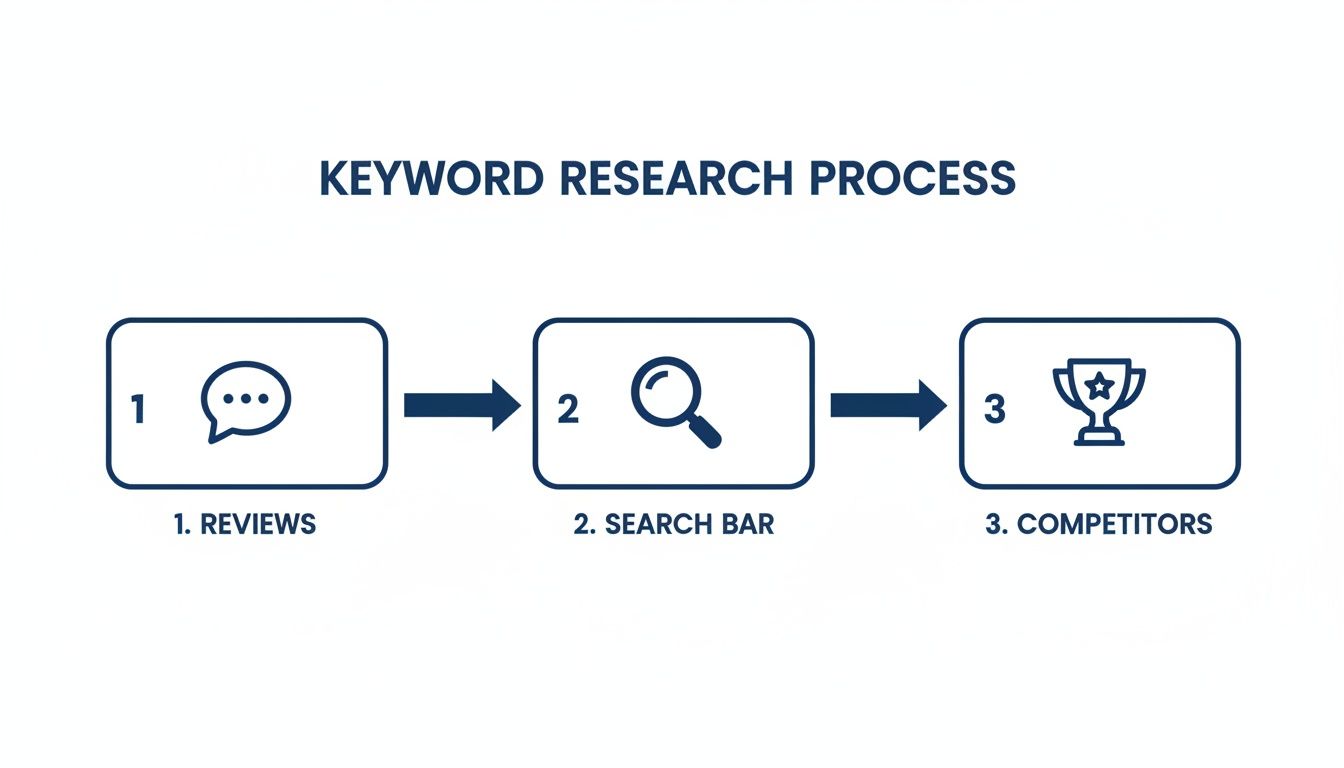
This flow—mining reviews, leveraging search suggestions, and analyzing competitors—builds the initial list that your PPC lab will then validate.
Tier Your Keywords for Strategic Action
With real-world Click-Through Rate (CTR) and Conversion Rate (CVR) data from your test campaigns, you can now tier your keywords. This isn’t just about finding the "best" ones; it’s about assigning each keyword a specific job.
Headline POV: Stop treating all keywords equally. A tiered approach allows you to allocate budget like an investor, placing your biggest bets on proven performers while using smaller funds to explore new opportunities and defend your brand territory.
Here’s a practical framework for creating your keyword tiers:
- Tier 1 (Growth Keywords): Your validated winners. They have strong conversion rates and manageable CPCs. Target these aggressively in manual, exact-match campaigns to drive sales velocity and boost organic rank.
- Tier 2 (Opportunity Keywords): These terms show promise but may have lower conversion rates or higher CPCs. Use them in phrase-match campaigns to capture related long-tail searches and continue gathering data without overspending.
- Tier 3 (Exploratory/Defensive Keywords): This includes broad terms, competitor brand names, and very low-volume long-tails. Run these in low-bid campaigns to maintain visibility, block rivals, and uncover hidden gems.
This matrix helps you visualize how to assign keywords to different strategic roles based on performance and business goals.
The Keyword Prioritization Matrix
This framework helps you score and prioritize keywords based on both search metrics and business goals, ensuring you allocate your resources effectively.
| Keyword Type | Primary Metric | Strategic Goal | Example Use Case |
|---|---|---|---|
| High-Intent Long-Tail | Conversion Rate | Maximize Sales Velocity | "organic matcha green tea powder for lattes" in an exact match campaign |
| High-Volume Broad | Search Volume, CTR | Build Brand Awareness & Discover New Terms | "green tea" in an auto or broad match campaign with a low bid |
| Competitor Brand Name | Clicks, ACoS | Conquesting & Market Share | Bidding on a rival brand's name to show up on their listings |
| Mid-Tail (Problem/Solution) | CVR, CPC | Capture Mid-Funnel Shoppers | "natural energy boost without caffeine" in a phrase match campaign |
Adopting this disciplined approach moves you from being a simple advertiser to a strategic portfolio manager. You’re no longer just buying clicks; you’re investing in the very assets—the keywords—that will fuel your brand’s profitable and sustainable growth on Amazon.
Where to Place Your Keywords So the A10 Algorithm Actually Sees Them
You have a validated, prioritized list of high-impact keywords. This is a significant milestone, but it's only half the job. Now you must strategically place them where Amazon's A10 algorithm will give them maximum weight. The algorithm doesn't read your listing; it scans specific fields and assigns a relevance score based on what it finds.
Think of your listing as a hierarchy of indexing power. Certain fields carry far more weight than others. Placing your most valuable keywords in these prime locations sends a direct signal to the algorithm that your product is a top match for a customer's search.
Your Title is Prime Real Estate
Let’s be crystal clear: the product title is the single most important on-page ranking factor. This is where your highest-priority, highest-relevance keywords must live. A high-performing title strikes a perfect balance between algorithmic relevance and human persuasion.
Sellers typically make two critical errors here: keyword stuffing, which creates a nonsensical, unreadable title, or using vague, brand-focused language that misses the core search terms customers actually use.
The optimal structure leads with your primary keyword, then flows into key features, benefits, or use cases that naturally incorporate other top-tier terms. A title like "Waterproof Hiking Backpack 50L Lightweight Daypack for Camping Travel" is infinitely more effective than "The Summit Pro by Outdoor Gear." The first tells both Amazon and the shopper exactly what the product is and what it's for.
Bullet Points: Where Conversion Meets Relevance
If the title is your headline, the bullet points are the subheadings that close the deal. This is your opportunity to weave in secondary and long-tail keywords. Each bullet should highlight a key feature or benefit while seamlessly embedding a specific search term.
Do not just list specs. Frame them as solutions.
- Instead of: "Made with ripstop nylon."
- Try: "Durable Ripstop Nylon ensures this backpack withstands rugged trails and harsh weather, making it the perfect outdoor adventure bag."
This approach achieves two critical goals: it provides the shopper with compelling, benefit-driven copy that drives conversion, and it strategically places important keywords where the A10 algorithm is looking for them.
Mastering long-tail keywords here can be a game-changer. These hyper-specific phrases often have less competition and significantly higher conversion rates. For example, a brand selling blenders saw a 45% sales uplift by identifying competitor long-tail keywords like “blender for green smoothies” and targeting them in both their listing copy and PPC campaigns. To dig deeper, you can explore how to build a competitive keyword strategy.
The Overlooked Power of Backend Search Terms
Backend search terms are your secret indexing weapon. This field is completely invisible to customers but is fully indexed by Amazon’s algorithm. You have a strict limit of 249 bytes—not characters—so be mindful of special symbols that consume more space.
This is the perfect place for:
- Synonyms and alternative terms (e.g., "daypack," "rucksack").
- Common misspellings.
- Keywords in other languages relevant to your customer base (e.g., Spanish).
- Long-tail variations that would sound unnatural in your visible copy.
Critical Takeaway: Do not repeat keywords from your title or bullet points in the backend fields. It is a complete waste of valuable space and provides zero additional ranking benefit. This section is exclusively for terms that do not appear anywhere else in your listing.
By strategically placing the best keywords for Amazon in these specific fields, you are engineering your listing for maximum algorithmic relevance and customer conversion.
Using PPC to Fuel Organic Rank and Dominate Your Niche

This is where strategy translates into market dominance. It's time to stop treating PPC as just a sales channel and start wielding it as your primary tool for driving organic growth. A well-executed paid strategy doesn't just generate short-term sales; it builds a long-term, defensible moat around your most profitable keywords.
The concept is simple but powerful. Amazon’s A10 algorithm is driven by one primary metric: sales velocity on a given keyword. When a customer searches for a keyword and then buys your product, it sends a powerful relevance signal to Amazon. PPC is the most direct and controllable way to generate those signals at scale.
Engineering Sales Velocity with Precision
Forget "set it and forget it" auto-campaigns. To ignite this growth flywheel, you must be surgical. This means building manual campaigns that are tightly focused on your validated, high-priority keywords. The goal is not just clicks—it’s high-intent, conversion-ready clicks that prove your product's relevance to the algorithm.
Your primary tools for this are exact match and phrase match campaigns.
- Exact Match Campaigns: Reserve these for your Tier 1 "Growth Keywords." By targeting only the exact search term, you ensure every ad dollar is laser-focused on generating sales for the keyword you want to rank for organically. There is no wasted spend.
- Phrase Match Campaigns: These are perfect for your Tier 2 "Opportunity Keywords." They provide broader reach, allowing you to capture related long-tail searches while maintaining high relevance. This is also an excellent way to continue discovering new, valuable search terms.
When you funnel your budget this way, every paid sale becomes a "vote" for your product's relevance on that specific term. You're sending a direct, powerful message to the A10 algorithm.
Smart Bidding to Maximize Impact
At this stage, your bidding must be aggressive but strategic. You are not just trying to win an auction; you are aiming to secure the premium top-of-search placements where conversion rates are highest. For your most critical keywords, use bid adjustments to specifically target the Top of Search (First Page).
This initial investment can feel steep, but it's a short-term push, not a permanent cost. You are generating the sales history needed to convince Amazon you deserve a top organic spot. Once you achieve a strong organic rank (e.g., in the top 5), you can strategically reduce bids on that keyword and allow your earned organic placement to do the heavy lifting.
Headline POV: This is how you transform ad spend into a balance sheet asset. You invest to earn the rank, then reduce spend to maintain it profitably. This creates a sustainable growth loop where paid and organic efforts are fully integrated.
The Unsung Hero: Negative Keywords
While aggressively targeting your best keywords, it is just as crucial to defend your budget against irrelevant, money-wasting clicks. A disciplined negative keyword strategy is your best defense. The Search Term Report is your playbook.
Establish a weekly routine of reviewing this report to identify search terms that are triggering your ads without conversion potential.
- Ad for a "leather messenger bag" showing up for "canvas messenger bag"? Add "canvas" as a negative phrase match.
- A competitor's brand name draining your budget with low-converting clicks? Add their brand name as a negative exact match (unless you are running a deliberate conquesting campaign).
This continuous optimization does more than save money. It sharpens the relevance signals you're sending to Amazon. By ensuring your ad only appears before the most qualified shoppers, you increase your conversion rate, further proving your product's relevance to the algorithm.
When you combine precision targeting, strategic bidding, and relentless optimization, your PPC campaigns transform from a cost center into a powerful engine for dominating search results and building a lasting, profitable organic advantage.
Answering Your Top Amazon Keyword Questions
Once you move past theory, a solid keyword strategy raises practical questions about day-to-day execution and common pitfalls. Let's address the operational realities that determine success or failure.
These aren't abstract concepts; they're the real-world decisions that protect ad spend, outmaneuver competitors, and ensure your keyword efforts translate into profitable growth.
How Often Should I Update My Amazon Keywords?
Keyword optimization is ongoing maintenance, not a one-time project. The key is to find a rhythm that maintains agility without disrupting your ranking progress. A balanced cadence is most effective.
- Weekly Check-in: Dedicate time each week to review PPC Search Term Reports. This is your high-impact maintenance window. You are hunting for two things: new, high-converting long-tail keywords to promote to manual campaigns, and irrelevant search terms to add to your negative keyword lists.
- Quarterly Deep Dive: Every 90 days, conduct a comprehensive audit. Re-evaluate your core keyword list, analyze competitor rankings for your top terms, and refresh the keywords in your title, bullets, and backend to reflect any major shifts in customer search behavior.
During key sales periods like Q4 or Prime Day, accelerate this cadence. The marketplace moves faster, and daily check-ins may be necessary to capitalize on trends or defend against aggressive competitors.
What Is Keyword Cannibalization and How Do I Avoid It?
Keyword cannibalization is a self-inflicted wound. It occurs when multiple products in your catalog compete against each other for the same keyword, both organically and in PPC. This splits your traffic, confuses the algorithm, drives up your CPCs, and almost always damages the conversion rate for both products.
To solve this, assign a single, primary keyword target to each product. Think of it as designating a "champion" for each search term.
Data-Driven Decision: Your PPC conversion data is the ultimate tie-breaker. If two ASINs are competing for "large yoga mat," analyze the data to see which one has the higher conversion rate for that exact phrase. That product becomes your designated champion.
Once you've identified the winner, the next steps are straightforward:
- Optimize the Champion: Fully optimize the winning ASIN's title, bullets, and backend for that primary keyword.
- Use Negative Keywords: In the ad campaigns for your other products, add that primary keyword as a negative exact match. This simple action stops them from competing and funnels all relevant traffic to your highest-converting product.
Should I Bid on My Own Brand Name?
Yes. Bidding on your own branded keywords is a non-negotiable defensive strategy. If you do not own the top sponsored ad slot for your own brand, you are inviting competitors to place ads there and siphon away customers who were specifically searching for you.
Consider it low-cost brand insurance. Branded campaigns are almost always the most profitable in your account, with extremely low CPCs and high conversion rates. This small investment allows you to:
- Control the entire customer journey from the moment they search your name.
- Block competitors from stealing sales that your marketing efforts generated.
- Dominate the top of the search results page, reinforcing your brand’s authority and building shopper trust.
Failing to do this is one of the most common and costly mistakes brands make. You are effectively handing your most qualified customers over to the competition.
Navigating the Amazon keyword ecosystem requires a data-first mindset and a strategic partner who can turn insights into profitable action. At Headline Marketing Agency, we build performance-focused PPC strategies that fuel organic growth and drive long-term, sustainable scale.
Stop guessing and start growing with a data-driven Amazon advertising strategy.
Get Your Free Amazon PPC Audit
Discover untapped growth opportunities and see how our data-driven approach can improve your ROAS.
Get Free Audit →Ready to Transform Your Amazon PPC Performance?
Get a comprehensive audit of your Amazon PPC campaigns and discover untapped growth opportunities.