How to Hire an Amazon SEO Consultant Who Drives Profitable Growth
Organic rank reduces dependency on paid ads. Our hire an Amazon SEO Consultant tactics complement PPC for sustainable, profitable growth.


An Amazon SEO consultant is a specialist who gets your products to the top of Amazon's search results to drive visibility, traffic, and—most importantly—profitable sales. But this isn't about stuffing keywords into a listing. A true expert builds a data-driven growth engine, integrating organic search with paid advertising to deliver sustainable, bottom-line results.
Why a Performance-First Amazon SEO Consultant is Non-Negotiable

If you're treating Amazon like just another sales channel, you're getting lost in the noise. It’s not just a marketplace; it's the world's largest product search engine, where billions of searches are conducted by customers with high purchase intent. In this hyper-competitive arena, a great product isn't enough. Visibility is everything, and organic search is the most profitable path to it.
This is why a sharp Amazon SEO consultant is a critical growth partner, not a tactical expense. The role has evolved far beyond simple listing tweaks. Today, a top-tier consultant is a performance strategist, blending deep knowledge of Amazon’s A9 algorithm with a firm grasp of unit economics and paid media. They aren't just chasing rankings; they're architecting profitable scale.
The Shift from Tactics to Integrated Growth Strategy
The old days of Amazon SEO—gaming the system and cramming in keywords—are over. Winning now demands a sophisticated, integrated strategy. A modern consultant understands that organic performance is inextricably linked to your PPC campaigns, conversion rates, inventory health, and customer reviews.
They operate at the intersection of these functions, leveraging data from one area to inform decisions in another. For instance, a smart consultant mines your PPC Search Query Performance (SQP) reports to refine organic keyword targeting. This creates a powerful flywheel: paid ads drive initial sales velocity and data, which in turn boosts organic rank, improves profitability, and ultimately lowers your Total Advertising Cost of Sale (TACOS).
Headline’s POV: A skilled consultant doesn't just "do SEO." They build a growth engine where paid and organic strategies amplify each other. PPC becomes a lever for organic growth, creating a flywheel effect that drives momentum and steals market share.
Over the last decade, the Amazon SEO consultant role has shifted from a niche service to a core pillar of a brand's growth strategy. With more than 9.7 million sellers competing globally and Amazon commanding nearly 40% of the U.S. eCommerce market, savvy brands now give Amazon's algorithm the same strategic attention as Google's. This is why a consultant is a key investment in annual budgets, right alongside retail media. You can discover more insights about the evolution of Amazon agencies and their strategic shift.
This performance-first mindset separates a true growth partner from a basic listing optimizer. They focus on the metrics that matter to your P&L, transforming your Amazon channel from a cost center into a predictable, profitable revenue machine.
What a Performance-Focused Consultant Actually Does
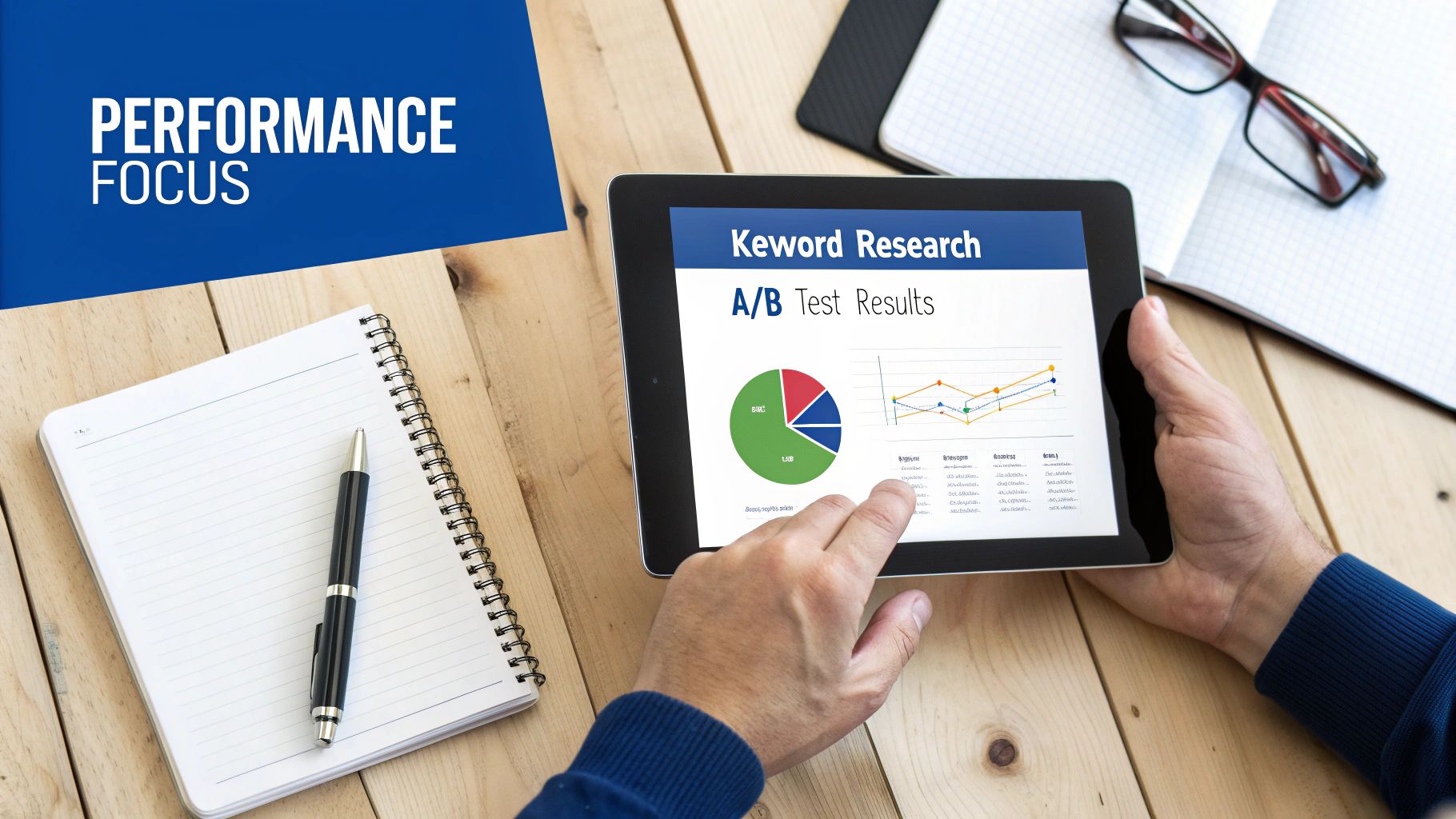
If a consultant's pitch is full of vague promises about "better rankings," be skeptical. A genuine Amazon SEO consultant executes specific, measurable services. Their work is a blend of data science, persuasive copywriting, and a deep understanding of what makes shoppers click "Add to Cart."
This isn't about guesswork or following generic blog advice. It's a systematic process where every action is tied to a key performance indicator (KPI), whether it's click-through rate (CTR), conversion rate (CVR), or organic rank. The operating principle is simple: if you can't measure it, you can't improve it.
Here’s a breakdown of what a skilled consultant delivers and how their efforts translate into real-world results.
Amazon SEO Consultant Services and Their Business Impact
| Service | Key Activities | Primary KPIs Impacted | Business Outcome |
|---|---|---|---|
| Keyword Research & Strategy | Mining Amazon SQP reports, competitor analysis, identifying long-tail and high-intent queries. | Impressions, Organic Rank, Keyword Rank Distribution | Increased visibility to relevant shoppers, capturing untapped market share. |
| Listing & Content Optimization | Writing titles, bullet points, and A+ Content that convert. Strategically placing keywords. | Click-Through Rate (CTR), Conversion Rate (CVR) | Higher traffic from search results and more sales from that traffic. |
| Backend Search Term Optimization | Filling hidden keyword fields with synonyms, misspellings, and related terms. | Indexed Keywords, Impressions | Broader search relevance without cluttering the customer-facing listing. |
| A/B Testing & CRO | Using "Manage Your Experiments" to test main images, titles, and A+ Content. | CTR, CVR, Add-to-Carts, Unit Session Percentage | Data-driven improvements that systematically increase sales and profitability. |
Each service builds on the last, creating a compounding effect that drives sustainable growth on the platform.
Data-Driven Keyword Research and Strategy
The entire foundation of Amazon SEO is identifying the exact search terms your customers use. A top-tier consultant goes beyond generic keyword tools, diving deep into first-party data that reveals actual customer behavior.
Their primary source is your Amazon Search Query Performance (SQP) reports. This is ground-truth data directly from Amazon, showing which search terms led shoppers to your products, along with impressions, clicks, and sales for each.
This level of insight allows them to:
- Find High-Intent Keywords: Pinpoint terms with high conversion rates but low organic rank—a clear opportunity for growth.
- Discover Untapped Long-Tail Phrases: Uncover specific, multi-word searches that competitors ignore but that convert exceptionally well.
- Validate PPC Targets: Use real organic search data to confirm which keywords are profitable enough to warrant ad spend.
By starting with this rich data, the consultant builds a keyword strategy based on proven purchase intent, not just flimsy search volume estimates.
Strategic Listing and Content Optimization
With a validated keyword strategy, the next step is to weave those terms into your product listings. This is a careful balancing act: the content must appeal to Amazon's A9 algorithm and persuade a human shopper to buy.
This is where expertise shines. A consultant for a cookware brand, for example, might find through SQP data that "non-toxic coating" is a key conversion driver. They would then strategically place this phrase in the title and first bullet point.
- Title Construction: They craft a title (under 200 characters) leading with primary keywords while clearly communicating the product's core benefit to earn the click.
- Bullet Point Copywriting: Bullet points are transformed from a dry feature list into a compelling benefit narrative, with secondary keywords placed naturally.
- Backend Search Terms: They maximize "hidden" keyword fields with valuable synonyms, alternate spellings, and related phrases that don’t belong on the customer-facing page.
Takeaway: A great consultant knows it’s not just about where you place keywords, but how you use them to tell a story that boosts conversions. A higher conversion rate is one of the strongest signals you can send to Amazon's algorithm, directly improving your organic rank.
A/B Testing and Conversion Rate Optimization
Optimization is never a one-time task. A performance-focused consultant treats your listing as a living asset that can always be improved. They use Amazon's "Manage Your Experiments" tool to run scientific A/B tests on critical page elements.
For instance, they might test two different main images to see which one achieves a higher CTR from the search results page. Or they could test two A+ Content layouts to determine which one drives more "Add to Carts." This methodical approach removes guesswork and ensures every change is statistically proven to improve performance.
The consultant’s job is to build and manage this continuous improvement cycle, turning small, incremental wins into significant, long-term growth in traffic and sales.
How to Vet and Hire the Right Amazon Partner
Hiring an Amazon SEO consultant is a make-or-break decision. The right partner unlocks profitable growth; the wrong one leads to wasted ad spend and missed opportunities. You need a true strategist who sees beyond flashy sales decks and focuses on what moves the needle: performance, profitability, and clear communication.
Approach the vetting process like a strategy session, not a job interview. You’re not hiring a task-doer; you're bringing on a partner who will directly impact your market share and bottom line. Be rigorous, focus on data, and dig into how they think about growing a business on Amazon.
Core Criteria for Evaluating Candidates
Before scheduling any calls, define your non-negotiables. This framework will keep you objective. A top-tier Amazon SEO consultant must bring more than just promises.
- Demand Proof: Vague success stories are a red flag. Ask for specific, relevant case studies. For instance: "Show me how you took a product from page three to the top five for its primary keyword." You want to see screenshots of sales growth, organic rank improvements, and hard numbers on conversion rate lifts.
- Speak the Language of Data: A great consultant is fluent in Amazon's first-party data tools, like Search Query Performance (SQP) reports and Brand Analytics. If they primarily discuss third-party tools, they may not be leveraging the most powerful data available.
- Connect PPC and Organic Strategy: This is critical. Ask them directly how they use PPC to fuel organic ranking. A consultant who can't clearly explain how they leverage ad data to find keywords, drive sales velocity, and inform listing copy lacks the holistic view required to win.
- Report on What Matters: Ask to see a sample report. A true partner will focus on business-impact metrics like Total ACoS (TACOS) and the lift in organic sales—not vanity metrics like the total number of indexed keywords.
It's also essential to find someone with a genuine understanding the unique needs of Amazon FBA sellers. Your business model has specific challenges, and their strategy must reflect that.
The Interview Questions That Cut Through the Fluff
Once you have a shortlist, it's time to test their strategic thinking.
"Walk me through a time you used PPC data to significantly improve a product's organic rank. What was the specific data point, what action did you take, and what was the measurable result?"
This separates the talkers from the doers. A strong answer will involve mining SQP reports for keywords that convert well but rank poorly, then launching a targeted Sponsored Products campaign to prove relevance and drive sales velocity for the A9 algorithm."How do you prove the ROI of your SEO work beyond just tracking organic sales?"
This reveals a true strategist. The best consultants will discuss tracking improvements in TACOS, measuring their client's "share of voice" for critical terms, and showing how their work impacts overall account profitability."Tell me about a listing optimization that failed. What was your hypothesis, what did the data show, and how did you pivot?"
You're looking for honesty and an analytical mindset. A consultant who claims they've never failed is either inexperienced or not transparent. The key is hearing how they analyzed what went wrong and used that data to inform the next test.
Takeaway: The goal of these questions isn’t to find someone who knows the jargon. It’s to find a partner who thinks about your business with a relentless focus on profitable growth.
Red Flags to Watch Out For
Knowing what to avoid is as important as knowing what to look for.
- Guarantees of "Page-One Rankings": Nobody can guarantee rankings on Amazon's complex, ever-changing algorithm. This promise is a classic red flag for outdated or risky black-hat tactics.
- Focus on Vanity Metrics: If they fixate on the number of keywords they can get you indexed for or search volume without mentioning conversion rates and profitability, their priorities are misaligned with your business goals.
- A "Secret Sauce" They Can't Explain: Transparency is non-negotiable. A consultant who won’t clearly explain their methodology is a major problem. They either lack a real strategy or are using methods you wouldn’t approve of.
By applying this rigorous vetting process, you can find an Amazon SEO consultant who will be a genuine growth partner, aligning their work directly with your most important business objectives.
Using PPC to Fuel Your Organic Growth Flywheel
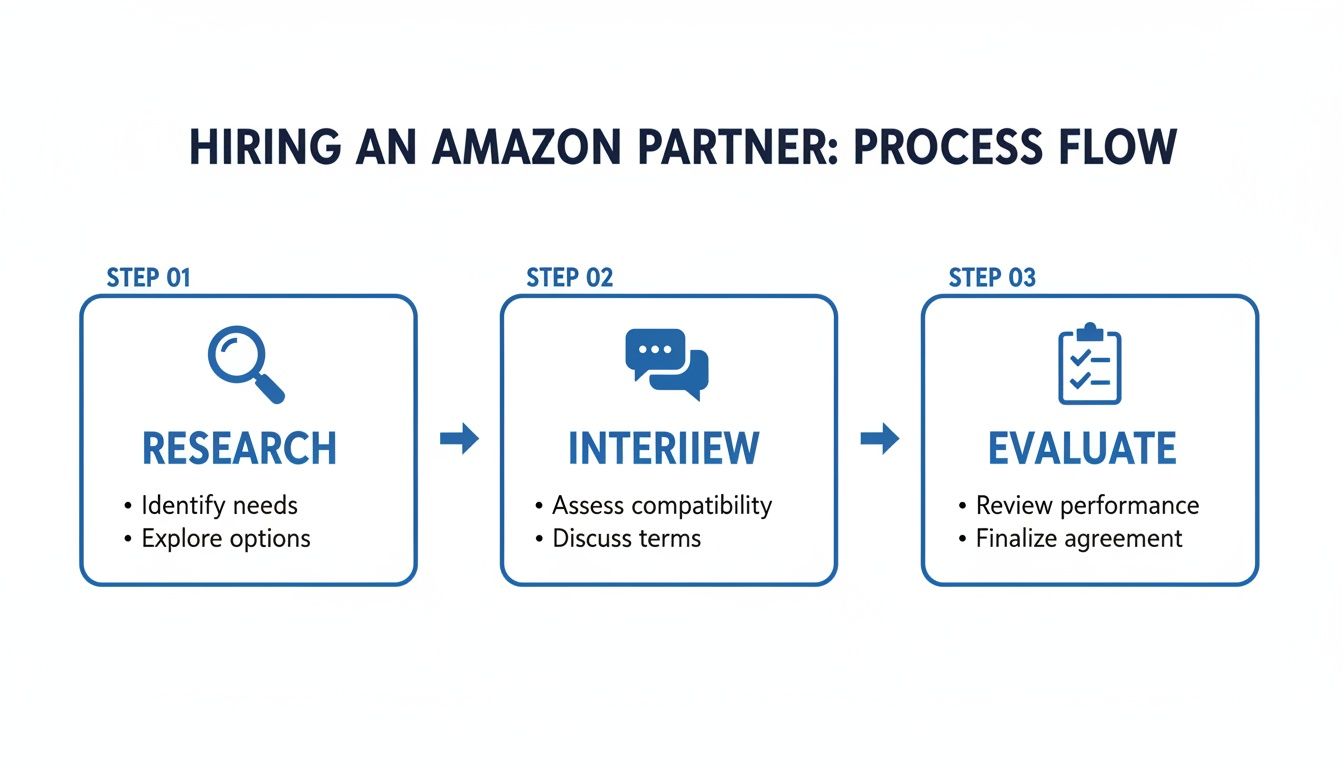
While this process flow provides a high-level map, the interview is where you separate a true strategist from a basic optimizer—especially when it comes to the interplay between paid and organic efforts.
Treating Amazon SEO and PPC as separate channels is one of the most common and costly mistakes brands make. A top-tier Amazon SEO consultant understands their deep integration and uses it to create a powerful growth flywheel where ad spend directly accelerates organic sales.
Instead of viewing PPC as just an expense, a seasoned consultant treats it as a data-gathering machine and a tool to build sales velocity. The insights and early momentum from targeted ads are precisely what Amazon's A9 algorithm needs to see before rewarding your products with higher organic rankings.
Using Ads to De-Risk Your SEO Strategy
Guessing which keywords belong in your product title is a waste of time and opportunity. A smarter approach is to use Sponsored Products campaigns as a validation lab, proving a keyword’s ability to convert before embedding it into your listing.
Here’s a real-world example:
- Identify an Opportunity: Your consultant finds a high-volume keyword where you have zero organic rank. A real-world case involved a new supplement brand targeting "vegan collagen."
- Launch a Test Campaign: They set up a small, surgical Sponsored Products campaign using an exact match for "vegan collagen" only. The campaign ran for two weeks to gather statistically significant data.
- Analyze the Data: The campaign showed a 15% conversion rate, well above the category average. This proved the term's high purchase intent.
- Optimize the Listing: Only after validation with ad dollars did they strategically add "Vegan Collagen" to the product title and bullets, leading to a jump from unranked to page one organically within 60 days.
This process removes guesswork, ensuring your SEO efforts are focused on terms that actually drive sales.
Headline’s POV: A sophisticated consultant doesn't guess—they test. They use targeted ad spend as a surgical tool to prove a keyword's value, turning your PPC budget into an R&D investment for your organic strategy.
Uncovering Hidden Gems in Your Ad Reports
Your advertising data is a goldmine of customer search behavior. The Search Query Performance (SQP) reports are ground zero for discovering how real shoppers actually find your products.
A proactive consultant regularly mines this data to find high-intent, long-tail search terms that competitors overlook. By adding these proven queries to your backend search terms and A+ Content, you start appearing organically for valuable searches flying under the radar. To manage this effectively, you need a system. Our guide on using an Amazon keyword rank tracker provides the structure to monitor these newfound terms and measure their impact. This loop—from paid data to organic optimization to rank tracking—is what defines a genuine growth strategist.
This data-driven approach of modern Amazon SEO consultants highlights the field's evolution. For instance, we know from broader SEO data that URLs with relevant keywords can see a 45% higher click-through rate. Amazon experts apply this same principle to product titles to win on a crowded search page. It’s why an effective Amazon consultant is a performance strategist who turns data into market share.
Measuring Success and Calculating Real ROI
Hiring an Amazon SEO consultant is a business decision that must deliver a clear, measurable return. If your consultant can't draw a straight line from their work to your bottom line, they aren't a strategist—they're an expense.
Profitability must be the primary measure of success. This means looking past flimsy metrics like Advertising Cost of Sale (ACoS), which only tells a fraction of the story. A consultant worth hiring will push you to focus on numbers that reflect the health of your entire Amazon business.
Moving Beyond ACoS to Metrics That Matter
Fixating on ACoS is like judging a car's performance by its top speed alone. A low ACoS is a hollow victory if total sales are flat or declining.
Real success is measured by the powerful synergy between paid and organic efforts. This is where Total Advertising Cost of Sale (TACOS) becomes your North Star metric.
- TACOS Formula: Total Ad Spend / Total Sales (Paid + Organic)
- What It Tells You: This percentage reveals how efficiently your ad spend is driving overall business growth. A steadily decreasing TACOS is the ultimate sign that your ad investment is fueling organic sales, making your business healthier and more profitable over time.
A skilled consultant's primary goal is to drive your TACOS down. This is the proof that their SEO and PPC strategies are creating a flywheel effect. Ad-driven sales improve organic rank, generating more sales without you having to pay for every click.
Calculating the True ROI of Your Consultant
To know if your investment is paying off, you need a no-nonsense way to calculate the return. The economics are compelling: nearly half (49%) of business owners believe SEO provides the best ROI of any marketing channel, and this is especially true on a high-intent marketplace like Amazon. Small lifts in conversion can lead to six or seven-figure revenue gains.
Here’s a basic formula to keep your consultant accountable:
(Incremental Gross Profit from Organic Sales - Consultant's Fee) / Consultant's Fee = ROI
To calculate "Incremental Gross Profit," establish your baseline organic sales before the consultant started. The difference between that baseline and your current organic sales, multiplied by your product margin, is the new profit their work has generated. Our guide on how to calculate marketing ROI breaks this down further.
Of course, this is about more than immediate wins. A big part of the value is long-term brand building. Learning how to calculate customer lifetime value will help you see the full impact of improved visibility and customer loyalty.
Building a Reporting System That Delivers Insights
Finally, demand reports that deliver actionable insights, not just data dumps. A great partner translates numbers into a strategic narrative.
Your reporting dashboard should provide a clear, at-a-glance view of:
- Organic vs. Paid Sales: Is your reliance on paid advertising decreasing over time?
- TACOS Trend: Is your overall advertising engine becoming more efficient?
- Keyword Rank for Top 5-10 Terms: Are you winning on the searches that matter most?
- Unit Session Percentage (CVR): Is your listing effectively converting the traffic it receives?
This kind of focused reporting keeps everyone aligned on the only goal that matters: profitable, sustainable growth for your brand on Amazon.
Got Questions? Let's Talk About Working With an Amazon SEO Pro
You've defined the role, know what to look for, and have your interview questions ready. But a few practical questions always come up before you're ready to make a decision.
Bringing in an Amazon SEO consultant is a significant investment of both capital and trust. Let's tackle the most common questions we hear so you can enter a partnership with total clarity.
How Much Should I Expect to Pay for an Amazon SEO Consultant?
The honest answer: it depends on the scope, catalog size, and the consultant's track record.
You'll typically see a few fee structures:
- Monthly Retainers: This is the most common model, with retainers ranging from $2,000 to $10,000+ per month. This is ideal for ongoing strategy, management, and optimization.
- Project-Based Fees: Best for one-time initiatives, like a full catalog audit and optimization overhaul. This is a great way to build a solid foundation before taking the work in-house.
- Performance-Based Models: Often a smaller base fee plus a percentage of sales growth. Be cautious and ensure the terms are crystal clear on how success and payment are measured.
Takeaway: Don't confuse cost with value. A cheap consultant who delivers zero results is far more expensive than a top-tier partner who doubles your organic sales. Focus on the potential ROI, not just the monthly invoice.
How Long Until I See Results from Amazon SEO?
Patience is a requirement in SEO. While quick fixes like optimizing backend search terms can show results in weeks, real, sustainable growth takes time. You have to earn the trust of Amazon's A9 algorithm with consistent, positive signals.
A realistic timeline often looks like this:
- Months 1-2 (Foundation): Deep-dive audits, keyword strategy finalization, and the first wave of listing optimizations. You may see early improvements in metrics like CTR.
- Months 3-6 (Momentum): You should start seeing tangible movement in organic rankings for target keywords as the PPC-to-organic flywheel begins to spin.
- Months 6+ (Scale): The growth engine should be running smoothly. You should see a clear lift in organic sales and a downward trend in your Total ACoS (TACOS) as your reliance on paid ads decreases.
A good consultant will set these expectations upfront and report on leading indicators like session and conversion rates, so you know you're on the right track long before you hit page one.
Should I Hire a Freelancer or an Agency?
This choice depends on your brand's needs and internal resources.
A freelance Amazon SEO consultant often provides deep expertise in one specific area. You get their direct, hands-on attention, which is perfect for brands wanting a single, dedicated expert to lead the charge.
An agency provides a full team: a main point of contact supported by copywriters, designers, data analysts, and PPC specialists. This model is often a better fit for larger brands with complex needs that extend beyond SEO and require coordination across multiple functions. Evaluate your team's strengths and weaknesses to identify your support gaps.
At Headline Marketing Agency, we provide the focused, strategic leadership of a dedicated consultant backed by the holistic expertise of an agency that masters both SEO and PPC. Let's build your profitable growth plan for Amazon.
Get Your Free Amazon PPC Audit
Discover untapped growth opportunities and see how our data-driven approach can improve your ROAS.
Get Free Audit →Ready to Transform Your Amazon PPC Performance?
Get a comprehensive audit of your Amazon PPC campaigns and discover untapped growth opportunities.