What Happened to the Amazon Early Reviewer Program & Why It Doesn't Matter
Amazon Early Reviewer Program is gone, but the review problem isn't. Here's what smart brands do now to build social proof that converts.

The Amazon Early Reviewer Program was Amazon's first official answer to the classic seller dilemma: launching a new product with zero reviews. For a flat fee, Amazon incentivized actual buyers with a small gift card to leave an honest review, providing a legitimate way to break the "no reviews, no sales" cycle that stifles new product performance.
But in 2021, Amazon retired it. This wasn't a loss for sellers. It was a strategic pivot, replacing a slow, limited tool with a far more powerful, data-driven ecosystem. For growth-focused brands, understanding this shift is key to building a modern, performance-first review strategy that actually drives scale.
What Was the Amazon Early Reviewer Program?

When a new product hits Amazon, the absence of reviews is a major conversion killer. No matter the ad spend, shoppers hesitate without social proof. This chicken-and-egg problem is precisely what the Early Reviewer Program was designed to solve. It was an official kickstart from Amazon, giving new listings a fighting chance to gather the first critical pieces of feedback needed to build shopper confidence.
How the Program Worked
Launched in 2018, the program's mechanics were simple. A brand paid a $60 fee per ASIN. In return, Amazon randomly selected customers who had purchased the product and offered them a small $1 to $3 gift card to share their honest feedback—positive or negative.
The goal was to secure the first one to five reviews that could make or break a launch. To maintain integrity, Amazon handled all communication; sellers had zero contact with reviewers. This structure was designed to ensure the reward was for participation, not a bribe for a positive rating. You can read more about how this tackled the initial review problem on edesk.com.
Reviews from this program were marked with a bright orange "Early Reviewer Rewards" badge. This transparency signaled to other shoppers that the reviewer received a small reward for their honest feedback, which helped maintain trust in the system.
Who Was Eligible to Participate?
The program was exclusively for new products from legitimate brands. To enroll an ASIN, sellers had to meet several criteria:
- Brand Registered: Enrollment required membership in the Amazon Brand Registry.
- Low Review Count: The product had to have fewer than five reviews.
- Minimum Price: The list price had to be above $15.
- U.S. Only: The program was limited to the U.S. marketplace.
Amazon would cease soliciting reviews once the product received five reviews through the program or after one year, whichever came first. This reinforced its purpose as a launchpad, not a continuous review generation tool.
Why Amazon Pulled the Plug on the Program
Amazon shuttered the Early Reviewer Program in 2021 not because it failed, but because it became obsolete. The platform had evolved, introducing smarter, more scalable tools that made the old system inefficient and slow—a poor investment for performance-focused brands. Understanding the why behind this decision is critical for building a winning review strategy today.
The program's core weakness was its speed. Brands paid the $60 fee and often waited months to acquire just five reviews. In Amazon's hyper-competitive environment, this slow drip of feedback offered a weak ROI. Brands need a high-velocity launch; the program delivered a trickle.
There was also a perception issue. Despite Amazon's transparency efforts, the incentive model—however small—created a potential for perceived bias. As Amazon intensified its focus on review authenticity, it began favoring systems that could generate massive volumes of organic feedback without direct compensation.
A New, More Powerful Playbook Emerged
The final nail in the coffin was the integration of superior, platform-wide review generation tools. Features like One-Tap Reviews and Global Review Sharing operated on a completely different scale, dwarfing the program's limited impact.
These new features were game-changers:
- One-Tap Reviews: This allowed shoppers to leave a star rating with a single click, dramatically reducing friction and increasing the total volume of feedback across the platform.
- Global Review Sharing: This feature syndicated reviews across international marketplaces, allowing a product to launch in a new country with instant social proof and eliminating the "cold start" problem.
Amazon officially closed new enrollments on March 10, 2021, and the program was fully decommissioned by April 25. As Modern Retail reported, platform-wide enhancements had steadily increased the natural review rate since 2018, making a slow, paid program redundant.
The Takeaway: The end of the Early Reviewer Program wasn't a loss for sellers. It was a clear signal of Amazon's commitment to building a more trustworthy and efficient review ecosystem, paving the way for superior tools like Amazon Vine.
Ultimately, Amazon's strategy shifted from paying for a handful of reviews to building an engine that makes feedback effortless for millions. For brands, this meant the focus had to evolve from chasing a few early reviews to architecting a holistic strategy that leverages all of Amazon's modern tools for sustainable growth.
How Early Reviews Fuel Your Growth on Amazon
While the Amazon Early Reviewer Program is history, the strategic imperative behind it is more critical than ever. Initial reviews are the fuel for Amazon's growth engine, directly impacting visibility, ad performance, and sales velocity. Driving traffic to a listing with zero reviews is a recipe for wasted ad spend; shoppers arrive, see no social proof, and leave. This is why a proactive review strategy is non-negotiable for any brand serious about profitable scale.
Winning Favor with the A9 Algorithm
Amazon's A9 algorithm is a sophisticated matching engine. Its primary goal is to connect shoppers with products they are most likely to purchase. A product's review count and average star rating are two of the most powerful signals it uses to predict conversion.
When a product accumulates reviews, it signals relevance and buyer interest to the algorithm, often resulting in higher organic search rankings. This creates a virtuous cycle: increased visibility drives more sales, which in turn generate more reviews. Over time, this reduces dependency on paid advertising and builds a more profitable, sustainable sales channel.
A Spiegel Research Center study found that a product with just five reviews is 270% more likely to be purchased than one with none. This data point alone quantifies the immense impact of initial social proof on conversion.
Driving Down ACOS by Increasing CVR
There is a direct correlation between reviews, conversion rate (CVR), and your Advertising Cost of Sale (ACOS). A strong foundation of positive reviews builds immediate trust, which naturally increases the percentage of clicks that turn into sales. When Amazon’s advertising algorithm sees that your product converts at a higher rate than competitors, it rewards you.
This performance advantage manifests in several ways:
- Better Ad Placements: Your ads are more likely to win top-of-search placements.
- Higher Click-Through Rates (CTR): Shoppers are far more inclined to click an ad for a 4.5-star product than one with no rating.
- Lower Cost-Per-Click (CPC): Higher CTR and CVR signal relevance to Amazon, often resulting in lower bid costs.
Each of these benefits contributes to a lower ACOS, making your ad budget more efficient and profitable. This is why a holistic approach to listing optimization on Amazon is so critical—it ensures your page is primed to convert every visitor your ads deliver.
During its operation, the Amazon Early Reviewer Program was a key tool for building this initial trust. Despite only 17% seller adoption, its impact was significant because a mere 1-1.5% of buyers leave reviews unprompted. For brands leveraging PPC, the program was a vital lever for kickstarting the A9 flywheel. Today, learning how to turn customer reviews into a powerful growth engine is a core competency for any Amazon brand.
Compliant Alternatives for Generating Reviews
With the Amazon Early Reviewer Program gone, brands must adopt a modern playbook for acquiring foundational reviews. The game has changed, but the new rules favor speed and quality. Today's compliant strategies are far more powerful than the old program, enabling brands to build a robust layer of social proof that makes advertising profitable from day one.
Amazon Vine: The Official Successor
Amazon Vine is the direct and vastly superior replacement for the Early Reviewer Program. It's not just an alternative; it's a strategic upgrade. Instead of randomly selecting past buyers, Vine provides your product to a pre-vetted, invitation-only group of Amazon’s most trusted reviewers, known as Vine Voices.
These are customers hand-selected by Amazon for their history of writing insightful and helpful reviews. Enrolling in Vine puts your product directly into the hands of these power users, who provide honest, in-depth feedback. It is a system engineered to generate high-quality social proof at launch velocity.
Key performance metrics of the Vine program:
- Enrollment Tiers: You can enroll a new product and provide up to 30 units to Vine Voices. The cost is tiered, ranging from free for 1-2 units to a fee for enrolling 11-30 units.
- High-Quality Reviews: Vine Voices are known for detailed, substantive reviews that provide real value to shoppers.
- Speed: While not guaranteed, brands often see the first Vine reviews appear within days or weeks—a stark contrast to the months the Early Reviewer Program could take.
- Authenticity: All Vine reviews are marked with a green "Vine Voice" badge for full transparency. Be prepared for unvarnished honesty; your product must be ready for scrutiny.
For any new product launch, Vine is the most efficient way to solve the "cold start" problem. Acquiring up to 30 detailed reviews immediately establishes credibility, boosting conversion rates and maximizing the ROI of your launch ad spend.
The Power of the "Request a Review" Button
Beyond Vine, Amazon provides a simple yet effective tool within Seller Central: the Request a Review button. For any order delivered between 5 and 30 days prior, sellers can trigger a standardized email from Amazon requesting both a product review and seller feedback.
This method is 100% compliant because the messaging is controlled entirely by Amazon, ensuring neutrality. While manual execution can be tedious, its impact is significant. Brands that systematize this process see a measurable lift in their organic review rate.
The key is operational consistency. Integrating the "Request a Review" function into a daily or weekly workflow creates a steady, compounding flow of organic feedback. It is a zero-cost, low-effort tactic to capture reviews from satisfied customers.
Compliant Automation and Inserts
To scale review requests, several third-party tools can automate the "Request a Review" process, integrating with your Seller Central account to trigger the request for every eligible order. When evaluating compliant alternatives, it's crucial to understand the features that drive performance; you can review a detailed list of Copycat247's features for Amazon sellers to see what is possible.
Another classic and compliant tactic is the product insert. A well-designed card included in your packaging can politely ask for an honest review. Compliance here is all about the wording.
DO:
- Politely request an honest review.
- Provide a QR code or simple URL to the product's review page.
- Thank the customer for their purchase.
DON'T:
- Ask for a positive or 5-star review.
- Offer any incentive, discount, or gift in exchange for a review.
- Divert customers with issues to contact you instead of leaving a review.
Combining these strategies—Vine for launches, automated requests for ongoing volume, and compliant inserts to capture additional feedback—forms the core of a modern review generation machine. This is a critical component of advanced Amazon product launch strategies designed for long-term market leadership.
Modern Amazon Review Generation Methods Compared
To guide your brand's decision-making, this table compares the top compliant strategies based on their performance characteristics.
| Method | Best For | Typical Cost | Review Quality | Key Consideration |
|---|---|---|---|---|
| Amazon Vine | New product launches needing a fast, strong base of social proof. | Free to a few hundred dollars, plus the cost of goods. | High (Detailed, in-depth from trusted reviewers). | Reviews can be brutally honest; your product must be top-notch. |
| "Request a Review" Button | Generating a steady, organic flow of reviews for all products. | Free (requires manual effort). | Average (Standard customer reviews). | Consistency is key. It's a numbers game that works over time. |
| Compliant Product Inserts | Capturing feedback from highly engaged customers at the unboxing moment. | Low (Cost of printing cards). | Average to High (Can motivate happy customers to share). | Wording must be 100% neutral and compliant with Amazon's TOS. |
| PPC & Listing Optimization | Driving sales from qualified buyers, which naturally leads to more reviews. | Varies (Your ad spend). | Average (Standard customer reviews). | This is a long-term strategy that builds on itself. |
Top-performing brands don't rely on a single method. They build an integrated system that leverages the high-impact velocity of Vine for launches with the steady, ongoing engine of automated requests and optimized sales funnels.
Using PPC to Fuel Your Review Engine
With the Amazon Early Reviewer Program gone, the most effective review generation strategy is one where advertising and customer feedback are interconnected. Smart PPC is not just a sales driver; it is the most powerful lever for generating the initial purchases required to seed reviews.
Treating ad spend and review strategy as separate functions is a critical error. They are two sides of the same coin. You cannot get reviews without sales, and paid advertising is the fastest, most controllable way to drive those first crucial orders. This kickstarts a powerful flywheel that becomes more efficient over time.
This flowchart outlines the modern playbook for acquiring early reviews now that the old program is defunct.
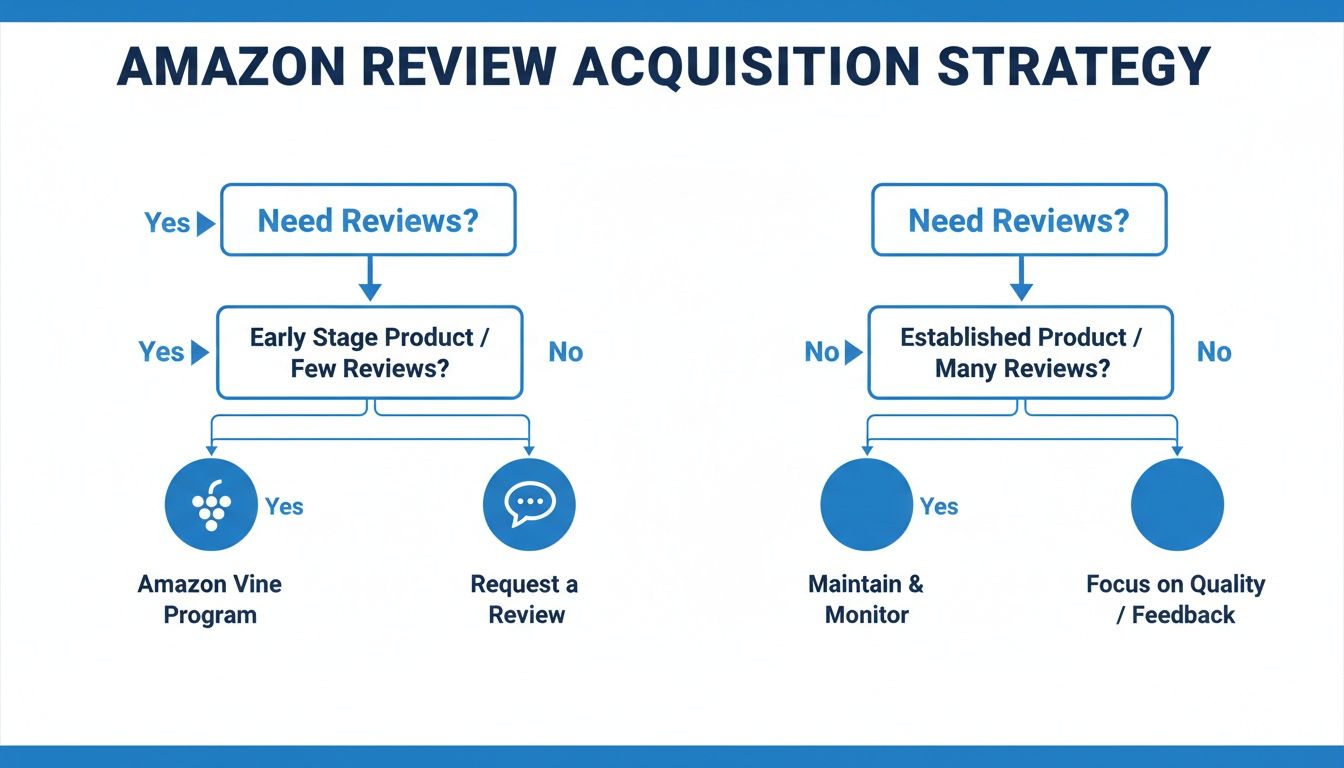
The primary takeaway is that modern tools like Amazon Vine and the "Request a Review" button are fueled by sales. A data-driven PPC strategy is the ignition for this entire engine.
Launching Targeted Campaigns for First Orders
Your launch PPC campaigns should be a surgical strike. The initial goal is not immediate profitability but generating a target number of sales from high-intent buyers. This requires a focused Sponsored Products campaign targeting long-tail, high-conversion keywords.
By concentrating your initial budget on a narrow set of exact-match keywords, you ensure that clicks are coming from highly qualified shoppers. A relevant visitor is more likely to purchase, and a customer who receives exactly what they expected is more likely to leave a positive review. This initial push is fundamental to boost your Amazon sales and get the review flywheel spinning.
Using Data to Ensure Traffic Quality
Driving traffic is easy; driving high-quality traffic is what separates winning brands. Amazon's Search Query Performance data is your most valuable asset here. This report reveals the exact search terms shoppers used before purchasing your product, providing a direct line of sight into customer intent.
This data allows for precise campaign optimization. If you identify sales from unexpected but relevant terms, add them to your campaigns. Conversely, if you are wasting budget on broad terms that generate clicks but no sales, add them as negative keywords. This protects your ad spend and improves the quality of traffic to your listing.
A superior customer experience begins with a superior search experience. When a shopper's search query leads them directly to the perfect product, satisfaction increases, as does the likelihood of a positive review.
Creating the Ultimate Growth Loop
This performance-focused methodology creates a virtuous cycle that powers long-term, profitable growth, far surpassing the limited impact of the old Amazon Early Reviewer Program.
The growth loop works as follows:
- PPC Drives Initial Sales: Targeted ads generate the first critical orders.
- Sales Create Review Opportunities: Each sale becomes an opportunity to leverage Amazon Vine or the "Request a Review" button.
- Reviews Improve Conversion Rate (CVR): Increased social proof boosts shopper confidence and CVR.
- Higher CVR & Rank Boost Ad Efficiency: A better CVR and higher organic rank signal quality to Amazon, leading to better ad placements and a lower ACOS (Advertising Cost of Sale).
This is not a static model. It is an active, data-driven strategy where PPC performance continuously informs listing and campaign optimizations. By focusing on high-quality traffic that converts, you aren’t just making sales—you are systematically building the social proof required to dominate your category.
Building Your Sustainable Review Strategy
The closure of the Amazon Early Reviewer Program was a catalyst, pushing savvy brands beyond single-tactic dependency. The modern approach is to build a multifaceted system that earns social proof as a natural byproduct of an excellent customer experience. It's about engineering a growth engine where every component—listing, advertising, and product—works in concert.
This process begins before a single ad dollar is spent. The foundational step is ensuring your product detail page is ‘Retail Ready.’ This means a fully optimized title, compelling A+ Content, and high-quality, informative images. Driving traffic to an unprepared listing is a surefire way to burn cash, suppress sales, and kill any chance of earning positive reviews.
From Feedback to Product Improvement
Once your listing is primed for conversion, the strategic mindset must shift. Customer feedback is not merely a star rating; it is a rich source of business intelligence. Analyzing reviews—both positive and negative—provides a direct conduit to customer sentiment and invaluable data for product iteration.
A key insight from Spiegel Research found that products with just five reviews are 270% more likely to sell than products with zero. That stat alone shows how critical it is to get that initial feedback to build momentum.
By analyzing this feedback for patterns, you can identify recurring issues, discover novel use cases, and generate data-backed ideas for future product development. This creates a powerful feedback loop: customer insights inform product improvements, which lead to higher customer satisfaction, which in turn generates more positive reviews. Feedback becomes an engine for innovation.
The Integrated Growth Engine
Winning on Amazon is not about optimizing a single metric in isolation. It's about building a self-reinforcing system where each element amplifies the others.
This is the performance-first philosophy:
- Optimize First: Achieve 'Retail Ready' status to maximize the conversion potential of every visitor.
- Advertise Strategically: Execute targeted PPC campaigns to drive initial sales from high-intent buyers most likely to become brand advocates.
- Listen and Iterate: Leverage customer feedback as a tool for product improvement. A superior product naturally earns superior reviews.
- Test and Refine: Continuously test creative and copy to improve CVR and ad performance.
This is a continuous cycle. An optimized listing improves ad efficiency. Efficient ads drive sales and reviews. Reviews provide the data to improve the product. A better product earns more social proof, further improving listing conversion. This is the engine of sustainable, profitable growth on Amazon.
Frequently Asked Questions
The end of the Amazon Early Reviewer Program raised critical questions for sellers. Here are no-nonsense answers to the most common queries we receive from brands navigating the modern review landscape.
Is Amazon Vine Better Than the Early Reviewer Program Was?
Yes, unequivocally. The Early Reviewer Program was a slow, low-impact tool. For a $60 fee, you might wait months for a maximum of five reviews.
Amazon Vine is an accelerant. You can generate up to 30 highly detailed reviews from Amazon's most credible reviewers, often within weeks. This velocity and quality provide the immediate social proof necessary to make your launch ad campaigns profitable from day one. It's a strategic investment in momentum, not just a handful of reviews.
Can I Get in Trouble for Asking for Reviews?
Yes—if you do it wrong. Amazon's Terms of Service are strict: you cannot offer incentives, selectively target happy customers, or attempt to divert negative feedback. Violating these rules is a fast track to account suspension.
However, Amazon encourages sellers to request reviews through approved channels. The "Request a Review" button in Seller Central is the safest method, as it triggers a 100% compliant, neutral email directly from Amazon. Using an approved third-party tool that automates this function is also a secure and scalable approach.
How Many Reviews Do I Need Before Running Aggressive PPC?
There is no universal magic number, but a data-backed benchmark is 15-20 reviews with a 4.0-star rating or higher. This is the threshold where a listing typically achieves sufficient social proof to convert paid traffic effectively.
A common and costly mistake is driving significant ad spend to a product page with zero or few reviews. Shoppers click, see no validation, and bounce. The result is a rock-bottom conversion rate and an unsustainable Advertising Cost of Sale (ACOS).
Securing foundational reviews through a program like Vine first ensures that every dollar invested in PPC thereafter works harder to drive profitable growth.
Ready to build a resilient review strategy fueled by expert advertising? Headline transforms your ad spend into a powerful engine for sales, social proof, and sustainable growth. Book a consultation with our Amazon experts today.
Get Your Free Amazon PPC Audit
Discover untapped growth opportunities and see how our data-driven approach can improve your ROAS.
Get Free Audit →Ready to Transform Your Amazon PPC Performance?
Get a comprehensive audit of your Amazon PPC campaigns and discover untapped growth opportunities.