A Performance-First Guide to Amazon DSP Advertising
Amazon DSP unlocks audiences Sponsored Ads can't reach. Our team breaks down Amazon DSP advertising for measurable results.

In a world of skyrocketing ad costs and brutal competition, simply buying clicks is a losing game. Sustainable growth requires a smarter strategy than just another ad platform to manage. This is precisely the opportunity Amazon DSP advertising presents. It's a programmatic platform that allows you to buy ad placements both on and off Amazon, shifting your focus from just capturing existing demand to actively creating it.
Why Amazon DSP Is a Strategic Growth Lever, Not Just an Ad Platform
Forget the old playbook of battling for bottom-of-funnel conversions with endlessly rising PPC bids. To truly win on Amazon, brands need an approach that builds brand equity, generates new demand, and leverages paid advertising to ignite the organic growth flywheel. This is where the Amazon Demand-Side Platform (DSP) fundamentally changes the game.
Unlike Sponsored Ads, which are excellent for targeting shoppers already searching on Amazon, DSP enables you to reach relevant audiences across the web. Think of it as moving from a reactive to a proactive stance. You're no longer just waiting for customers to find you; you're engineering encounters with high-potential buyers wherever they consume content.
This proactive approach is critical for achieving three core business objectives:
- Create New Demand: Introduce your brand to potential customers before they even realize they need your solution.
- Build Brand Affinity: Use compelling video and display ads to tell your story and stay top-of-mind, turning your brand into the default choice at the point of purchase.
- Drive Sustainable Scale: Increase sales velocity from off-Amazon channels, sending powerful signals to the A9 algorithm that your product is in high demand, which in turn boosts organic rankings.
When you influence the entire marketing funnel—from initial awareness to final purchase—Amazon DSP advertising stops being an expense line and becomes a predictable engine for profitability and market share growth.
Expanding Beyond the Amazon Ecosystem
The platform's reach has exploded, extending far beyond Amazon's own websites and apps. Amazon’s advertising revenue skyrocketed to $17.7 billion in Q3 2025, a massive 24% jump from the previous year, largely driven by this expansion. Advertisers can now programmatically reach audiences on massive streaming services like Roku, Netflix, and Spotify. You can read more about this impressive growth in ad revenue on MarketingDive.com.
This opens up incredible opportunities. To fully leverage Amazon DSP as a growth lever, you must understand key channels like Connected TV (CTV) advertising. Reaching viewers in their living rooms allows you to build brand equity on a scale once reserved for Fortune 500 companies, effectively turning ad spend into a long-term asset. A well-executed DSP strategy becomes a powerful lever for the entire business, driving direct sales, strengthening brand recall, and generating the sales velocity needed to climb organic search rankings—creating a self-sustaining cycle of growth and profitability.
Ready to Grow Beyond Sponsored Ads? Here’s How Amazon DSP Can Help
If you're like most brands, your Amazon advertising journey probably started with Sponsored Ads. And for good reason—they're incredibly effective at capturing shoppers who are ready to buy. But relying only on these pay-per-click (PPC) ads is like only fishing in one corner of a massive lake. You'll catch what swims by, but you're missing out on the biggest opportunities.
To truly scale your brand and build a sustainable business, you need to go beyond just capturing existing demand. You need to start creating it. This is exactly where Amazon DSP advertising changes the game.
Think about it this way: Sponsored Ads are reactive. They target shoppers who are already on Amazon, actively typing in keywords related to your products. It's a fantastic bottom-of-the-funnel tool. If you want a refresher, our guide on what PPC is on Amazon covers the nuts and bolts.
Amazon DSP, however, is proactive. It’s a full-funnel machine that uses programmatic ad buying to find and engage relevant audiences—not just on Amazon, but across a huge network of websites, apps, and even streaming TV. You're no longer waiting for customers to come to you; you're going to them, wherever they happen to be online.
So, Where Do These Ads Actually Show Up?
The sheer scale of where your ads can appear is what truly sets Amazon DSP apart. While Sponsored Ads are limited to Amazon's own search results and product pages, DSP campaigns cast a much, much wider net.
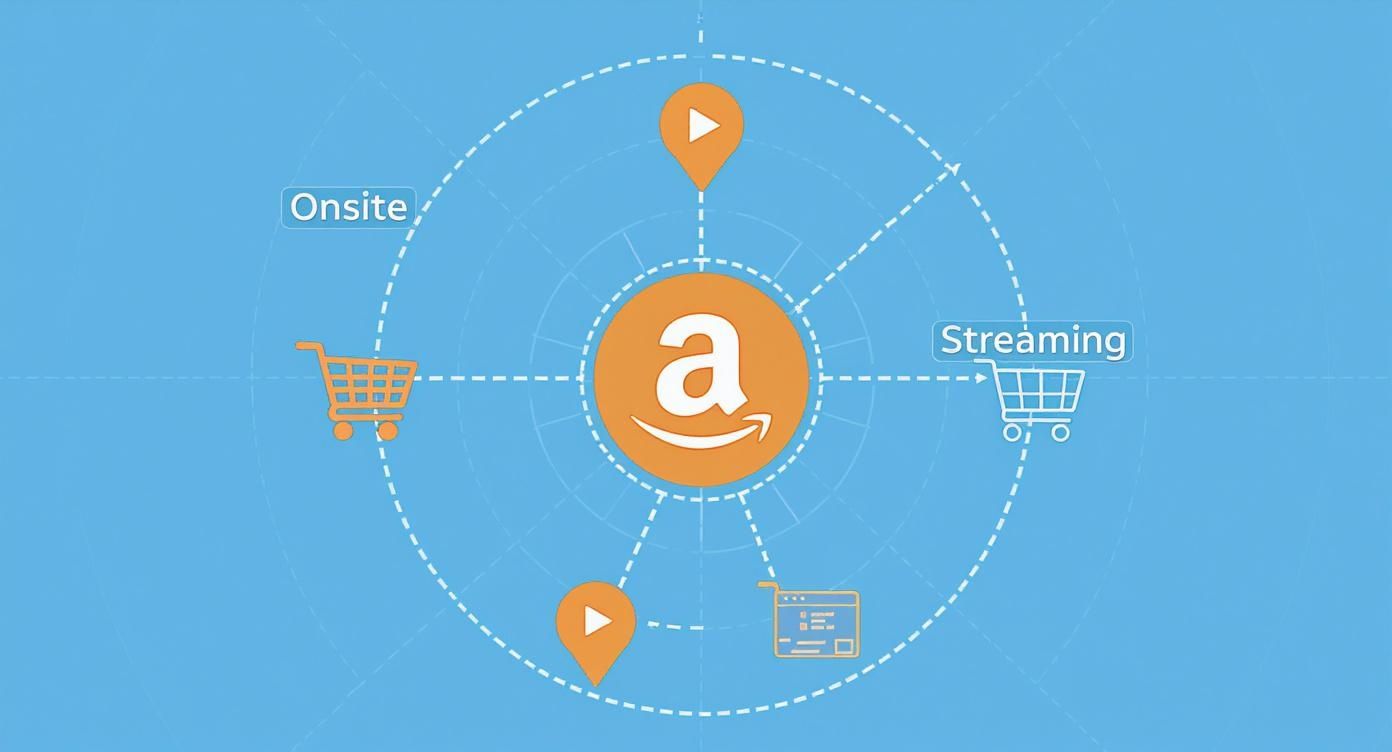
This map shows just how far your reach extends with DSP. It's not just an "Amazon" tool; it's a powerful platform for reaching people throughout their entire day online.
This expanded inventory includes:
- Amazon’s Own Turf: Prime real estate on Amazon.com, IMDb, Twitch, and even in places like Whole Foods Market properties.
- The Wider Web: Access to high-quality ad space on thousands of other websites and apps through Amazon Publisher Direct and other ad exchanges. Think premium news sites, lifestyle blogs, and more.
- The Living Room TV: The ability to run video ads on services like Freevee and other major Connected TV (CTV) platforms where your audience is streaming their favorite shows.
Imagine the journey you can create: a potential customer sees your video ad while watching a show on their smart TV, gets a reminder with a display ad while reading an article on their phone, and then sees your product again when they finally log into Amazon to shop. That’s the power of this cross-channel approach.
Amazon DSP vs Sponsored Ads: A Strategic Comparison
To help you decide where to best allocate your advertising dollars, it's crucial to understand the fundamental differences between these two platforms. This table breaks down their strategic purpose, targeting methods, and ideal use cases.
| Attribute | Sponsored Ads (PPC) | Amazon DSP (Programmatic) |
|---|---|---|
| Primary Goal | Drive immediate sales, convert high-intent shoppers | Build brand awareness, create demand, drive consideration |
| Audience Reach | On-Amazon only (search results, product detail pages) | On and off Amazon (websites, apps, streaming TV) |
| Targeting Method | Keyword-based: Targets what people are searching for | Audience-based: Targets who people are based on their behaviors |
| Funnel Stage | Bottom-of-Funnel (BOFU) | Top-of-Funnel (TOFU) & Mid-Funnel (MOFU) |
| Pricing Model | Pay-Per-Click (PPC) | Cost-Per-Mille (CPM) - Cost per 1,000 impressions |
| Best For | Capturing existing demand, defending brand space | Launching new products, building brand loyalty, retargeting |
| Management | Self-service via Seller Central or Ad Console | Managed service or agency-managed (self-service requires expertise) |
In short, Sponsored Ads are your closers, perfect for grabbing the sale at the last minute. Amazon DSP is your opener, building the relationship and guiding customers toward that final purchase decision over time.
It's About Targeting People, Not Just Keywords
The strategic thinking behind these two platforms couldn't be more different. Sponsored Ads are all about conversion. DSP is about starting a conversation and building a connection, often long before someone even thinks about searching for a product.
Sponsored Ads help you win the sale. Amazon DSP helps you win the customer for life.
With Sponsored Ads, you're betting on keywords and products. With DSP, you're investing in people. You get to tap into Amazon's incredible first-party data to build audiences based on real shopping behaviors, including:
- In-Market Audiences: Shoppers who are actively browsing and showing interest in your product category right now.
- Lifestyle Segments: Consumers who fit a certain profile, like "eco-conscious shoppers" or "new parents."
- Lookalike Audiences: New shoppers who share the same browsing and buying habits as your most loyal customers.
- Powerful Retargeting: People who have viewed your product, visited your website, or even purchased from a key competitor.
This ability to target based on behavior—not just search terms—is how you fill the top of your marketing funnel and create a steady stream of future customers. When you use both Sponsored Ads and DSP together, you create a powerful flywheel. The awareness and interest generated by your DSP campaigns directly feed the high-intent traffic that your PPC campaigns are ready to convert.
Using First-Party Data for Precision Targeting
The real power of Amazon DSP isn’t just reaching a large audience; it's reaching the right audience. This is powered by Amazon's unparalleled first-party shopper data—a direct window into the actual buying habits of millions of consumers. It's a level of targeting precision that keyword-focused Sponsored Ads simply cannot match.
Amazon's platform is built on data collected from real people actively shopping, providing a clear picture of their demographics, interests, device usage, and—most importantly—their purchase behavior. This data fuels sophisticated ad campaigns that programmatically identify the optimal placements for maximum impact. To see how this data works in practice, you can discover more insights about Amazon DSP's capabilities on CanopyManagement.com.
This shifts the entire dynamic. You move from guessing who your customers are to targeting them based on what you know they do. You're no longer just bidding on keywords; you're reaching real people based on proven interests and purchase history.
Building High-Intent Audiences from Scratch
With this data at your fingertips, you can construct custom audiences tailored to specific business goals, whether that’s launching a product or stealing market share. This is where raw data translates into profitable action.
Here are a few of the most powerful audience types you can create:
- In-Market Audiences: These are shoppers who’ve recently browsed products in your category, signaling they are close to a purchase. This is the perfect time to get your brand in front of them while they’re in the consideration phase.
- Lifestyle Segments: This allows you to connect with consumers based on their combined shopping habits that indicate a specific lifestyle, like "eco-conscious shoppers" or "new parents." It’s ideal for brands that align with specific values or life stages.
- Past Purchasers: Re-engage customers who already know and trust your brand. This is a highly cost-effective strategy for driving repeat purchases, announcing new products, and building customer loyalty.
- Competitor Conquesting: Target shoppers who have recently viewed or purchased from your direct competitors. This is a direct strategy to win over customers from rival brands at the critical moment of decision.
Targeting based on past actions is a fundamental principle of modern advertising. If you want to dive deeper into the mechanics, you can learn more about behavioral targeting in our detailed guide. By zeroing in on behavior, you ensure every ad dollar is spent on audiences most likely to convert.
Finding New Customers with Lookalike Audiences
One of the most potent tools in the DSP toolkit is the lookalike audience. This feature removes the guesswork from new customer acquisition.
A lookalike audience allows you to take a "seed" group—like your most valuable customers—and have Amazon identify millions of other shoppers who exhibit similar browsing and buying behaviors. It’s like cloning your ideal customer, over and over again.
This is an incredibly effective way to drive new-to-brand (NTB) sales. Instead of casting a wide, expensive net, you’re using data to pinpoint individuals who mirror the exact traits of your most profitable customers.
For example, a premium coffee brand could build a lookalike audience from customers who have purchased their top-selling espresso blend three or more times. Amazon's system then identifies other shoppers who also buy high-end coffee, browse espresso machines, and read coffee-related content. By serving ads directly to this highly qualified group, you dramatically increase the probability of acquiring a new customer, turning your ad budget into a powerful engine for growth.
Measuring Success Beyond Clicks
For too long, eCommerce leaders have been fixated on one metric: Return on Ad Spend (ROAS). While important, judging Amazon DSP advertising solely on last-click ROAS is like evaluating a marathon runner based on their first mile. You get a snapshot, but you miss the bigger picture of how the race was actually won.
DSP campaigns are designed to connect with customers at every stage of their journey, often well before they consider clicking "buy." Consequently, success must be measured with KPIs that capture this full-funnel impact. When you look beyond immediate clicks and sales, you begin to see how your advertising is building brand equity, generating new demand, and driving long-term, profitable growth.
Key Performance Indicators That Actually Matter
To get a true measure of your DSP campaign performance, you need to shift your focus from purely conversion-based metrics to indicators of genuine engagement and consideration. These are the numbers that reveal if your ads are capturing attention and moving shoppers closer to a purchase.
Here are the KPIs that tell the real story:
- Detail Page View Rate (DPVR): This metric is simple yet powerful. It's the percentage of people who saw your ad and then clicked to view your product detail page. A high DPVR indicates your creative and targeting are resonating with the right audience.
- Add-to-Cart (ATC) Rate: A classic mid-funnel metric, ATC tracks how many shoppers place your product in their cart after seeing an ad. It’s a strong signal that a consumer has moved from casual interest to serious consideration.
- New-to-Brand (NTB) Conversions: This is arguably the most critical metric for growth. NTB tracks sales from customers who haven't purchased from your brand on Amazon in the past 12 months. This is hard evidence that your DSP campaigns are acquiring new customers, not just recycling your existing base.
Focusing on New-to-Brand metrics is the ultimate proof of sustainable growth. It demonstrates that your Amazon DSP advertising is an engine for customer acquisition, directly contributing to long-term profitability and market share expansion.
You also can't forget about view-through conversions. These attribute sales to shoppers who saw your ad, didn't click, but came back to buy later. Understanding this behavior is crucial for judging the true impact of brand-building campaigns. To dig deeper, check out our guide on what a view-through conversion is and why it matters.
The Next Frontier in Measurement: Amazon Marketing Cloud (AMC)
The standard DSP dashboard provides a solid starting point, but the customer journey is complex and non-linear. To truly understand this intricate path to purchase, sophisticated brands are leveraging the Amazon Marketing Cloud (AMC).
Think of AMC as a secure, privacy-compliant data clean room. It allows you to analyze your campaign performance alongside your own data signals in an anonymized environment. This provides a holistic, cross-channel view of how all your advertising efforts—both Sponsored Ads and DSP—work in concert to drive sales.
With AMC, you can finally answer critical strategic questions:
- How many display ad impressions does a customer typically see before they initiate a branded search?
- Are consumers who watch our video ads more likely to convert later via a Sponsored Products ad?
- What is the optimal ad frequency in our retargeting campaigns to maximize sales without causing audience fatigue?
To truly grasp campaign impact beyond simple clicks, marketers need to embrace advanced real-time data analytics strategies. Within the Amazon world, AMC is the tool that unlocks this deeper level of analysis. By connecting the dots on a non-linear customer journey, you can finally prove the total value of your ad spend and make smarter decisions that boost both immediate sales and long-term brand health.
Actionable Playbooks for Key Business Goals
Theory is one thing; real-world application is another. A successful Amazon DSP advertising strategy isn't a single, rigid plan. It’s a series of targeted plays designed to solve specific business challenges. Let's move beyond what DSP can do and dive into battle-tested playbooks that drive tangible results.
Here are three performance-focused strategies you can adapt for critical moments in your brand's lifecycle. Each is designed to use paid advertising as a lever for profitable, long-term growth—where every dollar spent builds both immediate sales and lasting organic rank.
Playbook 1: Product Launch Acceleration
A new product launch on Amazon is a high-stakes game. You have a limited window to convince the A9 algorithm that your product deserves top placement. This playbook uses DSP to generate the initial sales velocity and traffic required to climb the rankings from day one.
- Objective: Generate immediate awareness and initial sales to kickstart organic momentum.
- Target Audiences:
- Competitor Conquesting: Target shoppers who recently viewed or purchased from your top three direct competitors. This is an aggressive tactic to intercept ready-to-buy customers.
- In-Market Segments: Reach consumers who are actively browsing your product category right now.
- Lookalikes of Past Purchasers: For a related product launch, create a lookalike audience from your existing best-sellers' customer list to find similar high-value buyers.
- Budget & Timing: Allocate a significant portion of your launch budget here for the first 30-60 days. The goal is a concentrated burst of activity to generate a spike in sales data.
- Expected Outcome: A surge in Detail Page Views and, most importantly, New-to-Brand (NTB) sales. This initial velocity signals to Amazon that your product is relevant and popular, helping you secure a stronger organic rank much faster than with PPC alone.
Playbook 2: Advanced Retargeting and Loyalty
Most shoppers don't convert on their first visit. This playbook is about efficiently re-engaging individuals who have already demonstrated interest. It's about closing the loop and transforming one-time buyers into repeat customers. The objective is to recapture lost sales and build loyalty with timely, relevant ads.
Retargeting is your lowest-hanging fruit. These audiences have already raised their hands. A smart Amazon DSP advertising strategy ensures you’re there to guide them across the finish line, turning consideration into conversion and one-time buyers into repeat customers.
- Objective: Recover abandoned carts, encourage repeat purchases, and increase customer lifetime value.
- Target Audiences:
- Product Viewers (Last 30 Days): Re-engage anyone who viewed your product page but did not add to cart.
- Cart Abandoners (Last 14 Days): Serve compelling ads to shoppers who were one step away from purchasing.
- Past Purchasers (Last 180 Days): Target previous customers to cross-sell complementary products or announce new arrivals.
- Your Website Visitors: Use the Amazon Ad Tag to retarget visitors from your own DTC site, bringing them back into the Amazon ecosystem to complete their purchase.
- Budget & Timing: This should be an "always-on" campaign. The budget can be flexible, scaling up during peak seasons. Due to its high efficiency, it typically delivers a strong ROAS.
- Expected Outcome: Higher Add-to-Cart rates, an improved overall conversion rate, and a measurable lift in repeat purchase frequency.
Playbook 3: Scalable Brand Building
Sustainable growth requires a full-funnel approach. While launch and retargeting campaigns drive immediate action, brand-building campaigns fill the top of your funnel with a steady stream of future customers. This playbook uses broad-reach tactics to increase brand awareness and build affinity.
In the crowded Amazon marketplace, brand recall is a significant competitive advantage. As of 2025, over 300,000 sellers on Amazon generate more than $100,000 in annual revenue, making it tougher than ever to stand out. You can learn more from some of these fascinating Amazon advertising statistics on SequenceCommerce.com.
- Objective: Increase top-of-funnel awareness, build brand equity, and introduce your brand to new audiences.
- Target Audiences:
- Lifestyle Segments: Connect with consumers based on their broader interests, such as "health-conscious consumers" or "outdoor enthusiasts."
- Demographic Targeting: Reach specific age, income, or geographic groups that align with your ideal customer profile.
- Contextual Targeting: Place your ads on websites and apps where the content is directly related to your products, capturing interest in the moment.
- Budget & Timing: This is a long-term investment. The focus is less on immediate ROAS and more on growing your brand's presence. Set a steady, consistent budget that you can maintain over time.
- Expected Outcome: Over time, you should observe growth in branded search volume, an increase in unassisted conversions, and a larger pool of engaged shoppers for your retargeting campaigns to convert.
Our Strategic Approach to Amazon DSP
Knowing what Amazon DSP can do is one thing. Actually using it to generate consistent, profitable growth? That's a completely different ballgame. A passive, "set it and forget it" mindset is a recipe for wasted ad spend. To get real results, you need a hands-on, data-obsessed approach that ties every single campaign back to your core business goals.
This is where having the right partner can turn Amazon DSP from a complicated tool into your most powerful growth driver. We don't just "manage campaigns." We build a complete system where your paid advertising directly fuels your bottom line and, crucially, helps lift your organic rankings over time. This performance-first thinking is what separates the brands that just get by from the ones that dominate their categories.
How We Put Your Data to Work
A great Amazon DSP strategy is built on a cycle of deep analysis and relentless optimization. It's about moving past vanity metrics to find the real insights that lead to bigger and better results. This process ensures your ad spend isn't just an expense—it's an investment in your brand's future.
Our management philosophy is straightforward and proven:
- Deep Audience Discovery: We start by digging into your own data and layering it with Amazon's incredible wealth of shopper insights. The goal is to build laser-focused audience segments by identifying your most valuable customers, mapping their buying habits, and finding the perfect moments to win over your competitors' shoppers.
- Strategic Campaign Architecture: We don't just run ads; we build full-funnel experiences that guide shoppers from "Who's that?" to "I'll buy it again." Every campaign, whether it’s for top-of-funnel brand awareness or a sophisticated retargeting push, has its own specific KPIs that ladder up to your main objective, like boosting your New-to-Brand customer numbers.
- Continuous, Hands-On Optimization: Your campaigns aren't left on autopilot. We are in them daily, tweaking bids, refining targeting, and A/B testing creative to make sure every dollar works as hard as it possibly can. This active management style stops budget drain before it starts and allows us to pivot quickly as the market changes.
- Advanced AMC Analysis: We use the Amazon Marketing Cloud (AMC) to see the whole story, not just the last chapter. AMC lets us understand the messy, non-linear path customers take, measure how DSP and Sponsored Ads influence each other, and make smarter, data-backed decisions that go way beyond last-click attribution.
The Headline Takeaway: The key to winning with Amazon DSP is to stop treating it like an advertising expense and start seeing it as a strategic investment. When managed properly, every ad dollar connects directly to real business outcomes—more market share, better organic visibility, and sustainable profits. Don't just run ads; build a growth engine.
A Few Common Questions About Amazon DSP
If you're still wrapping your head around DSP, you're in good company. Let's tackle some of the most frequent questions we hear from brand leaders.
What’s the Minimum I Should Budget for Amazon DSP?
Amazon used to suggest a starting point of around $35,000, but that number can be intimidating and isn't a strict requirement, especially if you're working with an agency.
The real question isn't about a minimum spend, but about what it takes to get enough data to make smart decisions. For a brand new to DSP, we've found that a test budget of $10,000-$15,000 over a month is a solid starting point. It's enough to gather meaningful data and see what’s working before you decide to go all-in.
Can I Run Amazon DSP Myself?
Technically, yes, there’s a self-service option. But it's not like running a simple Sponsored Products campaign. DSP is a complex machine with a steep learning curve.
Most brands get far better results by either using Amazon’s managed service or, more commonly, partnering with a specialized agency. An experienced team already knows the platform's quirks and how to squeeze every drop of performance out of your budget.
One of the biggest mistakes we see is brands treating DSP like a pay-per-click platform. It demands a completely different mindset focused on building audiences over time, not just immediate conversions. That's the strategic perspective a seasoned partner brings.
How Long Until I Actually See Results?
Patience is a virtue with DSP. It's not the instant gratification you get from Sponsored Ads. For top-of-funnel campaigns aimed at building brand awareness, it can easily take 3-6 months to see a noticeable lift in things like your branded search traffic.
That said, you won't be flying blind for that long. For campaigns targeting shoppers further down the funnel (like retargeting), you can start seeing a measurable impact on Detail Page Views and Add-to-Carts within the first 30-60 days. The goal here is to build a long-term growth engine, not just a short-term sales bump.
Ready to turn Amazon DSP into a predictable engine for profitability and organic growth? Headline Marketing Agency builds data-driven DSP strategies that connect every ad dollar to your bottom line. Learn how our expert team can help you scale sustainably.
Get Your Free Amazon PPC Audit
Discover untapped growth opportunities and see how our data-driven approach can improve your ROAS.
Get Free Audit →Ready to Transform Your Amazon PPC Performance?
Get a comprehensive audit of your Amazon PPC campaigns and discover untapped growth opportunities.