Beyond the Checklist: A Performance-First Guide to Amazon Account Management
Full-service Amazon account management should drive profit, not just dashboards. Here's how to evaluate real partner value.

When business leaders talk about "Amazon account management," they're often thinking about a to-do list. Fix a suppressed listing, launch an ad campaign, check inventory. But that reactive, task-based approach is a ceiling on your growth.
True Amazon account management is the strategic engine that drives profitability and sustainable scale. It's about building a proactive, performance-first system where every decision—from ad spend to inventory forecasting—is measured against its impact on your bottom line.
Rethinking Amazon Account Management: From Silos to System
Most brands hit a growth wall for one simple reason: they treat their Amazon channel as a collection of separate jobs. The ad team chases ACoS, the operations team worries about stock levels, and brand marketing polishes the listings. This siloed approach is the primary driver of inefficiency and missed opportunity.
A high-performance Amazon channel operates as a single, holistic business where every action has a ripple effect. A successful PPC campaign driving a 50% sales lift is a catastrophic failure if it leads to a stockout. That loss in sales velocity doesn't just cost you revenue today; it craters your organic rank, a setback that can take weeks, if not months, to recover from.
This performance-first mindset means understanding the symbiotic relationship between paid advertising and organic growth. The most successful brands don't just use PPC to acquire a sale; they use it as a strategic lever to accelerate the flywheel, capturing critical sales data that boosts organic rankings and builds a long-term competitive moat.
The Shift From Tactics To Strategy
Moving from a tactical checklist to a strategic framework is a fundamental change in how you view your Amazon business. You stop just doing things and start orchestrating a complex system designed for profitable scale.
This means:
- Proactive Planning: You're not just reacting to low-stock alerts. You’re anticipating inventory needs based on promotional calendars and forecasted ad-driven demand.
- Data Integration: You connect the dots between ad spend, inventory levels, and contribution margin to make ruthless, data-backed decisions about capital allocation.
- Compliance as a Guardrail: staying compliant with Amazon's changing policies isn't a chore; it's critical revenue insurance. Proactive compliance is a non-negotiable business function.
This strategic difference is reflected in performance data. While the average US SMB seller on Amazon brings in around $140,000 annually, profitability varies wildly. While 19% of sellers generate over $10,000 in monthly revenue, a staggering 31% make less than $500 per month. You can see more in recent Amazon FBA seller statistics. The gap isn't luck.
The core difference between a seven-figure seller and one struggling to break even isn't the product—it's the strategic orchestration of their Amazon account.
Ultimately, strategic management is your best defense against market volatility and account health crises. One misstep can have devastating consequences, which is why a deep understanding of how to prevent an https://www.headlinema.com/blog/amazon-account-suspension is more valuable than knowing how to fix one. When you treat your Amazon store like the integrated business it is, you're not just selling products; you're building a foundation for market leadership.
The Core Pillars of Amazon Performance
To drive sustainable growth on Amazon, you must stop thinking in terms of individual tasks and start managing an interconnected system. It's not about mastering one pillar; it's about orchestrating five critical components so they work in concert. When they're aligned, they create a powerful growth engine. When one is weak, the entire structure is compromised.
Think of it like an F1 car. Your ads are the high-octane fuel, but without a perfectly engineered chassis (inventory), an aerodynamic body (brand storytelling), and a compliant engine (policy adherence), you’re not winning any races.
Let's break down these five core pillars.
Advertising as a Growth Lever
Too many brands view advertising (PPC, DSP) as a direct sales channel, judging it solely on its immediate return. This is a critical error that severely limits growth potential. For performance-driven brands, advertising is the primary lever to kickstart and fuel the organic growth flywheel.
Every sale driven by a Sponsored Products ad is a powerful signal to Amazon's A9 algorithm. It validates that your product is relevant for specific keywords. This sales velocity directly improves your organic ranking for those same terms, leading to more organic sales, which further solidifies your rank. This is the self-sustaining loop you want to fuel.
The Key Takeaway: Your ad budget isn't an expense; it's an investment in your product's long-term organic ranking and market share. The goal isn't just a low ACoS (Advertising Cost of Sale), but a declining TACOS (Total Advertising Cost of Sale), which proves your ad spend is efficiently lifting the entire business, not just paid sales.
Listing Optimization and Brand Storytelling
Your product detail page is your digital shelf, your sales floor, and your brand ambassador all in one. In a marketplace as saturated as Amazon, it must do more than list features; it must convert. This is about more than just keyword stuffing.
A high-converting listing includes:
- Premium Creative: A+ Content, Brand Story modules, and professional videography transform a transactional page into a brand experience, increasing shopper confidence.
- Conversion-Focused Copy: Bullet points and descriptions must address customer pain points and articulate clear benefits, not just technical specs.
- Continuous Testing: A/B testing main images, titles, and A+ Content provides quantitative data on what actually drives clicks and conversions.
An optimized listing makes your advertising dollars work harder by improving your click-through rate (CTR) and conversion rate (CVR). A higher CVR means more sales for the same ad spend, directly feeding the sales velocity flywheel. Sophisticated brands even leverage AI content optimization for e-commerce to gain an edge.
This diagram shows how everything—Advertising, Inventory, and Compliance—is connected to your central strategy.
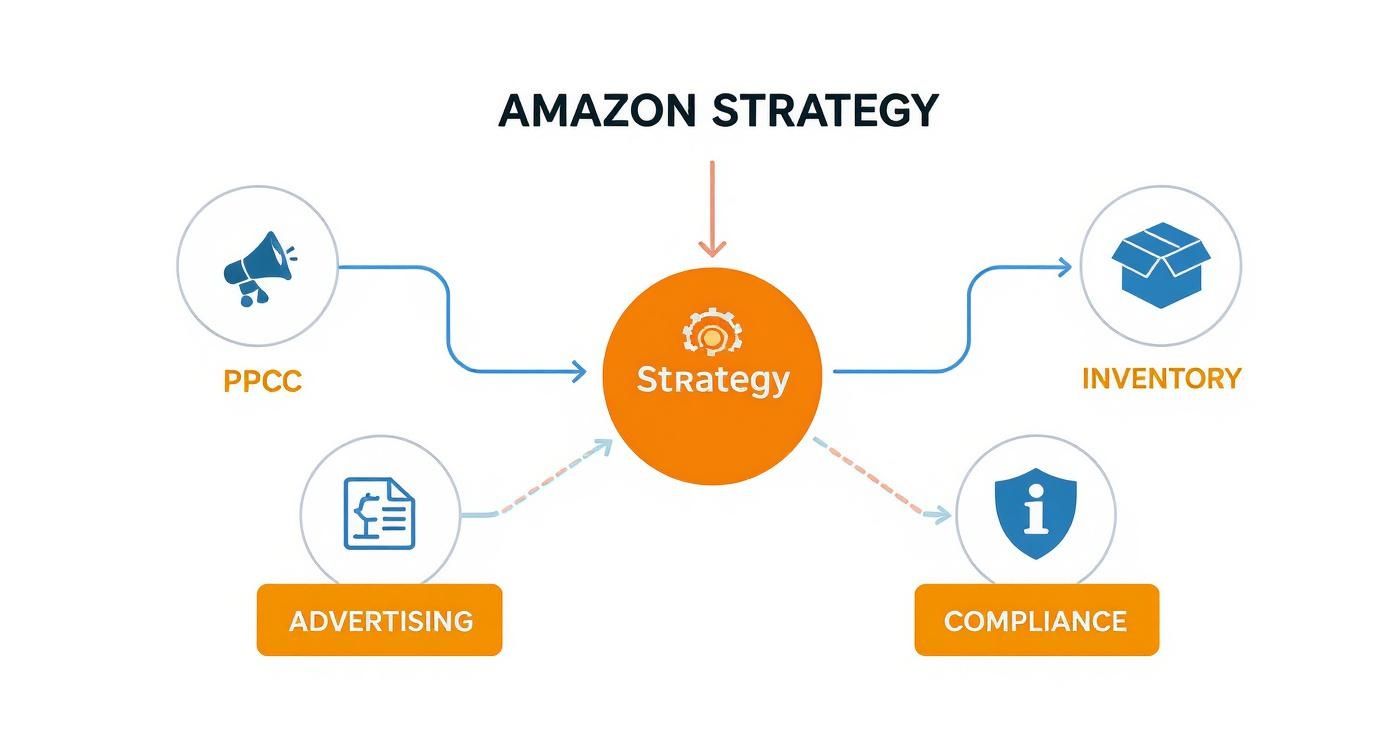
It’s a powerful reminder that none of these pillars exist in a vacuum. A weakness in one undermines the entire structure.
Inventory and Retail Readiness
You can have the best product and the most sophisticated ad campaigns on the planet, but if you're out of stock, you have nothing. A stockout is a multi-faceted disaster on Amazon. It halts sales momentum, signals unreliability to the algorithm, decimates your organic rank, and sends customers directly to your competitors.
This is where retail readiness becomes the non-negotiable foundation for growth. Being retail-ready means:
- Intelligent Forecasting: Using historical sales data, seasonality, and promotional calendars to accurately predict demand and maintain optimal stock levels.
- Buy Box Dominance: With over 82% of Amazon sales happening via the Buy Box, competitive pricing and pristine seller metrics are paramount.
- Supply Chain Efficiency: A streamlined process for moving goods into Amazon's fulfillment centers to minimize lead times and avoid costly downtime.
Without impeccable retail readiness, every advertising dollar is a gamble. You're effectively paying to send traffic to a closed store.
Policy and Compliance
Navigating Amazon's labyrinth of policies isn't just an administrative task; it's a critical risk management function. A single violation—whether for product safety, advertising guidelines, or review manipulation—can lead to listing suppression or a full account suspension, turning your revenue stream off overnight.
Proactive compliance management is your business's insurance policy. It involves systematically monitoring for updates and ensuring your listings, operations, and marketing practices remain well within Amazon's ever-shifting guardrails.
Brand Registry and Protection
Amazon Brand Registry is your primary defensive toolkit on the platform. It provides the essential tools to control your brand's presentation and combat infringement.
With Brand Registry, you can:
- Combat Counterfeiters: Efficiently report and remove fraudulent sellers who hijack your listings or infringe on your trademarks.
- Control Listing Content: Gain authority over your product detail pages, preventing unauthorized changes to titles, images, and descriptions.
- Access Superior Data: Unlock powerful tools like Brand Analytics, which provides invaluable insight into customer search behavior, market basket data, and competitor performance.
These five pillars are not a checklist to be completed; they are a dynamic system requiring constant strategic alignment. Effective Amazon account management ensures every pillar is robust, balanced, and working in unison to drive profitable, sustainable growth.
Measuring Performance for Profitable Growth
It's dangerously easy to get lost in vanity metrics. High impression counts and click volumes feel productive, but they don't pay the bills. For executive leaders, the only metrics that matter are those that provide a clear, unvarnished view of the channel's health and profitability.
The most common trap is an obsession with Advertising Cost of Sale (ACoS). While ACoS indicates the efficiency of a specific ad campaign, it fails to answer the most critical question: is your total advertising investment driving profitable growth for the entire business? A stellar 15% ACoS on a product with a 10% margin is a high-speed race to bankruptcy.

From Ad Metrics To Business Health
The first step toward profitable scale is connecting advertising performance to total business performance. This is where Total Advertising Cost of Sale (TACOS) becomes your north star. By measuring total ad spend against total revenue (paid + organic), TACOS reveals the true leverage of your advertising.
A downward-trending TACOS is a powerful indicator that your ad spend is successfully fueling organic sales, creating a more efficient business over time. If you need to dig deeper, we have a complete guide on how to calculate TACOS that helps steer this high-level strategy.
But TACOS is a proxy for the ultimate measure: profit. To get a true picture, you must focus on unit economics:
- Contribution Margin: The revenue from a single unit sale after subtracting all variable costs—cost of goods, Amazon fees, and ad spend. This is the true driver of profit.
- Net Profit: The bottom line. What's left after all expenses are paid. This number determines if your Amazon channel is a value-creator or a resource-drain for the parent company.
Shifting the focus from ACoS to contribution margin fundamentally changes decision-making. It allows you to set aggressive advertising goals for high-margin hero products while maintaining strict efficiency on lower-margin items, optimizing for total portfolio profit.
It is crucial to distinguish between metrics that look good in a report and those that drive intelligent business decisions.
Vanity Metrics vs Performance Metrics
| Metric Category | Common (Vanity) Metric | Performance-Focused Metric |
|---|---|---|
| Advertising | Clicks, Impressions, ACoS | TACOS, New-to-Brand Customer Rate, Ad-Attributed Margin |
| Sales | Gross Revenue | Contribution Margin, Net Profit |
| Brand Presence | Follower Count, Social Shares | Organic Keyword Rank, Share of Voice, Repeat Purchase Rate |
| Listing Health | Page Views | Unit Session Percentage (Conversion Rate) |
| Operations | Number of Orders Shipped | Order Defect Rate (ODR), In-Stock Rate |
Shifting your dashboard to the "Performance-Focused" column is the difference between being busy and being profitable.
Leading Indicators of Brand Strength
Beyond the financials, you must monitor the metrics that signal the underlying health and defensibility of your brand on Amazon. These are leading indicators that predict future sales and market position.
Organic Rank is paramount. If your products are climbing the search results for high-value keywords, it's proof that your strategy is building long-term equity. A rising organic rank means decreasing dependency on paid advertising for sales.
Another vital sign is your Unit Session Percentage (conversion rate). This metric reveals how effectively your product page converts traffic into sales. A low CVR is a major red flag, pointing to issues with pricing, creative, copy, or customer reviews. This must be addressed before scaling ad spend.
The Foundation: Operational Excellence
Finally, none of these growth metrics matter if the operational foundation is weak. Flawless execution is non-negotiable, as Amazon relentlessly tracks seller performance.
The Order Defect Rate (ODR) is one of the most critical operational KPIs. Amazon requires an ODR below 1%, but experienced brands aim for <0.5% as a buffer. This metric aggregates negative feedback, A-to-z claims, and chargebacks. A rising ODR is an early warning sign of systemic issues that can lead to account suspension.
Building a unified dashboard that tracks advertising, financial, brand, and operational metrics provides the 360-degree view required to make intelligent, high-stakes decisions. This level of clarity separates the brands that thrive from those that merely survive.
Building Your Amazon Growth Toolkit
On Amazon, your competitive edge is forged through efficiency and insight. While competitors are mired in manual processes and surface-level data, market leaders leverage a modern toolkit to automate tasks and turn data into profitable action. Effective Amazon account management is about building scalable workflows that translate raw data into strategic decisions.
This isn't about subscribing to a dozen SaaS platforms. It's about mastering the high-impact tools—many of them native to Seller Central—to automate repetitive work and free up human capital for high-level strategy.
Unearthing Customer Intent with Native Tools
Before considering third-party software, mastery of Amazon's native data sources is essential. These tools offer an unfiltered view of shopper behavior and are the foundation of any intelligent advertising or content strategy.
Two of the most powerful and underutilized resources are:
- Search Query Performance (SQP): This dashboard is a game-changer, revealing the exact search terms driving impressions, clicks, and sales for your brand, down to the ASIN level. It allows you to quantify your "share of voice" for any query and identify high-potential keywords where you have no presence.
- Brand Analytics: This is your source for competitive intelligence. Analyze market basket data to see what other products your customers buy, and use item comparison reports to see which competitor ASINs they view alongside yours. This is a goldmine for product development and cross-selling strategies.
A simple yet powerful workflow involves regularly "harvesting" converting search terms from SQP and plugging them into exact-match PPC campaigns. This drives highly qualified traffic and accelerates the organic growth flywheel with proven, customer-generated data.
Advanced Analytics with Amazon Marketing Cloud
For brands ready to move beyond standard reporting, the Amazon Marketing Cloud (AMC) offers a far more sophisticated level of analysis. AMC is a secure, private data environment built on AWS that allows you to join your advertising data with other signals to get a unified view of the customer journey.
Standard reports tell you what happened. AMC helps you understand why. It enables custom queries to answer complex business questions.
For example, a CPG brand used AMC to analyze path-to-purchase. They discovered that shoppers exposed to a Sponsored Brands Video ad first, followed by a Sponsored Display ad later, had a 30% higher conversion rate than those who saw only one ad type. This insight led to a full-funnel strategy overhaul, dramatically improving ad efficiency.
This is the level of granular attribution that separates market leaders from the pack, enabling surgical precision in media planning and budget allocation.
Building Scalable Workflows and Automation
With the right data, the next step is building repeatable processes that drive operational efficiency. Robust workflows remove guesswork and ensure consistency, which is critical for scaling your Amazon account management.
Key workflows to implement:
- Weekly Performance Review: A standing meeting to review core KPIs—TACOS, contribution margin, organic rank for top 10 keywords, and inventory health. The goal is to identify trends and assign clear, actionable next steps.
- Keyword Harvesting Cadence: A bi-weekly process to mine Search Query Performance and advertising reports for new, converting search terms. Systematically integrate these terms into PPC campaigns and listing copy.
- Inventory & Advertising Sync: A crucial check-in to align advertising plans with inventory reality. Use promotional calendars and ad spend forecasts to project sales velocity and prevent stockouts during key campaigns.
Many repetitive tasks within these workflows, like bid adjustments or keyword transfers, can and should be automated. This frees your team from spreadsheet drudgery to focus on the strategic analysis that truly drives growth.
Choosing Your Amazon Management Model
The decision of how to manage your Amazon channel—the classic "build vs. buy" dilemma—is one of the most critical strategic choices you'll make. It directly impacts control, cost, scalability, and ultimately, profitability. There is no single right answer, but there is a right answer for your business at its current stage.
The choice boils down to two paths: building an in-house team or partnering with a specialized agency. Choosing incorrectly leads to wasted capital, stalled growth, and ceded market share in a relentlessly competitive marketplace.
Let's apply a performance-first lens to help you make a decision that aligns with your strategic objectives.
The In-House Amazon Team
Bringing management in-house offers maximum control. The team is fully immersed in your brand culture and can ensure perfect alignment between Amazon activities and broader company goals. However, this path represents a significant commitment of capital and resources.
Winning on Amazon requires more than just assigning duties to an existing marketing manager. A truly competitive team requires specialized expertise.
A high-functioning in-house Amazon team typically requires:
- Amazon Channel Lead: A business owner who manages the channel P&L, sets the overarching strategy, and ensures integration between advertising, operations, and brand.
- PPC/Advertising Specialist: A data-driven expert fluent in Sponsored Products, Brands, and Display, with deep knowledge of keyword research, bid management, and analytics platforms like Amazon Marketing Cloud.
- Inventory & Operations Manager: An analyst focused on demand forecasting, FBA replenishment, and maintaining retail readiness to avoid stockouts and excess storage fees.
- Content & Listing Specialist: A creative talent with a data-driven mindset, responsible for optimizing product pages, A+ Content, and Brand Stores for conversion.
The primary challenge is cost and talent acquisition. Recruiting, training, and retaining a full team of A-players is a significant, long-term investment. Furthermore, internal teams can develop tunnel vision, missing out on the cross-category insights an agency gains from a diverse client portfolio.
Partnering With a Performance Agency
For brands lacking the resources or desire to build a department from scratch, an agency provides immediate access to a team of specialists and their enterprise-level toolset. A true partner agency functions as an extension of your team, bringing a data-first mentality and years of platform experience to your amazon account management.
However, the market is saturated with agencies offering commoditized services. A genuine performance partner moves beyond tactical campaign management to provide strategic guidance that drives profitable business growth.
A top-tier agency doesn't report on ACoS; they report on contribution margin. They don't just manage bids; they build integrated strategies that leverage advertising to grow your organic rank and overall market share. They should challenge your assumptions and bring proactive ideas to the table.
When evaluating agencies, you must look beyond the sales pitch. For brands that view advertising as their primary growth engine, exploring specialized Amazon advertising management services can provide the focused expertise needed for aggressive scaling.
A Playbook for Selecting the Right Agency
To identify a true performance partner, use this vetting framework. Ask these direct questions and demand specific, data-backed answers:
- Strategic Approach: "How do you connect ad spend to our bottom-line profitability? Show me how you measure success beyond ACoS and ROAS."
- Data Capabilities: "What is your tech stack? Do you have expertise in Amazon Marketing Cloud and Search Query Performance data? Describe a time an insight from the data led to a major strategic pivot for a client."
- Transparency & Reporting: "What does a performance report look like? What is the cadence of our strategic meetings, and what KPIs will we review to measure progress against our business goals?"
- Team Expertise: "Who, specifically, will be managing my account? What is their direct experience in my category and with brands of my scale?"
This is a foundational business decision. If you build in-house, be prepared to invest heavily in top-tier talent. If you partner with an agency, be relentless in your search for a true strategic partner who shares your obsession with data, transparency, and the bottom line.
Turning Management Into a Competitive Edge
Effective Amazon account management is not an operational cost; it is a direct investment in your brand's defensibility and your most powerful competitive advantage. The central imperative is to adopt a holistic, performance-first mindset where every action is measured by its impact on profitability and sustainable growth.
It’s time to stop viewing advertising as a mere expense. It is a strategic lever for building durable organic rank, capturing market share, and accelerating the growth flywheel. Every advertising dollar is an investment in your brand's long-term enterprise value, not just a short-term transaction. This mindset must be underpinned by an obsession with operational excellence.
From Management to Orchestration
Make retail readiness your highest priority. A rock-solid operational foundation is the prerequisite for aggressive growth; a single stockout can negate weeks of hard-won advertising momentum. Your supply chain strategy and your advertising strategy must be inextricably linked.
The brands that win on Amazon aren't just managing tasks—they're orchestrating a complex system where advertising, inventory, and content work in perfect concert to drive profit.
Finally, whether you build an in-house team or partner with a data-driven agency like Headline, demand strategic thinking and transparent, business-level reporting. Elevate the conversation beyond tactical metrics like ACoS to what truly moves the needle: contribution margin, TACOS, and net profitability.
This is the shift that separates market leaders from the rest of the pack—the evolution from simple management to strategic orchestration. It’s how you transform your Amazon presence from a sales channel into a scalable, defensible, and highly profitable business unit.
Frequently Asked Questions
When it comes to managing an Amazon business, brand leaders often find themselves wrestling with the same tough questions. Let's cut through the noise and get straight to the answers that actually help you grow your brand profitably on the platform.
What Is the Most Common Mistake in Amazon Account Management?
The single biggest mistake is operating in silos. The PPC team chases ad metrics, the inventory team watches stock levels, and the content team works on creative, all disconnected from one another. This is a recipe for a disjointed strategy that quietly bleeds money.
A prime example: a wildly successful ad campaign drives sales through the roof, but no one looped in operations. The product stocks out. The immediate result? Lost sales. The long-term damage? Plummeting sales velocity and a cratered organic rank that takes months to rebuild. Effective Amazon account management integrates these functions, ensuring advertising strategy is always informed by operational reality.
How Often Should I Review My Amazon Account Performance?
You don’t need to obsess over every metric every day. The trick is to match your review schedule to how quickly a metric can change and how much it impacts your business.
A practical cadence for C-level and director oversight:
- Weekly: Monitor high-level advertising efficiency (TACOS), sales velocity, and inventory health (weeks of cover). This is about spotting major trends and ensuring the ship is pointed in the right direction.
- Monthly: Conduct a full business review focused on profitability. Analyze contribution margin by ASIN, overall channel net profit, and shifts in organic keyword rankings for your most critical terms. This is where strategic decisions are made.
- Quarterly: Hold a strategic planning session. Assess performance against quarterly goals, analyze the competitive landscape, and set the high-level priorities for the upcoming quarter.
When Should Our Brand Hire an Amazon Management Agency?
There are a few clear inflection points. The most common is when you recognize your in-house team lacks the specialized expertise or bandwidth to reach the next stage of growth. If your growth has plateaued, if you're consistently losing ground to competitors, or if your team is bogged down in tactical execution instead of strategy, it's time to seek an expert partner.
A great agency isn’t just an outsourced service provider. They bring deep platform expertise, enterprise-level analytics tools, and cross-category insights that can accelerate growth and profitability in ways that are difficult for most internal teams to replicate.
How Do I Measure the True Profitability of My Amazon Channel?
Look past revenue and ACoS. The single most important metric for understanding true profitability is your contribution margin per unit.
This calculation forces you to account for every variable cost associated with a sale: your Cost of Goods Sold (COGS), all Amazon fees (referral, FBA, storage), and product-level advertising spend. The remainder is the actual profit generated by each sale. Understanding this number provides the clarity to make intelligent decisions on pricing, ad spend allocation, and portfolio strategy.
Ready to turn your Amazon channel into a true profit engine? At Headline Marketing Agency, we use a data-driven approach that ties every advertising decision directly to your bottom line. Let's build sustainable growth together. Learn more about our Amazon advertising services.
Get Your Free Amazon PPC Audit
Discover untapped growth opportunities and see how our data-driven approach can improve your ROAS.
Get Free Audit →Ready to Transform Your Amazon PPC Performance?
Get a comprehensive audit of your Amazon PPC campaigns and discover untapped growth opportunities.