Mastering Amazon Advertising Services for Profitable Scale
Advertising on Amazon gets more competitive every year. Here's how we stay ahead with Amazon Advertising Services across 12 marketplaces.

When e-commerce leaders discuss Amazon advertising services, they're talking about a powerful toolkit for market domination. This isn't just about running a few pay-per-click (PPC) ads. It’s a sophisticated ecosystem designed to build brands, acquire new customers, and drive profitable growth. A modern Amazon strategy treats advertising not as an expense, but as a primary lever for boosting organic rank, increasing total sales velocity, and achieving sustainable scale.
For decision-makers, the goal is to shift from viewing ads as a cost center to leveraging them as a strategic growth investment that fuels the entire Amazon flywheel.
Moving Beyond ACOS: The Shift to a Performance-First Mindset
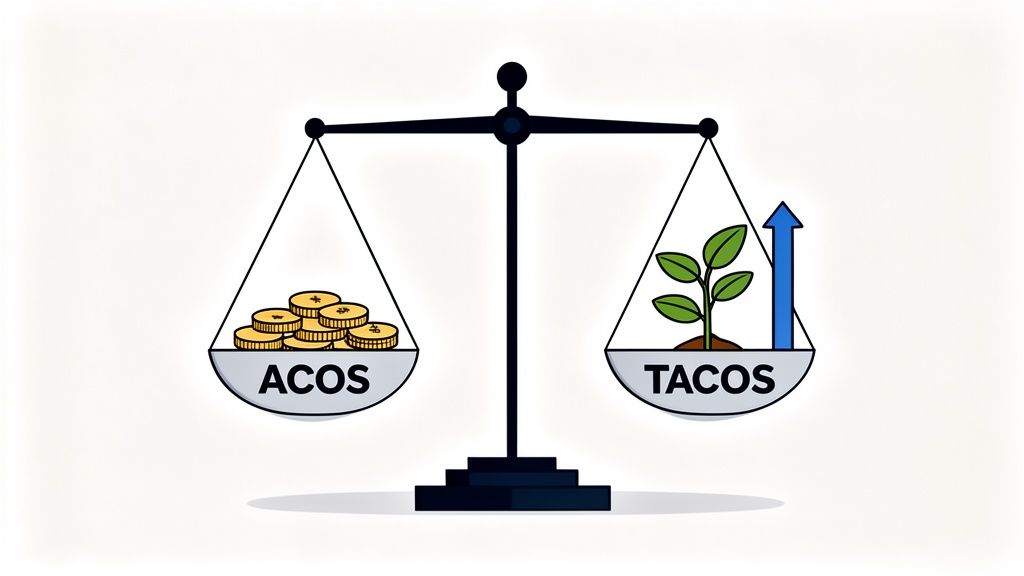
For too long, the conversation around Amazon advertising has been fixated on one metric: Advertising Cost of Sale (ACOS). This simple calculation—ad spend divided by ad revenue—only provides a narrow, often misleading, snapshot of performance. Chasing a low ACOS is a common mistake that throttles growth and misses the bigger picture.
Sustainable scale on Amazon is achieved by turning ad spend into an engine that lifts your entire business. The strategic objective is to use paid advertising to accelerate your organic keyword rankings, improve your Best Seller Rank (BSR), and drive up your total sales. This is the core of Headline’s POV: PPC is a lever for organic growth and long-term profitability.
Why TACOS is Your True North Metric
A performance-first Amazon strategy is built on the powerful connection between paid and organic sales. Think of it as a flywheel: strategic ad spend drives sales, which signals relevance to Amazon's A9 algorithm, leading to better organic visibility. Better visibility results in more organic sales, reducing your long-term dependency on advertising.
To measure this effectively, you must focus on the metrics that reflect total business health:
- Total Advertising Cost of Sale (TACOS): This is the critical metric. It measures your total ad spend against your total revenue (paid + organic). A decreasing TACOS is the clearest indicator that your advertising is successfully boosting organic sales and improving overall account profitability.
- Organic Rank Velocity: Are your ad campaigns measurably improving your product's organic search position for high-value keywords? This must be tracked.
- New-to-Brand (NTB) Customer Acquisition: What percentage of your ad-driven sales are from customers purchasing from your brand for the first time? This is a key indicator of scalable growth.
The big shift is from vanity metrics to business impact. An aggressive launch campaign might carry a 60% ACOS, which looks alarming in isolation. But if it secures a top-three organic rank and drives your TACOS down from 25% to 10% over the following quarter, it was a profoundly smart and profitable investment.
The Failure of Generic, ACOS-Obsessed Strategies
This is precisely why cookie-cutter strategies fail. They treat advertising as an isolated activity, ignoring its symbiotic relationship with organic performance. This leads to missed growth opportunities and inefficient capital allocation. For any e-commerce leader, the path forward is a data-driven approach that connects every ad dollar to a tangible business outcome. To execute this, a deep understanding of how to calculate Return on Ad Spend (ROAS) and what ACOS on Amazon really means is foundational.
The Takeaway: Stop asking, "What's my ACOS?" Start asking, "How is my advertising investment impacting my total sales velocity and organic market share?" This shift in perspective is the first step toward building a dominant, profitable brand on Amazon.
Your Strategic Amazon Advertising Toolkit
To execute a winning strategy, you must master the tools at your disposal. Amazon’s advertising platform is a powerful suite of options, but effective use requires knowing which tool to deploy for which strategic objective. Forget the generic definitions; let's focus on how each ad type drives tangible business results.
Think of it as a specialized toolkit. You wouldn't use a sledgehammer for detail work. Similarly, you must match the right ad format to your immediate goal, whether it’s launching a new product, defending market share, or creating new customer demand.
The core of Amazon's PPC ecosystem is built around three primary ad types: Sponsored Products, Sponsored Brands, and Sponsored Display. Each plays a distinct but complementary role in a full-funnel strategy.
Sponsored Products: The High-Intent Conversion Driver
Sponsored Products are the ads appearing directly in search results and on product detail pages. They are the workhorses of your advertising, designed to capture high-intent shoppers at the exact moment of purchase consideration.
These cost-per-click (CPC) ads target specific keywords or products, making them exceptionally effective at driving immediate sales. When a customer searches for "noise-canceling headphones," a Sponsored Product ad places your brand directly in their path. The data is clear: Sponsored Products accounted for a massive 68% of Amazon's ad revenue in a recent quarter, underscoring their central role in the platform's ecosystem. Amazon's massive advertising growth is fueled by this high-intent environment. You can find more data on Amazon's advertising sales and market performance.
Sponsored Brands: Building Brand Equity and Owning the Shelf
While Sponsored Products drive individual conversions, Sponsored Brands are about owning the digital shelf. These banner ads appear at the top of search results, featuring your logo, a custom headline, and multiple products.
This ad type is your brand-building engine. It provides the canvas to tell a story and present a curated collection, making it ideal for increasing brand awareness and driving "new-to-brand" customer acquisition.
A strategic Sponsored Brands campaign doesn't just sell one product; it introduces shoppers to your entire catalog. By directing traffic to a custom Storefront or showcasing a product line, you can increase average order value and build lasting brand recognition.
Sponsored Display: Retargeting and Strategic Conquesting
Sponsored Display ads extend your reach beyond search results. These visual, self-service ads can appear on competitor product pages, the Amazon home page, and off-Amazon across the web.
Their core strength is retargeting. You can re-engage shoppers who viewed your product but didn't convert, reminding them of their interest and pulling them back to complete the purchase. This is a critical tool for maximizing the value of every visitor. Another powerful application is "conquesting"—placing your ads on competitor listings to intercept shoppers at the final stage of their decision-making process.
Amazon DSP: Creating New Demand at Scale
For brands executing a true full-funnel strategy, the Amazon DSP (Demand-Side Platform) is the ultimate top-of-funnel tool. Unlike self-service PPC ads, the DSP allows you to programmatically buy video and display ads to reach specific audiences both on and off Amazon.
This is where you shift from capturing existing demand to creating it. With the DSP, you can:
- Build Custom Audiences: Target users based on their Amazon shopping behaviors, lifestyle interests (e.g., "fitness enthusiasts"), or interactions with competitor brands.
- Run High-Impact Video Campaigns: Leverage video to tell your brand story on platforms like Twitch, Freevee, and other premium publisher sites.
- Achieve Omnichannel Reach: Follow your ideal customer across the web, building brand awareness long before they initiate a search on Amazon.
Matching Amazon Ad Types to Business Goals
This table connects primary ad types to the business objectives they are best suited to achieve, providing a clear, brand-relevant framework for action.
| Ad Type | Primary Goal | Key Use Case | Targeting Capabilities |
|---|---|---|---|
| Sponsored Products | Drive immediate sales velocity | Capturing high-intent shoppers on search & product pages for conversion. | Keywords, ASINs, Categories |
| Sponsored Brands | Build brand awareness & equity | Introducing shoppers to your full product line or Storefront to drive brand discovery. | Keywords, ASINs, Categories |
| Sponsored Display | Re-engage & conquer | Retargeting past viewers; conquesting competitor detail pages. | Product/Interest targeting, Views remarketing |
| Amazon DSP | Create new demand | Reaching new, high-value audiences on and off Amazon with video & display ads. | In-market, Lifestyle, Lookalike, & Custom Audiences |
Each of these Amazon advertising services is a powerful lever. The key is strategic deployment. Sponsored Products drive conversion, Sponsored Brands build authority, Sponsored Display re-engages and conquers, and the DSP creates new demand. A sophisticated strategy integrates them all into a self-reinforcing growth engine.
Building a Full-Funnel Growth Flywheel
Allocating budget to disconnected PPC campaigns is a recipe for inefficiency. Elite brands on Amazon don't view their advertising as a collection of separate tactics. Instead, they engineer a single, powerful system designed to guide shoppers from initial awareness to loyal, repeat customers.
This is the "flywheel" model in action. Paid ads initiate sales and traffic, signaling relevance to Amazon's algorithm and boosting organic rankings. As products climb the search results, you earn more high-converting organic sales. With this momentum, you can optimize ad spend, lowering your Total Advertising Cost of Sale (TACOS) and building a more profitable, defensible business.
Top of Funnel (TOFU): Creating New Demand
The flywheel starts at the top of the funnel (TOFU). The objective here is not just to capture existing demand, but to create it by reaching shoppers who are not yet aware of your brand or solution.
Your primary tools at this stage are Sponsored Brands video and the Amazon DSP. A compelling video ad can interrupt a passive browsing session and tell a powerful brand story, building recall and pulling new-to-brand customers into your ecosystem. The DSP acts as a force multiplier, allowing you to target precise audiences based on their shopping and media consumption habits, both on and off Amazon. This is how you get in front of the right people before they even know they need you.
This flowchart illustrates how different ad types map to each stage of the customer journey.
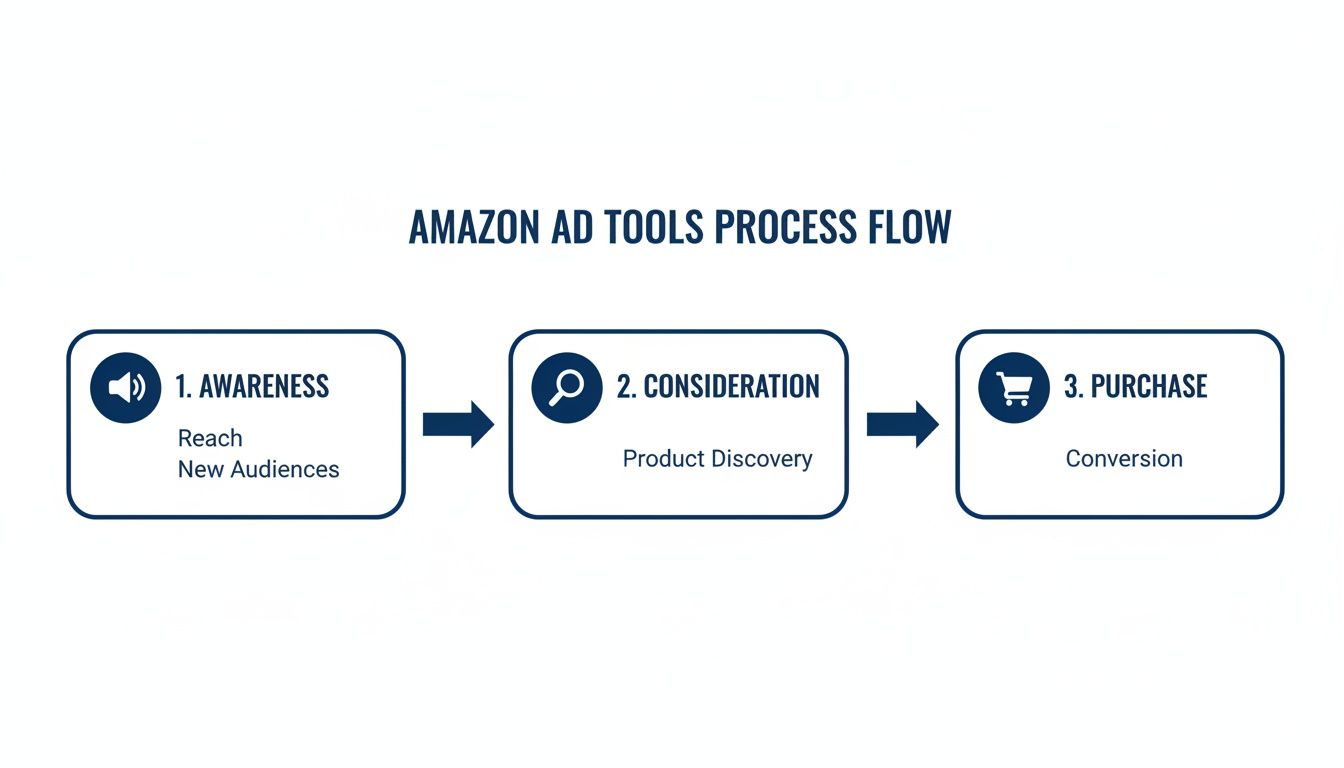
A winning strategy engages customers at every stage, not just at the point of purchase.
Middle of Funnel (MOFU): Driving Consideration and Re-Engagement
Once you have their attention, you enter the middle of the funnel (MOFU), where the focus shifts to keeping your brand top-of-mind as shoppers evaluate their options.
Sponsored Display is the star player here. Its retargeting capabilities are essential for re-engaging users who visited your product detail page but did not purchase. By serving them a visual ad—perhaps on a competitor's listing or another website—you reinforce their initial interest. This is how you prevent valuable, high-intent traffic from leaking out of your funnel.
You invested to get that first click; don't let it go to waste. A strategic Sponsored Display campaign is often the critical nudge that converts consideration into purchase.
To amplify this flywheel beyond advertising, it's wise to explore effective e-commerce marketing automation strategies to complement your efforts.
Bottom of Funnel (BOFU): Securing the Sale and Defending Your Brand
At the bottom of the funnel (BOFU), the objective is direct and clear: close the sale. Sponsored Products campaigns are the primary tool for this, targeting high-intent keywords to appear precisely when a customer is ready to buy.
However, a robust BOFU strategy involves both offense and defense. It is non-negotiable to run "defensive" campaigns on your own branded keywords. If you don't occupy this space, a competitor will, siphoning off customers actively searching for you. Additionally, "offensive" product targeting campaigns on competitor detail pages are a powerful tactic for capturing market share from shoppers just one click away from buying from a rival.
A full-funnel strategy is a dynamic system. You use DSP and video to fill the top, Sponsored Display to nurture the middle, and Sponsored Products to convert the bottom. This integrated approach ensures every ad dollar works harder, driving not just immediate sales but the sustainable, long-term growth that defines a category leader.
The Profitability Metrics That Actually Matter
The Amazon advertising industry has been handicapped for years by its obsession with a single, often misleading metric: Advertising Cost of Sale (ACOS). While ACOS measures ad efficiency in a narrow sense, fixating on it leads to short-sighted decisions, such as cutting spend on a campaign that is driving significant organic growth.
True profitability on Amazon is not achieved by minimizing ad spend in a vacuum. It's about understanding how that ad spend acts as a catalyst for the entire business. To gain this strategic clarity, leaders must shift their focus from ACOS to metrics that reflect total business impact.
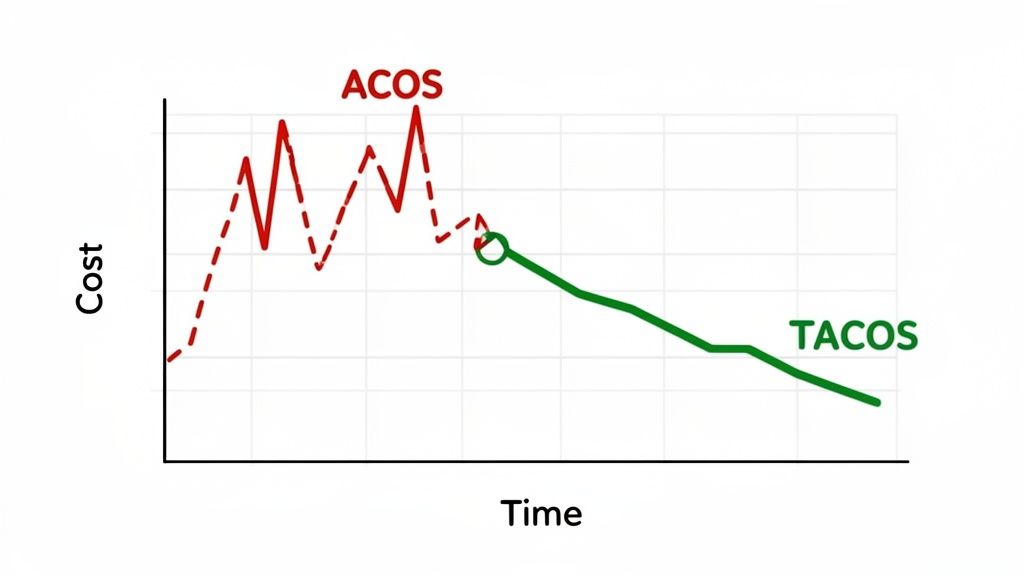
TACOS: Your True North for Performance
Total Advertising Cost of Sale (TACOS) is the single most important metric for evaluating the true effectiveness of your amazon advertising services. Unlike ACOS, TACOS measures your ad spend against your total revenue—both paid and organic.
The formula is straightforward:
TACOS = (Total Ad Spend / Total Revenue) x 100
This one number instantly reveals the health of your advertising flywheel. A downward-trending TACOS is a clear sign of success. It means your ad investment is effectively driving organic sales, improving keyword rankings, and making your business more profitable and less reliant on paid media. A high ACOS can be a strategic and acceptable part of a plan if it's contributing to a declining TACOS.
A decreasing TACOS is the ultimate proof that your advertising is an investment, not an expense. It demonstrates that you are building a sustainable growth engine where paid acquisition fuels organic visibility.
Connecting Ad Spend to Organic Market Share
The next level of analysis is to draw a direct line from advertising performance to organic gains. A primary objective of aggressive PPC campaigns, particularly during a product launch, is to secure a top organic position for high-volume keywords. This is where profitable scale is unlocked. A product on the first page of search results receives a massive, sustained lift in traffic and sales at no marginal cost per click.
To measure this, you must track:
- Organic Rank for Target Keywords: Is your investment in PPC measurably improving your organic position for your most valuable search terms?
- Best Seller Rank (BSR): A lower BSR indicates you are outselling competitors in your category. Your advertising campaigns should have a direct, positive impact on this rank.
Analyzing these metrics alongside TACOS provides a three-dimensional view of performance. It reframes the central question from, "How low can I get my ACOS?" to "Is my ad spend efficiently acquiring market share and long-term organic dominance?" For a deeper analysis, explore our guide to critical advertising performance metrics.
Real-World Example: An Investment, Not an Expense
Here’s how this performance-first mindset plays out. A premium coffee brand launches a new espresso machine and invests heavily in Sponsored Products targeting "espresso machine."
Month 1 (Launch): The brand invests $5,000 in ads, generating $10,000 in attributed sales for a 50% ACOS. Viewed in isolation, this looks like a failure. However, total sales reached $15,000 (including $5,000 in organic sales), resulting in a 33% TACOS. Critically, their organic rank for "espresso machine" jumped from page 10 to page 2.
Month 3 (Scale): Ad spend is optimized down to $3,000. Ad sales are $9,000, for a much healthier 33% ACOS. But the real win is this: now ranked #3 organically, the product's total sales have surged to $40,000. The TACOS has plummeted to an exceptionally profitable 7.5%.
The initial high ACOS was not a loss; it was a strategic investment in acquiring valuable organic real estate that now delivers compounding returns. This is the performance-first thinking that separates market leaders from the rest.
How to Choose the Right Advertising Partner
Selecting a partner to manage your Amazon advertising is one of the most critical decisions a brand will make. The right agency operates as a true extension of your team, relentlessly focused on profitability and sustainable growth. The wrong one can burn through your budget with generic, ACOS-focused tactics that fail to build long-term value.
The stakes are higher than ever. With Amazon's ad revenue hitting $56.2 billion globally—a 20% year-over-year increase—the platform is more competitive and complex. This is where an expert partner becomes indispensable. You can learn more about the rapid growth of Amazon's ad platform.
To find a true partner, you must ask the right questions—questions that cut through the sales pitch and reveal their strategic depth.
Vetting Your Potential Agency Partner
First, eliminate the question, "What's your typical ACOS?" from your vocabulary. It's a surface-level query. A top-tier agency thinks beyond single metrics and speaks the language of total profitability and organic growth.
Instead, lead with these critical questions:
- How do you measure success beyond ACOS? The answer must immediately reference TACOS, organic rank improvement, and new-to-brand customer acquisition. If they pivot back to ACOS, their strategic framework is outdated.
- Show us a case study where you intentionally ran a high ACOS to decrease TACOS. This is a litmus test. It separates tactical managers from true strategists. A sophisticated agency understands that aggressive upfront investment—during a launch, for example—is often required to secure the organic positioning that drives long-term profitability.
- What is your proficiency with Amazon Marketing Cloud (AMC)? AMC is the enterprise-level analytics tool for deep path-to-purchase analysis. An agency leveraging Amazon Marketing Cloud can move beyond standard reports to uncover granular insights that provide a significant competitive advantage.
Your objective is not to hire a campaign manager. You are seeking a data-driven growth partner who can directly link every dollar of ad spend to bottom-line impact.
Understanding Engagement and Pricing Models
Once you have vetted their strategic capabilities, it's time to discuss their fee structure. Most agencies offering Amazon advertising services operate on one of a few common models.
1. Percentage of Ad Spend
The agency charges a fee based on a percentage of your monthly ad spend, typically 10-20%.
- Pro: Simple and scales with your budget.
- Con: Can create a potential conflict of interest, as the agency's revenue increases with your spend, not necessarily your profitability.
2. Flat Retainer Fee
A fixed monthly fee is charged for management services, regardless of spend.
- Pro: Predictable costs and incentivizes the agency to maximize efficiency.
- Con: May not be cost-effective for smaller brands or might not scale with the complexity of larger accounts.
3. Hybrid Model (Retainer + Performance)
This model combines a base retainer with performance-based bonuses tied to achieving specific KPIs, such as hitting a TACOS target or a total revenue goal.
- Pro: This is the ideal partnership model. It aligns the agency's financial success directly with your business objectives.
- Con: Requires clear, mutually-agreed-upon goals and tracking.
Choosing an agency is a significant decision. For a more detailed guide, our breakdown on selecting an Amazon advertising agency offers a comprehensive checklist. Ultimately, you want a partner whose success is inextricably linked to yours—one who prioritizes transparent communication and drives real, profitable growth.
Your Action Plan for Dominating the Marketplace
A brilliant strategy is useless without execution. It’s time to implement a clear, repeatable plan for profitable growth. This is your roadmap for taking control of your Amazon performance, starting now.
This no-nonsense plan focuses on three core pillars that connect your amazon advertising services directly to your P&L. Each step builds on the last, creating a robust foundation for sustainable market leadership.
Step 1: Audit Performance Through the Lens of TACOS
First, establish an honest baseline using the right metric. Cease the obsession with ACOS. Instead, analyze your Total Advertising Cost of Sale (TACOS) for the last 90 days.
This single metric reveals the true efficiency of your ad spend in lifting the entire business. A high or rising TACOS is a critical warning sign that your advertising is not effectively fueling organic growth. Conversely, a low or declining TACOS confirms your flywheel is spinning efficiently.
Step 2: Conduct a Rigorous Retail Readiness Audit
Even the most sophisticated advertising campaign will fail if it directs traffic to a product page that is not optimized for conversion. Before allocating another dollar to media spend, ensure your listings are retail-ready.
A thorough audit covers these key areas:
- Optimized Content: Are your titles, bullets, and A+ Content fully optimized with high-volume keywords and compelling, benefit-driven copy?
- High-Quality Visuals: Do you have a full suite of professional images and a product video that clearly demonstrates value and use cases?
- Social Proof: Is your average star rating above 4.0? Do you have a consistent strategy for generating authentic reviews?
Advertising earns the click; your listing must earn the sale. Driving paid traffic to an underperforming product page is the fastest way to destroy your budget and marketing ROI.
Step 3: Set Clear, Performance-Based 90-Day Goals
With a clear performance baseline and retail-ready listings, you can set intelligent, measurable goals. Avoid vague objectives like "increase sales." Be specific and tie goals to business outcomes.
Your 90-day goals should look like this:
- New Product Launch: Achieve a top-10 organic rank for three primary keywords.
- Profitability Improvement: Decrease TACOS by 15% for your hero product.
- Market Share Capture: Achieve a 75%+ top-of-search impression share against your top competitor.
Executing this plan requires focus, discipline, and expertise. This is where a true growth partner makes a decisive difference. At Headline, we transform this action plan into tangible results, using data-driven strategies to make your ad spend a predictable engine for market domination.
Got Questions? We've Got Answers
Let's cut through the jargon. Here are no-nonsense answers to the most common questions we hear from eCommerce and retail leaders about Amazon advertising.
What's the Real Difference Between Amazon PPC and DSP?
Think of it in terms of demand capture vs. demand creation. Amazon PPC (Sponsored Ads) is about capturing existing demand. It's like having the best-placed stall in a busy market. You target shoppers who are already on Amazon and actively searching for products like yours. It is a bottom-of-funnel, conversion-focused tool.
Amazon DSP is about creating new demand. It's the equivalent of a multi-channel brand campaign using TV and billboards. The DSP is a programmatic platform that lets you buy display and video ads to reach ideal customer profiles wherever they consume media—on and off Amazon. You use DSP for top-of-funnel brand building and to introduce your products to new audiences before they even begin their search.
How Much Should I Actually Spend on Amazon Ads?
There is no magic number. Your budget should be a dynamic investment tied to your TACOS (Total Advertising Cost of Sale) goal. A healthy, mature brand might aim for a TACOS between 8-15%. This indicates your advertising is efficiently lifting both paid and organic sales.
For a new product launch or an aggressive market share push, your investment will be significantly higher. The initial ACOS may be high, but this is a strategic cost to acquire the sales velocity and ranking momentum that leads to a much lower, more profitable TACOS in the long run.
Your ad budget is not a fixed expense line. It is a flexible investment lever that should be adjusted based on strategic objectives, whether that's securing organic rank or launching your next blockbuster product.
When Do I Use Sponsored Display vs. Amazon DSP?
Sponsored Display is your tactical tool for on-Amazon retargeting and conquesting. It's a highly effective, self-service option for re-engaging shoppers who have viewed your product page or for placing ads on competitor listings. Think of it as a precision instrument for middle and bottom-of-funnel tactics.
You deploy the Amazon DSP for large-scale, strategic, top-of-funnel campaigns. The DSP is a more complex platform (often requiring a managed service) designed for ambitious brand-building initiatives. Use the DSP when your goals are to reach new audiences off-Amazon, leverage high-impact video creative, and build sophisticated custom audiences to generate net-new demand.
You'll need every advantage, as competition is intensifying. The average cost-per-click (CPC) on Amazon recently hit $1.12, a 15.5% increase year-over-year, and spiked to $1.19 during peak season. You can review the data on the rising costs and competition in Amazon advertising to understand the landscape.
Ready to turn your ad spend into a predictable engine for profitable growth? At Headline Marketing Agency, we build data-driven Amazon advertising strategies that focus on the metrics that matter most to your bottom line. Let's talk about a strategy for your brand.
Get Your Free Amazon PPC Audit
Discover untapped growth opportunities and see how our data-driven approach can improve your ROAS.
Get Free Audit →Ready to Transform Your Amazon PPC Performance?
Get a comprehensive audit of your Amazon PPC campaigns and discover untapped growth opportunities.